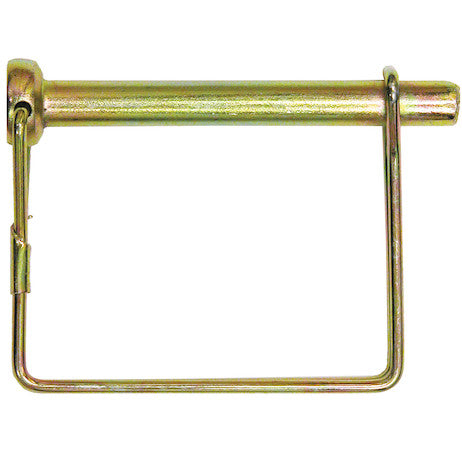
Buyers Products Snapper Pins are used as a convenient way to fasten accessories on truck equipment. Snapper lock pins join the benefits of a pin and cotter combination in a single assembly. Simply pull the wire loop over the pin to lock it in place. It quickly releases for easy removal. Snapper pins are yellow zinc-plated for corrosion resistance.
Specifications
| Clearance (in.) | 1-1/2 |
|---|---|
| Pin Dia (in.) | 1/4 |
| Pin Length (in.) | 4 |
| Usable Length (in.) | 3-1/2 |
The Snapper Pin, specified with a 1/4 inch diameter and 3-1/2 inch usable length, further enhanced by yellow zinc plating, represents a critical component in fastening technology. Designed for rapid deployment and secure retention, this product transcends the conventional limitations of multi-component fastening systems by integrating the pin and its locking mechanism into a single, cohesive unit. Its engineering is optimized for applications demanding both efficiency and reliability, particularly within the challenging environments often encountered in truck equipment and similar industrial settings. This technical overview will delve into the precise mechanical design, material science, surface treatment, application scope, and performance advantages that define this particular Snapper Pin, elucidating its role as a superior fastening solution.
At the core of the Snapper Pin's efficacy is its innovative locking mechanism. Unlike traditional clevis pins that necessitate a separate cotter pin, often a hairpin or R-clip, the Snapper Pin incorporates an integral spring-loaded wire loop. This loop, typically fabricated from high-tensile spring steel, is permanently attached to the main body of the pin. To secure an accessory, the pin is inserted through the aligned bores of the components. The wire loop is then pulled over the exposed end of the pin, engaging a circumferential groove or a specifically designed shoulder on the pin's shaft. This action creates a positive lock, effectively preventing axial displacement of the pin due to vibration, shock, or incidental contact. The release mechanism is equally straightforward: a simple manual disengagement of the wire loop from the pin's end allows for quick withdrawal. This single-assembly design significantly reduces installation and removal times, minimizes the risk of losing small, individual cotter pins, and enhances operational safety by ensuring a consistent and reliable lock every time. The integrated design also contributes to a cleaner, more streamlined aesthetic, which can be advantageous in visible applications.
The dimensional specifications of this Snapper Pin are paramount to its functional integrity. The 1/4 inch (6.35 mm) diameter dictates its compatibility with bores of corresponding size, ensuring a snug fit that minimizes play and maximizes shear strength. A precisely toleranced bore engagement is crucial for preventing accelerated wear on both the pin and the mating components. The 3-1/2 inch (88.9 mm) usable length refers to the effective grip range—the maximum thickness of material that can be securely fastened between the pin's head and the locking position of the wire loop. This generous usable length provides substantial versatility, accommodating a wide array of mounting brackets, hitches, and attachment points that commonly feature thicker material sections. It is critical that the total thickness of the assembly being fastened does not exceed this usable length to ensure the wire loop can fully engage the pin, thereby guaranteeing the secure locking function. The overall pin length, specified as 4 inches (101.6 mm), accounts for the usable length plus the necessary extension for the head and the locking groove/shoulder, ensuring adequate structure for both retention and manual manipulation. The specified clearance of 1-1/2 inches (38.1 mm) refers to the spatial requirement for the wire loop to swing freely and engage or disengage, emphasizing the importance of considering surrounding structures during installation planning to prevent interference with the locking mechanism's operation.
The material selection for the Snapper Pin is integral to its structural performance and longevity. Typically, Snapper Pins are manufactured from high-grade carbon steel, chosen for its excellent balance of tensile strength, yield strength, and ductility. Common steel grades such as AISI 1018, 1035, or similar alloys are frequently employed due to their workability and ability to withstand significant shear and bending stresses without brittle failure. The pin's solid construction, as opposed to hollow alternatives, inherently contributes to its robust load-bearing capabilities. The inherent strength of the steel body ensures that the pin can reliably manage the dynamic forces and static loads associated with heavy-duty truck equipment, agricultural machinery, and various industrial applications. For the wire loop, spring steel, such as music wire or specific grades of chrome silicon or carbon steel, is selected for its superior elastic properties, ensuring that the loop maintains its tension and shape through countless cycles of engagement and disengagement. This resilience is critical for the long-term integrity of the locking mechanism, guaranteeing consistent performance over the product's lifespan.
A distinguishing characteristic of this Snapper Pin is its yellow zinc-plated finish, a sophisticated surface treatment that enhances the fastener's durability and visual identification. Zinc plating, specifically electroplating, involves depositing a thin layer of zinc onto the steel substrate. This process provides sacrificial corrosion protection, meaning the zinc layer will corrode before the underlying steel, thereby preserving the structural integrity of the pin. The yellow coloration is achieved through a subsequent chromate conversion coating, often referred to as "yellow chromate." This post-treatment process reacts with the zinc to form a passive layer composed of various chromium compounds. This chromate layer significantly boosts the corrosion resistance beyond that offered by zinc alone, imparting superior protection against white rust (zinc corrosion) and red rust (steel corrosion). The yellow chromate also offers a degree of self-healing capability; minor scratches or abrasions to the coating can sometimes be re-passivated by the chromate film, extending the protective life. Beyond its protective qualities, the yellow zinc plating provides a distinctive aesthetic, often aiding in product identification or signaling a specific protective finish, which can be beneficial in inventory management or maintenance operations. Compared to clear or black zinc coatings, yellow zinc offers enhanced corrosion resistance in many environments due to the specific chemistry of the chromate conversion layer. This robust finish makes the Snapper Pin suitable for outdoor and intermittently harsh conditions where moisture, road salt, or other corrosive agents are present, extending the service life of both the pin and, by extension, the equipment it secures.
The application versatility of the Snapper Pin with a 1/4in diameter and 3-1/2in usable length is extensive, particularly within the purview of truck equipment. It serves as an ideal fastening solution for securing trailer hitches and drawbars, ensuring that trailers remain safely coupled during transit. It is frequently employed on various agricultural implements attached to tractors, providing quick changes of plows, cultivators, sprayers, and other essential tools. In construction, these pins are used for temporary or semi-permanent attachments on machinery, securing outrigger pads, or articulating joints. The quick-release feature is particularly advantageous for frequently adjusted or swapped components, reducing downtime and improving operational efficiency. Beyond heavy equipment, its utility extends to a multitude of industrial and commercial applications. This includes securing safety guards on machinery, locking scaffolding components, fastening gates and enclosures, or retaining adjustment points on conveyors and material handling equipment. Its resistance to corrosion, facilitated by the yellow zinc plating, makes it well-suited for outdoor installations or environments with fluctuating humidity and temperature. Even in marine applications, where robust corrosion resistance is paramount, these pins can serve effectively for non-submerged components, given their enhanced protective coating. Furthermore, the Snapper Pin finds its place in various DIY projects, recreational vehicle setups, and utility trailers, wherever a dependable, easy-to-use, and quickly removable fastener is required.
The performance characteristics of this Snapper Pin underscore its value proposition. Its robust construction and positive locking mechanism provide excellent resistance to vibration-induced loosening, a common failure mode for less sophisticated fastening methods. This inherent stability ensures that accessories and components remain securely attached, preventing accidental detachment that could lead to equipment damage, operational failure, or safety hazards. The solid 1/4 inch diameter shaft offers significant shear strength, allowing it to withstand the lateral forces typically encountered in its intended applications. While it is not designed as a shear pin to intentionally break under overload, its material properties ensure reliability under normal operating conditions. The ease of use, characterized by the simple pull-and-lock/release action, translates directly into increased productivity. Operators can quickly change accessories or reconfigure equipment without needing tools or fumbling with separate cotter pins, which often leads to lost hardware and wasted time. The yellow zinc plating not only extends the product's lifespan by mitigating corrosion but also maintains its functional integrity by preventing rust accumulation that could seize the pin or degrade the locking mechanism. This combination of mechanical strength, operational efficiency, and environmental resilience makes the Snapper Pin an exceptionally reliable and cost-effective fastening solution over its operational lifetime.
When selecting and installing the Snapper Pin, several technical considerations are crucial to optimize performance and safety. Firstly, precise diameter matching is imperative. The 1/4 inch pin diameter should correspond to a bore with minimal clearance to ensure proper load distribution and prevent premature wear or wobbling. Excessively loose fits can lead to increased stress concentrations and accelerated fatigue failure. Secondly, the 3-1/2 inch usable length must be carefully matched to the thickness of the material being fastened. It is critical that the entire assembly to be secured fits within this usable length to allow the wire loop to fully engage the pin's locking feature. Insufficient usable length will prevent proper locking, compromising the fastener's security. Conversely, excessive usable length relative to the material thickness may result in unnecessary protrusion, which could be a snag hazard or indicate an inefficient use of the pin. Thirdly, the 1-1/2 inch clearance specification highlights the need for adequate spatial consideration around the pin's head and locking mechanism. Obstructions within this clearance area could impede the wire loop's ability to fully articulate and engage, rendering the locking function ineffective. Proper installation involves ensuring that the components are fully aligned, the pin slides in smoothly, and the wire loop snaps securely into place, indicating full engagement. Regular visual inspections are recommended, especially in high-vibration or high-wear applications, to check for any signs of material fatigue in the wire loop, excessive wear on the pin shaft, or degradation of the zinc plating. While the yellow zinc plating offers excellent corrosion resistance, exposure to highly aggressive chemicals or extreme abrasive conditions might necessitate more frequent inspection or alternative fastening solutions.
The Snapper Pin holds significant comparative advantages over several alternative fastening methods. Compared to traditional clevis pins secured with separate cotter pins (e.g., hairpin cotters or split pins), the Snapper Pin’s integrated design dramatically simplifies assembly and disassembly. This eliminates the risk of losing small cotter pins, a common frustration and safety concern in busy work environments. The positive locking action of the Snapper Pin’s wire loop often provides a more secure and robust retention than the frictional engagement of a hairpin cotter, which can sometimes work loose under severe vibration. Against R-clips or hitch pins with simple detent balls, the Snapper Pin generally offers a more definitive and tactile locking feedback, providing greater assurance of secure fastening. While quick-release pins with push-button mechanisms exist, they often represent a higher cost and greater complexity, whereas the Snapper Pin provides a remarkably effective and durable solution at a more economical price point. Furthermore, the yellow zinc plating on this Snapper Pin offers superior corrosion protection compared to plain steel pins or those with lesser coatings, extending its operational life and maintaining its aesthetic integrity even in challenging environmental conditions. The engineering behind the Snapper Pin represents a thoughtful balance of simplicity, strength, and functionality, making it a preferred choice for professionals seeking efficiency without compromising security or durability in their fastening solutions.
In conclusion, the Snapper Pin with a 1/4 inch diameter and 3-1/2 inch usable length, meticulously finished with yellow zinc plating, is a meticulously engineered fastening component designed for high-demand applications. Its integrated design streamlines operations by combining the pin and its locking mechanism into a single, intuitive unit, thereby enhancing efficiency and reducing the potential for lost hardware. The specific dimensions are carefully chosen to offer broad compatibility and robust load-bearing capabilities for various accessories and equipment. The robust carbon steel construction, coupled with the advanced yellow zinc plating, ensures exceptional durability and extended service life, even when exposed to corrosive elements. This pin offers a superior blend of mechanical integrity, ease of use, and environmental resistance, making it an indispensable asset for truck equipment, agricultural machinery, construction apparatus, and a myriad of industrial and recreational applications where reliable, quick-release fastening is paramount. By understanding its technical specifications, material science, and operational advantages, users can confidently deploy this Snapper Pin to optimize the performance, safety, and longevity of their equipment. It stands as a testament to practical engineering, providing a dependable solution that consistently meets the rigorous demands of professional environments.