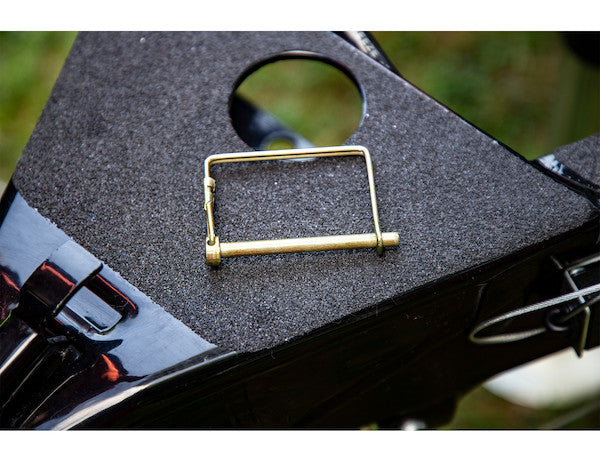
Buyers Products Snapper Pins are used as a convenient way to fasten accessories on truck equipment. Snapper lock pins join the benefits of a pin and cotter combination in a single assembly. Simply pull the wire loop over the pin to lock it in place. It quickly releases for easy removal. Snapper pins are yellow zinc-plated for corrosion resistance.
Specifications
| Clearance (in.) | 1-5/8 |
|---|---|
| Pin Dia (in.) | 1/2 |
| Usable Length (in.) | 2-1/2 |
Advanced Technical Overview: The Snapper Pin - 1/2in Diameter x 2-1/2in Usable Length, Yellow Zinc Plated
The Snapper Pin, meticulously engineered by Buyers Products, represents a critical advancement in fastening technology, offering a robust, reliable, and exceptionally user-friendly solution for securing various components, particularly within demanding operational environments such as those encountered in truck equipment and industrial applications. This specific model, with its 1/2-inch diameter, 2-1/2-inch usable length, and premium yellow zinc plating, is designed to meet stringent performance requirements, combining mechanical integrity with superior corrosion resistance.
Core Functionality and Design Principles
At its core, the snapper pin design integrates the functionalities of a traditional clevis pin and a cotter pin into a singular, self-contained assembly. This innovative approach eliminates the need for separate fastening components, streamlining installation processes and significantly reducing the risk of lost or misplaced parts. The mechanism revolves around a robust wire loop, typically fabricated from high-tensile spring steel, which is articulately hinged at the head of the main pin body. When the pin is inserted through a bore, the wire loop is simply pulled over the end of the pin and allowed to snap into a specially designed groove or notch. This action creates a secure, positive lock, preventing unintentional disengagement even under vibratory loads or dynamic forces. The inherent spring tension of the wire ensures a constant clamping force, maintaining the pin's position without reliance on external tools or secondary locking mechanisms.
The quick-release functionality is an equally important design consideration. To disengage the pin, an operator simply reverses the locking action by pulling the wire loop off the pin end. This permits rapid removal and re-installation, making it ideal for applications requiring frequent adjustments, attachment changes, or routine maintenance. The ergonomic design of the wire loop facilitates easy manipulation, even when wearing gloves, enhancing operational efficiency and safety in industrial settings. This combination of swift engagement and disengagement, coupled with a highly reliable locking action, positions the snapper pin as a superior alternative to multi-component fastening systems.
Precision Engineering: Dimensions and Tolerances
Understanding the precise specifications of the Snapper Pin is crucial for optimal application and performance:
- Pin Diameter (1/2 inch): The 1/2-inch (12.7 mm) pin diameter is a critical dimension that dictates the compatibility with mating components. This diameter is a widely recognized standard in light to medium-duty industrial and agricultural equipment, ensuring interoperability with various implements, linkages, and assemblies. Pins of this diameter are engineered to withstand significant shear and bending loads, providing a secure connection suitable for applications involving moderate tensile and compressive forces. The consistent diameter along the usable length ensures a snug fit within appropriately sized bores, minimizing play and wear, thereby extending the service life of both the pin and the associated equipment.
- Usable Length (2-1/2 inches): The 2-1/2-inch (63.5 mm) usable length refers to the effective portion of the pin that can pass through and secure components. This dimension is paramount for accommodating varying material thicknesses of the items being fastened. A 2-1/2-inch usable length provides ample capacity for joining multiple components, such as a bracket to a frame, or securing implements with thicker mounting points. It is crucial to select a pin with a usable length that adequately protrudes through the final component to allow the wire loop to engage fully and securely, without undue stress on the locking mechanism.
- Clearance (1-5/8 inches): The "Clearance" specification, at 1-5/8 inches (41.275 mm), generally refers to the maximum effective distance from the underside of the pin head to the point where the wire loop mechanism effectively engages the pin shaft to create a secure lock. More precisely, it can also refer to the internal clear length required for the components the pin is intended to secure, ensuring that the locking mechanism operates freely without interference. Alternatively, it might denote the space required for the wire loop to fully articulate and secure the pin, particularly in installations where clearance around the pin head is restricted. Proper consideration of this dimension is essential to ensure that the pin can be fully inserted and locked in place without obstruction, allowing the spring-loaded loop to snap into its designated groove efficiently. Failure to account for this clearance could compromise the security of the fastening or impede the quick-release function, potentially leading to operational inefficiencies or safety hazards.
Manufacturing tolerances for these dimensions are rigorously controlled to ensure consistent fit, reliable performance, and interchangeability. The precise machining of the pin body, especially the groove or indent for the wire loop, is vital for the integrity of the locking mechanism. Any deviation could result in a loose connection or an unreliable lock, undermining the pin’s primary function.
Advanced Corrosion Protection: Yellow Zinc Plating
The yellow zinc plating applied to this snapper pin is not merely an aesthetic choice; it is a meticulously engineered surface treatment designed to provide exceptional corrosion resistance and enhanced durability in challenging environments. Zinc plating is a sacrificial coating that protects the underlying steel substrate through a process known as galvanic corrosion. Zinc is more electrochemically active than steel; therefore, when exposed to corrosive elements (such as moisture, salt, or chemicals), the zinc corrodes preferentially, preserving the integrity of the steel component.
The "yellow" aspect of the plating refers to the chromate conversion coating applied over the electroplated zinc layer. This chromate layer is achieved through a passivation process that enhances the protective properties of the zinc. The chromate coating forms a complex barrier that further inhibits oxidation of the zinc, extending its sacrificial protection capabilities. Yellow chromates, often containing hexavalent chromium (though modern formulations increasingly utilize trivalent chromium for environmental compliance), provide superior corrosion resistance compared to clear or blue chromates. They are particularly effective in environments exposed to road salts, industrial pollutants, and humid conditions, which are common in truck equipment and outdoor machinery applications.
Key benefits of yellow zinc plating include:
- Superior Corrosion Resistance: Significantly extends the lifespan of the pin by protecting against rust and oxidation, crucial for components exposed to the elements.
- Enhanced Durability: The hard zinc and chromate layers provide a degree of surface hardness that resists minor abrasions and wear, contributing to the pin’s longevity.
- Aesthetic Identification: The distinct yellow hue often serves as a visual identifier for components with enhanced corrosion protection, making them easy to distinguish from standard clear zinc or unplated hardware.
- Cost-Effectiveness: Offers a high degree of protection at a more economical cost compared to stainless steel or more exotic alloys, making it an ideal solution for mass-produced industrial fasteners.
The application of this plating adheres to strict industry standards, ensuring uniform thickness and consistent protective qualities across the entire surface of the pin, including intricate features such as the wire loop and engagement grooves.
Versatile Applications Across Industries
The Snapper Pin’s robust design and quick-release functionality make it indispensable across a wide spectrum of industries and applications:
- Agricultural Equipment: Widely used for securing implements to tractors, attaching PTO shafts, locking hitch pins, and securing components on cultivators, plows, planters, and harvesters. The ease of use facilitates quick attachment changes in the field, maximizing operational uptime.
- Construction Machinery: Employed in securing attachments for excavators, skid steers, backhoes, and bulldozers. Also utilized for temporary fastening of scaffolding, safety barriers, and equipment guards where rapid deployment and removal are essential.
- Transportation and Logistics: Critical for truck and trailer applications, including securing trailer hitches, safety chains, cargo ramps, fifth wheel mechanisms, and various other accessories on commercial vehicles. The corrosion resistance is particularly vital given exposure to road spray, salt, and varying weather conditions.
- Marine Applications: While not typically the primary choice for submerged applications due to the limits of zinc plating in constant saltwater exposure, it is frequently used for securing boat covers, trailer components, dock accessories, and other marine equipment exposed to intermittent moisture or freshwater environments, where quick attachment and detachment are beneficial.
- Recreational Vehicles (RVs) and Powersports: Used for securing tow hitches, bike racks, cargo carriers, and other accessories on RVs, ATVs, UTVs, and snowmobiles, offering convenience and reliability for recreational users.
- Industrial Manufacturing and Maintenance: Valuable for quickly securing jigs, fixtures, safety guards, access panels, and temporary stops on machinery. Its reusability and ease of operation make it a staple in maintenance workshops for quick repairs and adjustments.
- Material Handling: Utilized in conveyor systems, pallet jacks, and lift equipment for securing components that require periodic removal or adjustment.
The ability to provide a secure yet easily reversible connection positions the snapper pin as a preferred fastener wherever efficiency, safety, and reliability are paramount.
Comparative Advantages Over Traditional Fasteners
When contrasted with traditional fastening methods, the Snapper Pin offers several distinct advantages:
- Efficiency and Speed: Far surpasses the installation and removal speed of clevis pins secured with separate cotter pins or split pins. The single-assembly design eliminates the need for fiddly alignment and manipulation of multiple small components, drastically cutting down on operational time.
- Reduced Part Loss: Integrating the locking mechanism directly onto the pin means there are no separate cotter pins or clips to misplace. This reduces inventory management complexity and minimizes downtime associated with searching for or replacing lost components.
- Enhanced Reliability: The spring-loaded wire loop provides a positive, secure lock that is less prone to accidental disengagement than bent-wire cotter pins, especially in high-vibration environments. The robust construction ensures consistent locking force over many cycles.
- Reusability and Longevity: Designed for repeated use, the high-quality materials and protective plating ensure a long service life. Unlike cotter pins that often deform upon removal and are not intended for repeated bending, snapper pins maintain their functionality through countless engagement cycles.
- Ease of Operation: The ergonomic design allows for easy manipulation, even with gloved hands, which is a significant safety and efficiency benefit in industrial settings where personal protective equipment is mandatory.
Material Science and Manufacturing Excellence
The fundamental integrity of the Snapper Pin begins with the selection of high-grade materials. The main pin body is typically constructed from hardened carbon steel, chosen for its excellent tensile strength, shear strength, and fatigue resistance. This ensures the pin can withstand the significant mechanical stresses encountered in its intended applications without deformation or failure. The precise heat treatment of the steel further enhances its mechanical properties, achieving the optimal balance between hardness and toughness.
The wire loop component is usually crafted from spring steel, such as a high-carbon alloy steel, which possesses superior elastic properties. This allows the loop to deform repeatedly and return to its original shape, maintaining the necessary spring tension for the locking mechanism. The critical interaction points, such as the hinge and the engagement groove on the pin, are designed to minimize wear and maintain functionality over extended periods.
Manufacturing processes involve precision machining, cold heading, or forging of the pin body, followed by meticulous grinding and deburring to achieve the specified dimensions and surface finish. The wire loop is formed through specialized bending and coiling techniques, ensuring consistent spring force and correct geometry for reliable locking. Finally, the electroplating and chromate conversion processes are carried out under strict controls to ensure uniform coating thickness, optimal adhesion, and the desired level of corrosion resistance, meeting or exceeding relevant ASTM or other industry standards.
Installation, Maintenance, and Safety Considerations
Installation of the Snapper Pin is straightforward:
- Align the components to be fastened and ensure their bores are correctly sized for the 1/2-inch pin diameter.
- Insert the pin through the aligned bores until the wire loop end protrudes beyond the final component.
- Pull the wire loop over the end of the pin until it snaps securely into its designated groove. Verify the lock is positive by gently attempting to pull the pin free.
For maintenance, periodic inspection is recommended, especially in harsh environments. Operators should look for:
- Plating Integrity: Check for significant wear, chipping, or flaking of the yellow zinc plating, which could indicate localized loss of corrosion protection.
- Pin Body Wear: Inspect the pin shaft for signs of excessive wear, scoring, or bending, particularly if there is significant movement between the pin and the bore.
- Wire Loop Condition: Ensure the wire loop is not deformed, cracked, or loose at its hinge point. The spring action should remain firm and effective.
Any pin showing significant signs of damage or wear that could compromise its structural integrity or locking mechanism should be replaced immediately. Proper selection of pin material and coating for the specific environmental conditions is a key safety factor. Always ensure the pin’s rated load capacity is appropriate for the application’s dynamic and static loads. Adhering to these maintenance protocols ensures the continued safe and reliable operation of equipment secured by Snapper Pins.
Conclusion
The Snapper Pin, with its 1/2-inch diameter, 2-1/2-inch usable length, and yellow zinc plating, represents a highly refined fastening solution for demanding industrial and mobile equipment applications. Its ingenious single-assembly design, combined with robust materials and advanced corrosion protection, delivers unparalleled convenience, efficiency, and reliability. From agricultural machinery to heavy-duty truck equipment, this snapper pin provides a critical balance of strength, ease of use, and longevity, significantly contributing to operational uptime and safety across a multitude of sectors. Its technical specifications and design principles underscore a commitment to engineering excellence, making it an indispensable component for professionals who require dependable and high-performance fastening solutions.