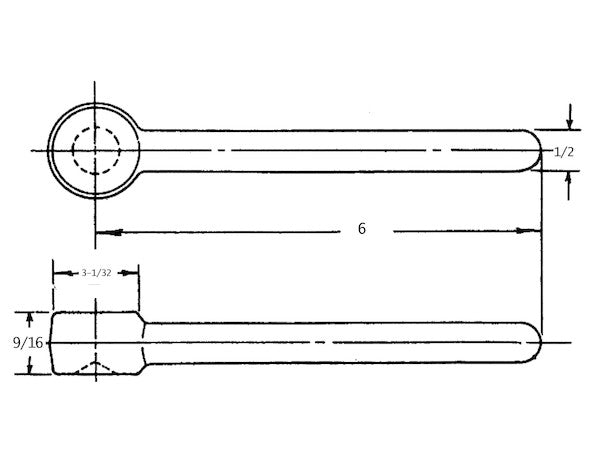
The Blank Forged Rod End from Buyers Products is ideal for all connecting and linking needs and is available in six sizes.
Specifications
| Thread Stocked | - |
| Outer Eye Diameter (in.) | 3.031 " |
| Bolt Shaft Diameter (in.) | .500 " |
| Bolt Shaft Length (in.) | 6.000 " |
| Eye Opening (in.) | 0.563 " |
Advanced Technical Overview: 1/2 x 6 Inch Blank Forged Rod End
This technical description provides an in-depth analysis of the 1/2 x 6 Inch Blank Forged Rod End, a critical component manufactured by Buyers Products. Designed for a wide array of connecting and linking applications, this rod end exemplifies robust construction, precision engineering, and material integrity, making it suitable for demanding industrial and commercial environments. The absence of a pre-threaded stock signifies its versatility, allowing for custom threading or welding to meet specific application requirements, thereby offering unparalleled adaptability in mechanical systems.
Material Science and Forging Process
The foundation of this rod end's exceptional performance lies in its material composition and the meticulous forging process. While the specific alloy is not explicitly stated, common industry practice for such components points towards high-strength carbon steels (e.g., AISI 1045, 4140) or alloy steels, selected for their superior tensile strength, yield strength, and fatigue resistance. These materials are chosen to withstand significant dynamic and static loads, abrasion, and environmental stressors inherent in heavy-duty applications.
Forging, as the manufacturing method, is paramount to the product's structural integrity. Unlike casting or machining from bar stock, forging involves shaping metal through localized compressive forces using hammers or presses. This process refines the metal's grain structure, aligning the grain flow with the part's contours. This optimized grain flow results in a component with:
- Enhanced Strength-to-Weight Ratio: Forged parts often exhibit higher strength and toughness for a given weight compared to parts produced by other methods.
- Superior Fatigue Resistance: The refined grain structure minimizes internal voids and discontinuities, which are common initiation points for fatigue cracks. This significantly extends the service life under cyclic loading conditions.
- Improved Impact Resistance: The uniform, dense grain structure allows the material to absorb and distribute impact energy more effectively, reducing the likelihood of brittle fracture.
- Reduced Material Waste: Forging processes can be more efficient in material utilization, particularly for high-volume production, contributing to cost-effectiveness.
The "blank" designation further implies that the forging is in its pre-finished state, ready for subsequent machining operations such as drilling, reaming, tapping, or welding. This allows system designers maximum flexibility in integrating the rod end into diverse mechanical linkages without being constrained by pre-existing thread specifications.
Dimensional Analysis and Engineering Specifications
The provided specifications are crucial for proper integration and performance prediction. Let's delve into each parameter:
Thread Stocked: -
This indicates a fundamental design philosophy: adaptability. By omitting a pre-threaded shank, the Blank Forged Rod End offers unparalleled customization. This feature is particularly valuable for applications requiring non-standard thread pitches, left-hand threads, fine threads, or specific material compatibility for welding or bonding. Engineers can specify custom threading (e.g., Unified National Coarse (UNC), Unified National Fine (UNF), Metric ISO, ACME) or can prepare the shank for direct welding into a larger assembly, providing a permanent and robust connection. This blank canvas approach reduces inventory complexity for manufacturers and offers greater design freedom for end-users.
Outer Eye Diameter (in.): 3.031"
The Outer Eye Diameter (OED) is a critical dimension that defines the external boundary of the spherical bearing housing or the eye itself. A larger OED generally correlates with increased material around the eye, contributing to higher ultimate tensile strength and resistance to deformation under extreme radial loads. This dimension influences the overall footprint of the rod end within an assembly and dictates the space required for clearance and mounting. The substantial 3.031-inch OED suggests a robust design capable of supporting significant loads and providing ample material for structural integrity around the bolt shaft.
Bolt Shaft Diameter (in.): 0.500"
Also referred to as the bore diameter, pin diameter, or inner eye diameter, this specification directly corresponds to the nominal diameter of the bolt, pin, or shaft that will pass through the eye of the rod end. A 0.500-inch (1/2 inch) diameter is a common standard in many mechanical and structural applications, allowing for interchangeability with a wide range of standard fasteners. The precision of this bore is critical for minimizing play (lash) in the linkage, which can lead to premature wear, noise, and reduced accuracy in motion control applications. The fit between the bolt and the eye opening should be carefully considered, ranging from a clearance fit (for easy assembly and misalignment tolerance) to a transition or interference fit (for zero-lash requirements, often achieved through reaming or specialized fastening techniques).
Bolt Shaft Length (in.): 6.000"
This dimension specifies the overall length of the integral shaft extending from the eye. The 6.000-inch (6-inch) length provides substantial material for various post-forging operations. This generous length allows for:
- Custom Threading: Sufficient length for cutting long threads, ensuring maximum thread engagement and load distribution.
- Weld Preparation: Adequate surface area for robust welding to other structural components, potentially requiring chamfering or beveling for full penetration welds.
- Machining Features: Capacity to machine complex features like keyways, splines, or reduced diameter sections for specialized connections.
- Adjustability: For applications where the rod end needs to be trimmed to a precise length during assembly, minimizing waste and ensuring precise fit.
The length also contributes to the bending moment resistance of the shaft, which is important when off-axis loads are applied or when the shaft itself acts as a lever arm.
Eye Opening (in.): 0.563"
This specification, often synonymous with the bore or inner diameter of the eye, confirms the precise internal dimension through which the connecting element (bolt or pin) will pass. The difference between the 0.500" bolt shaft diameter and the 0.563" eye opening suggests an intended clearance fit. This clearance (0.063") is significant and indicates that the rod end is likely designed for applications where:
- Misalignment Accommodation: A degree of angular or axial misalignment between connected components needs to be tolerated without inducing binding or excessive stress on the fastener.
- Ease of Assembly: Facilitates quicker and less precise assembly, which is beneficial in high-volume production or field repairs.
- Lubrication: Allows for space for lubricants to penetrate and reduce friction between the bolt and the eye, especially if a bushing or spherical bearing is not used.
- Wear Considerations: While some play is inherent, for critical applications, a hardened bushing or a more precise bearing insert might be specified to reduce wear and maintain tight tolerances over time.
For applications requiring zero-play or rotational motion, a spherical plain bearing (e.g., using a hardened steel ball with a PTFE liner) would typically be pressed into the eye, or a precision bushing would be installed to match the bolt diameter with minimal clearance.
Applications and Versatility
The 1/2 x 6 Inch Blank Forged Rod End finds its utility across a broad spectrum of industries due to its robust design and customizable nature. Key application areas include:
- Heavy Equipment: Construction machinery (excavators, loaders), agricultural equipment (tractors, implements), and mining equipment where reliable linkages are crucial for hydraulic cylinders, steering mechanisms, and suspension systems.
- Transportation: Commercial trucks, trailers, buses, and off-highway vehicles for steering linkages, suspension components, control rods, and stabilizer links.
- Industrial Machinery: Robotics, automation systems, material handling equipment, and specialized manufacturing machinery requiring robust and adaptable pivot points or tension/compression links.
- Custom Fabrication: Prototyping, bespoke machinery, and aftermarket modifications where off-the-shelf solutions may not fit the precise dimensional or loading requirements.
- Marine Applications: Suitable for marine steering systems, engine linkages, and control surfaces, provided appropriate corrosion-resistant coatings or materials are applied post-machining.
The "blank" nature of the rod end makes it particularly valuable for R&D engineers and custom fabricators who require components that can be tailored precisely to their unique design constraints and performance objectives.
Installation and Integration Considerations
Proper installation and integration are paramount to achieving the intended performance and longevity of the Blank Forged Rod End. Key considerations include:
- Machining Precision: Any post-forging machining (threading, reaming, boring) must adhere to tight tolerances to prevent stress concentrations, ensure proper fit, and maintain the integrity of the forged material.
- Welding Procedures: If welded, appropriate welding techniques, filler materials, and pre/post-weld heat treatments (if specified for the base material) must be followed to avoid metallurgical degradation, embrittlement, or distortion.
- Fastener Selection: The chosen bolt or pin should be of appropriate grade (e.g., Grade 8, Class 10.9) to match the load capacity of the rod end and secured with appropriate locking mechanisms (nuts, cotter pins) to prevent loosening under vibration.
- Load Alignment: While the eye opening allows for some misalignment, minimizing angular and axial misalignment during assembly extends the life of the rod end and connected components.
- Lubrication: Depending on the application, a regular lubrication schedule may be required, especially if the rod end operates without a self-lubricating spherical bearing.
- Environmental Protection: For corrosive environments, appropriate surface treatments (e.g., zinc plating, galvanization, powder coating) should be applied after all machining and welding operations.
- Dynamic vs. Static Loading: Engineers must consider both static loads (tension, compression) and dynamic loads (fatigue, impact) when designing the system. The forged construction inherently offers superior dynamic loading characteristics.
- Stress Concentration: Avoid sharp corners or abrupt changes in cross-section during custom machining, as these can create stress risers that reduce fatigue life.
Quality Assurance and Standards
Buyers Products, as a reputable manufacturer, is expected to adhere to stringent quality control standards throughout the manufacturing process. This typically includes:
- Material Certification: Verification of raw material composition and mechanical properties.
- Process Control: Monitoring of forging temperatures, die conditions, and cooling rates.
- Dimensional Inspection: Post-forging and post-machining dimensional checks using precision instruments (calipers, micrometers, CMMs).
- Non-Destructive Testing (NDT): For critical applications, NDT methods like magnetic particle inspection or ultrasonic testing may be employed to detect internal flaws or surface cracks.
- Mechanical Testing: Periodic tensile testing, impact testing, and hardness testing of production samples to confirm mechanical properties.
Adherence to relevant industry standards (e.g., ASTM for materials, ASME for design practices, SAE for automotive applications) further assures the reliability and interoperability of the component.
Conclusion
The 1/2 x 6 Inch Blank Forged Rod End from Buyers Products represents a high-quality, versatile, and robust solution for critical mechanical linkages. Its forged construction ensures superior mechanical properties, including enhanced strength, fatigue resistance, and impact toughness. The "blank" nature of its shank provides engineers and fabricators with maximum flexibility for custom threading, welding, or machining, allowing for precise integration into a diverse range of applications. The detailed specifications provided enable accurate design and integration, emphasizing the importance of proper fastener selection, load alignment, and post-processing considerations. This product is an essential component for designing and building durable, high-performance systems across various industrial sectors.