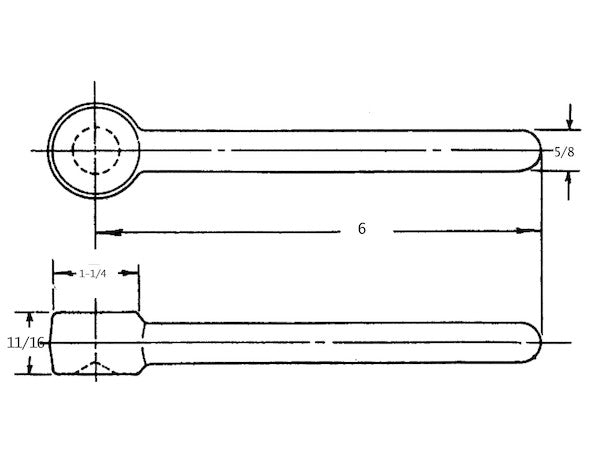
The Blank Forged Rod End from Buyers Products is ideal for all connecting and linking needs and is available in six sizes.
Specifications
| Bolt Shaft Length (in.) | 6.000 " |
| Thread Stocked | - |
| Eye Opening (in.) | 0.688 " |
| Bolt Shaft Diameter (in.) | .625 " |
| Outer Eye Diameter (in.) | 1.250 " |
Advanced Technical Overview: The 5/8 x 6 Inch Blank Forged Rod End
The 5/8 x 6 Inch Blank Forged Rod End, supplied by Buyers Products, represents a critical component within a vast array of mechanical linkage systems. Designed for robust performance and adaptability, this particular rod end is engineered to facilitate reliable connection and articulation in demanding applications. Its foundational strength derives from its forged construction, a manufacturing process that imparts superior material properties compared to other forming methods. This detailed exposition will delve into the technical specifications, material science, manufacturing processes, application versatility, and integration considerations pertinent to this industrial-grade component.
Material Science and Forging Process
The efficacy and durability of a rod end are primarily dictated by its material composition and the method of its formation. Forged components, such as this blank rod end, are manufactured by subjecting a raw metal billet to localized compressive forces using dies. This process, typically performed at elevated temperatures (hot forging), refines the material's grain structure, eliminating porosity and voids while aligning the grain flow with the part's contour. This optimized grain structure significantly enhances the material's mechanical properties, including tensile strength, yield strength, fatigue resistance, and impact toughness, making it inherently superior to cast or machined components from the same alloy.
While the specific alloy for this blank forged rod end is not explicitly stated, common materials for such applications include various grades of carbon steel, alloy steel, or stainless steel. For general-purpose industrial applications requiring high strength and moderate corrosion resistance, medium-carbon alloy steels like AISI 4140 or 1045 are frequently utilized. These steels, when properly forged and heat-treated, offer an excellent balance of strength, ductility, and machinability. The forging process ensures a consistent, high-density material throughout the rod end, critical for resisting stress concentrations and premature failure under dynamic loads.
The "blank" designation is significant, indicating that the rod end is supplied without pre-machined threads. This characteristic offers paramount flexibility for custom applications, allowing engineers to specify and machine threads (e.g., right-hand, left-hand, fine pitch, coarse pitch, metric, or imperial) precisely to their design requirements. This not only accommodates a wider range of mating components but also optimizes the fit and engagement depth for specific load profiles, preventing potential stress risers associated with inadequate thread engagement.
Detailed Dimensional Analysis
The provided specifications are crucial for proper integration and performance assessment:
-
Bolt Shaft Length (in.): 6.000" (152.4 mm)
This dimension refers to the overall length of the solid cylindrical portion extending from the eye. This length provides substantial material for custom threading or other machining operations. A 6-inch shaft offers ample engagement for various clevises, brackets, or other linkage components, ensuring stable and secure connections. It also allows for greater adjustability in linkage length post-machining. -
Thread Stocked: -
As previously noted, the absence of pre-threaded stock is a key feature, providing design flexibility. This necessitates secondary machining for thread creation, allowing for bespoke threading to match specific application needs (e.g., UNC, UNF, ISO Metric, Acme, Buttress threads). -
Eye Opening (in.): 0.688" (17.4752 mm)
Also known as the bore diameter, this dimension specifies the internal diameter of the eye through which a pin, bolt, or shaft will pass. A nominal 0.688-inch opening suggests it is designed to accommodate a 5/8-inch (0.625-inch) diameter pin with an intentional clearance fit. The clearance ensures ease of assembly and permits rotational movement, which is characteristic of rod end applications. The precise clearance (0.063 inches or approximately 1.6mm) allows for minor misalignments and thermal expansion while minimizing slop, ensuring smooth articulation. -
Bolt Shaft Diameter (in.): 0.625" (15.875 mm)
This is the outer diameter of the solid shaft portion. It directly corresponds to the stated 5/8-inch nominal size of the rod end. This diameter is the basis for all subsequent threading or machining operations on the shaft. Maintaining precise dimensional tolerances on this diameter is critical for consistent machining and robust component integration. -
Outer Eye Diameter (in.): 1.250" (31.75 mm)
This dimension refers to the external diameter of the circular portion containing the eye opening. It is a critical parameter for calculating stress concentrations around the eye, determining the required clearances within mounting brackets, and assessing the overall strength and load-bearing capacity of the eye itself. A larger outer eye diameter generally indicates a greater material cross-section around the bore, enhancing resistance to radial and axial loads.
Engineering Considerations and Performance Attributes
The design and material properties of this blank forged rod end contribute to several critical performance attributes:
- Load Bearing Capacity: Due to its forged construction, this rod end exhibits superior strength and resistance to static and dynamic loads compared to cast or machined equivalents. The controlled grain flow minimizes stress risers, allowing the component to withstand higher tensile, compressive, and shear forces without plastic deformation or fracture. The 0.625-inch shaft diameter and 1.250-inch outer eye diameter indicate a robust cross-section capable of transmitting significant forces.
- Fatigue Resistance: Components in linkage systems are often subjected to cyclic loading, making fatigue resistance a paramount concern. The refined grain structure and absence of internal defects in forged components significantly improve their fatigue life. This translates to extended operational longevity, reducing maintenance requirements and enhancing system reliability in applications experiencing repeated load cycles.
- Impact Toughness: In environments where sudden shock loads or impacts are possible, the high impact toughness of forged steel is a distinct advantage. The material's ability to absorb energy before fracturing prevents catastrophic failures, contributing to overall system safety and durability.
- Versatility through Blank Configuration: The "blank" nature of the shaft is a significant engineering advantage. It allows designers to select the optimal thread type (e.g., ACME for high load transmission, fine threads for precise adjustment) and length for specific applications. This eliminates the need for adapters or custom-manufactured threaded sections, simplifying BOM and reducing potential points of failure. Furthermore, the shaft can be machined for other features like keyways, snap ring grooves, or special profiles, expanding its functional utility beyond traditional threaded rod end applications.
- Corrosion Resistance (Material Dependent): While the base material is likely steel, subsequent surface treatments or coatings can be applied post-machining to enhance corrosion resistance, catering to outdoor, marine, or chemically aggressive environments. Common treatments include zinc plating, galvanization, or specialized paint coatings, depending on the desired protection level and cost constraints.
Applications and Integration
The 5/8 x 6 Inch Blank Forged Rod End is highly versatile and finds utility across numerous industries and mechanical systems:
- Automotive and Heavy Equipment: Critical for steering linkages, suspension components, control arms, and hydraulic cylinder connections in trucks, buses, construction machinery (excavators, loaders), agricultural equipment (tractors, harvesters), and specialty vehicles. Its robustness makes it suitable for demanding, high-load environments.
- Industrial Machinery: Utilized in manufacturing equipment, automation systems, presses, conveyors, and material handling systems for transmitting motion, accommodating angular misalignment, and providing pivot points. Examples include connecting hydraulic or pneumatic cylinders to machine frames, or linking cam followers to control levers.
- Marine Applications: With appropriate surface treatment, these rod ends can be integrated into marine steering systems, throttle controls, and various deck machinery, offering reliable operation in corrosive saltwater environments.
- Agricultural Equipment: Essential for implements like plows, cultivators, and sprayers, where strong, adjustable linkages are required to withstand rugged field conditions and varying loads.
- Specialty and Custom Fabrication: Its blank nature makes it ideal for prototyping, custom machinery builds, and one-off projects where off-the-shelf threaded rod ends do not meet specific dimensional or thread requirements. Fabricators can machine the shaft to precise lengths and thread types for bespoke applications.
- Structural and Motion Control Systems: Used in various structures requiring articulated joints, such as theatrical rigging, stage equipment, and architectural elements that need to accommodate movement or provide adjustable support.
Installation and Maintenance Considerations
Proper installation and periodic maintenance are crucial for maximizing the service life and ensuring the reliable operation of the rod end:
- Machining Accuracy: Given that the shaft is blank, precise machining of threads or other features is paramount. Inaccurate threading can lead to poor engagement with mating components, premature wear, or catastrophic failure under load. Careful attention to thread class, pitch diameter, and surface finish is required.
- Pin Selection and Fit: The pin or bolt used in the 0.688-inch eye opening must be selected to ensure an appropriate fit. A slight clearance is necessary for articulation, but excessive clearance will lead to slop, accelerated wear, and potential impact loading. The pin material should also be appropriate for the applied loads and environmental conditions.
- Lubrication: Although this is a blank rod end, many applications benefit from lubrication between the pin and the eye bore to reduce friction and wear. Depending on the application, this could involve a grease fitting on the mounting bracket, or the use of self-lubricating bushings within the eye (if machined to accommodate them).
- Alignment: Proper alignment of the rod end within the linkage system minimizes eccentric loading and bending moments on the pin and eye, which can lead to premature fatigue failure.
- Regular Inspection: Periodic inspection for signs of wear, deformation, or corrosion in the eye, pin, and threaded sections is recommended, especially in high-cycle or high-load applications. Any cracking, elongation of the eye, or excessive play indicates a need for replacement.
- Torque Specifications: When assembling threaded connections, adherence to manufacturer-recommended torque specifications is essential to ensure proper clamping force without overstressing the threads or component material.
Conclusion
The 5/8 x 6 Inch Blank Forged Rod End from Buyers Products stands as a testament to robust engineering and versatile design. Its forged construction ensures superior mechanical properties, including enhanced strength, fatigue resistance, and impact toughness, making it suitable for the most demanding industrial and commercial applications. The "blank" shaft configuration provides unparalleled flexibility, allowing engineers and fabricators to customize threading and other features to precisely meet specific project requirements. By understanding its material science, dimensional specifics, and application considerations, this component can be effectively integrated into a wide range of mechanical linkage systems, ensuring long-term reliability and optimal performance.