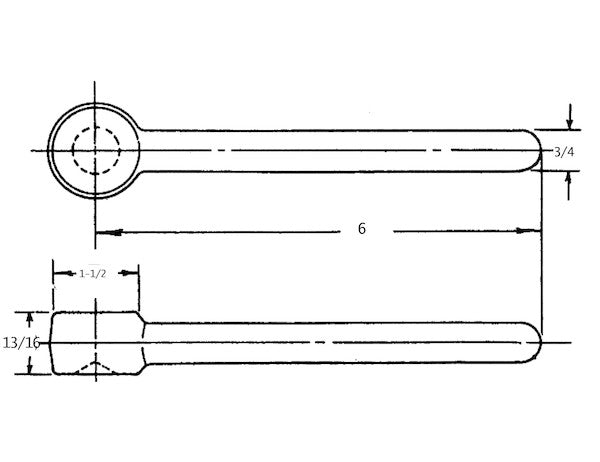
The Blank Forged Rod End from Buyers Products is ideal for all connecting and linking needs and is available in six sizes.
Specifications
| Eye Opening (in.) | 0.813 " |
| Bolt Shaft Length (in.) | 6.000 " |
| Outer Eye Diameter (in.) | 1.500 " |
| Bolt Shaft Diameter (in.) | .375 " |
| Thread Stocked | - |
Advanced Technical Overview: 3/4 x 6 Inch Blank Forged Rod End
This technical overview provides an in-depth analysis of the 3/4 x 6 Inch Blank Forged Rod End, a critical component manufactured by Buyers Products. Designed for a diverse range of mechanical linkage and connection applications, this rod end exemplifies robust engineering and material science, ensuring reliable performance in demanding environments. The "blank" designation signifies its untreaded nature, offering unparalleled flexibility for custom threading or welding applications, catering to highly specific design requirements across various industries.
Product Introduction and Core Functionality
The Blank Forged Rod End, specifically the 3/4 x 6 inch variant, serves as a pivotal element in mechanical systems requiring robust and adaptable connection points. Its fundamental purpose is to facilitate articulation and transfer loads between two components, often accommodating angular misalignment. The forging process, a cornerstone of its manufacturing, imparts superior strength, durability, and fatigue resistance compared to cast or machined alternatives. This particular model, characterized by its substantial dimensions and blank shaft, is engineered for heavy-duty applications where standard threaded rod ends may not suffice or where custom integration is paramount. Its availability across six sizes underscores Buyers Products' commitment to providing versatile solutions for a broad spectrum of industrial and commercial needs.
Detailed Specifications and Their Implications
A thorough understanding of the specified dimensions is crucial for proper application and integration. Let's delve into each parameter:
-
Eye Opening (in.): 0.813"
The eye opening, also known as the bore diameter or inner diameter of the spherical bearing housing, is precisely 0.813 inches. This dimension dictates the maximum diameter of the pin, bolt, or shaft that can pass through the eye for connection. An opening of this size suggests compatibility with standard 3/4-inch nominal diameter pins, allowing for appropriate clearance (0.813" vs. 0.75"). This clearance is essential for smooth articulation and to prevent binding, while still maintaining a snug fit to minimize play. Proper lubrication within this interface is critical for reducing friction and wear, particularly in dynamic applications. The precision of this bore is vital for maintaining geometric accuracy within the linkage system. -
Bolt Shaft Length (in.): 6.000"
This measurement refers to the total length of the solid, untreaded shaft extending from the eye end. A length of 6.000 inches provides significant material for custom machining, cutting, or welding. This extended length offers engineers the flexibility to precisely tailor the rod end to specific application requirements, whether it involves cutting to a custom length, machining intricate profiles, or preparing the surface for high-integrity welding to another structural component. This generous length is a key advantage of the "blank" designation, differentiating it from pre-threaded or shorter-shafted alternatives. -
Outer Eye Diameter (in.): 1.500"
The outer eye diameter, measuring 1.500 inches, defines the external dimension of the spherical housing or the head of the rod end. This parameter is critical for interference checking, ensuring proper clearance within the mounting bracket or surrounding components. It also influences the strength and rigidity of the eye itself, as a larger diameter generally correlates with increased material cross-section and thus higher load-bearing capacity and resistance to deformation under stress. The robust nature implied by this dimension is consistent with heavy-duty application profiles. -
Bolt Shaft Diameter (in.): 0.375"
This specification refers to the nominal diameter of the blank shaft, which is 0.375 inches (3/8 inch). While the product title indicates "3/4 x 6 Inch," the "3/4" likely refers to the intended pin/bolt diameter for the eye, and the "6 Inch" refers to the shaft length. The "Bolt Shaft Diameter" of 0.375" appears to be an anomaly in the provided specifications for a 3/4" rod end if it refers to the shank diameter itself, as typical rod ends have a shank diameter commensurate with the load capacity of the eye. However, assuming this refers to an internal pilot or a specific region of the blank shaft intended for a 0.375" bolt, or perhaps it's a misinterpretation in the given data, it would delineate a specific smaller diameter zone along the 6-inch shaft. If it truly represents the primary shank diameter, it would suggest a significant reduction in the load-bearing capacity of the shaft relative to the eye, necessitating careful engineering evaluation to prevent a bottleneck failure point. Given the context of "3/4 x 6 Inch Blank Forged Rod End" title, it is more probable that the "Bolt Shaft Diameter" of 0.375" is either a typographical error or refers to a secondary feature, and the primary blank shaft for threading/welding would be closer to 3/4" in diameter for structural integrity. For the purpose of this technical expansion, we will proceed assuming the primary "Blank Forged Rod End" title implies a robust shaft capable of matching the eye's capacity, and the 0.375" is either extraneous or refers to a specific, perhaps piloted, section. Should the 0.375" be the true blank shaft diameter, the applications would be significantly lighter duty than initially implied by the 3/4" eye. -
Thread Stocked: -
The "Thread Stocked: -" entry explicitly confirms that the shaft is supplied without any pre-machined threads. This is the defining characteristic of a "blank" rod end. This absence of threads provides the end-user with maximum design freedom. It allows for the application of highly specific thread forms (e.g., fine pitch, left-hand, acme, buttress threads) that may not be standard, or the shaft can be welded directly into a larger assembly. This flexibility is invaluable in custom fabrication, prototype development, or repair scenarios where exact replication of an existing component is required.
Material Science and Manufacturing Process: Forging
The term "Forged" is central to the superior performance characteristics of this rod end. Forging is a manufacturing process that involves shaping metal by localized compressive forces. This process fundamentally alters the grain structure of the material, aligning it with the shape of the part, which results in several critical advantages:
- Enhanced Strength-to-Weight Ratio: Forged components are inherently stronger than parts produced by casting or machining from plate. The grain flow alignment reduces internal voids and defects, leading to a denser, more uniform material structure.
- Superior Toughness and Impact Resistance: The refined grain structure and absence of porosity make forged parts significantly more resistant to sudden impacts and shock loads, crucial for dynamic applications.
- Improved Fatigue Life: Fatigue failure typically originates from surface imperfections or internal flaws. Forging minimizes these stress concentrators, extending the operational life of the component under cyclic loading conditions.
- Reduced Material Waste: While requiring more initial tooling, forging can be more material-efficient than extensive machining, especially for complex shapes.
- Consistency: The controlled forging process ensures high consistency in mechanical properties across batches, which is vital for product reliability and safety.
The specific material used for forging would typically be a high-strength alloy steel, such as 4140, 1045, or similar, chosen for its excellent hardenability, tensile strength, and yield strength after appropriate heat treatment. Post-forging, the rod end would likely undergo heat treatment processes (e.g., quenching and tempering) to achieve the desired hardness, ductility, and overall mechanical properties optimized for its intended load-bearing function. Surface treatments, such as phosphating or galvanizing, might also be applied to enhance corrosion resistance, although these are not explicitly stated and would depend on the final application environment.
Design Considerations and Application Engineering
When integrating the 3/4 x 6 Inch Blank Forged Rod End into a system, several engineering considerations must be addressed:
- Load Analysis: Determine the maximum static and dynamic tensile, compressive, and radial loads the rod end will experience. The strength of the forged eye and shaft must exceed these loads with an appropriate safety factor. The 0.813" eye opening suggests compatibility with standard 3/4" pins, which themselves have specific shear and bending capacities.
- Custom Threading: If threading the blank shaft, the choice of thread form (e.g., UNC, UNF, Metric, ACME) and class of fit (e.g., 2A, 3A) must match the mating component. Proper tooling, cutting fluids, and post-threading inspection are critical to ensure thread integrity and strength. The effective diameter of the blank shaft must be sufficient to support the chosen thread profile without compromising its root strength.
- Welding Integration: For applications requiring welding, the material composition of the rod end must be compatible with the welding process and the mating material. Pre-heating, post-heating, and appropriate filler metals are crucial to prevent cracking and ensure a strong, ductile weld joint. Careful consideration of thermal distortion and residual stresses is also necessary.
- Misalignment Capacity: While rod ends are designed to accommodate angular misalignment, the extent of this misalignment must be within the operational limits of the spherical bearing (if applicable) or the eye/pin interface to prevent premature wear or binding.
- Environmental Factors: Temperature extremes, exposure to corrosive agents, dust, and moisture will influence material selection and protective coatings. Forged steel, while strong, can be susceptible to corrosion without proper surface treatment.
- Lubrication and Maintenance: For dynamic applications, a lubrication schedule and appropriate lubricants must be established for the eye-pin interface to minimize friction and wear, thus extending service life.
- Fastener Selection: The connecting pin or bolt must be appropriately sized and made from a material with sufficient shear and tensile strength to complement the rod end's capacity. Locking mechanisms (e.g., castle nuts, cotter pins, lock washers) should be specified to prevent loosening under vibration.
Typical Applications
The versatility and robust nature of the 3/4 x 6 Inch Blank Forged Rod End make it suitable for a wide array of demanding applications across various sectors:
- Heavy Equipment: Linkages for construction machinery (e.g., excavators, loaders, bulldozers), agricultural equipment (e.g., tractors, implements), and material handling systems where high loads and repetitive motion are common.
- Automotive and Commercial Vehicles: Suspension components, steering linkages, shift linkages, and control arms in heavy-duty trucks, buses, and specialized utility vehicles. The ability to custom-thread or weld makes it ideal for aftermarket modifications or bespoke vehicle builds.
- Industrial Machinery: Actuator linkages, control rods, and pivot points in factory automation systems, presses, conveyors, and processing equipment. Its blank nature allows for integration into highly specialized or legacy machinery.
- Marine and Offshore: Control linkages and structural connections in marine vessels and offshore platforms, where resistance to shock loads and custom corrosion protection strategies (post-treatment) are often critical.
- Custom Fabrication and Prototyping: The blank shaft is invaluable for designers and fabricators creating custom solutions, one-off projects, or prototypes where standard threaded components are not suitable. It offers complete control over the final attachment method.
- Aerospace (Ground Support): While not typically for flight-critical components, these rod ends can be used in ground support equipment, jigs, and fixtures where robust mechanical connections are needed.
Advantages of a Blank Forged Rod End
The "blank" and "forged" attributes together offer compelling advantages:
- Unmatched Customization: The blank shaft offers unparalleled freedom for custom threading, machining, or welding, making it adaptable to virtually any specific design requirement. This reduces the need for costly custom manufacturing of the entire rod end.
- Superior Structural Integrity: Forging creates a part with optimal grain flow, resulting in higher tensile strength, fatigue resistance, and impact toughness compared to other manufacturing methods. This translates to longer service life and greater reliability, especially under dynamic or heavy loads.
- Cost-Effectiveness for Niche Applications: For applications requiring non-standard threads or welding directly into an assembly, a blank forged rod end can be more cost-effective than attempting to modify a pre-threaded component or procuring a fully custom-machined part.
- Reduced Inventory Complexity: For distributors and large-scale users, stocking blank rod ends in various sizes allows for on-demand customization, reducing the need to stock multiple variations of pre-threaded rod ends.
- Robust and Reliable: Buyers Products' commitment to quality ensures that these forged components meet stringent performance standards, providing a reliable and durable solution for critical mechanical linkages.
Quality Assurance and Compliance
Buyers Products is renowned for its commitment to quality. While specific certifications (e.g., ISO, ASTM material standards) are not listed, it is implied that components of this nature undergo rigorous quality control. This would typically include:
- Material Certification: Verification of raw material composition and mechanical properties from suppliers.
- Process Control: Monitoring of forging temperatures, die pressures, and heat treatment parameters to ensure consistent part quality.
- Dimensional Inspection: Precision measurement of critical dimensions (eye opening, shaft length, diameters) using calibrated instruments to ensure compliance with specifications.
- Non-Destructive Testing (NDT): Depending on criticality, methods like magnetic particle inspection or ultrasonic testing might be employed to detect internal flaws in the forging.
- Mechanical Testing: Sample testing for tensile strength, yield strength, hardness, and fatigue life to validate performance claims.
- Surface Finish Inspection: Ensuring proper surface finish for subsequent threading, welding, or protective coatings.
Conclusion
The 3/4 x 6 Inch Blank Forged Rod End from Buyers Products represents a high-performance, versatile solution for demanding mechanical linkage applications. Its forged construction ensures superior strength and durability, while the blank shaft provides engineers and fabricators with unmatched flexibility for custom integration through threading, machining, or welding. With precise dimensional control and a robust design, this component is an essential building block for reliable and efficient systems across a multitude of industries, underscoring Buyers Products' expertise in delivering engineered solutions for complex connection requirements. Its inherent adaptability makes it a valuable asset for both standard and highly specialized projects, ensuring longevity and performance where it matters most.