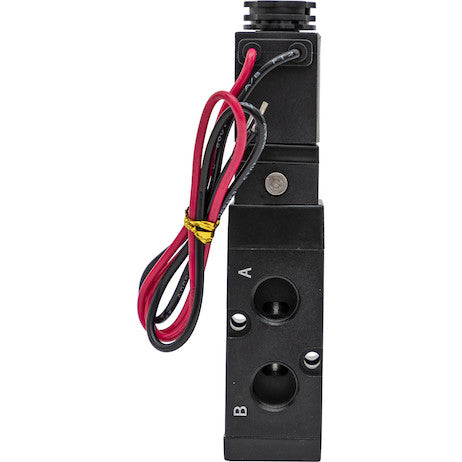
Buyers Products 4-Way, 2-Position Solenoid Air Valve controls the air flow required for precise operation in many air cylinder applications. It allows you to use or activate a pneumatic system remotely with an easy-to-install electronic switch. It has five standard 1/4 in. NPT ports for adequate air flow. The rugged 12V coil comes complete with 2 in. flying leads. While the valve is a standard 4-way, it can be easily converted to 3-way operation by installing two pipe plugs.
Specifications
| Depth (in.) | 1-3/8 |
|---|---|
| Feathering | No |
| Height (in.) | 4-3/4 |
| Number of Ports | 3 |
| Port Size | 0.250 |
| Port Type | NPT |
| Rated Pressure | 130 |
| Spring to Neutral / Deadman Control (y/n) | N |
| Valve Action | 4-Way, 2 Position |
| Valve Actuation | 12 VDC |
| Valve Primary Application | Solenoid Tailgate Valve |
| Width (in.) | 1 |
Advanced Technical Overview: The 4-Way, 2-Position Solenoid Air Valve for Precision Pneumatic Control
The Buyers Products 4-Way, 2-Position Solenoid Air Valve represents a critical component in modern pneumatic control systems, offering robust and precise management of air flow for a diverse array of applications. Designed for the rigorous demands of industrial and mobile environments, this valve facilitates the remote, electronic actuation of pneumatic cylinders, ensuring operational efficiency and enhanced safety. This detailed technical description will elaborate on the valve's functional characteristics, its operational principles, design specifications, application versatility, and installation considerations.
Fundamental Principles of 4-Way, 2-Position Operation
At the core of this device's utility is its "4-Way, 2-Position" configuration, a standard nomenclature in fluid power. The "4-Way" designation refers to the valve's capacity to manage four distinct flow paths: a pressure inlet (P), two cylinder or work ports (A and B), and two exhaust ports (EA and EB, often referred to as R and S). This architecture is specifically engineered for the control of double-acting pneumatic cylinders, which require air pressure to be applied to alternate sides of a piston to achieve both extension and retraction. In the first stable position, pressure air from the P port is directed to cylinder port A, while cylinder port B is simultaneously connected to exhaust port EB. This causes the cylinder rod to extend. In the second stable position, the flow paths are reconfigured: pressure air from P is now directed to cylinder port B, and cylinder port A is connected to exhaust port EA, resulting in the cylinder rod's retraction. This bidirectional control capability is paramount for complex mechanical movements.
The "2-Position" aspect signifies that the valve possesses two distinct and stable operational states, toggling between these states upon command. Unlike proportional or feathering valves (as indicated by "Feathering: No" in the specifications), this valve operates in a discrete ON/OFF manner, providing full air flow to one side of the cylinder and simultaneously exhausting the other. This inherent simplicity contributes to its reliability and suitability for applications requiring definitive, clear-cut actions rather than modulated speed or force control. The absence of a spring-to-neutral or deadman control mechanism (indicated by "Spring to Neutral / Deadman Control (y/n): N") further implies that once actuated, the valve maintains its selected position until an opposing electrical signal is applied, providing a maintained control state ideal for processes where continuous actuation is required without constant electrical input, or for applications where the valve's last commanded state needs to be maintained.
Solenoid Actuation and Electrical Interface
The valve's actuation is achieved via an integrated solenoid, an electromechanical device central to its remote control capabilities. The "12VDC" (12 Volts Direct Current) coil is a crucial specification, making this valve particularly well-suited for mobile applications, vehicle auxiliary systems, and industrial setups where a 12VDC power source is readily available. The solenoid coil, when energized by the 12VDC supply, generates a magnetic field that physically shifts an internal spool or poppet within the valve body. This mechanical displacement reconfigures the internal flow paths, transitioning the valve from one 2-position state to the other. The "rugged 12V coil" emphasizes durability, suggesting a design resistant to common stressors like vibration, temperature fluctuations, and electrical transients often encountered in demanding operational environments.
The electrical interface is provided by "2 in. flying leads," which are pre-attached wires extending from the solenoid coil. These leads simplify the electrical connection process, allowing for direct integration into control circuits without requiring specialized connectors or intricate wiring procedures at the valve itself. This design choice underscores the product's emphasis on ease of installation and field serviceability. The ability to remotely activate the pneumatic system through an electronic switch offers significant operational advantages: it eliminates the need for manual intervention at the valve location, facilitates integration with PLC (Programmable Logic Controller) or other electronic control units, and enables precise timing and sequencing of pneumatic operations, thereby enhancing automation and operator safety.
Port Configuration and Fluidic Dynamics
The valve features "Five 1/4 inch NPT ports," a standard and highly practical configuration for its specified applications. These ports are meticulously designed for specific functions: one pressure inlet (P), two work ports (A and B) connecting to the double-acting cylinder, and two exhaust ports (EA and EB) for releasing spent air. The "1/4 inch NPT" designation refers to the nominal diameter of the port and the thread standard. NPT (National Pipe Taper) threads are widely adopted in North America for fluid power connections due to their self-sealing characteristic; the tapered threads, when properly engaged and sealed with thread sealant, create a mechanically sound and leak-resistant connection as they wedge together.
The sizing of these ports at 1/4 inch is optimized for adequate air flow in many pneumatic cylinder applications, balancing flow capacity with physical footprint and cost. While a specific Cᵥ (flow coefficient) value is not provided, the "adequate air flow" claim implies that the internal passageways and port geometry are designed to minimize pressure drop across the valve, thereby maximizing the efficiency of the pneumatic system. A rated pressure of "130 PSI" indicates the maximum operating pressure the valve can safely and reliably withstand. This pressure rating is robust enough for most standard industrial and mobile pneumatic systems, which typically operate within the 80-120 PSI range. Maintaining consistent pressure and managing exhaust efficiently are critical for responsive cylinder movement and overall system performance, areas where this 5-port configuration excels by providing dedicated, unimpeded pathways for both supply and exhaust air.
Operational Versatility: 3-Way Conversion
A notable feature of this 4-way valve is its inherent versatility, specifically its capacity to be "easily converted to 3-way operation by installing two pipe plugs." This adaptability provides significant practical and economic benefits. A 3-way valve is typically used for controlling single-acting pneumatic cylinders, which extend when pressurized and retract via an internal spring or external force when the pressure is released. Converting this 4-way valve involves blocking one of the work ports (e.g., port B) and one of the exhaust ports (e.g., exhaust port EB) using appropriate NPT pipe plugs. In this modified configuration, the valve functions as a 3-way device: air is directed from the pressure port (P) to the remaining open work port (A) to extend the cylinder, and when the valve shifts, port A is then connected to the remaining open exhaust port (EA), allowing the cylinder to retract. This strategic design allows users to stock a single valve type for multiple applications, reducing inventory complexity and offering greater flexibility in system design and field modifications. For applications requiring simpler ON/OFF control of single-acting actuators, this conversion capability avoids the necessity of purchasing a separate 3-way valve.
Robustness, Durability, and Environmental Suitability
The product's stated "rugged 12V coil" and its "Solenoid Tailgate Valve" primary application underscore its design for durability in challenging environments. Solenoid valves intended for tailgate applications on commercial vehicles (e.g., dump trucks, utility trucks) are inherently exposed to harsh conditions, including vibration, shock, dust, moisture, extreme temperatures, and corrosive agents like road salt and cleaning chemicals. To withstand these stressors, such valves typically feature robust construction materials. The valve body is likely constructed from high-strength, corrosion-resistant metals such as anodized aluminum or brass, providing structural integrity and protection against external elements. Internal components, including the spool, seals, and springs, are chosen for their wear resistance and compatibility with compressed air, which may contain trace amounts of oil or moisture.
The solenoid coil itself is encapsulated or sealed to protect its windings from moisture ingress and physical damage, ensuring consistent electrical performance. The 2-inch flying leads are typically jacketed with durable insulation materials that resist abrasion, temperature extremes, and chemical exposure, maintaining electrical integrity over the valve's operational lifespan. This emphasis on robustness translates into a high mean time between failures (MTBF), reduced maintenance requirements, and reliable operation under conditions that would compromise less robust components, thereby ensuring continuous uptime for critical vehicle and industrial functions.
Advanced Applications and System Integration
While the primary application is listed as a "Solenoid Tailgate Valve," the functional characteristics of this 4-way, 2-position solenoid air valve extend its utility to a much broader spectrum of pneumatic applications. In mobile equipment, beyond tailgates, it is ideal for controlling snow plow angling mechanisms, salt spreader gates, refuse truck compactors, auxiliary lift axles, and various implement functions on agricultural and construction machinery. Its 12VDC actuation is particularly advantageous in these vehicle-based systems, directly interfacing with the vehicle's electrical system.
In industrial settings, this valve is indispensable for a wide range of automation tasks. It can be integrated into assembly lines for controlling clamping, pushing, or ejecting mechanisms; in packaging machinery for opening/closing flaps or actuating pick-and-place grippers; and in material handling systems for conveyor diverters or indexing stations. For process control, it can manage the opening and closing of larger pneumatic actuators connected to process valves. Integration into larger control architectures, such as those employing PLCs, Distributed Control Systems (DCS), or Human-Machine Interfaces (HMIs), is straightforward due to its simple electrical ON/OFF control. This allows for sophisticated sequencing, interlocks, and remote diagnostics, maximizing operational efficiency and safety across complex manufacturing and processing environments.
Installation, Maintenance, and Performance Optimization
Proper installation is paramount to leveraging the full performance and longevity of the 4-Way, 2-Position Solenoid Air Valve. Mechanical installation involves securing the valve to a stable surface using appropriate fasteners, ensuring it is positioned to allow for easy access to ports and electrical connections, and that it is protected from direct impact or excessive vibration. When connecting pneumatic lines, the use of high-quality NPT pipe thread sealant (e.g., PTFE tape or liquid sealant) is critical to create leak-free connections for the 1/4 inch NPT ports, preventing pressure loss and ensuring system efficiency. Clear labeling of pressure, work, and exhaust ports facilitates correct plumbing, which is essential for proper cylinder function.
Electrical wiring requires connecting the 12VDC power source and control signal to the flying leads, adhering to polarity if specified, and ensuring connections are secure and protected from environmental factors. Overcurrent protection (fusing) should be incorporated into the control circuit to safeguard the solenoid coil and associated wiring. For optimal performance, the incoming compressed air supply should be properly conditioned, typically through a Filter-Regulator-Lubricator (FRL) unit. Filtration removes particulate contaminants and moisture, preventing internal valve damage and extending seal life. Pressure regulation ensures a stable operating pressure (within the 130 PSI limit), crucial for consistent cylinder force and speed. Lubrication, if required by downstream components, can also contribute to system longevity.
Routine maintenance primarily involves periodic inspection for air leaks, checking electrical connections for corrosion or looseness, and ensuring the air supply remains clean and dry. While the "rugged" design minimizes internal wear, preventing contamination is key to long-term reliability. By following proper installation guidelines and implementing a preventative maintenance schedule, users can ensure that this solenoid air valve consistently delivers precise, reliable control for its intended applications, minimizing downtime and maximizing productivity.
Conclusion
The Buyers Products 4-Way, 2-Position Solenoid Air Valve is an expertly engineered pneumatic control device, designed for precision, reliability, and versatility. Its fundamental 4-way, 2-position functionality provides definitive bidirectional control for double-acting air cylinders, while its 12VDC solenoid actuation enables convenient remote electronic operation, making it ideal for mobile and industrial applications. Featuring five robust 1/4 inch NPT ports capable of handling up to 130 PSI, it ensures efficient air flow and secure connections. The added flexibility of easy conversion to a 3-way configuration further enhances its value, allowing it to adapt to diverse single-acting cylinder requirements. Constructed for durability in harsh environments, this valve stands as a testament to practical engineering, offering a robust, dependable, and economically advantageous solution for a wide array of pneumatic control challenges, from heavy-duty vehicle systems to sophisticated industrial automation processes. Its technical specifications and design features collectively position it as a superior choice for professionals seeking reliable and precise pneumatic system management.