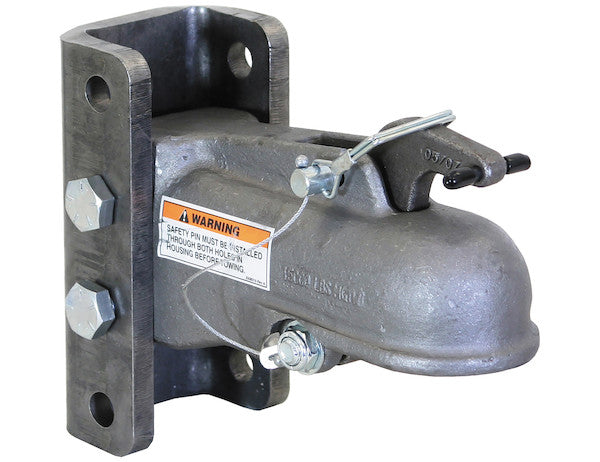
The Adjustable Cast Couplers with 3 Position Channel from Buyers Products takes the chore out of coupling your trailer. Its spring-loaded auto-engage latch lets you quickly lock it to a hitch ball with just one hand. The latch can be pinned opened for ease of uncoupling. The 3 position channel allows height adjustability for leveling your trailer. Simply bolt the coupler into the channel bracket to fit your needs. Fasteners are included. Made of rugged cast steel, the coupler can handle loads of 10,000 lb (2 in. ball) or 15,000 lb (2-5/16 in. ball).
Specifications
| Ball Diameter (in.) | 2 |
|---|---|
| Channel Depth (in.) | 2.44 |
| Channel Height (in.) | 7.63 |
| Channel Thickness | .50 |
| Channel Width (in.) | 2.94 |
| Class | Class IV |
| Coupler Style | Adjustable |
| Finish | Plain |
| M.G.T.W. (lbs) | 10,000 |
| Material | Cast Steel |
| Mount Style | Bolt-on |
| Mounting Hole Diameter | 0.656 |
| Mounting Hole Pattern | Vertical |
| Mounting Holes Center to Center | 2.00 |
Technical Overview: The COUPLER, 2in ASSY W/3 POSITION CHANNEL for Professional Trailer Applications
The COUPLER, 2in ASSY W/3 POSITION CHANNEL, engineered by Buyers Products, represents a critical component in the secure and efficient integration of a trailer with its towing vehicle. This robust assembly is designed for rigorous professional applications, emphasizing durability, operational simplicity, and paramount safety standards. Its core functionality revolves around providing a steadfast connection point, while its adjustable channel mechanism allows for precise trailer leveling, optimizing towing dynamics across diverse operational scenarios.
Material Science and Structural Integrity: Cast Steel Construction
At the heart of this coupler's exceptional performance and longevity is its construction from rugged cast steel. Cast steel, a ferrous alloy, is renowned in heavy-duty applications for its superior strength-to-weight ratio, excellent shock absorption characteristics, and resistance to fatigue. The casting process allows for the creation of complex geometries with uniform material properties, which is crucial for components subjected to significant multi-directional forces during towing. Unlike fabricated or stamped steel components, cast steel typically exhibits isotropic properties, meaning its strength is consistent regardless of the direction of applied stress. This inherent structural integrity provides a robust foundation, ensuring the coupler can reliably withstand the dynamic loads, torsional stresses, and vibrational forces encountered during prolonged periods of heavy-duty trailering. The .50 inch (1/2 inch) channel thickness further underscores this commitment to structural resilience, providing substantial material cross-section to distribute applied stresses effectively and resist deformation.
Precision Coupling Mechanism: The Spring-Loaded Auto-Engage Latch
The design of the spring-loaded auto-engage latch system is a testament to functional engineering focused on operational efficiency and safety. This mechanism facilitates a swift, single-hand coupling operation, minimizing the effort and potential for error during trailer attachment. Upon lowering the coupler onto the hitch ball, the internal spring mechanism actuates, causing the latch to automatically engage and secure the ball within the coupler housing. This auto-engagement feature provides immediate positive feedback of a secure connection, a crucial safety aspect for operators. Furthermore, the latch incorporates a provision for being pinned in an open position. This feature is invaluable during uncoupling procedures, allowing the operator to disengage the coupler from the hitch ball with enhanced control and without the need to manually hold the latch open. This controlled release mechanism contributes significantly to reducing the risk of accidental drops or uncontrolled trailer movements during disconnection, thereby enhancing site safety and operational workflow.
Adjustability for Optimal Towing Dynamics: The 3-Position Channel
The integral 3-position channel is a hallmark of this coupler assembly's versatility and performance optimization. Trailer leveling is not merely an aesthetic concern; it is fundamental to safe and efficient towing. An improperly leveled trailer can lead to several adverse conditions, including:
- Uneven Weight Distribution: If the trailer is nose-up or nose-down, weight is not evenly distributed across the trailer axles and the tow vehicle's hitch, leading to increased wear on tires and suspension components.
- Reduced Braking Performance: Improper weight distribution can compromise the effectiveness of trailer brakes and the tow vehicle's braking system.
- Impaired Handling and Stability: An unlevel trailer can induce sway, particularly at higher speeds or in crosswinds, significantly increasing the risk of loss of control.
- Excessive Tongue Weight or Insufficient Tongue Weight: A nose-down attitude can increase tongue weight beyond safe limits for the tow vehicle and hitch, while a nose-up attitude can dangerously reduce it, leading to instability.
- Reduced Aerodynamic Efficiency: An unlevel trailer presents a larger frontal area or creates turbulent airflow, increasing drag and reducing fuel economy.
Load Capacity and Class IV Rating: Meeting Demanding Performance Requirements
The COUPLER, 2in ASSY W/3 POSITION CHANNEL is engineered to meet the stringent demands of heavy-duty towing, evidenced by its impressive Maximum Gross Trailer Weight (M.G.T.W.) ratings. For applications utilizing a 2-inch hitch ball, the coupler is rated for a M.G.T.W. of 10,000 lb. When equipped for a 2-5/16 inch hitch ball, this capacity escalates to 15,000 lb. These ratings position the coupler firmly within the Class IV category according to the Society of Automotive Engineers (SAE) J684 standard for trailer hitches and couplers. A Class IV rating signifies suitability for towing heavy-duty utility trailers, car haulers, larger boat trailers, and mid-sized construction equipment. It's imperative that the M.G.T.W. of the coupler matches or exceeds the Gross Trailer Weight (GTW) of the trailer and its load, as well as the towing capacity of the tow vehicle and hitch system. Furthermore, proper consideration of tongue weight (typically 10-15% of GTW) is vital for maintaining stability and control during towing, and the robust design of this coupler is fully capable of managing the corresponding vertical loads. The ability to accommodate two different ball sizes through interchangeable components (though this specific product is a "2in ASSY") offers a degree of flexibility for operators managing varied trailer fleets, assuming the correct ball component is paired with the appropriate coupler assembly variant.
Installation and Maintenance Best Practices
The bolt-on mount style of this coupler assembly offers significant advantages in terms of installation and field serviceability. Unlike weld-on couplers, a bolt-on system eliminates the need for specialized welding equipment and expertise, simplifying installation and allowing for easier replacement or adjustment. The precise mounting hole pattern (vertical, 2.00 in. center-to-center) and the specified 0.656 in. mounting hole diameter ensure compatibility with standard trailer tongue configurations. When installing, it is critical to:
- Utilize Appropriate Fasteners: While fasteners are included, verify that they are of suitable grade (typically Grade 5 or 8) and properly torqued to manufacturer specifications. Over- or under-tightening can compromise the integrity of the connection.
- Ensure Proper Alignment: The coupler must be squarely aligned with the trailer tongue to prevent undue stress on the mounting bolts and the trailer structure.
- Regular Inspection: Periodically inspect the coupler assembly, channel bracket, and mounting bolts for any signs of wear, fatigue, corrosion, or deformation. Particular attention should be paid to the latching mechanism to ensure smooth operation and full engagement.
- Lubrication: Moving parts within the latch mechanism should be periodically cleaned and lubricated with a suitable grease or lubricant to ensure reliable operation and prevent corrosion.
- Protective Coating: While the coupler has a "plain" finish, indicating raw cast steel, it is highly recommended to apply a protective coating (e.g., paint, primer, or rust inhibitor) after installation. This will significantly enhance corrosion resistance and extend the operational life of the unit, especially in environments exposed to moisture, road salts, or harsh weather conditions.
Applications and Versatility
The COUPLER, 2in ASSY W/3 POSITION CHANNEL is ideally suited for a broad spectrum of commercial and heavy-duty towing applications. Its robust design and adjustable features make it a preferred choice for:
- Commercial Utility Trailers: Hauling construction materials, landscaping equipment, or municipal service gear.
- Equipment Transport Trailers: Safely securing excavators, skid steers, scissor lifts, and other heavy machinery.
- Agricultural Trailers: Connecting implements or transport trailers for farm operations.
- Vehicle Haulers: Ensuring stable transport of automobiles or other vehicles.
- Heavy-Duty Boat Trailers: Providing a secure link for larger watercraft.
Conclusion: An Engineered Solution for Demanding Towing Operations
In summary, the COUPLER, 2in ASSY W/3 POSITION CHANNEL by Buyers Products is a meticulously engineered solution designed to deliver unparalleled reliability, safety, and operational efficiency in demanding towing environments. Its foundation in high-strength cast steel, combined with a user-friendly spring-loaded auto-engage latch and a critical 3-position adjustable channel, positions it as a superior choice for professionals. The detailed specifications, including its Class IV rating and substantial M.G.T.W. capabilities, underscore its suitability for a wide array of heavy-duty applications. By adhering to best practices for installation and maintenance, operators can ensure that this coupler assembly provides years of dependable service, enhancing both the safety and productivity of their towing operations.