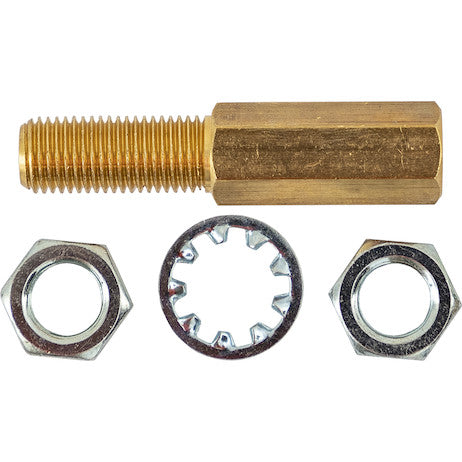
Buyers Products 3/8 Inch-24 Thread Bulkhead Fitting for .260 Conduit is used to create a bulkhead style attachment on the output end of cables. Nuts and bolts are included.
Specifications
| Material | Multiple |
| FInish | Plain |
| Use WIth | VCGT3100 Cables |
The Buyers Products 3/8 Inch-24 Thread Bulkhead Fitting for .260 Conduit represents a critical component in the meticulous design and robust implementation of industrial and commercial cabling systems. This precision-engineered fitting is specifically designed to facilitate a secure, organized, and protected pass-through for cables encased within .260 inch conduits, establishing a definitive bulkhead style attachment point. Its core function is to transition cables from an internal, often protected, environment to an external one, or between compartments within a complex system, while maintaining structural integrity and often, environmental sealing.
At the heart of this fitting’s design is the 3/8 Inch-24 thread specification. This nomenclature refers to a Unified National Fine (UNF) thread series, which is characterized by a finer pitch compared to its coarse (UNC) counterpart. The '3/8 inch' denotes the nominal major diameter of the thread, while '24' indicates 24 threads per inch (TPI). The UNF standard provides several distinct advantages pertinent to bulkhead applications. The finer thread pitch results in a greater number of threads engaging over a given axial length, distributing the load more effectively and offering enhanced resistance to loosening under vibration. This characteristic is paramount in applications subject to dynamic stresses, such as those found in automotive, heavy machinery, and marine environments. Furthermore, the finer pitch often allows for more precise adjustments during installation, ensuring an optimal clamping force and a more secure attachment. The mechanical advantage gained from a finer thread also means that less torque is required to achieve a desired clamping force, reducing the risk of material deformation or thread stripping during assembly, especially when dealing with various material compositions.
The functionality of this fitting is intrinsically linked to its compatibility with .260 inch conduits. Conduit, in the context of electrical and mechanical systems, serves as a protective enclosure for cables, shielding them from physical damage, moisture, chemicals, and sometimes electromagnetic interference (EMI). The .260 inch internal diameter of the conduit dictates the maximum external diameter of the cable or bundle of wires it can accommodate. Precision in this dimension is crucial for ensuring a snug fit, preventing movement that could lead to abrasion, and maintaining any specified ingress protection (IP) ratings. This particular conduit size suggests applications where single or multiple smaller gauge wires require robust protection. Common materials for such conduits include flexible nylon, PVC, or various metallic alloys, each chosen for specific environmental resilience, flexibility, and cost considerations. The bulkhead fitting securely grips this conduit, preventing it from being pulled out or pushed back through the panel, thereby providing strain relief and maintaining the integrity of the cable routing.
The "bulkhead style attachment" is a fundamental feature, describing the fitting's ability to mount flush with or through a panel, wall, or enclosure. This design inherently provides a professional, clean, and durable point of entry or exit for cabling. A typical bulkhead installation involves drilling a precisely sized hole in the panel, through which the threaded portion of the fitting passes. A nut (often one of the "nuts and bolts included") is then tightened on the opposite side of the panel, clamping the fitting securely in place. This method ensures that the cable or conduit is anchored firmly, preventing stress on the internal connections and enhancing the overall aesthetic and functional integrity of the system. In many instances, the bulkhead design can be augmented with sealing elements, such as O-rings or gaskets, to provide environmental protection against dust, water, or other contaminants, crucial for maintaining the operational reliability of sensitive electronics or mechanical systems in harsh conditions.
The "Material: Multiple" specification is indicative of a versatile manufacturing approach, allowing Buyers Products to select optimal materials based on specific performance requirements, cost-efficiency, and application environments. Common materials for such fittings include various grades of brass, stainless steel (e.g., 304, 316), plated steel (e.g., zinc-plated steel), and high-performance engineering plastics like nylon or acetal (Delrin). Each material offers a unique set of properties:
- **Brass:** Known for its excellent machinability, good electrical conductivity, and superior corrosion resistance, particularly in marine or humid environments. It also exhibits good strength and ductility.
- **Stainless Steel:** Offers exceptional corrosion resistance, high tensile strength, and durability across a wide temperature range. It is often chosen for applications requiring hygiene, chemical resistance, or extreme environmental resilience.
- **Plated Steel:** Typically carbon steel coated with zinc or other protective layers to enhance corrosion resistance and improve appearance. It provides a cost-effective solution for many general industrial applications where high-grade stainless steel might be overkill.
- **Engineering Plastics (e.g., Nylon, Acetal):** These materials provide inherent electrical insulation, lightweight properties, and resistance to many chemicals. They are non-corrosive and often used in applications where weight reduction is critical or where galvanic corrosion between dissimilar metals is a concern.
The "Finish: Plain" designation signifies that the fitting components are left in their natural state after manufacturing, without additional coatings, platings, or surface treatments. For metallic components, this usually means a raw, unpolished surface, reflecting the base material's inherent color and texture. While a plain finish might seem rudimentary, it offers several advantages. It avoids the added cost and potential complications associated with plating processes, such as hydrogen embrittlement in high-strength steels or variations in dimensional tolerances that can occur with thick coatings. For components made of naturally corrosion-resistant materials like stainless steel or certain plastics, a plain finish is perfectly adequate for many environments. In situations where additional corrosion protection or aesthetic appeal is desired, plain finished components can be post-processed by the end-user with paints, powder coatings, or specialized platings tailored to their specific application requirements. It also ensures that the precise dimensions achieved during machining are maintained without the variable thickness of a surface coating.
The inclusion of "Nuts and bolts are included" is a practical benefit, simplifying the procurement and installation process. For a bulkhead fitting, this typically means a nut or two for securing the fitting to the panel and potentially an additional nut for compressing a gland or collar around the conduit to achieve a tight seal and strain relief. The precise type of nuts (e.g., hex nuts, lock nuts, jam nuts) and bolts (though "bolts" here might refer to threaded components of the fitting itself rather than external mounting bolts) will depend on the material and intended clamping force. The inclusion of these fasteners ensures compatibility and eliminates the need for installers to source them separately, which can save significant time and reduce potential errors associated with mismatched components. These fasteners are generally selected to match the material strength and corrosion resistance of the fitting itself, guaranteeing a cohesive and durable assembly.
The specification "Use With: VCGT3100 Cables" provides critical context for the application of this bulkhead fitting. While the specific characteristics of "VCGT3100 Cables" are not universally known without further product details from Buyers Products, this designation implies a specific series or type of cable for which this fitting has been optimized. Typically, such specialized cables could be multi-conductor control cables, sensor cables, power cables with specific voltage and current ratings, or communication cables with particular impedance characteristics. The critical aspect for the fitting is the cable's outer diameter, flexibility, and potentially its jacket material, all of which must be compatible with the internal dimensions and sealing mechanism of the fitting when used with the .260 conduit. The fitting ensures that the VCGT3100 cable, or similar cables requiring robust protection, maintains its operational integrity as it passes through an enclosure. This includes providing critical strain relief to prevent the cable from pulling away from its termination points and protecting it from abrasion at the panel's edge, both of which are common failure modes in improperly routed and secured cabling systems. The use of this specific fitting with VCGT3100 cables guarantees a validated and reliable interface, enhancing the longevity and performance of the entire cable assembly.
The installation process for the 3/8 Inch-24 Thread Bulkhead Fitting is straightforward but requires adherence to best practices to ensure optimal performance. First, a precise hole, typically corresponding to the major diameter of the 3/8-inch thread, must be drilled into the panel where the cable pass-through is desired. The thickness of this panel should be within the operational range for which the fitting's threaded length and associated nuts are designed. Once the hole is prepared, the threaded portion of the fitting is inserted. A nut is then threaded onto the fitting from the opposite side of the panel and tightened. For critical applications, it is advisable to use a torque wrench to apply the manufacturer-recommended torque, ensuring a secure grip without over-tightening, which could deform the panel or strip the threads. If environmental sealing is required, an O-ring or gasket might be placed between the fitting and the panel before tightening. After the fitting is securely mounted, the .260 inch conduit, containing the VCGT3100 cable, is inserted into the fitting's opening. Depending on the design, an internal compression nut or gland within the fitting is then tightened to create a seal and provide strain relief around the conduit. Proper alignment and ensuring the conduit is fully seated are crucial during this step. The use of appropriate wrenches for tightening all components is essential to prevent damage to the fitting or fasteners.
The advantages conferred by utilizing a dedicated bulkhead fitting like this are manifold. Foremost is the superior protection it offers to the cable and conduit system. By providing a fixed, abrasion-resistant point of entry/exit, it prevents the conduit from rubbing against sharp panel edges, significantly extending its lifespan and that of the enclosed cable. This also mitigates the risk of short circuits or signal degradation caused by damaged insulation. Secondly, it provides effective strain relief, preventing tension from being transmitted directly to the cable terminations, which are often the most fragile points in a wiring harness. Thirdly, the bulkhead design contributes to a neat, professional, and organized cable management system, enhancing aesthetics and simplifying troubleshooting and maintenance. In many industrial and commercial settings, an organized cabling system is a hallmark of quality and attention to detail. Furthermore, when properly installed, these fittings can contribute to the overall ingress protection (IP) rating of an enclosure, safeguarding internal components from dust, moisture, and other environmental hazards. This level of protection is vital for maintaining the reliability and longevity of electrical and electronic equipment, especially in demanding operational environments.
Beyond the fundamental benefits, this fitting also supports adherence to various industry standards and best practices. In sectors such as automotive, marine, and industrial automation, robust cable management and protection are often mandated by regulatory bodies and internal quality standards. The ability to create a secure, strain-relieved, and potentially sealed pass-through helps systems meet these stringent requirements for safety, reliability, and electromagnetic compatibility (EMC). For instance, in applications where electromagnetic interference (EMI) shielding is critical, a metallic bulkhead fitting can be incorporated into the enclosure's grounding scheme, helping to maintain shield continuity across the penetration point, thereby minimizing RF leakage or ingress. The mechanical strength offered by the 3/8 Inch-24 UNF thread, combined with the durable materials of the fitting, ensures long-term performance even in environments subject to significant vibration, shock, or temperature fluctuations. The fine thread pitch, as discussed, inherently resists loosening under dynamic loads, an invaluable characteristic for mobile or high-vibration equipment. Moreover, the ease of installation and replacement that such a standardized fitting offers contributes to reduced downtime and lower maintenance costs over the operational life of the equipment.
In conclusion, the Buyers Products 3/8 Inch-24 Thread Bulkhead Fitting for .260 Conduit is far more than a simple connector; it is a critical engineering component that underpins the reliability, safety, and longevity of sophisticated cabling systems. Its precise thread specifications, compatibility with specific conduit and cable types like VCGT3100, and robust bulkhead design ensure a secure, protected, and professional cable pass-through. The strategic choice of multiple materials and the inclusion of necessary fasteners further enhance its adaptability and ease of deployment across a broad spectrum of demanding applications. By effectively managing cable entry and exit points, this fitting plays an indispensable role in safeguarding valuable electronic and mechanical assets, ensuring uninterrupted operation, and contributing to overall system integrity in challenging industrial and commercial environments. Its meticulous design reflects a commitment to technical excellence and practical utility, making it an essential component for engineers and technicians focused on high-performance cable management solutions.