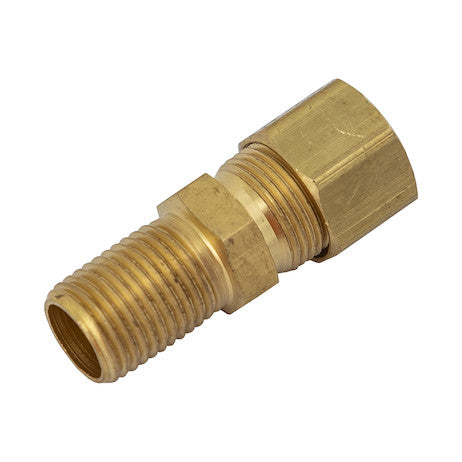
Buyers Products 1/2 Inch-20 Thread Bulkhead Fitting is used to create a thread bulkhead style attachment on the output end of cables with conduit measuring 3/8 in.
Specifications
| FInish | Plain |
| Material | Brass |
| Use WIth | .375 Conduit |
Technical Overview: Buyers Products 1/2 Inch-20 Thread Bulkhead Fitting
The Buyers Products 1/2 Inch-20 Thread Bulkhead Fitting represents a precision-engineered component designed to facilitate robust and secure cable termination within industrial, automotive, and marine applications. This fitting is specifically crafted to establish a bulkhead-style attachment, providing a stable and protected egress point for cables equipped with 3/8-inch conduit. Its design ethos prioritizes durability, ease of integration, and long-term operational reliability, making it an essential element for professional-grade installations.
Fundamental Design and Purpose
A bulkhead fitting, by definition, is a mechanical component engineered to pass a cable, hose, or pipe through a panel or wall, maintaining a sealed and organized connection. The 1/2 Inch-20 Thread Bulkhead Fitting excels in this role by offering a standardized thread size – 1/2 inch with 20 threads per inch (TPI) – which is a common specification for mechanical fastening in numerous sectors. This threading ensures compatibility with a wide array of existing threaded ports and mounting hardware, simplifying installation and replacement processes.
The primary function of this particular fitting is to enable the creation of a secure and isolated pass-through for cables that are protected by a 3/8-inch conduit. The conduit serves as a crucial protective layer, shielding the internal wiring from mechanical abrasion, moisture, chemicals, and other environmental hazards. The bulkhead fitting extends this protection by providing a structured point of exit or entry through an enclosure wall, dashboard, or chassis, ensuring the conduit remains firmly anchored and the cable's integrity is preserved.
Material Science: The Choice of Brass
The selection of brass as the primary material for this bulkhead fitting is a critical engineering decision, reflecting a careful balance of material properties optimized for demanding environments. Brass, an alloy primarily composed of copper and zinc, offers a superior combination of characteristics that are highly advantageous for this application:
- Corrosion Resistance: Brass exhibits excellent resistance to corrosion, particularly in moist or saline environments. This makes the fitting ideal for outdoor applications, marine settings, and industrial environments where exposure to water, humidity, and various chemicals is common. Unlike steel, brass does not readily rust, contributing significantly to the longevity and reliability of the connection.
- Machinability: Brass is highly machinable, allowing for the precise threading and intricate geometries required for a reliable bulkhead fitting. This ease of machining translates into tighter manufacturing tolerances, which are crucial for ensuring a secure and leak-free fit.
- Strength and Durability: While not as strong as some steel alloys, brass offers sufficient mechanical strength to withstand the forces typically encountered in cable management applications, including vibrational stress and moderate torque during installation. Its inherent ductility also helps prevent brittle fracture under stress.
- Electrical Conductivity (Irrelevant for structural but inherent): While this fitting serves a mechanical role rather than an electrical one, the inherent electrical conductivity of brass is a notable characteristic. In scenarios where accidental contact with electrical components might occur, brass does not pose an insulation risk, though proper grounding is always paramount for safety.
- Temperature Stability: Brass maintains its mechanical properties over a wide range of operating temperatures, ensuring the fitting performs consistently in both hot and cold environments without significant degradation or expansion/contraction issues that could compromise the seal.
The "Plain" finish indicates that the brass is left in its natural state after machining, without additional coatings or plating. This choice is often made to leverage the inherent aesthetic and performance benefits of brass directly, avoiding the potential for coating degradation or chipping over time, especially in high-wear areas or environments where chemical resistance is paramount.
Precision Engineering for .375 Conduit Integration
A key specification of this fitting is its compatibility with .375-inch conduit, which translates to 3/8 inch. This precise internal dimension ensures a snug and secure fit for the conduit, preventing slippage or unwanted movement of the cable assembly. The internal design of the fitting would incorporate a retention mechanism, typically a compression gland or a threaded collar, that firmly grips the exterior of the conduit. This mechanism is crucial for:
- Strain Relief: By anchoring the conduit, the fitting provides effective strain relief for the cable. This prevents tension from being directly applied to the electrical terminations inside the equipment, significantly reducing the risk of wire fatigue, breakage, or loosening of connections.
- Environmental Sealing: When properly installed, the fitting forms a barrier against the ingress of dust, moisture, and contaminants into the enclosure. This is particularly important for protecting sensitive electronic components or maintaining the integrity of control systems in harsh environments. The design likely includes provisions for an O-ring or gasket to enhance the seal between the fitting and the mounting panel, as well as between the fitting and the conduit.
- Mechanical Protection: It protects the conduit itself from sharp edges of the bulkhead opening, preventing wear and tear that could compromise the conduit's protective capabilities over time.
The precision in machining the internal diameter for the .375 conduit is paramount. An undersized bore would prevent installation, while an oversized bore would compromise the grip and sealing capabilities. Buyers Products' commitment to precise manufacturing ensures that this critical interface is dimensionally accurate for reliable performance.
Installation and Application Considerations
The installation of the 1/2 Inch-20 Thread Bulkhead Fitting is straightforward, yet requires attention to detail to ensure optimal performance:
- Panel Preparation: A precisely sized hole must be drilled or punched into the mounting panel. For a 1/2 inch-20 thread, the appropriate clearance hole diameter must be selected to allow the threaded portion of the fitting to pass through while leaving sufficient material for the locking nut to seat securely.
- Mounting: The main body of the fitting is inserted through the prepared hole. A locking nut (often supplied with the fitting or readily available due to standard threading) is then threaded onto the fitting from the opposite side of the panel and tightened. Proper torque application is essential; overtightening can strip threads or deform the panel, while undertightening compromises the mechanical stability and seal.
- Conduit Insertion: The 3/8-inch conduit, with the cable routed through it, is then inserted into the designated port of the bulkhead fitting.
- Conduit Retention: Depending on the specific design, a compression nut, collar, or other retention mechanism on the fitting is tightened to securely grip the conduit. This step finalizes the strain relief and sealing functions.
Applications for this type of bulkhead fitting are diverse and span numerous industries:
- Automotive and Heavy Equipment: Ideal for routing control cables, sensor wires, or power cables through vehicle firewalls, dashboards, or chassis components, protecting them from engine heat, road debris, and vibrations.
- Marine Vessels: Essential for passing electrical cables or control lines through bulkheads on boats and ships, providing robust protection against saltwater corrosion and the elements.
- Industrial Machinery: Used in control panels, junction boxes, and machinery enclosures to organize and protect wiring entering and exiting critical components, ensuring operational safety and reliability in factory settings.
- HVAC Systems: For routing electrical and control wiring through equipment housings, protecting against moisture, dust, and temperature fluctuations.
- Outdoor Enclosures: In telecommunications cabinets, security camera housings, or lighting fixtures, where cables need to pass through weatherproof enclosures while maintaining environmental integrity.
Technical Standards and Quality Assurance
While specific industry standards for this exact product might vary, Buyers Products fittings are typically manufactured to meet or exceed general engineering standards for threading (e.g., ANSI/ASME B1.1 for Unified Inch Screw Threads), material composition (e.g., ASTM standards for brass alloys), and dimensional tolerances. This adherence ensures interoperability, consistent performance, and reliability. Quality assurance processes likely include:
- Material Certification: Verification that the brass alloy meets specified compositional requirements.
- Dimensional Inspection: Precise measurements of all critical dimensions, including thread pitch, diameter, and conduit bore, to ensure conformity.
- Thread Gauging: Use of Go/No-Go gauges to confirm thread accuracy and compatibility.
- Visual Inspection: Examination for surface imperfections, burrs, or manufacturing defects.
The robust construction and material choice of the 1/2 Inch-20 Thread Bulkhead Fitting underscore its suitability for professional use where failure is not an option. Its design facilitates efficient and secure cable management, contributing to the overall safety, longevity, and performance of the systems it integrates with. By providing a dependable interface for conduit-protected cables, Buyers Products delivers a component that enhances the resilience and maintainability of complex electrical and control installations.
In summary, the Buyers Products 1/2 Inch-20 Thread Bulkhead Fitting is not merely a piece of hardware but a critical infrastructure component. Its technical specifications—1/2 inch-20 thread, brass material, plain finish, and .375 conduit compatibility—are carefully chosen and engineered to deliver optimal performance in environments demanding robust, corrosion-resistant, and secure cable pass-through solutions. This fitting embodies a commitment to quality and functional excellence, making it an indispensable choice for engineers, technicians, and installers seeking reliable cable management solutions.