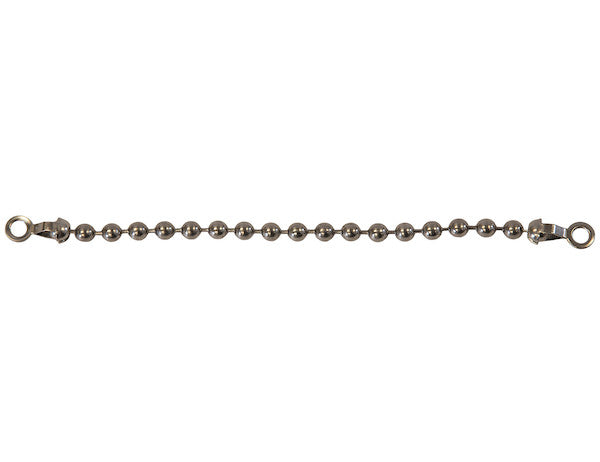
The Buyers Products Chain Kit is a ball-style pull chain ideal for connecting throttle controls to linkages. It has a durable stainless steel construction.
Specifications
| Material | Stainless Steel |
| Use WIth | Throttle Controls |
| Length | 6.000 " |
| FInish | Plain |
Advanced Technical Overview: Buyers Products Stainless Steel Ball-Style Pull Chain Kit for Throttle Controls
The Buyers Products Chain Kit represents a precision-engineered component designed for critical mechanical linkage applications, specifically within throttle control systems. This ball-style pull chain, constructed entirely from high-grade stainless steel, offers a robust and reliable solution for transmitting tensile forces between a throttle control mechanism and its associated linkage. Its design prioritizes durability, corrosion resistance, and consistent performance across a wide range of operational environments.
Material Science and Construction
The selection of stainless steel as the primary material for this chain kit is not arbitrary but a deliberate engineering choice driven by its superior mechanical properties and environmental resilience. Stainless steel, an iron-based alloy containing a minimum of 10.5% chromium, forms a passive layer of chromium oxide on its surface, providing exceptional resistance to rust and corrosion. This characteristic is particularly vital for applications where exposure to moisture, road salts, chemicals, or varying temperatures is common, as is often the case in automotive, marine, agricultural, and industrial throttle control systems.
The specific grade of stainless steel utilized typically falls within the austenitic series (e.g., 304 or 316), known for their excellent strength-to-weight ratio, ductility, and weldability. While the specification indicates "Stainless Steel," further technical details would often clarify the exact alloy. Grade 304 stainless steel offers a balance of corrosion resistance and cost-effectiveness, making it suitable for many general-purpose applications. Grade 316, with its added molybdenum content, provides enhanced resistance to pitting and crevice corrosion, particularly in chloride-rich environments, making it a premium choice for more aggressive conditions.
The manufacturing process for the ball-style chain involves precision stamping and forming of individual components, followed by intricate assembly. Each spherical "ball" element is typically cold-formed from stainless steel wire or sheet, ensuring high dimensional accuracy and surface finish. These balls are then crimped or swaged onto a continuous length of stainless steel wire, forming a series of interconnected beads. This construction method offers several advantages:
- Flexibility: The discrete ball and wire segments allow the chain to articulate smoothly around curves and corners without kinking, facilitating easy routing within confined spaces.
- Tensile Strength: The stainless steel wire provides the primary tensile strength, while the securely fastened balls ensure consistent pitch and prevent elongation under load.
- Reduced Friction: The spherical nature of the balls and the minimal contact points contribute to lower internal friction compared to traditional roller chains, leading to smoother operation and reduced wear.
- Self-Cleaning: The open design of the ball chain can be less prone to accumulating dirt and debris than other chain types, although regular inspection and cleaning are still recommended in harsh environments.
The specified "Plain" finish indicates that the stainless steel has not undergone additional surface treatments like polishing, passivation, or coating. While a plain finish for stainless steel still benefits from the material's inherent corrosion resistance, passivation (a chemical treatment to enhance the chromium oxide layer) could further improve resistance in highly aggressive chemical environments. However, for most throttle control applications, the inherent properties of plain stainless steel are sufficient.
Functional Application: Throttle Control Linkages
The primary function of this chain kit is to establish a reliable mechanical link within a throttle control system. In such systems, the chain transmits the mechanical input from a throttle lever, pedal, or hand control to a carburetor, fuel injection pump, or electronic throttle body. The 6.000-inch length is a critical dimension, suggesting its use in applications where precise, short-distance actuation is required, often as an intermediary link or an extension within a more complex linkage assembly.
Throttle control systems demand high reliability and responsiveness. Any failure in the linkage can result in loss of control over engine RPM, posing significant safety and operational risks. The Buyers Products chain addresses these demands through its robust construction:
- Positive Engagement: The ball-style design ensures a positive and consistent connection, minimizing backlash and play in the throttle response. This is crucial for smooth acceleration and deceleration, particularly in precision control applications.
- Corrosion Resistance in Harsh Environments: Vehicles, heavy equipment, and industrial machinery often operate in conditions exposing linkage components to moisture, dust, dirt, fuels, and lubricants. Stainless steel's resistance to these elements ensures the chain maintains its integrity and functionality over extended periods, preventing seizing or degradation that could impair throttle operation.
- Thermal Stability: Engine compartments and outdoor environments experience significant temperature fluctuations. Stainless steel exhibits excellent thermal stability, resisting expansion, contraction, and material degradation across a wide operational temperature range, ensuring consistent mechanical properties and performance.
- Vibration Resistance: Engines and machinery generate substantial vibration. The flexible nature of the ball chain, coupled with the strength of stainless steel, allows it to withstand these dynamic stresses without premature fatigue or failure, maintaining the integrity of the throttle connection.
Installation typically involves connecting one end of the chain to the throttle control lever or cable and the other end to the throttle body linkage arm. Specialized connectors, often included in a complete kit or sold separately, are used to secure the ball chain ends to the respective components. These connectors are usually designed to mate securely with the ball segments, ensuring a robust and non-slipping attachment.
Technical Specifications and Performance Metrics
While the provided specifications are concise, they highlight key parameters:
- Material: Stainless Steel - As discussed, this dictates the primary mechanical and environmental performance characteristics.
- Use With: Throttle Controls - Defines the intended application context and implies the design considerations for dynamic loading, corrosion, and precision.
- Length: 6.000 " - A critical dimensional specification. In mechanical systems, exact length is often paramount for proper calibration and range of motion. A deviation in length could lead to improper throttle opening/closing, or interference with other components. This precision suggests the chain is intended for specific, possibly constrained, applications where custom cutting is not an option or is undesirable.
- Finish: Plain - Denotes the surface treatment, indicating inherent material properties are relied upon for performance.
Further technical specifications, crucial for a comprehensive engineering assessment, would typically include:
- Tensile Strength (Ultimate and Yield): The maximum force the chain can withstand before breaking (ultimate) or deforming permanently (yield). These values are essential for ensuring the chain can safely transmit the required actuation force from the throttle control without failure.
- Working Load Limit (WLL): A conservative maximum load that the chain should be subjected to in regular operation, usually a fraction (e.g., 1/4 to 1/10) of the ultimate tensile strength, incorporating a safety factor.
- Pitch: The distance between the centers of adjacent balls. This dimension is crucial for compatibility with connectors and ensuring smooth operation.
- Ball Diameter: The diameter of the spherical elements, which influences strength, flexibility, and compatibility with attachment points.
- Wire Diameter: The diameter of the connecting wire, directly impacting the chain's tensile strength.
- Operating Temperature Range: The temperature extremes within which the chain can reliably function without significant degradation of material properties or performance. For stainless steel, this range is typically very wide, often from sub-zero cryogenic temperatures to several hundred degrees Celsius.
- Fatigue Life: The number of load cycles the chain can endure before material fatigue leads to failure. This is particularly important in continuously operated systems where the throttle control is frequently actuated.
- Corrosion Resistance Ratings: Specific data regarding resistance to various chemical agents (e.g., acids, alkalis, salts, fuels) relevant to the intended application environment. ASTM or ISO standards often provide metrics for this.
Maintenance and Longevity
Despite its durable stainless steel construction, regular inspection of the Buyers Products Chain Kit is recommended to ensure optimal performance and longevity, especially in demanding environments. Key inspection points include:
- Visual Integrity: Check for any signs of physical damage, such as bent links, frayed wires, or deformed balls.
- Corrosion: While stainless steel is highly resistant, prolonged exposure to specific aggressive chemicals or high chloride concentrations without proper cleaning can, in rare cases, lead to surface discoloration or pitting.
- Attachment Points: Verify that the chain remains securely fastened to both the throttle control and the linkage. Loose connections can introduce play or lead to disconnection.
- Freedom of Movement: Ensure the chain moves freely without binding or obstruction throughout its intended range of motion. Debris accumulation or damage to adjacent components could impede movement.
Given its "Plain" finish and stainless steel composition, lubrication is generally not required for the chain itself, as the low-friction ball design and inherent material properties prevent significant wear between the ball and wire segments. However, any pivot points or bearings within the broader throttle linkage system should be maintained according to manufacturer specifications.
Conclusion
The Buyers Products Chain Kit is a testament to sound engineering principles applied to a seemingly simple component. Its stainless steel construction, combined with the inherently flexible and robust ball-style design, makes it an exceptionally reliable choice for connecting throttle controls to linkages. The 6.000-inch length and "Plain" finish denote a product designed for straightforward integration into specific mechanical systems where durability, precise actuation, and resistance to environmental degradation are paramount. As a critical component in systems governing engine speed and power output, the technical merits of this chain kit contribute significantly to the safety, efficiency, and longevity of the equipment it serves, solidifying its position as a high-performance solution in its category.