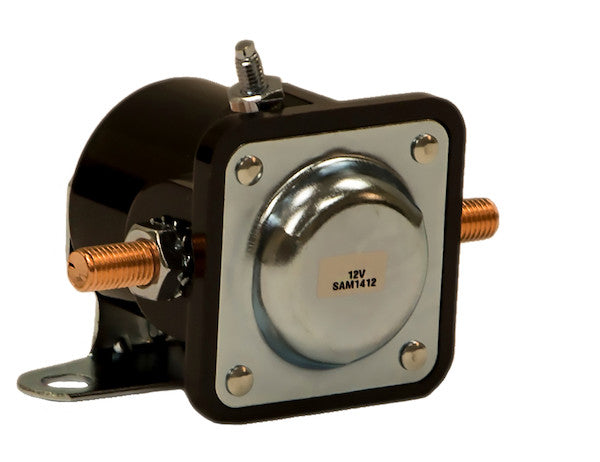
Buyers Products Intermittent Duty 12 Volt Plastic Case Solenoid features low-input, high-output operation ideal for 12V snow plows and lift gates that require heavy duty electric motors. The solenoid is available in a positive 12V-activated or a ground-activated model. Both have threaded terminals and pre-drilled mounting holes that make installation a snap.
Specifications
| Compares To | Meyer 15370/61179, Curtis TPB61A |
|---|---|
| Current Rating | 100 |
| Duty | Intermittent |
| Housing Material | Polymer |
| Mount Style | Right Angle Bracket |
| Number of Terminals | 3 |
| Switch Style | Positive Switched |
Advanced Technical Overview: Buyers Products 12 Volt Intermittent Duty Solenoid
The Buyers Products 12 Volt Plastic Case Insulated Solenoid, engineered for intermittent duty and activated by a +12V signal, represents a critical component in the electrical systems of heavy-duty mobile equipment. This device is meticulously designed to facilitate the low-input, high-output current switching necessary for robust applications such as 12V snow plows and hydraulic lift gates, which inherently demand significant power to operate their heavy-duty electric motors. Its robust construction and precise operational parameters ensure reliable performance in demanding environments, making it an indispensable part of commercial and industrial vehicular electrical architectures.
Fundamentals of Solenoid Operation and Electromagnetism
At its core, a solenoid functions on the principle of electromagnetism, converting electrical energy into mechanical motion to actuate a switch. This particular solenoid is a relay-type device, specifically designed for high-current applications. When a low-current control voltage (in this case, +12V) is applied to the solenoid's coil, it generates a magnetic field. This magnetic field then pulls a ferromagnetic plunger, or armature, into the coil. The movement of this plunger mechanically closes a set of heavy-duty contacts, establishing a connection between a high-current input terminal (typically from the battery) and a high-current output terminal (leading to the motor or load). This effectively allows a low-power control signal to switch a much higher power circuit, providing both control and protection for sensitive control systems.
The insulated plastic casing plays a pivotal role in the solenoid's functionality and safety. By encasing the coil and contact mechanism within a non-conductive polymer, the risk of accidental short circuits is significantly reduced, enhancing electrical safety and preventing potential damage to other electrical components or the operator. Furthermore, the insulation contributes to the solenoid's durability by protecting internal components from environmental contaminants, moisture, and mild corrosive agents, which are commonly encountered in the challenging operational conditions of snow plows and lift gates.
Understanding Intermittent Duty Cycles
The specification of "Intermittent Duty" is crucial for this solenoid's application profile. An intermittent duty cycle implies that the device is designed to operate for relatively short periods, followed by sufficient OFF times to allow for thermal dissipation. This design is optimized for applications where the electrical load, typically a motor, is not continuously energized. For instance, a snow plow's hydraulic pump motor or a lift gate's motor will run only when the plow is being raised/lowered or the gate is articulating. During these operational phases, the motor draws a high current, and the solenoid handles this demand. However, these phases are punctuated by periods of inactivity where the motor, and consequently the solenoid, are disengaged.
Technically, intermittent duty ratings are often characterized by a duty cycle percentage (e.g., 25% or 50% duty cycle over a specific time period, like 5 minutes). This means the solenoid can be ON for a fraction of that period. Operating an intermittent duty solenoid continuously or for durations exceeding its specified ON-time can lead to overheating, coil degradation, contact welding, and ultimately, premature failure. The 100 Amp current rating, coupled with its intermittent duty design, signifies its capability to manage high transient loads effectively, while the polymer housing provides inherent thermal management properties and insulation against heat transfer to adjacent components during its operational phases.
Detailed Electrical Specifications and Their Implications
Voltage Rating: 12 Volts
The 12-volt operating voltage is standard for most automotive, light truck, and many heavy-duty equipment electrical systems. This ubiquitous voltage allows for direct integration into existing vehicle power supplies without the need for voltage converters. The consistency of 12V supply ensures optimal performance of the solenoid's coil, generating the necessary magnetic force to actuate the contacts reliably. Careful attention to system voltage stability is paramount, as significant voltage drops can reduce solenoid efficiency, leading to "chattering" or insufficient contact pressure, which can cause premature contact wear and arcing.
Current Rating: 100 Amperes
A 100 Ampere current rating is a significant indicator of this solenoid's robust capabilities. This high current capacity is specifically engineered to handle the substantial electrical draw of heavy-duty electric motors found in applications like snow plows and hydraulic lift gates. These motors often experience high inrush currents upon activation and sustained high currents during operation under load. The solenoid's contacts are constructed from materials designed to withstand these high current densities and the associated thermal stress, minimizing resistance and heat generation across the contacts. Proper wire gauging for the main power circuits connected to a 100A solenoid is critical; using inadequate wire sizes can lead to excessive voltage drop, overheating, and potential fire hazards.
Switch Style: Positive Switched (+12V To Activate)
This solenoid operates as a "Positive Switched" device, meaning it is activated when a +12V signal is applied to its control terminal. In this configuration, the solenoid's coil has one end connected to the main +12V power supply (or a switched +12V source) and the other end typically connected to a control input that receives a +12V signal for activation. When the control signal provides +12V, a voltage differential across the coil (or specifically, the control side of the coil is connected to ground, and the activation signal applies +12V to the other side) energizes it, leading to actuation. This is a common and straightforward method of control in automotive and heavy equipment applications, often integrated with toggle switches, ignition circuits, or electronic control units (ECUs). Understanding the positive switched logic is essential for correct wiring and preventing misoperation or damage.
Number of Terminals: 3
The presence of three terminals indicates a specific wiring configuration for this solenoid. Typically, these terminals serve the following functions:
- Main Power Input: This terminal connects directly to the positive terminal of the vehicle's 12V battery or a high-current 12V power source, often via a heavy-gauge cable and a fuse/breaker.
- Main Power Output: This terminal connects to the positive terminal of the heavy-duty electric motor or the primary load that the solenoid is intended to energize. This connection also uses heavy-gauge cabling.
- Control/Activation Terminal: This smaller terminal receives the +12V activation signal from a control switch, relay, or ECU. The other side of the coil is typically internally grounded or connected to a dedicated ground terminal.
This three-terminal configuration simplifies installation by clearly delineating the power and control circuits, minimizing the chance of wiring errors and optimizing electrical flow.
Material Science: Polymer Housing and Insulation
The choice of "Polymer" as the housing material is a deliberate engineering decision that offers several distinct advantages over traditional metallic housings for this application. Polymers, specifically engineered thermoplastics, provide excellent electrical insulation properties. This is critical in preventing stray currents, accidental grounding, and short circuits, particularly in environments where moisture or conductive contaminants might be present. The non-conductive nature of the polymer case inherently enhances safety by isolating the live electrical components from the external environment and potential contact points.
Beyond electrical insulation, polymer housings offer superior resistance to corrosion compared to many metals. Exposure to road salts, de-icing chemicals, moisture, and other corrosive agents is a constant challenge for equipment like snow plows. The polymer material is chemically inert to many common corrosives, ensuring the solenoid's structural integrity and aesthetic appearance are maintained over extended periods in harsh conditions. Additionally, polymers are generally lighter than metallic alternatives, contributing to overall weight reduction in the vehicle. They can also offer better vibration dampening characteristics, which helps to protect the internal electrical and mechanical components from fatigue caused by constant operational vibrations in heavy equipment.
Mechanical Design: Right Angle Bracket Mount Style
The "Right Angle Bracket" mount style significantly enhances the versatility and ease of installation for this solenoid. This design typically features an integral mounting flange or bracket that allows the solenoid to be securely fastened to a chassis, frame, or equipment housing at a 90-degree angle relative to its main body. This orientation often optimizes space utilization in crowded engine compartments or equipment bays, allowing for more flexible positioning to accommodate cabling and other components. The pre-drilled mounting holes facilitate a quick and precise installation, ensuring a stable and vibration-resistant attachment. A secure mount is paramount in mobile applications to prevent physical damage to the solenoid, ensure reliable electrical connections, and mitigate stress on wiring terminals due to movement.
Application-Specific Advantages for Snow Plows and Lift Gates
The Buyers Products 12 Volt Intermittent Duty Solenoid is specifically tailored for the arduous demands of 12V snow plows and lift gates. In these applications, electric motors are responsible for critical functions such as raising and lowering plow blades, angling them, or articulating lift gate platforms. These operations require instantaneous delivery of high current to the motor to overcome significant mechanical loads.
For snow plows, the solenoid enables efficient control of hydraulic pump motors, which are activated intermittently for precise blade positioning. The ability to handle 100 Amps ensures that even under heavy loads (e.g., dense snow, frozen conditions), the motor receives adequate power. For lift gates, the solenoid facilitates the controlled operation of the hydraulic pump motor, ensuring smooth and reliable lifting and lowering of cargo. The intermittent duty rating perfectly matches the operational cycles of these systems, providing peak power when needed and allowing for cooling during inactive periods, thus extending the solenoid's service life.
The insulated plastic case is particularly beneficial in these environments. Snow plows operate in extreme cold, often exposed to road salts and moisture, which can quickly degrade metallic components and compromise electrical integrity. The polymer housing provides superior protection against these corrosive elements and acts as an additional layer of insulation against temperature extremes. Similarly, lift gates, often exposed to weather and washdowns, benefit from the solenoid's environmental resistance and robust design.
Installation Best Practices and Maintenance Considerations
The design of this solenoid, featuring threaded terminals and pre-drilled mounting holes, simplifies the installation process. For optimal performance and longevity, several best practices should be observed:
- Secure Mounting: Utilize all pre-drilled mounting holes with appropriate fasteners to ensure the solenoid is firmly affixed, minimizing vibration and movement that could lead to wiring stress or internal component damage.
- Proper Wiring: Always use wire gauges that are appropriate for the 100 Amp current rating of the main power circuits. Undersized wires will lead to voltage drop and generate excessive heat. Ensure all terminal connections are clean, corrosion-free, and torqued to the manufacturer's specifications to prevent loose connections, arcing, and heat buildup. Dielectric grease can be applied to terminals to further enhance corrosion protection.
- Fuse/Circuit Breaker Protection: Integrate appropriate fusing or circuit breakers on the main power input line to protect the circuit and the solenoid from overcurrent conditions or short circuits.
- Control Circuit Integrity: Ensure the +12V activation signal is clean and stable. Intermittent or weak control signals can cause solenoid "chattering," leading to accelerated contact wear.
- Environmental Placement: While the polymer housing offers excellent environmental resistance, mounting the solenoid in a location that provides some protection from direct, prolonged exposure to extreme moisture, impact, or excessive heat sources (e.g., exhaust manifolds) can further extend its operational lifespan.
Routine inspection for corrosion at terminals, wire integrity, and mounting security can help identify potential issues before they lead to operational failure, thereby ensuring consistent and reliable performance.
OEM Compatibility and Value Proposition
The compatibility with OEM part numbers such as Meyer 15370/61179 and Curtis TPB61A underscores this solenoid's adherence to industry standards and its viability as a direct replacement or upgrade for a wide range of existing equipment. This cross-compatibility offers significant advantages for maintenance professionals and fleet managers, simplifying parts procurement and ensuring seamless integration into diverse machinery fleets.
In conclusion, the Buyers Products 12 Volt Plastic Case Insulated Solenoid for Intermittent Duty, with its +12V activation, is a meticulously engineered electrical component designed for high-current, demanding applications. Its combination of robust 100 Amp capacity, polymer housing for insulation and corrosion resistance, intermittent duty cycle optimization, and straightforward installation makes it an exceptionally reliable and cost-effective solution for ensuring the efficient and safe operation of 12V snow plows, lift gates, and similar heavy-duty mobile equipment. This solenoid exemplifies advanced design principles aimed at maximizing performance and durability in the most challenging operational environments.