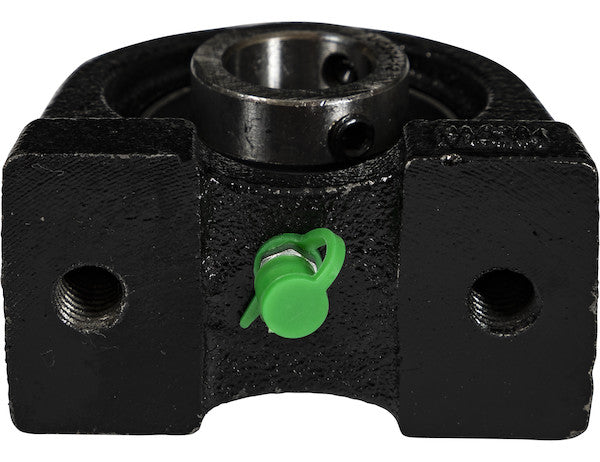
Specifications
| Bearing Insert Material | Carbon Steel |
|---|---|
| Bearing Insert Type | Self Aligning |
| Bore Diameter | 0.750 |
| Greasable (y/n) | Yes |
| Housing Finish | Powder-Coat |
| Housing Material | Cast Iron |
| Locking Type | - |
The Replacement 3/4 Inch Pillow Block Spinner Bearing with Tap Base represents a meticulously engineered solution for supporting rotating shafts in a multitude of industrial, agricultural, and general machinery applications. This robust unit is designed to provide stable, low-friction operation, ensuring the longevity and efficiency of your mechanical systems. Integrating a high-performance self-aligning carbon steel bearing insert within a durable cast iron housing, further protected by a resilient powder-coat finish, this component is built for demanding environments and sustained operational integrity. Its greasable design and precise 0.750-inch bore diameter underscore its utility as a reliable replacement part or as a critical component in new equipment design.
Pillow block bearings, fundamentally, are mounted bearings that serve as supports for rotating shafts, providing a housing for a bearing insert that allows for radial and sometimes limited axial motion. Their design typically encompasses a solid housing, often split or unsplit, with mounting bolt holes to securely fasten the unit to a flat surface. This particular unit distinguishes itself with a "tap base," implying pre-tapped holes for simplified and highly secure mounting, which eliminates the need for through-bolting and nuts from the underside, often simplifying installation in constrained spaces or enhancing assembly speed. The inherent advantages of pillow block bearings over unmounted counterparts include superior protection against contaminants, enhanced lubrication retention, and ease of replacement, all contributing to extended operational lifecycles and reduced maintenance downtime.
The designation "Spinner Bearing" implies an application where the bearing is subjected to continuous rotation, often at moderate to high speeds, and where rotational stability and efficiency are paramount. Such bearings are commonly found in equipment like agricultural processing machinery, agitators, mixers, conveying systems, or specialized textile machinery where a consistent spinning motion is vital. In these applications, the bearing must not only support the radial loads imposed by the rotating shaft but also maintain precise alignment and minimal friction to prevent energy loss and premature wear. The design elements of this particular pillow block bearing – specifically its self-aligning insert, durable materials, and effective lubrication system – are perfectly suited to meet these demanding operational criteria.
A detailed technical examination of the specifications reveals the careful consideration given to performance and durability. The **Bore Diameter of 0.750 inches** signifies a standard imperial shaft size, making this bearing compatible with a vast array of existing industrial and agricultural equipment. Precision in bore diameter is critical for ensuring a snug fit with the shaft, minimizing any potential for fretting corrosion or eccentric motion that could lead to vibration and premature failure. This common size also facilitates ease of sourcing replacement shafts or integrating the bearing into standard machine designs. The precise fit ensures optimal load distribution, preventing localized stress concentrations on the shaft or the inner ring of the bearing.
The choice of **Carbon Steel for the Bearing Insert Material** is a strategic decision balancing cost-effectiveness with robust mechanical performance. Carbon steel is renowned for its high tensile strength, good hardness, and excellent wear resistance when properly heat-treated. These properties are fundamental for bearing applications, enabling the insert to withstand the rolling and sliding contact stresses inherent in rotational motion. While advanced alloy steels might offer superior performance in extreme environments, carbon steel provides an optimal balance for general industrial and agricultural applications, delivering reliable service under moderate loads and speeds. Its inherent strength ensures the bearing races can endure the repetitive stress cycles without undergoing plastic deformation, contributing significantly to the bearing's overall fatigue life. Proper lubrication, as ensured by the "Greasable" feature, is crucial for carbon steel inserts to prevent surface corrosion and maintain optimal performance over time.
The **Self-Aligning Bearing Insert Type** is a critical feature that significantly enhances the reliability and operational lifespan of the unit. This design incorporates a spherical outer surface on the bearing insert, which allows it to pivot freely within the correspondingly spherical inner bore of the cast iron housing. The primary benefit of this self-aligning capability is its ability to compensate for initial static or dynamic angular misalignments that may arise from manufacturing tolerances in machinery frames, shaft deflection under load, or inaccuracies during installation. By allowing the bearing to adjust its angle relative to the shaft, it ensures that loads are distributed evenly across the rolling elements (balls or rollers), rather than concentrating stress on one side. This even load distribution prevents localized wear, reduces internal friction and heat generation, and drastically minimizes the risk of premature bearing failure that often results from misalignment. This feature is particularly valuable in applications where precise alignment is difficult to achieve or maintain, such as in agricultural machinery operating on uneven terrain or in long conveyor systems where shaft deflection is common.
The specification **Greasable (Yes)** is an indication of the bearing's commitment to extendable service life and ease of maintenance. The presence of a grease fitting (typically a Zerk fitting) allows for periodic re-lubrication of the bearing. Lubrication is paramount in any rolling element bearing as it serves multiple vital functions: it reduces friction between the rolling elements and raceways, dissipates heat generated during operation, prevents wear by forming a protective film, and guards against corrosion of the internal components. Regular replenishment of grease flushes out contaminants, maintains optimal viscosity, and refreshes the protective properties of the lubricant. Adhering to a proper lubrication schedule, using the recommended type and quantity of grease, is directly correlated with maximizing the bearing's operational life, reducing energy consumption, and minimizing unexpected downtime due to bearing failure.
The **Housing Finish: Powder-Coat** speaks to the durability and protective qualities of the external structure. Powder coating is a highly effective finishing process where dry powder is electrostatically applied to the cast iron housing and then cured under heat. This process creates a uniform, hard, and resilient finish that offers several advantages over traditional liquid paint applications. Foremost among these is superior corrosion resistance, forming a robust barrier against moisture, chemicals, UV radiation, and other environmental aggressors. This is particularly important in outdoor applications, agricultural settings, or industrial environments where exposure to harsh conditions is common. Additionally, powder coating provides excellent resistance to chipping, scratching, and abrasion, maintaining the aesthetic integrity and protective capabilities of the housing even under mechanical stress. The durable finish contributes significantly to the overall longevity of the pillow block unit, reducing the need for premature replacement due to external degradation.
The choice of **Cast Iron for the Housing Material** underscores the product's commitment to robustness and performance stability. Cast iron is a widely favored material for bearing housings due to its unique combination of mechanical properties. It possesses high compressive strength, providing a rigid and stable foundation for the bearing insert, which is essential for maintaining precise alignment under dynamic loads. Critically, cast iron exhibits excellent vibration damping characteristics. This means it can effectively absorb and dissipate operational vibrations generated by the rotating shaft and bearing, leading to smoother, quieter running machinery and reduced stress on adjacent components. Its good thermal conductivity also aids in dissipating heat generated by the bearing, contributing to cooler operation and extended lubricant life. Furthermore, cast iron is cost-effective and relatively easy to cast into complex shapes, making it an ideal choice for durable and high-volume component manufacturing. The inherent weight of cast iron also contributes to the stability of the mounted unit, further enhancing its vibration damping capabilities.
The inclusion of a **Tap Base** on this pillow block bearing significantly streamlines the installation process and enhances the overall stability of the mounted unit. A tap base typically refers to a housing design where the mounting holes are pre-tapped, meaning they contain internal threads. This design eliminates the requirement for through-holes and the use of separate nuts on the underside of the mounting surface. Instead, bolts can be directly threaded into the housing itself, securely fastening the bearing unit to the machine frame or support structure. This feature is particularly advantageous in applications where access to the underside of the mounting surface is restricted, making installation faster, simpler, and more efficient. The direct bolting mechanism into the sturdy cast iron base ensures a very firm and vibration-resistant connection, which is crucial for maintaining shaft alignment and reducing operational noise and wear over time. It also contributes to a cleaner, more compact installation footprint.
While the **Locking Type** is specified as "-", it is crucial to discuss the general principles of shaft retention for optimal bearing performance. In pillow block bearings, securing the bearing inner ring firmly to the shaft is paramount to prevent relative motion, which could lead to fretting corrosion, wear, and ultimately, premature bearing failure. Common methods for locking a bearing to a shaft include set screw locking, eccentric locking collars, or adapter sleeves. Although a specific type is not detailed for this product, proper installation involves ensuring that the shaft is securely integrated with the inner ring to prevent any slip or creep. For a self-aligning bearing, maintaining concentricity and preventing shaft walk are key to harnessing its full benefits. Users should ensure that their mounting practices adequately secure the 0.750-inch shaft within the bearing, applying appropriate torque and checking for stability during initial operation.
Effective installation, operation, and maintenance are crucial for maximizing the service life and performance of this replacement pillow block spinner bearing. Prior to installation, it is essential to inspect the shaft for any burrs, damage, or excessive wear, and to ensure the mounting surface is clean, flat, and rigid. During installation, the bearing should be securely bolted down via its tap base, ensuring even torque distribution to prevent housing distortion. The shaft should be inserted smoothly, and if an internal locking mechanism is present (even if not explicitly listed as a "type"), it should be engaged according to standard practices to ensure a firm, concentric fit. Regular re-lubrication through the greasable fitting is vital, following manufacturer recommendations for grease type and frequency, which depend on operating conditions such as speed, load, and environmental factors. Periodic monitoring for unusual noise, vibration, or excessive heat can provide early indicators of potential issues, allowing for proactive maintenance and preventing catastrophic failure. Proper storage of spare units in a clean, dry environment will also ensure their readiness for use.
The applications for this 3/4 inch pillow block spinner bearing are extensive and varied. In **agricultural machinery**, it can be found in components of grain conveyors, balers, small tillers, and specialized harvesting equipment where robust, self-aligning support for rotating shafts is essential to handle dynamic loads and environmental contaminants. Within **material handling systems**, it is ideal for small conveyor rollers, idler pulleys, and various packaging and sorting machinery. Its durability and powder-coat finish make it suitable for general **industrial machinery**, including drive shafts, tensioners, and support rollers in manufacturing lines. Even in smaller-scale **food processing equipment** (with appropriate food-grade lubricants), it can provide reliable service. The combination of its precise bore, self-aligning capability, and durable construction also makes it a strong candidate for **DIY projects, custom machinery builds, and specialized hobbyist equipment** that demands industrial-grade reliability.
In summary, the Replacement 3/4 Inch Pillow Block Spinner Bearing with Tap Base offers a compelling value proposition rooted in its meticulously chosen specifications and design features. Its **enhanced durability** is guaranteed by the robust cast iron housing and the superior protective qualities of the powder-coat finish. **Reliable performance** is delivered through the high-strength carbon steel bearing insert, critically complemented by the self-aligning feature that accommodates misalignment and extends operational life. **Ease of maintenance** is facilitated by the greasable design, allowing for simple and effective lubrication. **Simplified installation** is a key benefit of the tap base, reducing assembly time and complexity. Furthermore, its **versatility** with a standard 0.750-inch bore diameter ensures broad compatibility across a myriad of applications. This bearing is not merely a component; it is an investment in the sustained efficiency, stability, and longevity of the machinery it serves. It stands as an ideal replacement part for worn units or as an optimal choice for original equipment where dependable, low-maintenance rotational support is a prerequisite, offering a balanced blend of technical excellence and practical utility for demanding operational environments.