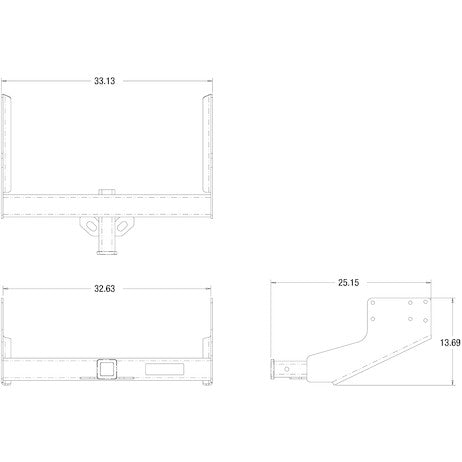
Class 4 Hitch Receiver for Ford Transit Cutaway Cab & Chassis from Buyers Products will handle loads up to 8,000 lbs (MGTW) and 800 lbs (MVL). They feature a corrosion-resistant black powder-coated finish for long life. Hitch receivers are available for Ford Transit cutaway cab & chassis. Mounting hardware is included. The receiver accept 2 in. hitches and accessories.
Specifications
| Application Summary | Ford?? Transit Cutaway Cab & Chassis |
|---|---|
| Class | Class IV |
| Color | Black |
| Depth (in.) | 25 |
| Finish | Powder-Coat |
| Height (in.) | 14 |
| M.G.T.W. (lbs.) | 7,500 |
| M.V.L. (lbs.) | 750 |
| Make | Ford?? |
| Material | Carbon Steel |
| Model | Transit |
| Mount Type | Bolt-On |
| Receiver Tube Size (in.) | 2.00 |
| Style | Cutaway Cab & Chassis |
| Width (in.) | 33.13 |
Advanced Technical Overview: Class 4 Hitch Receiver for Ford Transit Cutaway Cab & Chassis
This comprehensive technical overview delves into the engineering, functionality, and operational benefits of the Class IV Hitch Receiver specifically designed for the Ford Transit Cutaway Cab & Chassis. Manufactured by Buyers Products, this heavy-duty towing solution is engineered to meet the rigorous demands of commercial and specialized applications, providing a robust interface for a wide range of towing and hauling tasks. With an impressive Maximum Gross Trailer Weight (MGTW) capacity of 7,500 lbs and a Maximum Vertical Load (MVL), commonly referred to as tongue weight, of 750 lbs, this Class IV receiver stands as a testament to durability and reliability. Its meticulous design, integrating high-strength carbon steel with a superior black powder-coated finish, ensures not only exceptional performance but also an extended service life in challenging environmental conditions.
Class IV Rating: A Benchmark for Heavy-Duty Towing
The classification of this hitch receiver as Class IV signifies its capability to handle substantial towing loads, adhering to the stringent guidelines set forth by the Society of Automotive Engineers (SAE) J684 standard for trailer hitches. A Class IV hitch is designed for heavy-duty applications, bridging the gap between medium-duty tasks and the most extreme commercial towing requirements. The MGTW of 7,500 lbs indicates the maximum allowable weight of the fully loaded trailer, including its cargo. Simultaneously, the MVL of 750 lbs represents the maximum downward force that the trailer's tongue can exert on the hitch receiver. Adherence to these specifications is paramount for safe and efficient towing, preventing overloading of the vehicle's chassis, suspension, and braking systems. The Class IV designation ensures that the structural integrity of the hitch receiver, its mounting points, and the materials used are all engineered to withstand the dynamic forces encountered during heavy-duty towing, including acceleration, braking, cornering, and potential road irregularities.
Precision Engineering and Material Science: Carbon Steel Construction
The foundation of this hitch receiver's strength and longevity lies in its material composition: high-strength carbon steel. Carbon steel is selected for its superior mechanical properties, including high tensile strength, yield strength, and inherent toughness, which are critical for components subjected to significant stress and dynamic loads. The specific grade of carbon steel used is chosen to provide an optimal balance between strength and ductility, ensuring the hitch can deform slightly under extreme conditions without catastrophic failure. The manufacturing process involves precision cutting, forming, and welding techniques, typically utilizing advanced robotic or highly skilled manual welding (e.g., MIG or TIG welding) to create strong, consistent, and defect-free joints. These robust welds are essential for distributing towing forces evenly across the hitch structure and into the vehicle's frame. The structural design of the receiver tube and mounting plates is optimized through finite element analysis (FEA) to identify and mitigate stress concentrations, thereby enhancing overall durability and safety margins.
Corrosion Protection: The Black Powder-Coat Finish
Longevity in harsh operating environments is a critical requirement for trailer hitches. This Class IV receiver features a premium black powder-coated finish, a sophisticated coating technology that far surpasses conventional paint applications in terms of durability and corrosion resistance. The powder coating process involves electrostatically applying a dry powder, typically a thermoset polymer, to the precisely cleaned carbon steel substrate. The charged powder particles adhere to the grounded metal surface, after which the entire assembly is cured in a high-temperature oven. During curing, the powder melts and flows to form a smooth, continuous, and highly uniform coating that bonds securely to the metal. This process creates a resilient barrier against external aggressors such as moisture, road salts, chemicals, UV radiation, and abrasive impacts from road debris. The black finish provides not only superior protection but also a professional aesthetic that complements the vehicle's appearance. This robust protective layer significantly extends the operational life of the hitch, minimizing maintenance requirements and preserving its structural integrity over years of service.
Tailored Integration: Ford Transit Cutaway Cab & Chassis Specificity
A key attribute of this Class IV hitch receiver is its precise engineering for the Ford Transit Cutaway Cab & Chassis platform. Unlike generic hitches, a custom-fit solution ensures seamless integration with the vehicle's unique frame architecture. The Ford Transit Cutaway Cab & Chassis is a versatile platform, frequently utilized for vocational upfits such as utility trucks, delivery vehicles, service bodies, shuttle buses, and recreational vehicle (RV) conversions. These applications often demand significant towing capabilities. The design of this hitch accounts for the specific frame rail dimensions, mounting points, and chassis clearances of the Transit Cutaway, ensuring a perfect bolt-on fit without the need for drilling, welding, or modifications to the vehicle's frame. This bespoke fitment is crucial for maintaining the vehicle's structural integrity, warranty, and adherence to safety standards. The dimensions of the hitch – 25 inches in depth, 14 inches in height, and 33.13 inches in width – are carefully calibrated to align with the vehicle's undercarriage geometry, providing optimal ground clearance while positioning the receiver tube effectively for various trailer setups.
Standardized Connectivity: The 2-Inch Receiver Tube
The inclusion of a 2.00-inch receiver tube is a fundamental design choice that aligns with industry standards, offering unparalleled versatility and compatibility. The 2-inch square receiver opening is the most common size for Class III and Class IV hitches in North America, allowing for seamless integration with a vast array of towing accessories. This standardization means that users can readily connect various types of ball mounts (fixed or adjustable drop/rise), weight distribution hitches, pintle hooks, cargo carriers, bike racks, and other utility attachments without requiring specialized adapters. This universal compatibility enhances the functionality of the Ford Transit Cutaway Cab & Chassis, transforming it into a highly adaptable workhorse for both commercial operations and recreational pursuits. The precision of the 2-inch opening ensures a snug fit for accessories, minimizing movement and play, which contributes to safer and more stable towing dynamics.
Simplified Installation: Bolt-On Design and Included Hardware
The design philosophy behind this hitch receiver prioritizes ease and security of installation. As a bolt-on type, it eliminates the complexities, equipment, and potential structural weakening associated with welding a hitch to the vehicle's frame. Bolt-on installations are favored for their reversibility, precision, and adherence to manufacturer specifications. Each unit is supplied with all necessary mounting hardware, a significant advantage for installers. This complete hardware kit typically includes application-specific bolts, washers, and nuts, all engineered to match the strength requirements of the hitch and the vehicle's frame. The inclusion of hardware ensures that the correct grade and type of fasteners are used, critical for achieving the specified torque values and maintaining the integrity of the connection. This "ready-to-install" approach streamlines the installation process, reduces labor time, and provides peace of mind that the hitch is mounted securely and correctly, minimizing potential for installation errors and maximizing operational safety.
Operational Considerations and Safety Protocols
Operating a vehicle with a Class IV hitch receiver requires adherence to specific safety protocols and an understanding of dynamic towing principles. Exceeding the specified MGTW of 7,500 lbs or MVL of 750 lbs can lead to severe safety risks, including compromised vehicle handling, extended braking distances, tire failure, and potential structural damage to both the vehicle and the trailer. It is imperative that users perform pre-tow inspections, ensuring that the trailer is properly loaded with adequate tongue weight (typically 10-15% of the MGTW), that safety chains are correctly attached, and that all lighting and braking systems are functional. For trailers exceeding a certain weight threshold (often 3,000 lbs in many jurisdictions), supplemental trailer brakes and a compatible brake controller are legally mandated and crucial for safe operation. Weight distribution systems, while not always strictly necessary within the MVL limits, can further enhance stability and restore optimal vehicle leveling, particularly with heavier loads. Regular inspection of the hitch receiver itself—checking for signs of wear, rust, cracks, or loose fasteners—is also vital for ensuring continued safe operation throughout its service life.
Versatile Applications and Enhanced Productivity
The integration of this Class IV hitch receiver significantly broadens the functional capabilities of the Ford Transit Cutaway Cab & Chassis across numerous sectors. For commercial enterprises, it facilitates the towing of heavy equipment trailers, construction materials, landscape trailers, generators, and mobile workshops, thereby increasing operational efficiency and reducing the need for specialized transport vehicles. Delivery and logistics companies can utilize it for additional cargo capacity through utility trailers. For those in specialized trades, it allows for the transportation of specific tools, machinery, and supplies directly to job sites. In the realm of recreational vehicle conversions, it provides the essential foundation for towing auxiliary vehicles, cargo trailers for extended trips, or even small boat trailers. This versatility directly translates into enhanced productivity, expanded service offerings, and greater return on investment for vehicle owners.
Maintenance and Longevity Maximization
While engineered for robustness, consistent performance and maximum longevity of the Class IV hitch receiver are best ensured through a routine maintenance regimen. The powder-coated finish, while highly durable, should be periodically cleaned to remove accumulated dirt, salt, and grime, which can, over time, degrade its protective qualities. Mild soap and water are generally sufficient for cleaning. Any areas where the powder coat may have been chipped or scratched due to severe impact should be touched up promptly with a suitable corrosion-inhibiting paint to prevent localized rust formation. Furthermore, all bolts and fasteners should be inspected at regular intervals, especially after demanding towing operations, to confirm they remain torqued to specifications. The receiver tube itself should be kept clean of debris, and a light application of grease or anti-seize compound on the inside surface of the receiver can facilitate easier insertion and removal of hitch accessories and prevent galvanic corrosion between dissimilar metals. Addressing any signs of wear, distortion, or damage promptly will extend the life of the hitch and maintain its operational safety.
Conclusion: An Indispensable Asset for Ford Transit Cutaway Operations
In summary, the Class IV Hitch Receiver for the Ford Transit Cutaway Cab & Chassis from Buyers Products represents a pinnacle of engineering excellence, delivering unparalleled strength, durability, and functional versatility. Its robust carbon steel construction, fortified with a corrosion-resistant black powder-coat finish, ensures maximum longevity and performance in the most demanding commercial and vocational applications. With a certified MGTW of 7,500 lbs and an MVL of 750 lbs, it provides the formidable towing capacity required for substantial loads, while the standard 2-inch receiver tube guarantees broad compatibility with a multitude of towing accessories. The meticulously engineered bolt-on design, complete with all necessary mounting hardware, simplifies installation and assures a precise, secure fit specific to the Ford Transit platform. This product is not merely an accessory; it is an indispensable asset that significantly expands the operational capabilities, efficiency, and safety profile of the Ford Transit Cutaway Cab & Chassis, making it an essential investment for professionals and enthusiasts seeking maximum utility from their vehicle.