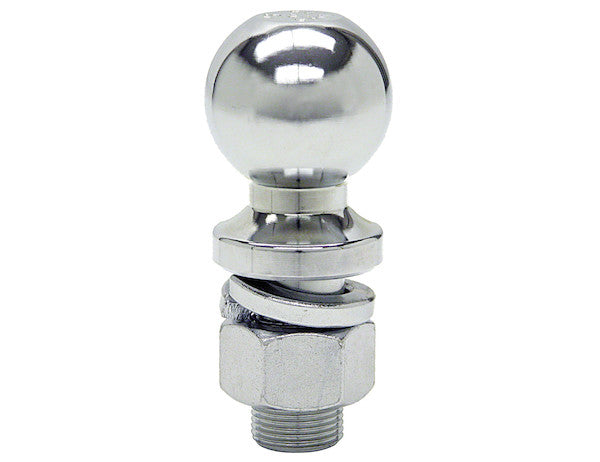
Chrome Hitch Balls from Buyers Products are available in all standard sizes to handle virtually any towing application. All hitch balls feature wear-resistant chrome plating for durability and style. They are packaged individually.
Specifications
| Ball Diameter (in.) | 2 |
|---|---|
| Ball Finish | Chrome |
| M.G.T.W. (lbs) | 3,500 |
| Material | Carbon Steel |
| Shank Diameter (in.) | 0.75 |
| Shank Length (in.) | 2.125 |
Advanced Technical Overview: Buyers Products 2-Inch Chrome Hitch Ball
The Buyers Products 2-inch Chrome Hitch Ball, featuring a 3/4-inch shank diameter and 2-1/8-inch length, represents a meticulously engineered and robustly constructed component essential for secure and reliable trailer towing systems. As a critical interface between the tow vehicle and the trailer coupler, its design specifications—including ball diameter, shank dimensions, material composition, and maximum gross trailer weight (M.G.T.W.)—are paramount to ensuring towing safety, stability, and optimal performance across a wide array of light to medium-duty applications. Buyers Products is recognized for its commitment to manufacturing high-quality towing hardware, guaranteeing that each hitch ball adheres to stringent industry standards and offers exceptional wear resistance and aesthetic appeal through its durable chrome plating. This comprehensive technical analysis will explore the specific attributes of this hitch ball, elucidating the engineering principles, material science, installation protocols, and safety considerations that define its functionality and reliability.
Detailed Specifications Analysis: Precision Engineering for Towing Excellence
Ball Diameter (2 inches): The Kinematic Interface
The 2-inch ball diameter is a widely adopted standard for hitch balls in North America, primarily utilized for Class I, II, and many Class III towing applications. This dimension is critical for establishing precise compatibility with the trailer coupler. A precisely manufactured 2-inch ball ensures an optimal, secure fit within a correspondingly sized coupler, effectively minimizing detrimental play and mitigating premature wear on both components. Deviations from this standard can lead to precarious towing conditions, including excessive movement, accelerated wear, or, in extreme cases, complete disconnection. The spherical geometry of the ball facilitates multi-directional articulation, allowing the trailer to pivot relative to the tow vehicle during turns, over uneven terrain, and during vertical displacement, all while maintaining a steadfast mechanical connection. Industry standards, such as those promulgated by SAE J684, define the performance requirements for hitch balls and couplers, thereby ensuring broad interoperability and safety across different manufacturers. For a 3,500 lbs M.G.T.W. rating, the 2-inch ball provides ample surface area to distribute the complex forces exerted by the trailer, preventing localized stress concentrations that could precipitate material fatigue or structural failure.
Shank Diameter (3/4 inch or 0.75 inches): The Structural Anchor
The shank is the cylindrical, threaded portion of the hitch ball that extends through the ball mount or drawbar, functioning as the primary anchoring point. A shank diameter of 3/4 inch (0.75 inches) is specifically engineered to fit snugly into ball mount holes of identical dimension. This precise fit is indispensable for maintaining stability and efficient load transfer. An undersized shank within an oversized hole would result in a loose connection, leading to dynamic shock loads, accelerated wear on both the shank and the ball mount, and potential structural fatigue. Conversely, an oversized shank would simply be incompatible. The robust diameter of the shank ensures its capacity to withstand the substantial shear forces and bending moments generated during vehicle acceleration, braking maneuvers, and turning. The threaded portion of the shank is meticulously designed to engage securely with the retaining nut, distributing the clamping force uniformly across the ball mount and preventing undesirable rotation or dislodgment of the ball. The integrity of the shank is unequivocally fundamental to the overall strength rating of the entire towing assembly.
Shank Length (2-1/8 inches or 2.125 inches): Ensuring Secure Engagement
A shank length of 2-1/8 inches is precisely engineered to accommodate a diverse range of ball mount thicknesses while providing ample thread engagement for the retaining nut. Proper shank length is critical for two principal reasons: 1) Sufficient Thread Engagement: It guarantees that the retaining nut can be fully threaded onto the shank, engaging a sufficient number of threads to achieve the specified torque values and prevent stripping under operational loads. Insufficient thread engagement drastically diminishes the clamping force and the overall structural integrity of the connection. 2) Clearance: It ensures adequate protrusion beyond the ball mount for the proper placement of the washer and nut, facilitating correct tightening with standard wrenches or calibrated torque tools without mechanical interference. This specific length also accounts for potential design variations in different ball mounts. The engineering of this precise length carefully balances the necessity for robust attachment across varied ball mount thicknesses with the practical considerations of installation ease and component fitment. An excessively long shank might protrude unnecessarily, whereas an inadequate length compromises fundamental safety.
Maximum Gross Trailer Weight (M.G.T.W. - 3,500 lbs): Defining Capability
The M.G.T.W. of 3,500 pounds is a paramount performance metric, signifying the maximum permissible weight of a fully loaded trailer that this hitch ball is engineered to safely tow. This rating encompasses the weight of the trailer itself plus all its cargo. It is absolutely imperative that the actual gross trailer weight never exceeds this specified limit, as doing so can lead to catastrophic failure of the hitch ball or other critical components within the towing system, potentially resulting in loss of control, severe accidents, and extensive damage. The 3,500 lbs rating typically classifies this hitch ball for light-to-medium duty applications, encompassing: small utility trailers, jet ski or personal watercraft trailers, small single-axle boat trailers, pop-up campers, lightweight enclosed cargo trailers, and some smaller recreational vehicles. When selecting a hitch ball, it is crucial to ensure that its M.G.T.W. rating meets or exceeds the M.G.T.W. of the trailer to be towed. Furthermore, the hitch ball's rating must also be compatible with, and must not exceed, the lowest weight rating of any other component in the towing chain, including the hitch receiver, ball mount, and the tow vehicle's overall stated towing capacity. This layered consideration ensures that the entire system operates well within safe design parameters, rigorously adhering to the "weakest link" principle.
Material (Carbon Steel): The Foundation of Strength
This hitch ball is precision-fabricated, typically through forging or machining, from high-grade carbon steel, a material specifically selected for its exceptional mechanical properties indispensable for demanding towing applications. Carbon steel provides a superior balance of tensile strength, yield strength, and ductility. Tensile strength refers to its ability to withstand pulling forces without fracturing, which is vital as the hitch ball experiences constant tensile loads from the trailer. Yield strength signifies its resistance to permanent deformation, ensuring the hitch ball retains its original shape under typical towing loads to maintain a secure connection. Ductility, while not desired under normal operating conditions, offers a crucial margin of safety against brittle failure under extreme, unexpected shock loads. The specific grade of carbon steel employed is meticulously chosen to impart optimal hardness and toughness, thereby ensuring robust resistance to wear, impact, and fatigue. The manufacturing process often involves forging, which refines the grain structure of the steel, significantly enhancing its strength and durability by aligning the material flow along the axis of greatest stress. This creates a stronger, more resilient component compared to cast alternatives. The inherent characteristics of carbon steel establish it as a cost-effective yet profoundly reliable material for safety-critical components such as hitch balls.
Finish (Chrome Plating): Durability, Aesthetics, and Protection
The wear-resistant chrome plating applied to this hitch ball fulfills multiple critical functions that extend far beyond mere aesthetics: 1) Corrosion Resistance: Chrome plating serves as a formidable barrier against environmental aggressors such as moisture, road salt, corrosive chemicals, and general atmospheric oxidation. This protection is vital, as the formation of rust on the hitch ball can compromise its structural integrity, impede smooth coupling, and significantly diminish its operational lifespan. The multi-layered nature of quality chrome plating, often incorporating underlying nickel layers, significantly enhances this protective barrier. 2) Surface Hardness and Wear Resistance: The electrodeposited chrome layer is substantially harder than the underlying carbon steel. This increased surface hardness provides superior resistance to abrasion, scratching, and wear, particularly from the friction generated during the constant articulation within the trailer coupler. This extended wear resistance ensures a consistently snug fit over thousands of miles of towing. 3) Reduced Friction: The smooth, low-friction surface of chrome can contribute to smoother engagement and disengagement with the trailer coupler, minimizing binding and facilitating easier hook-ups. 4) Aesthetic Appeal: Beyond its functional benefits, the mirror-like finish of chrome provides a professional and polished appearance, complementing the overall look of the tow vehicle and trailer. This visual quality is a hallmark of Buyers Products' commitment to premium finishes. The chrome plating process involves meticulous surface preparation, followed by electrodeposition in multiple stages to maximize adhesion, corrosion resistance, and overall durability.
Engineering and Design Principles: Foundations of Reliability
The design of the 2-inch Chrome Hitch Ball is a testament to applied mechanical engineering principles, specifically focused on efficient load transfer, advanced material science, and uncompromising safety. Every dimension and material choice is rigorously calculated to withstand the complex, dynamic forces encountered during towing operations. Load Distribution: The spherical shape of the ball is optimally designed for distributing forces uniformly across the internal surfaces of the trailer coupler, effectively preventing point loading and minimizing localized stress concentrations. This design ensures that vertical (tongue weight), horizontal (acceleration/braking), and torsional (turning) forces are absorbed and transmitted smoothly. Stress Analysis: Engineers employ sophisticated finite element analysis (FEA) to simulate various towing scenarios, accurately identifying potential stress points within the ball and shank. This detailed analysis rigorously informs material selection and structural geometry to ensure that even under maximum rated loads and dynamic conditions, the component operates well within its elastic limits, thereby preventing plastic deformation or catastrophic fracture. Fatigue Resistance: Towing subjects components to continuous cyclic loading, which can lead to fatigue failure over time. The judicious choice of carbon steel, coupled with robust design dimensions and superior manufacturing processes, aims to maximize the fatigue life of the hitch ball, ensuring long-term reliability. The wear-resistant chrome plating further protects the surface from micro-cracks that could propagate into larger fatigue failures. Thread Design: The threads on the shank are expertly engineered for high strength and resistance to stripping. Specific thread forms (e.g., coarse UNC threads) are chosen for their superior ability to withstand the high clamping forces required to securely fasten the hitch ball to the ball mount, providing maximum strength in this critical application.
Installation and Maintenance: Operational Integrity
Proper installation is absolutely paramount to fully leveraging the safety and performance capabilities of the Buyers Products hitch ball. First, verify that the hitch ball's M.G.T.W. rating, ball diameter, shank diameter, and shank length are entirely compatible with your trailer, ball mount, and tow vehicle's specific requirements. Next, insert the shank of the hitch ball through the designated hole in the ball mount; a flat washer, if supplied, should be placed between the ball mount and the retaining nut. The most critical step is applying the correct torque to the retaining nut. For a 3/4-inch shank, recommended torque values typically range from 150-250 ft-lbs (approximately 200-340 Nm), though it is imperative to consult the specific torque specifications provided by Buyers Products or the ball mount manufacturer, as these can vary. Under-torquing can lead to the nut loosening, causing dangerous play, accelerated wear, and potential catastrophic detachment. Conversely, over-torquing can stretch or strip the threads, weaken the shank, or deform the ball mount. A precisely calibrated torque wrench must be utilized for this procedure. For maintenance, conduct regular inspections before each towing trip, visually examining the hitch ball for any signs of wear, pitting, corrosion, cracks, or deformation. Pay close attention to the chrome plating, the ball's spherical integrity, and the shank’s threads. Keep the hitch ball meticulously clean and free of dirt, grease, and debris; a clean surface allows for easy inspection and proper coupler engagement. While the chrome finish is inherently low-friction, a light application of automotive-grade grease to the ball surface can further reduce friction and wear between the ball and coupler, especially under heavy use or in prolonged towing conditions, ensuring compatibility with the coupler material. When not in use, storing the hitch ball indoors or under cover will significantly extend its lifespan by protecting it from harsh environmental exposure.
Safety and Compliance: Non-Negotiable Standards
The hitch ball is arguably the most critical component in the trailer towing system, as it forms the direct mechanical link between the tow vehicle and the trailer; its failure can lead to dire consequences. Therefore, rigorous adherence to safety standards and best practices is non-negotiable. Buyers Products hitch balls are meticulously designed to meet or exceed industry standards such as SAE J684, which specifies comprehensive performance requirements for removable or permanent hitch systems. This compliance ensures a fundamental baseline of safety and interoperability. Always ensure that the Gross Trailer Weight (GTW) of the trailer does not exceed the M.G.T.W. rating of the hitch ball, the ball mount, the hitch receiver, or the tow vehicle's stated towing capacity. The lowest rating among all components dictates the maximum safe towing load for the entire system. While M.G.T.W. specifies the overall weight, proper tongue weight (typically 10-15% of GTW for conventional trailers) is also crucial for stable towing. An improperly distributed load, leading to either excessive or insufficient tongue weight, can induce dangerous trailer sway and potential loss of control. A comprehensive pre-trip inspection of the entire towing setup, encompassing the hitch ball, coupler, safety chains, lights, and tires, is absolutely essential before embarking on any journey. This routine check can proactively identify potential issues before they escalate into significant safety hazards.
Applications and Versatility: Broad Utility
Given its 2-inch ball diameter and 3,500 lbs M.G.T.W. capacity, this specific Chrome Hitch Ball from Buyers Products is exceptionally versatile for a wide array of personal and light commercial towing needs. Its robust construction renders it ideal for: Recreational Towing: Connecting various recreational trailers such as personal watercraft trailers, small fishing boats, utility trailers for ATVs or dirt bikes, and compact pop-up campers. Light Utility Towing: Perfectly suitable for landscape trailers, small construction equipment trailers, and general cargo trailers utilized by homeowners or small businesses. Vehicle Compatibility: Designed to be mounted on a diverse range of tow vehicles including light trucks, SUVs, and some cars equipped with appropriate Class I, II, or light Class III hitch receivers and ball mounts. The universal appeal of the 2-inch ball, combined with the proven durability and precision engineering synonymous with Buyers Products, makes this hitch ball an unequivocally reliable choice for users seeking a high-performance, long-lasting towing solution.
Conclusion: Uncompromising Quality and Performance
The Buyers Products 2-inch Chrome Hitch Ball with a 3/4-inch shank diameter and 2-1/8-inch length exemplifies superior engineering and manufacturing quality within the towing industry. Its meticulously chosen specifications—from the robust carbon steel construction to the protective and aesthetically pleasing chrome plating, and its precise dimensional tolerances—ensure optimal performance, exceptional durability, and paramount safety for towing applications up to 3,500 pounds M.G.T.W. By thoroughly understanding the technical intricacies of its design, strictly adhering to proper installation torque specifications, and consistently performing diligent maintenance, users can confidently rely on this hitch ball to provide a secure, efficient, and dependable connection between their tow vehicle and trailer. Buyers Products' unwavering commitment to excellence is distinctly evident in every aspect of this component, offering invaluable peace of mind and reliable service for countless miles on the road.