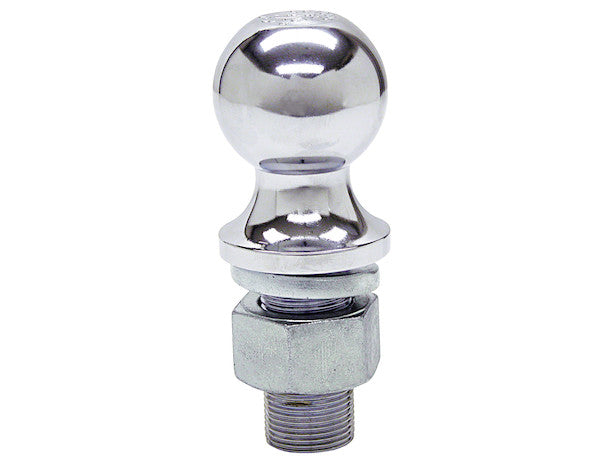
Chrome Hitch Balls from Buyers Products are available in all standard sizes to handle virtually any towing application. All hitch balls feature wear-resistant chrome plating for durability and style. They are packaged individually.
Specifications
| Ball Diameter (in.) | 2-5/16 |
|---|---|
| Ball Finish | Chrome |
| M.G.T.W. (lbs) | 10,000 |
| Material | Carbon Steel |
| Shank Diameter (in.) | 1.00 |
| Shank Length (in.) | 2.75 |
Advanced Product Overview: 2-5/16 Inch Chrome Hitch Ball with 1 Inch Shank and 2-3/4 Inch Length
The 2-5/16 inch chrome hitch ball, featuring a 1 inch shank diameter and a 2-3/4 inch shank length, manufactured by Buyers Products, represents a critical component in the secure and efficient transmission of towing forces from a tow vehicle to a trailer. Engineered for robust performance, this hitch ball is designed to accommodate a diverse range of towing applications, providing a reliable coupling point for trailers with compatible 2-5/16 inch couplers. Its construction from high-grade carbon steel, complemented by a wear-resistant chrome plating, ensures exceptional durability, corrosion resistance, and aesthetic integrity, even under demanding operational conditions. With a Maximum Gross Trailer Weight (M.G.T.W.) rating of 10,000 lbs, this hitch ball is ideally suited for medium to heavy-duty towing requirements, encompassing a wide array of recreational, commercial, and utility trailers. The meticulous design and manufacturing processes adhere to stringent industry standards, ensuring that this product not only meets but often exceeds the performance expectations for safety and reliability in the towing ecosystem.
Precision Engineering and Material Science
The foundation of this hitch ball's superior performance lies in its material composition and precise engineering. Fabricated from high-strength carbon steel, the ball undergoes specialized manufacturing processes to optimize its mechanical properties. Carbon steel is selected for its advantageous balance of tensile strength, yield strength, and impact resistance, properties critical for components subjected to dynamic loads and stresses inherent in towing operations. The exact grade of carbon steel is chosen to ensure it can withstand the substantial shear, compressive, and tensile forces exerted during acceleration, braking, and maneuvering of a 10,000 lb trailer. Furthermore, the material's fatigue resistance is paramount, guaranteeing structural integrity over countless towing cycles. This selection underscores a commitment to engineering excellence, providing a core structure capable of enduring rigorous operational demands without compromising safety or longevity.
Dimensional Specifications and Compatibility
The precise dimensions of this hitch ball are not arbitrary but are dictated by established industry standards for towing equipment, primarily SAE J684 and VESC-V-5. The 2-5/16 inch (approximately 58.74 mm) ball diameter is a standard size for Class III, Class IV, and some lighter Class V trailer applications. This specific diameter is crucial for achieving a proper and secure mechanical interlock with a corresponding 2-5/16 inch trailer coupler. A mismatch in ball and coupler sizes can lead to excessive play, premature wear, potential decoupling, or catastrophic failure, all of which pose significant safety hazards. Therefore, rigorous adherence to this specification ensures optimal engagement, minimizing slack and distributing forces effectively across the contact surfaces, thereby enhancing towing stability and safety.
The shank, the threaded cylindrical portion that passes through the ball mount, is equally critical. With a 1.00 inch (25.4 mm) diameter, it is designed to fit precisely into hitch ball mount holes engineered for this specific dimension. The integrity of the connection between the hitch ball and the ball mount relies heavily on a snug fit, preventing movement and ensuring that the load is transferred efficiently to the tow vehicle's receiver hitch. The 2-3/4 inch (69.85 mm) shank length is another vital dimension. This length is engineered to accommodate the typical thickness of a range of ball mounts, allowing for adequate thread engagement for the securing nut and any necessary washers (such as a lock washer and flat washer) without bottoming out or leaving insufficient threads for secure fastening. Proper thread engagement is essential for developing the necessary clamping force to hold the ball securely in place and to prevent loosening under dynamic towing conditions. Insufficient thread engagement can lead to thread stripping or reduced load-carrying capacity, jeopardizing the entire towing assembly.
The Benefits of Chrome Plating
The external finish of this hitch ball is an electroplated layer of high-quality chrome. This chrome plating serves multiple critical functions beyond mere aesthetics. Technically, electroplating involves depositing a thin layer of chromium onto the carbon steel substrate through an electrochemical process. This process creates a surface that is significantly harder and more resistant to abrasion than raw carbon steel, effectively mitigating wear from the constant friction and rotational forces exerted by the trailer coupler during towing. The wear-resistant properties of chrome plating contribute directly to the extended service life of the hitch ball, maintaining its precise spherical geometry and preventing premature degradation.
Furthermore, chrome is exceptionally resistant to various forms of corrosion, including oxidation (rust) and chemical degradation from road salts, moisture, and environmental pollutants. In a towing environment, where components are frequently exposed to harsh outdoor elements, this corrosion resistance is indispensable for preserving the structural integrity and functionality of the hitch ball over time. The smooth, non-porous surface of chrome plating also facilitates easier cleaning and maintenance, allowing for quick removal of dirt, grease, and debris. This ease of maintenance not only preserves the ball's appearance but also allows for more effective visual inspection for signs of wear or damage. The reflective, polished appearance of chrome also contributes to the professional look of the towing setup, consistent with the high-quality standards of Buyers Products.
Maximum Gross Trailer Weight (M.G.T.W.) Rating and Safety Implications
The M.G.T.W. rating of 10,000 lbs (approximately 4,536 kg) is a critical performance specification. This rating indicates the maximum weight of a fully loaded trailer that the hitch ball is engineered to safely tow. It is imperative that the weight of the trailer, including its cargo and any fluids, does not exceed this rating. Exceeding the M.G.T.W. can lead to catastrophic failure of the hitch ball, resulting in the detachment of the trailer and severe safety risks. This rating is determined through rigorous testing and calculations, taking into account the material properties, dimensions, and manufacturing quality of the hitch ball.
It is crucial to understand that the hitch ball's M.G.T.W. rating is only one component of the overall towing system's capacity. The ultimate towing capacity is limited by the component with the lowest rating within the entire system, which includes the tow vehicle's rating, the receiver hitch, the ball mount, and the trailer's coupler. Therefore, users must verify that all components in their towing setup meet or exceed the intended load capacity to ensure safe operation. This hitch ball's 10,000 lb rating positions it within the range suitable for numerous substantial towing tasks, such as hauling large recreational vehicles, multi-place boat trailers, enclosed car carriers, small construction equipment, and heavy utility trailers, providing a robust solution for demanding applications.
Manufacturing Process and Quality Assurance
The production of Buyers Products hitch balls involves a series of precision manufacturing steps, each subject to stringent quality control. The process typically begins with the selection of high-quality carbon steel bar stock, which is then forged or machined to achieve the initial rough shape of the hitch ball. Forging, in particular, enhances the material's grain structure and strength, making the final product more resilient. Subsequent machining operations precisely form the spherical head and the threaded shank, ensuring exact adherence to dimensional tolerances. The threads on the shank are then cut or rolled with precision to ensure smooth engagement with the securing nut and to maximize resistance to stripping under torque. After machining, the balls undergo a multi-stage cleaning and surface preparation process to ensure optimal adhesion for the chrome plating. The electroplating process is carefully controlled to achieve a uniform, durable, and aesthetically pleasing chrome layer. Finally, each hitch ball undergoes a thorough inspection for dimensional accuracy, finish quality, and material integrity before being individually packaged. This comprehensive manufacturing and quality assurance regimen ensures that every hitch ball leaving the factory meets the high standards expected from Buyers Products.
Installation Guidelines and Best Practices
Proper installation of the hitch ball is paramount for safety and performance. The following procedure outlines the recommended steps for mounting the 2-5/16 inch hitch ball onto a compatible ball mount:
- Component Verification: Before installation, verify that the 1.00 inch shank diameter of the hitch ball matches the hole diameter on your ball mount. Ensure the ball mount's M.G.T.W. rating meets or exceeds the hitch ball's 10,000 lb rating.
- Preparation: Clean the hitch ball shank and the ball mount hole thoroughly to remove any grease, dirt, or debris that could impede proper seating or torque.
- Insertion: Insert the threaded shank of the hitch ball through the designated hole in the ball mount from the top.
- Washer Placement: Place a split lock washer onto the shank, followed by a flat washer if recommended by the ball mount or hitch ball manufacturer. The lock washer is crucial for preventing the nut from loosening due due to vibrations and dynamic loads during towing.
- Nut Fastening: Thread the appropriate castle nut or hex nut onto the shank. Ensure the nut is correctly oriented and begins to engage the threads smoothly.
- Torque Application: Using a calibrated torque wrench, tighten the nut to the specific torque value recommended by the hitch ball or ball mount manufacturer. For a 1-inch shank diameter, this torque specification is typically substantial, often ranging from 150-250 ft-lbs (approximately 203-339 Nm). Over-tightening can strip threads or deform components, while under-tightening can lead to loosening and failure. Accurate torque is vital for creating the necessary clamping force to secure the hitch ball.
- Cotter Pin (if applicable): If a castle nut is used, insert a cotter pin through the pre-drilled hole in the shank and castle nut, bending the ends to prevent its dislodgement. This acts as a secondary safety mechanism.
- Final Inspection: Visually inspect the installed hitch ball to ensure it is seated correctly, and all components are secured.
Maintenance and Longevity
To maximize the lifespan and ensure the continued safe operation of the 2-5/16 inch chrome hitch ball, routine maintenance is recommended:
- Pre-Trip Inspection: Before each towing operation, inspect the hitch ball for any signs of wear, such as flattening of the ball's top surface, deep scratches, gouges, or deformation. Check for any cracks in the material or plating, particularly around the base of the ball where it meets the shank.
- Corrosion Check: Examine the chrome plating for bubbling, peeling, or significant rust spots. While chrome is corrosion-resistant, damage to the plating can expose the underlying carbon steel to corrosive elements.
- Tightness Verification: Periodically check the torque of the securing nut, especially after initial use and before long trips, as fasteners can sometimes loosen over time due to vibration.
- Lubrication: Apply a light coating of automotive or marine-grade grease to the surface of the hitch ball before coupling. This lubrication reduces friction between the ball and the trailer coupler, minimizing wear on both components, facilitating smoother articulation, and preventing squeaking.
- Cleaning: After use, clean the hitch ball to remove dirt, road grime, and old grease. This prevents abrasive particles from accumulating and causing premature wear.
- Replacement: A hitch ball showing significant signs of wear, deformation, cracking, or severe corrosion must be replaced immediately. The integrity of the hitch ball is paramount to towing safety.
Target Applications and User Profile
This 2-5/16 inch chrome hitch ball with its 10,000 lb M.G.T.W. is an indispensable component for a wide spectrum of towing applications and user groups. It is ideally suited for:
- Recreational Enthusiasts: Towing large travel trailers, fifth-wheel conversion adapters (if applicable to ball mount type), multi-axle boat trailers, or toy haulers for extended vacations and outdoor activities.
- Commercial Operations: Hauling car carriers, heavy-duty utility trailers laden with equipment, landscape trailers, or small to medium construction equipment suchers compact excavators or skid steers.
- Agricultural Sector: Transporting various types of farm equipment, livestock trailers, or large utility trailers for supplies and produce.
- General Utility: Any scenario requiring the reliable towing of trailers up to 10,000 lbs where a 2-5/16 inch coupler is present.
The product caters to professional contractors, experienced recreational vehicle owners, fleet managers, and anyone requiring a high-capacity, durable, and visually appealing hitch ball for demanding towing tasks. The individual packaging further ensures that each product arrives in pristine condition, ready for immediate deployment.
Conclusion
The 2-5/16 inch chrome hitch ball with a 1 inch shank diameter and 2-3/4 inch length from Buyers Products embodies the pinnacle of robust engineering and reliable performance in the towing industry. Its carefully selected carbon steel construction, precision machining, and wear-resistant chrome plating coalesce to deliver a component of exceptional strength, durability, and corrosion resistance. With a substantial 10,000 lb M.G.T.W. rating, it offers a secure and high-capacity interface for a multitude of medium to heavy-duty trailers. Adherence to strict dimensional tolerances and the critical role of proper installation and maintenance underscore its commitment to user safety and longevity. This hitch ball is more than just a connecting piece; it is a meticulously engineered component designed to facilitate safe, efficient, and dependable towing operations, reinforcing Buyers Products' reputation for delivering superior quality towing solutions.