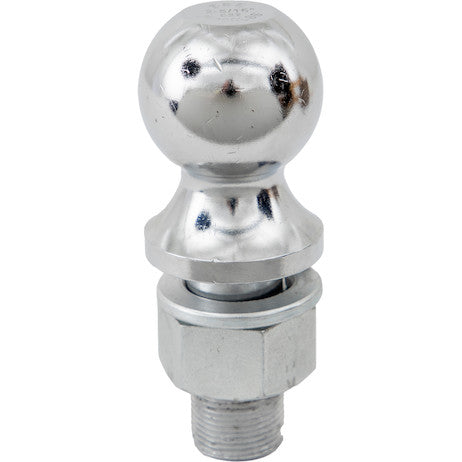
Bulk Hitch Balls from Buyers Products feature either a chrome or zinc-plated finish, making them an attractive, durable option for a wide range of towing applications. The hitch balls are rated to 2,000-10,000 lb depending on model. Choose from a variety of sizes and ball shank lengths for the ideal fit. Each ball is individually bagged, labeled, and UPC bar coded.
Specifications
| Ball Diameter (in.) | 2-5/16 |
|---|---|
| Ball Finish | Chrome |
| M.G.T.W. (lbs) | 20,000 |
| Material | Carbon Steel |
| Shank Diameter (in.) | 1.25 |
| Shank Length (in.) | 2.75 |
Advanced Engineering and Performance Analysis of the 2-5/16 Inch Bulk Chrome Hitch Ball
The 2-5/16 inch bulk chrome hitch ball, featuring a 1-1/4 inch shank diameter and a 2-3/4 inch shank length, represents a critical component in the heavy-duty towing industry. Manufactured by Buyers Products, this specific configuration is engineered to provide superior performance, durability, and safety for demanding towing applications. This technical exposition delves into the material science, manufacturing precision, performance specifications, and application considerations that underscore the robust design of this essential towing accessory.
Material Science: High-Strength Carbon Steel
At the core of this hitch ball's exceptional strength and resilience is its construction from high-grade carbon steel. Carbon steel is an iron-carbon alloy renowned for its mechanical properties, including high tensile strength, yield strength, and hardness, which are paramount for components subjected to significant dynamic loads and stresses inherent in towing operations. The specific carbon content and alloying elements are meticulously controlled during the steelmaking process to achieve a balance of strength, ductility, and toughness. This ensures that the hitch ball can withstand the substantial tensile and shear forces exerted during acceleration, braking, and cornering, without exhibiting brittle failure or excessive deformation.
The selection of carbon steel for hitch balls involves a careful consideration of its microstructure and mechanical response under various loading conditions. Through processes such as forging, the steel's grain structure is refined, enhancing its strength and fatigue resistance. Subsequent heat treatments, such as quenching and tempering, can further optimize the material's properties, increasing hardness and wear resistance while maintaining a suitable level of toughness to absorb sudden impacts. This meticulous material engineering ensures that the hitch ball not only meets but often exceeds the rigorous performance benchmarks required for heavy-duty towing, providing a reliable and safe connection point between the tow vehicle and the trailer.
Advanced Surface Treatment: Chrome Plating Technology
The distinctive chrome-plated finish on this hitch ball is not merely for aesthetic appeal; it serves a crucial functional role in enhancing the component's longevity and performance. Chrome plating involves the electrodeposition of a thin layer of chromium onto the carbon steel substrate. This process imparts several critical advantages, making it an ideal choice for towing equipment exposed to harsh environmental conditions.
Firstly, chrome offers exceptional corrosion resistance. Towing equipment frequently encounters moisture, road salts, chemicals, and abrasive particles, all of which can accelerate the degradation of unprotected ferrous metals. The dense, non-porous nature of the chrome layer acts as an effective barrier, preventing oxidation and preserving the structural integrity of the underlying steel. This significantly extends the operational lifespan of the hitch ball, reducing maintenance requirements and ensuring consistent performance over time.
Secondly, chrome plating significantly increases the surface hardness of the hitch ball. This enhanced hardness provides superior wear resistance, particularly in the critical interface between the hitch ball and the trailer coupler. Repeated coupling and uncoupling, combined with the constant rotational and translational friction during towing, can lead to abrasive wear. The hardened chrome surface minimizes material loss, maintains the precise spherical geometry of the ball, and thereby ensures a consistently secure and tight fit within the coupler, mitigating slack and associated dynamic stresses.
Furthermore, the smooth, low-friction surface of chrome plating facilitates smoother articulation within the trailer coupler, reducing wear on both the ball and the coupler mechanism. This contributes to a quieter towing experience and prolongs the life of the entire hitch system. While zinc plating also offers corrosion protection, chrome plating typically provides a superior level of hardness and a more robust, long-lasting protective barrier, especially under severe operating conditions, solidifying its preference for heavy-duty applications where maximum durability and aesthetic preservation are desired.
Precision Engineering: Ball Diameter (2-5/16 Inches)
The specification of a 2-5/16 inch ball diameter is a critical dimension that dictates the compatibility and load-bearing capacity of the hitch system. This particular diameter is standardized for heavy-duty towing applications, primarily associated with Class IV and Class V trailer hitches. Adherence to this precise dimension is paramount to ensure a safe and secure connection with the corresponding trailer coupler.
An undersized ball would result in excessive play within the coupler, leading to accelerated wear, increased dynamic stresses, and potential catastrophic disconnection. Conversely, an oversized ball would prevent proper coupling. The exacting manufacturing tolerances applied during the production of these hitch balls guarantee that the spherical geometry and diameter conform to industry standards, ensuring optimal engagement with certified trailer couplers. This precise fit is fundamental to distributing the substantial 20,000 lb M.G.T.W. (Maximum Gross Trailer Weight) effectively across the contact surfaces, minimizing stress concentrations and maximizing the operational safety of the towing assembly. The 2-5/16 inch ball is the industry standard for heavier trailers such as large agricultural equipment, substantial construction trailers, and heavy-duty utility or car haulers, necessitating a robust and dependable coupling interface.
Structural Integrity: Shank Diameter (1-1/4 Inches)
The shank of the hitch ball serves as the critical mechanical link that transmits the entire towing load from the ball to the hitch ball mount or drawbar. A shank diameter of 1-1/4 inches (1.25 inches) is specifically engineered to accommodate the immense forces associated with a 20,000 lb M.G.T.W. rating. The cross-sectional area of the shank is directly proportional to its ability to resist shear forces and bending moments. A larger diameter provides a greater material volume to absorb and distribute these stresses, thereby preventing deformation or fracture under peak loads.
The selection of a 1-1/4 inch shank diameter is a deliberate engineering decision based on empirical testing and theoretical stress analysis, ensuring that the shank possesses sufficient ultimate tensile strength and shear strength to withstand the static and dynamic loads encountered during heavy-duty towing. This robust diameter also ensures compatibility with heavy-duty ball mounts and drawbars that are designed with adequately sized mounting holes to support such high capacities. Improper matching of shank diameter to the ball mount's hole can compromise the entire towing system's integrity, leading to premature wear, loosening, or catastrophic failure. The substantial shank diameter is a clear indicator of this hitch ball's intended use in the most demanding towing scenarios, where uncompromising strength is a non-negotiable requirement.
Optimal Engagement: Shank Length (2-3/4 Inches)
The shank length, specified at 2-3/4 inches (2.75 inches), is a critical dimension that ensures proper and secure mounting of the hitch ball to the ball mount or drawbar. This length is precisely calculated to provide adequate thread engagement with the retaining nut, allowing for the application of specified torque values to securely fasten the ball. Insufficient shank length could result in inadequate thread engagement, leading to loosening of the nut under vibration and dynamic loads, compromising the connection's integrity.
Conversely, an excessively long shank might interfere with certain hitch receiver designs or components beneath the drawbar. The 2-3/4 inch length is optimized to accommodate a wide range of ball mount thicknesses commonly found in heavy-duty applications, ensuring that sufficient threads extend below the mounting surface for the washer and nut to be properly secured. This design consideration ensures maximum clamping force can be achieved without bottoming out the nut or compromising thread integrity, guaranteeing a robust and permanent mechanical connection that can reliably transmit the significant forces associated with a 20,000 lb M.G.T.W.
Performance Specification: Maximum Gross Trailer Weight (20,000 lbs)
The Maximum Gross Trailer Weight (M.G.T.W.) rating of 20,000 lbs is the ultimate testament to the engineering and material quality of this hitch ball. This specification indicates the maximum aggregate weight of the fully loaded trailer that the hitch ball is certified to safely tow. A rating of 20,000 lbs positions this hitch ball firmly within the heavy-duty segment of towing components, suitable for Class IV and Class V applications, which typically encompass large industrial trailers, multi-car haulers, substantial boat trailers, agricultural implements, and construction equipment.
Achieving this substantial rating requires rigorous design, material selection, and manufacturing processes that adhere to or exceed industry standards such as SAE J684. This standard outlines comprehensive testing protocols to evaluate the structural integrity and durability of hitch balls under various static and dynamic load conditions, including tensile, compressive, and fatigue testing. The 20,000 lb M.G.T.W. rating signifies that the hitch ball has successfully demonstrated its capacity to withstand the formidable stresses generated by trailers of this magnitude, including vertical tongue weight and horizontal pulling forces, while maintaining a substantial safety factor to account for unforeseen load variations and operational contingencies.
It is imperative that the hitch ball's M.G.T.W. rating meets or exceeds the actual gross weight of the trailer being towed. Furthermore, all other components in the towing system—including the hitch receiver, ball mount, and safety chains—must also be rated for at least the same capacity. The 20,000 lb rating is a critical safety parameter, offering assurance of the component's capability for the most demanding towing tasks, provided that it is correctly installed and maintained within its specified operational limits.
Application Versatility and Reliability
The combination of a 2-5/16 inch ball diameter, 1-1/4 inch shank diameter, 2-3/4 inch shank length, and a 20,000 lb M.G.T.W. rating renders this bulk chrome hitch ball exceptionally versatile for a vast array of heavy-duty towing applications. Its robust design is ideally suited for professionals in construction, agriculture, transportation, and marine industries who rely on dependable equipment for their daily operations. From towing excavators and backhoes to hauling large livestock trailers or multiple vehicles, the engineered resilience of this hitch ball provides a critical link in the operational chain.
Its resistance to corrosion and wear, attributable to the chrome finish and carbon steel construction, ensures consistent performance even in challenging environments such as saltwater proximity, dusty construction sites, or agricultural fields exposed to fertilizers and pesticides. The inherent durability minimizes downtime due to equipment failure, thereby enhancing productivity and reducing operational costs over the long term. This product is specifically designed to meet the rigorous demands of continuous, heavy-duty use, making it an invaluable asset for any fleet manager or individual requiring maximum towing capability and unwavering reliability.
Installation Best Practices and Maintenance Protocols
Proper installation is paramount to leveraging the full 20,000 lb capacity and ensuring the safety of this hitch ball. The 1-1/4 inch shank requires a ball mount with a precisely sized mounting hole. Installation typically involves inserting the shank through the ball mount, placing a lock washer (if not integrated into the nut) and then threading the specialized nut onto the shank. Crucially, the nut must be torqued to the manufacturer's specified value, typically in the range of 300-450 ft-lbs for a shank of this diameter, using a calibrated torque wrench. This ensures maximum clamping force and prevents loosening under dynamic loads, which could lead to play, wear, or catastrophic failure.
Regular maintenance is also vital. Before each tow, inspect the hitch ball for any signs of wear, pitting, corrosion, or deformation, particularly around the ball surface and the shank threads. Ensure the nut remains tightly torqued. Periodically, apply a thin layer of high-pressure, water-resistant grease to the ball surface to reduce friction and wear between the ball and coupler. This proactive approach to installation and maintenance significantly extends the life of the hitch ball and, more importantly, enhances towing safety for all components in the system.
Quality Assurance and Packaging Efficiency
The commitment of Buyers Products to quality is reflected in the meticulous manufacturing processes and stringent quality control applied to each hitch ball. From material sourcing to the final chrome plating, every stage is monitored to ensure consistency, dimensional accuracy, and adherence to performance specifications. This commitment provides end-users with a product that meets the highest industry standards for strength and reliability. The individual packaging, with each ball bagged, labeled, and UPC bar coded, simplifies inventory management for distributors and retailers, protects the chrome finish during transit and storage, and facilitates efficient point-of-sale transactions. This attention to detail underscores a professional approach to product delivery, ensuring that each customer receives a premium, ready-to-use component.
Safety Considerations in Heavy-Duty Towing
While the 2-5/16 inch bulk chrome hitch ball is engineered for maximum strength and durability, safe towing practices are paramount. It is critical to always verify that the M.G.T.W. rating of the hitch ball, hitch receiver, ball mount, and tow vehicle all meet or exceed the gross weight of the trailer and its contents. The tongue weight of the trailer must also be within the specified limits of all components. Overloading any single component can lead to catastrophic failure, regardless of the individual strength of other parts. Regular inspection of the entire towing system for wear, damage, or loose connections is essential, along with adherence to all applicable federal, state, and local towing regulations. Investing in a high-quality, properly rated hitch ball like this one from Buyers Products is a fundamental step towards safe and efficient heavy-duty towing.
Conclusion
The 2-5/16 inch bulk chrome hitch ball with a 1-1/4 inch shank diameter and 2-3/4 inch shank length represents a pinnacle of engineering for heavy-duty towing applications. Its robust carbon steel construction, enhanced by a durable chrome finish, guarantees exceptional strength, corrosion resistance, and wear characteristics essential for demanding environments. With a commanding M.G.T.W. of 20,000 lbs, precisely engineered dimensions, and backed by the reputable quality of Buyers Products, this hitch ball provides a reliable, safe, and long-lasting solution for professionals requiring uncompromising performance in their towing operations. Its technical specifications affirm its suitability for the most rigorous industrial, commercial, and agricultural tasks, making it an indispensable component for secure trailer coupling.