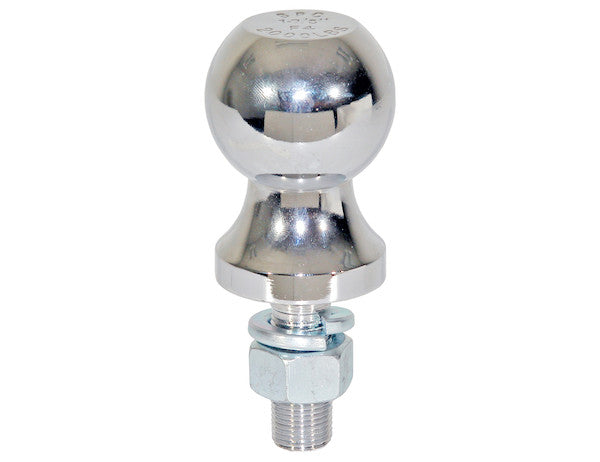
Bulk Hitch Balls from Buyers Products feature either a chrome or zinc-plated finish, making them an attractive, durable option for a wide range of towing applications. The hitch balls are rated to 2,000-10,000 lb depending on model. Choose from a variety of sizes and ball shank lengths for the ideal fit. Each ball is individually bagged, labeled, and UPC bar coded.
Specifications
| Ball Diameter (in.) | 2 |
|---|---|
| Ball Finish | Chrome |
| M.G.T.W. (lbs) | 3,500 |
| Material | Carbon Steel |
| Shank Diameter (in.) | 0.75 |
| Shank Length (in.) | 1.75 |
The 2-inch Bulk Chrome Hitch Ball with a 3/4-inch shank diameter and 1-3/4-inch shank length from Buyers Products represents a pinnacle of precision engineering and robust construction, specifically designed to meet the rigorous demands of various light-to-medium duty towing applications. This critical component serves as the mechanical interface between a towing vehicle's hitch system and a trailer's coupler, facilitating the safe and secure transfer of kinetic energy and static load forces. Our commitment to manufacturing excellence ensures that each hitch ball not only adheres to, but often surpasses, stringent industry standards, providing unparalleled reliability and operational longevity for commercial enterprises, fleet managers, and individual operators alike.
Engineered for Precision: The 2-Inch Ball Diameter
The selection of a 2-inch ball diameter is not arbitrary; it signifies adherence to one of the most widely adopted standards for trailer couplers in North America, particularly for Class I and Class II towing systems. This standardized dimension ensures broad interoperability, allowing the hitch ball to seamlessly engage with a vast array of trailers, from light utility and small boat trailers to personal watercraft and ATV haulers. The spherical geometry of the 2-inch ball is meticulously calibrated to provide optimal surface contact with the trailer's coupler, thereby minimizing potential play and mitigating wear over extended periods of use. This precise fit is paramount for stability, reducing unwanted vibrations and impacts that can lead to premature component fatigue or, critically, compromise towing safety. The smooth, consistent surface finish further enhances this engagement, facilitating effortless coupling and uncoupling operations while preserving the integrity of both the ball and the coupler's internal mechanisms.
Advanced Surface Treatment: The Chrome Plating Advantage
The chrome finish applied to this hitch ball is a deliberate engineering choice, offering significant functional and aesthetic advantages beyond mere visual appeal. Chrome plating, typically achieved through an electrochemical process, involves depositing a thin, durable layer of chromium onto the carbon steel substrate. This process imparts several critical properties:
- Superior Corrosion Resistance: The primary functional benefit of chrome plating is its exceptional resistance to corrosion. Towing environments expose hitch components to a wide array of corrosive agents, including moisture, road salts, de-icing chemicals, and atmospheric pollutants. The dense, non-porous nature of chrome acts as a robust barrier, preventing rust and oxidation from degrading the underlying carbon steel, thereby extending the component's operational life significantly.
- Enhanced Wear Resistance: Chrome possesses a high degree of hardness, making it highly resistant to abrasion and wear. During coupling and uncoupling, as well as throughout dynamic towing operations, the hitch ball experiences frictional forces against the trailer coupler. The chrome layer minimizes material loss from these interactions, preserving the ball's critical dimensions and ensuring a consistently secure fit over thousands of cycles.
- Reduced Friction: The inherently smooth surface of chrome plating contributes to lower coefficients of friction between the hitch ball and the coupler. This not only eases the coupling process but also reduces the generation of heat and wear during operation, further contributing to the longevity of both components.
- Aesthetic Durability and Maintainability: While not the sole purpose, the lustrous, mirror-like finish of chrome provides a professional appearance that resists tarnishing and discoloration. Furthermore, its smooth surface is easy to clean, allowing for the quick removal of dirt, grease, and road grime, thus simplifying maintenance and ensuring continued optimal performance. The ability of the chrome to maintain its structural and aesthetic integrity in harsh conditions underscores its suitability for heavy-duty applications where appearance often reflects underlying quality.
Material Science: High-Strength Carbon Steel Construction
The foundation of this hitch ball's exceptional strength and durability lies in its construction from high-grade carbon steel. Carbon steel is selected for its advantageous balance of mechanical properties, which are critical for components subjected to significant tensile, shear, and fatigue stresses during towing operations. While specific grades can vary, typical selections often fall within the medium-carbon steel range (e.g., SAE 1045 or similar alloys), known for their excellent strength-to-weight ratio and ability to be heat-treated for enhanced performance.
- Tensile Strength and Yield Strength: Carbon steel exhibits high tensile strength, the maximum stress it can withstand before fracturing, and a robust yield strength, the stress at which it begins to deform permanently. These properties are crucial for resisting the pulling forces exerted by the trailer, ensuring the hitch ball maintains its structural integrity under static and dynamic loads up to its rated M.G.T.W.
- Hardness and Toughness: Through precise manufacturing processes, including forging and subsequent heat treatment (such as quenching and tempering), the carbon steel's microstructure is optimized. This process enhances surface hardness, which contributes to wear resistance, while maintaining internal toughness, preventing brittle fracture under shock loads or sudden impacts.
- Fatigue Resistance: Towing operations expose hitch components to repetitive loading cycles, which can lead to material fatigue over time. The inherent fatigue resistance of quality carbon steel, combined with appropriate design considerations, ensures that the hitch ball can withstand prolonged periods of use without developing microscopic cracks that could propagate into larger structural failures.
The manufacturing process typically involves hot forging, where the steel is heated and shaped under immense pressure. This process refines the grain structure of the metal, aligning it with the direction of anticipated stresses, which significantly enhances the material's overall strength and resilience. Subsequent machining ensures precise dimensional accuracy, while the chrome plating is then applied to the meticulously prepared surface, creating a composite structure optimized for both strength and environmental protection.
Critical Rating: Maximum Gross Trailer Weight (M.G.T.W.) of 3,500 lbs
The Maximum Gross Trailer Weight (M.G.T.W.) rating of 3,500 lbs for this specific hitch ball is a critical safety and performance parameter. M.G.T.W. represents the maximum permissible weight of the fully loaded trailer that the hitch ball is engineered to safely tow. This rating is not merely a guideline but a fundamental limitation derived from extensive engineering analysis, material testing, and the application of rigorous safety factors. Manufacturers adhere to industry standards, such as SAE J684, which outline specific test protocols for determining these ratings.
Establishing an M.G.T.W. involves:
- Static Load Testing: The hitch ball is subjected to static loads that far exceed its rated capacity to determine its ultimate tensile and shear strengths.
- Dynamic Testing: Components are often subjected to repeated stress cycles simulating real-world towing conditions to evaluate fatigue resistance.
- Application of Safety Factors: A significant safety margin (e.g., typically a 2:1 or 3:1 ratio of ultimate strength to rated capacity) is incorporated to account for unpredictable variables such as dynamic road conditions, sudden braking, accelerations, uneven load distribution, and potential manufacturing variances. This ensures the hitch ball can safely handle loads up to its rating without risk of immediate failure and provides a buffer against unforeseen stresses.
It is absolutely imperative that the M.G.T.W. of the hitch ball always meets or exceeds the actual gross weight of the trailer being towed. Furthermore, the hitch ball's rating must also be compatible with the lowest M.G.T.W. rating among all other components in the towing system, including the trailer coupler, the ball mount, the hitch receiver, and the towing vehicle itself. Neglecting to match these capacities, particularly by using a hitch ball with an insufficient M.G.T.W., can lead to catastrophic structural failure, loss of trailer control, severe accidents, and significant legal liabilities. The 3,500 lbs M.G.T.W. makes this hitch ball ideally suited for a broad spectrum of light-to-medium duty trailers, offering a robust and secure connection for applications such as utility trailers, smaller boat trailers, jet ski trailers, and various recreational towing needs, providing peace of mind through engineered safety.
The Engineered Shank: Diameter (3/4 Inch) and Length (1-3/4 Inch)
The shank is the foundational element that secures the hitch ball to the ball mount or drawbar, acting as the primary load-bearing interface for vertical and horizontal forces. Its dimensions, specifically the diameter and length, are critically important for system integrity and compatibility.
- Shank Diameter (0.75 Inches): A 3/4-inch shank diameter (0.75 inches) is a common standard for hitch balls rated up to approximately 3,500 lbs, making this specific product highly compatible with a wide range of standard ball mounts and drawbars. This diameter is precisely engineered to fit snugly into corresponding holes in hitch components, minimizing movement and ensuring a secure mechanical connection. The cross-sectional area of the shank directly relates to its shear strength, which is the ability to resist forces that attempt to cut or break it. The 3/4-inch diameter provides ample material to withstand the significant shear stresses encountered during acceleration, braking, and dynamic road conditions, efficiently transferring the trailer's weight and kinetic forces through the ball mount to the towing vehicle's frame. Stress concentration points, such as where the ball transitions into the shank and at the thread roots, are meticulously designed to distribute forces evenly and prevent localized fatigue.
- Shank Length (1-3/4 Inches): The 1-3/4-inch shank length is designed to accommodate various thicknesses of ball mount platforms or drawbars. Adequate shank length is crucial to ensure that, once the hitch ball is inserted through the mounting hole, sufficient threading remains exposed below the platform to engage the lock washer and nut properly. Proper thread engagement is paramount for maintaining the torque specified for installation, which prevents the nut from loosening under vibration and dynamic loads. A shank that is too short would result in insufficient thread engagement, leading to an insecure connection and potential failure, while an excessively long shank might interfere with other components or create unnecessary leverage points. This specific length, 1-3/4 inches, is carefully balanced to provide broad compatibility with standard drawbar thicknesses while ensuring maximum security and adherence to industry-recommended fastening practices, including the use of a high-strength washer and nut system. The interplay between the precise shank diameter and length ensures a robust, stable, and compliant connection for reliable towing performance.
Adherence to Industry Standards and Quality Assurance
The manufacturing of the 2-inch Bulk Chrome Hitch Ball is underpinned by an unwavering commitment to industry standards and rigorous quality assurance protocols. Buyers Products components are engineered not only to meet but often exceed the performance criteria established by relevant organizations, ensuring product safety, reliability, and interoperability.
- SAE J684 Compliance: A key benchmark in North America is SAE J684, "Trailer Couplings, Hitches and Safety Chains - Automotive Type." This standard specifies dimensional requirements, test procedures, and performance criteria for various components of the trailer towing system, including hitch balls. Adherence to SAE J684 ensures that the hitch ball's dimensions, material properties, and load-carrying capabilities are systematically validated through prescribed testing methodologies, guaranteeing a predictable and safe performance profile.
- Manufacturing Tolerances and Dimensional Accuracy: During production, advanced CNC machining and precise forging techniques are employed to maintain extremely tight manufacturing tolerances. Dimensional accuracy in the ball diameter, shank diameter, and shank length is critically controlled to ensure perfect fitment with standard couplers and ball mounts, minimizing play and optimizing load transfer.
- Material Verification and Metallurgical Analysis: Raw materials (carbon steel) undergo stringent inspection upon receipt. This includes chemical composition analysis and mechanical testing to verify that they meet specified material grades and properties. Metallurgical analysis may be conducted to confirm the desired grain structure and ensure the effectiveness of heat treatment processes.
- Non-Destructive Testing (NDT) and Visual Inspection: Components may be subjected to non-destructive testing methods, such as magnetic particle inspection or ultrasonic testing, to detect any internal flaws or surface discontinuities that could compromise structural integrity. Each hitch ball also undergoes thorough visual inspection to identify any surface defects, inconsistencies in the chrome plating, or manufacturing anomalies.
- Load Testing and Fatigue Analysis: Beyond standard compliance, Buyers Products often conducts internal load testing that simulates extreme towing conditions to evaluate ultimate strength and fatigue resistance, ensuring a robust safety margin above the rated M.G.T.W.
- Process Control and Traceability: Throughout the manufacturing lifecycle, robust process control systems are implemented to ensure consistency. Batch traceability allows for detailed monitoring of materials, processes, and inspection results, facilitating swift identification and resolution of any potential quality issues.
This multi-faceted approach to quality assurance guarantees that every 2-inch Bulk Chrome Hitch Ball delivered is a product of superior engineering, ready to perform reliably in demanding environments.
Versatile Applications and Target Segments
The 2-inch Bulk Chrome Hitch Ball, with its 3,500 lbs M.G.T.W. and precise dimensions, is engineered for exceptional versatility, making it an indispensable component across a broad spectrum of towing applications. Its robust design and standard sizing make it suitable for numerous light-to-medium duty towing requirements for both professional and recreational users.
- Light-Duty Utility Trailers: Ideal for general-purpose utility trailers used for hauling landscaping materials, tools, or household goods.
- Small Boat and Personal Watercraft Trailers: Perfectly suited for towing single or dual jet ski trailers, small fishing boats, or dinghies, where corrosion resistance is particularly beneficial.
- ATV and Powersport Equipment Trailers: Provides a secure connection for trailers transporting ATVs, UTVs, dirt bikes, or other recreational vehicles.
- Cargo Carriers and Tow Dollies: Compatible with various hitch-mounted cargo carriers or small tow dollies designed for compact vehicles.
- Commercial and Fleet Operations: Its bulk packaging and consistent quality make it an economical and reliable choice for businesses that manage fleets of service vehicles, rental equipment, or need to frequently replace or outfit trailers. This includes landscaping companies, construction subcontractors, equipment rental agencies, and small delivery services.
- Retail and Aftermarket Sales: Distributors and retailers benefit from the individual bagging, labeling, and UPC bar coding, streamlining inventory management and point-of-sale processes, ensuring an accessible and identifiable product for end-users.
The "bulk" offering caters specifically to scenarios where efficiency and cost-effectiveness for high-volume procurement are paramount, without compromising on the quality and safety critical for reliable towing operations.
Strategic Bulk Packaging and Logistics
The offering of this 2-inch Chrome Hitch Ball in "bulk" is a strategic decision designed to optimize efficiency and cost-effectiveness for high-volume users, distributors, and retailers, while maintaining meticulous attention to product integrity through advanced packaging and logistical features.
-
Individual Bagging: Each hitch ball is individually sealed in a durable protective bag. This serves several crucial functions:
- Corrosion Protection: The bag acts as an additional barrier against moisture, dust, and environmental contaminants, preserving the pristine chrome finish and preventing premature corrosion during storage and transit.
- Scratch and Impact Prevention: Individual packaging prevents metal-on-metal contact between units, eliminating scratches, scuffs, or minor dings that could compromise the aesthetic appeal or surface integrity of the chrome plating.
- Cleanliness: Ensures each product remains clean and ready for immediate installation upon removal from its packaging, free from workshop dust or debris.
-
Labeling and UPC Bar Coding: Every individually bagged hitch ball is clearly labeled with essential product information and features a Universal Product Code (UPC) bar code. This facilitates:
- Efficient Inventory Management: Streamlines receiving, stocking, and tracking processes for warehouses, distributors, and retail outlets, reducing human error and improving operational throughput.
- Rapid Point-of-Sale: Enables quick and accurate scanning at the point of sale, enhancing customer service and transaction speed.
- Product Identification: Provides clear and immediate identification of product specifications (e.g., ball diameter, shank dimensions, M.G.T.W.), which is crucial for correct product selection and preventing misapplication.
- Traceability: Supports internal quality control and external regulatory compliance by allowing for batch and production data linkage, if necessary.
- Cost-Effectiveness for Volume Buyers: The bulk format inherently offers economic advantages for businesses requiring multiple hitch balls. It optimizes packaging materials, reduces labor in handling, and streamlines shipping, translating into reduced per-unit costs for buyers such as fleet operators, equipment rental companies, and automotive parts suppliers.
- Logistical Efficiency: The standardized, individually packaged units are easy to consolidate for shipping, stack, and store, maximizing space utilization in warehouses and on delivery vehicles.
This comprehensive approach to bulk packaging ensures that the product arrives in optimal condition, is easy to manage, and supports efficient business operations throughout the supply chain.
Installation Protocols and Maintenance Best Practices
Proper installation and routine maintenance are paramount for maximizing the operational life and ensuring the safety of the 2-inch Chrome Hitch Ball.
-
Installation Procedures:
- Component Compatibility: Ensure the hitch ball's shank diameter and length are compatible with the ball mount's mounting hole and thickness.
- Cleanliness: Before assembly, ensure all mating surfaces (hitch ball shank, ball mount hole, washer, nut) are clean and free of dirt, grease, or rust.
- Correct Orientation: Insert the hitch ball shank through the top of the ball mount. Place a lock washer (typically included or recommended) over the threaded shank, followed by the retaining nut.
- Torque Specification: This is critical. Consult the hitch ball manufacturer's or vehicle/hitch manufacturer's instructions for the precise torque specification for the shank nut. For a 3/4-inch shank, common torque values typically range from 150-250 ft-lbs (approximately 200-340 Nm). Use a calibrated torque wrench to achieve the exact specified torque. Under-tightening can lead to loosening and component fatigue; over-tightening can stretch the threads, weaken the shank, or deform the ball mount.
- Visual Confirmation: After torquing, visually inspect the assembly to ensure the nut is fully seated, the lock washer is properly compressed, and there is no visible play.
-
Maintenance Best Practices:
-
Regular Inspection: Prior to each towing operation and periodically during extended trips, conduct a thorough visual inspection of the hitch ball. Look for:
- Wear: Excessive wear marks, particularly flat spots or grooves on the ball surface, indicate potential degradation.
- Corrosion: Any signs of rust or significant pitting on the chrome surface, which could compromise structural integrity. While chrome is corrosion-resistant, damage to the plating can expose the underlying steel.
- Cracks or Deformation: Micro-fractures, stress cracks, or any signs of deformation on the ball, shank, or threads.
- Looseness: Check for any play between the hitch ball and the ball mount. Re-torque the nut if necessary.
- Cleaning: Regularly clean the chrome surface with mild soap and water, then dry thoroughly. This removes abrasive dirt and prevents corrosive agents from accumulating. Avoid harsh chemicals or abrasive cleaners that can damage the chrome finish.
- Lubrication: While opinions vary, some users apply a thin layer of grease to the hitch ball to reduce friction and wear between the ball and the coupler. Ensure this is a clean, appropriate lubricant and reapply as needed.
- Storage: When not in use, consider storing the ball mount with the hitch ball in a dry, protected environment to minimize exposure to elements.
-
Regular Inspection: Prior to each towing operation and periodically during extended trips, conduct a thorough visual inspection of the hitch ball. Look for:
Adherence to these protocols ensures maximum safety, prolongs component life, and maintains optimal towing performance.
Safety Imperatives in Towing
Towing operations inherently involve significant safety considerations, and the proper selection, installation, and maintenance of the hitch ball are foundational to minimizing risks. A comprehensive understanding and strict adherence to safety imperatives are non-negotiable for anyone engaging in towing activities.
- Weight Capacity Matching: As previously emphasized, the gross weight of the loaded trailer must never exceed the M.G.T.W. rating of the hitch ball, the ball mount, the hitch receiver, or the towing vehicle's capacity. Exceeding any of these limits is a critical safety violation that can lead to catastrophic mechanical failure, loss of vehicle control, and severe accidents.
- Proper Hitch Ball and Coupler Compatibility: Always ensure the hitch ball diameter precisely matches the size of the trailer coupler. A mismatch, even by a small fraction of an inch, can result in an insecure connection, allowing the coupler to disengage during towing.
- Secure Installation: The hitch ball must be installed onto the ball mount with the correct torque specifications, using a suitable lock washer and nut. Regularly check that the nut remains tightly fastened and that there is no movement between the ball and the mount.
- Coupler Engagement: Verify that the trailer coupler is fully seated over the hitch ball and that its latching mechanism is securely engaged and locked according to the trailer manufacturer's instructions. A visual and tactile check (e.g., trying to lift the trailer tongue off the ball) should confirm the connection.
- Safety Chains: Always cross and attach safety chains between the trailer and the towing vehicle. These chains serve as a backup in the event of a primary hitch failure, preventing the trailer from completely separating. Ensure they are correctly rated for the trailer's weight and have enough slack to allow for turns but not so much that they drag on the ground.
- Trailer Lighting and Brakes: Confirm that all trailer lights (tail, brake, turn signals) are fully functional and that any trailer braking system (if applicable and required by law for the trailer's weight) is properly connected and operational.
- Load Distribution: Properly distribute the trailer's load to achieve the recommended tongue weight (typically 10-15% of the gross trailer weight). Incorrect load distribution can lead to dangerous trailer sway, reduced steering control, and increased braking distances for the towing vehicle.
- Pre-Trip Inspections: Conduct a thorough pre-trip inspection before every journey. This includes checking the hitch connection, safety chains, lights, tires (both vehicle and trailer), fluid levels, and overall condition of both the towing vehicle and the trailer.
- Driving Practices: Adopt safe towing driving practices: reduce speed, increase following distances, anticipate turns and stops, and be aware of increased vehicle length and weight. Avoid sudden maneuvers.
By adhering to these stringent safety imperatives, operators can significantly mitigate risks, ensuring secure and responsible towing operations with the 2-inch Chrome Hitch Ball from Buyers Products.
Conclusion: The Definitive Choice for Reliable Towing
The 2-inch Bulk Chrome Hitch Ball with a 3/4-inch shank diameter and 1-3/4-inch shank length from Buyers Products stands as an exemplary solution for demanding light-to-medium duty towing applications. Its meticulous engineering, leveraging high-strength carbon steel and a durable chrome finish, ensures superior resistance to wear, corrosion, and the dynamic forces inherent in towing. With a robust M.G.T.W. of 3,500 lbs, this component offers a reliable and secure interface, critical for the safe transport of a diverse range of trailers. Adherence to stringent industry standards like SAE J684, coupled with a commitment to precise manufacturing tolerances and rigorous quality assurance, guarantees a product of unwavering performance and longevity. The strategic bulk packaging, featuring individual bagging, labeling, and UPC bar coding, further enhances its value proposition for commercial operations, simplifying logistics and inventory management without compromising product integrity. When seeking a hitch ball that embodies strength, durability, precision, and economic efficiency for high-volume needs, this Buyers Products offering presents itself as the definitive choice, providing the foundational reliability essential for confident and secure towing.