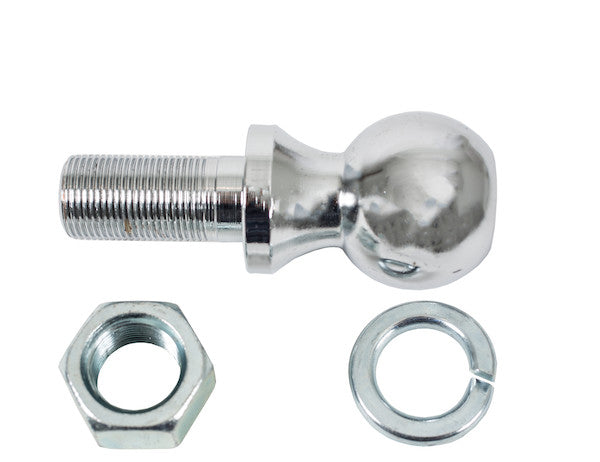
Bulk Hitch Balls from Buyers Products feature either a chrome or zinc-plated finish, making them an attractive, durable option for a wide range of towing applications. The hitch balls are rated to 2,000-10,000 lb depending on model. Choose from a variety of sizes and ball shank lengths for the ideal fit. Each ball is individually bagged, labeled, and UPC bar coded.
Specifications
| Ball Diameter (in.) | 2 |
|---|---|
| Ball Finish | Chrome |
| M.G.T.W. (lbs) | 5,000 |
| Material | Carbon Steel |
| Shank Diameter (in.) | 1.00 |
| Shank Length (in.) | 2.125 |
Technical Overview: 2 Inch Chrome Hitch Ball with 1 Inch Shank and 2-1/8 Inch Length
The 2-inch chrome hitch ball, featuring a 1-inch shank diameter and a 2-1/8 inch effective shank length, represents a critical component in the vast ecosystem of towing apparatus. Engineered for robust performance and designed to facilitate secure coupling between a towing vehicle and a trailer, this specific hitch ball variant is meticulously manufactured to meet stringent industry standards, ensuring both safety and longevity across diverse towing applications. Its design, material composition, and surface treatment are optimized for a Maximum Gross Trailer Weight (M.G.T.W.) rating of 5,000 lbs, making it suitable for a broad spectrum of light-to-medium duty towing requirements.
Material Science and Engineering: The Foundation of Strength and Durability
Carbon Steel Core
At the core of this hitch ball's exceptional strength and resilience is its foundation in high-grade carbon steel. Specifically, materials such as AISI 1045 or similar medium-carbon steel alloys are typically employed due to their superior balance of tensile strength, yield strength, and ductility. AISI 1045, for instance, is an unalloyed medium carbon steel renowned for its excellent mechanical properties when subjected to appropriate heat treatment. Its chemical composition generally includes approximately 0.43-0.50% carbon, 0.60-0.90% manganese, and trace amounts of other elements that enhance its structural integrity. This precise metallurgical composition ensures that the hitch ball can withstand the significant static and dynamic forces encountered during towing, including vertical tongue weight, longitudinal braking and acceleration forces, and lateral sway.
The manufacturing process for the carbon steel core typically begins with hot forging. This process involves heating the steel to a high temperature and then shaping it under immense pressure. Hot forging refines the grain structure of the steel, eliminating internal voids and creating a more homogeneous, anisotropic material that exhibits enhanced strength and toughness, particularly in critical stress areas such as the ball-to-shank transition. Following forging, precision machining operations are performed to achieve the exact dimensions, surface finishes, and thread specifications required for the ball diameter, shank diameter, and thread pitch. This multi-stage process ensures dimensional accuracy and optimal material utilization.
Thermal Treatment Processes
To further optimize the mechanical properties of the carbon steel, the forged and machined components undergo specialized heat treatment processes. These typically include quenching and tempering. Quenching involves rapidly cooling the steel from an elevated temperature (austenitizing temperature) to transform its microstructure into martensite, a very hard and brittle phase. Subsequently, tempering is performed by reheating the martensitic steel to an intermediate temperature, which reduces its brittleness, relieves internal stresses, and improves its toughness and ductility while retaining a significant level of hardness and strength. This carefully controlled thermal cycle is critical in achieving the desired balance of properties that allows the hitch ball to withstand repetitive stress cycles without material fatigue or brittle fracture.
Chrome Plating: Advanced Surface Protection and Aesthetic Enhancement
The distinctive chrome finish is not merely an aesthetic enhancement; it is a meticulously applied layer designed to provide critical functional benefits. The chrome plating process, typically electroplating, involves depositing a thin layer of chromium onto the carbon steel substrate. This process begins with thorough cleaning and surface preparation of the steel component to ensure optimal adhesion and a flawless finish. This often includes degreasing, acid etching, and rinsing steps to remove all contaminants and activate the surface.
The primary functions of the chrome plating include:
- Superior Corrosion Resistance: Chromium is highly resistant to oxidation, preventing rust and other forms of corrosion that can significantly degrade the structural integrity and appearance of steel. This is particularly vital in outdoor and marine environments where exposure to moisture, road salts, de-icing chemicals, and other corrosive agents is commonplace. The dense, passive oxide layer formed on the chromium surface acts as an effective barrier against environmental degradation.
- Enhanced Surface Hardness and Abrasion Resistance: Chrome plating significantly increases the surface hardness of the hitch ball, improving its resistance to wear and abrasion. This is crucial as the hitch ball constantly interacts with the trailer coupler, experiencing friction and localized pressure. A harder surface minimizes material loss and maintains the spherical geometry, which is essential for consistent and safe coupling.
- Reduced Friction Coefficient: The smooth and hard surface of chrome plating reduces the coefficient of friction between the hitch ball and the trailer coupler. This facilitates easier coupling and uncoupling operations and minimizes wear on both components, contributing to their extended service life and operational smoothness.
- Aesthetic Appeal: The bright, reflective chrome finish provides a professional and high-quality appearance, contributing to the overall visual integrity of the towing setup. This is often a preferred finish for consumers who value both performance and aesthetics.
- Durability in Harsh Environments: The combined properties of corrosion and abrasion resistance ensure that the chrome hitch ball performs reliably in a wide range of operational temperatures and environmental conditions, from arid deserts to humid coastal regions.
The electroplating process is carefully controlled to ensure uniform thickness and consistent adhesion of the chrome layer. Quality control measures often include thickness testing (e.g., X-ray fluorescence), adhesion testing, and accelerated corrosion testing (e.g., salt spray per ASTM B117) to verify the long-term protective capabilities of the finish.
Precision Dimensions and Their Significance
Ball Diameter: 2 Inches (50.8 mm)
The 2-inch ball diameter is a widely recognized and standardized size within the North American towing industry, governed by specifications such as SAE J684 for trailer couplings, hitches, and safety chains. This standardization ensures interoperability between various trailer couplers and towing vehicles. A 2-inch ball is commonly used for trailers with M.G.T.W. ratings typically ranging from 2,000 lbs to 8,000 lbs, making the 5,000 lb rating of this specific hitch ball perfectly aligned with its intended application domain. The spherical geometry is precisely machined to ensure a snug fit within the coupler socket, minimizing play and providing a stable connection.
Shank Diameter: 1 Inch (25.4 mm)
The 1-inch shank diameter is a critical determinant of the hitch ball's load-bearing capacity and its compatibility with various hitch ball mounts or drawbars. A larger shank diameter provides a greater cross-sectional area, which directly translates to enhanced shear strength and resistance to bending under vertical and longitudinal loads. The selection of a 1-inch shank for a 5,000 lb rated ball is an engineering decision that balances the required strength with the common mounting hole sizes found in hitch ball mounts. It ensures that the component can safely transfer the forces from the trailer to the hitch receiver without structural compromise.
Shank Length: 2-1/8 Inches (2.125 inches or 53.975 mm)
The effective shank length of 2-1/8 inches is a precisely engineered dimension crucial for proper and secure installation. This length dictates the maximum thickness of the hitch ball mount or drawbar through which the shank can pass while still allowing sufficient thread engagement for the lock washer and nut. Adequate thread engagement is paramount for safety, as it ensures that the nut can be torqued to the manufacturer's specified value, preventing loosening due to vibration and dynamic forces during operation. An insufficient shank length would prevent proper nut installation, leading to an unsafe connection, while an excessively long shank might protrude unnecessarily, potentially snagging or interfering with other components. This specific length is optimized for standard hitch ball mount thicknesses, typically up to 3/4 inch or 1 inch, allowing for secure fastening.
Thread Specification
While not explicitly listed, the shank typically features a Unified National Fine (UNF) or Unified National Coarse (UNC) thread form. For hitch balls of this diameter, a common specification might be 1"-14 UNF or 1"-8 UNC, with UNF threads often preferred for applications requiring higher strength and resistance to loosening due to vibration, thanks to their finer pitch and greater thread contact area. The threads are precision-rolled or cut to ensure a smooth, durable engagement with the retaining nut, facilitating proper torque application and long-term security.
Maximum Gross Trailer Weight (M.G.T.W.): 5,000 lbs
The M.G.T.W. rating of 5,000 lbs signifies the maximum total weight of a fully loaded trailer that this hitch ball is engineered to safely tow. This rating is a composite value derived from extensive engineering analysis, material testing, and compliance with industry standards such as SAE J684. It takes into account the material properties of the carbon steel, the structural integrity imparted by forging and heat treatment, the precision of the dimensions (ball diameter, shank diameter, and length), and the quality of the chrome plating. It is imperative that the M.G.T.W. rating of the hitch ball always meets or exceeds the actual loaded weight of the trailer, and also that it does not exceed the lowest rating of any other component in the towing system, including the hitch receiver, ball mount, and the towing vehicle itself. Exceeding this rating can lead to catastrophic failure, posing severe safety risks.
Towing Applications and Versatility
With its 5,000 lb M.G.T.W. rating and standard 2-inch ball size, this chrome hitch ball is exceptionally versatile, catering to a wide array of towing needs. Typical applications include:
- Utility Trailers: For hauling landscaping materials, tools, refuse, or general cargo.
- Boat Trailers: Suitable for towing small to medium-sized boats, including fishing boats, jet skis, and recreational watercraft.
- Small to Medium RVs/Campers: Appropriate for compact travel trailers and pop-up campers within the weight limits.
- Car Tow Dollies: For towing vehicles behind RVs or for transport services, provided the combined weight is within limits.
- Equipment Trailers: For transporting smaller pieces of construction equipment, ATVs, or motorcycles.
- Agricultural Use: For light-duty farm trailers and implements.
Its robust construction and corrosion-resistant finish make it suitable for consistent use in demanding outdoor environments, where exposure to elements like dirt, gravel, mud, and water is routine.
Manufacturing Excellence and Quality Assurance
The production of these hitch balls adheres to a rigorous quality management system, encompassing every stage from raw material procurement to final packaging. Key elements of this system include:
- Raw Material Verification: Incoming carbon steel is inspected and certified to meet specified chemical compositions and mechanical properties.
- Process Control: Each manufacturing step—forging, machining, heat treatment, and chrome plating—is meticulously controlled to maintain dimensional accuracy, material integrity, and surface finish quality. This includes monitoring temperatures, pressures, cycle times, and bath chemistries.
- Dimensional Inspection: Continuous in-process and final inspections utilize precision measurement tools such as calipers, micrometers, thread gauges, and coordinate measuring machines (CMMs) to ensure all critical dimensions (ball diameter, shank diameter, shank length, thread pitch) conform to engineering drawings and industry standards.
- Mechanical Testing: Sample products or material batches undergo destructive testing, including tensile strength, yield strength, and hardness tests, to validate that the material meets the specified mechanical performance criteria after heat treatment.
- Corrosion Resistance Testing: Periodic salt spray testing (e.g., per ASTM B117) verifies the integrity and protective capability of the chrome plating against corrosive environments.
- Visual Inspection: Each hitch ball undergoes a final visual inspection to identify any surface imperfections, plating defects, or anomalies that could compromise performance or appearance.
These stringent quality control protocols ensure that every hitch ball consistently meets the specified M.G.T.W. rating and provides reliable, safe performance throughout its operational lifespan.
Packaging and Bulk Distribution Advantages
The strategy of offering these hitch balls in bulk, with each unit individually bagged, labeled, and UPC bar coded, provides significant advantages for distributors, retailers, and end-users alike:
- Inventory Management Efficiency: Individual UPC bar coding streamlines inventory tracking, point-of-sale operations, and warehouse management, reducing manual errors and improving data accuracy.
- Protection During Transit and Storage: Individual bagging protects the chrome finish from scratches, abrasions, and environmental contaminants during shipping and storage, ensuring that each product arrives in pristine condition.
- Ease of Retail Display and Sale: Pre-labeled and bar-coded units are ready for immediate display and sale, minimizing preparation time for retailers.
- Cost-Effectiveness for High-Volume Users: Bulk purchasing typically offers a lower per-unit cost, which is beneficial for businesses that require a large quantity of hitch balls for their operations, such as fleet maintenance facilities, trailer manufacturers, or automotive parts suppliers.
- Reduced Waste: Efficient bulk packaging can often be designed to minimize overall packaging material, contributing to environmental sustainability efforts.
Installation and Maintenance Best Practices
Proper installation and routine maintenance are crucial for maximizing the safety and lifespan of the hitch ball:
- Correct Mounting: The hitch ball shank must pass through the mounting hole of the hitch ball mount, with the shoulder of the ball resting firmly against the top surface of the mount.
- Secure Fastening: A lock washer should be placed between the nut and the underside of the hitch ball mount. The nut must then be torqued to the manufacturer's specified value (typically found in the hitch or ball mount instructions) using a calibrated torque wrench. This ensures adequate clamping force and prevents loosening during operation.
- Regular Inspection: Before each tow, inspect the hitch ball for any signs of wear, corrosion, cracks, deformation, or loose components. Pay particular attention to the ball surface, the shank, and the integrity of the nut and washer.
- Lubrication: Apply a thin layer of high-quality lithium-based grease to the surface of the hitch ball to reduce friction and wear between the ball and the trailer coupler. This also aids in preventing rust accumulation in the contact area.
- Cleaning and Storage: After use, clean the hitch ball to remove dirt, grime, and road salt. Store the ball mount assembly in a dry environment when not in use to prolong its life and maintain its aesthetic finish.
Conclusion
The 2-inch chrome hitch ball with a 1-inch shank diameter and 2-1/8 inch length, rated for 5,000 lbs M.G.T.W., represents a superior engineered solution for reliable and safe towing. Its foundation in high-strength carbon steel, optimized through precise forging and heat treatment, coupled with a durable, corrosion-resistant chrome plating, ensures exceptional performance and longevity. Designed for widespread compatibility and manufactured under stringent quality controls, this product offers a compelling combination of technical excellence, practical utility, and aesthetic appeal for a diverse range of towing applications. Its availability in bulk, complete with individual bagging and bar coding, further underscores its suitability for efficient distribution and professional application.