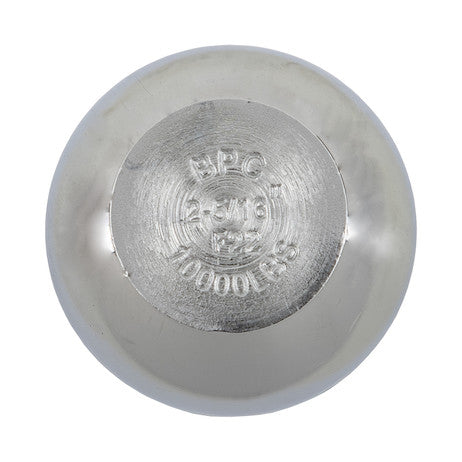
Bulk Hitch Balls from Buyers Products feature either a chrome or zinc-plated finish, making them an attractive, durable option for a wide range of towing applications. The hitch balls are rated to 2,000-10,000 lb depending on model. Choose from a variety of sizes and ball shank lengths for the ideal fit. Each ball is individually bagged, labeled, and UPC bar coded.
Specifications
| Ball Diameter (in.) | 2-5/16 |
|---|---|
| Ball Finish | Chrome |
| M.G.T.W. (lbs) | 10,000 |
| Material | Carbon Steel |
| Shank Diameter (in.) | 1.25 |
| Shank Length (in.) | 2.50 |
Advanced Technical Overview: 2-5/16 Inch Bulk Chrome Hitch Ball for Heavy-Duty Towing
The 2-5/16 inch chrome hitch ball with a 1-1/4 inch shank diameter and a 2-1/2 inch shank length, manufactured by Buyers Products, represents a critical component in robust trailer towing systems. Engineered for demanding applications, this specific hitch ball is rated for a Maximum Gross Trailer Weight (M.G.T.W.) of 10,000 pounds, signifying its suitability for substantial loads encountered in commercial, agricultural, and heavy recreational contexts. Its design and material selection adhere to stringent industry standards, ensuring superior strength, durability, and operational safety. This comprehensive technical overview delves into the specific attributes, engineering considerations, application suitability, and maintenance protocols associated with this high-performance towing accessory.
Precision Engineering for Optimal Performance
The core functionality of any hitch ball relies on its ability to withstand significant dynamic forces while maintaining a secure connection between the tow vehicle and the trailer coupler. The 2-5/16 inch diameter is a standard size for Class III, IV, and V hitches, commonly utilized for larger utility trailers, car haulers, boat trailers, and mid-sized RVs. This diameter is precisely calibrated to mate with similarly sized trailer couplers, ensuring minimal play and a secure mechanical interface. Any deviation in diameter, even fractional, could lead to excessive wear, rattling, or, in extreme cases, disengagement under load. The spherical geometry of the ball facilitates articulation, allowing for turns and uneven terrain without binding, while distributing the load evenly across the contact surface within the coupler.
Material Science: Carbon Steel for Unyielding Strength
At the heart of this hitch ball's impressive 10,000 lb M.G.T.W. rating is its construction from high-grade carbon steel. Carbon steel is selected for its exceptional balance of tensile strength, yield strength, and fatigue resistance, properties critical for components subjected to repetitive stress cycles and shock loads inherent in towing operations. Specifically, the carbon content and potential alloying elements contribute to the steel's ability to resist deformation under static weight and dynamic forces such as acceleration, braking, and road undulations. The manufacturing process typically involves hot forging, which refines the grain structure of the steel, eliminating internal voids and enhancing the material's overall strength and toughness. This process ensures that the hitch ball can endure the severe shear and tensile stresses applied at the interface with the trailer coupler and the ball mount.
The Protective and Aesthetic Value of Chrome Plating
The chrome-plated finish on this hitch ball is not merely for aesthetic appeal; it serves crucial functional roles that enhance the product's longevity and performance. Chrome plating, a process involving electrodeposition of a thin layer of chromium onto the carbon steel substrate, provides an exceptionally hard and corrosion-resistant surface. This hard chrome layer significantly increases the surface hardness of the ball, reducing wear from constant friction with the trailer coupler, especially during sharp turns or when operating on rough terrain. Furthermore, chromium is highly resistant to oxidation and various environmental corrosives, including road salts, moisture, and chemical exposure, which are ubiquitous in towing environments. This protective barrier prevents rust and pitting, which could otherwise compromise the structural integrity of the steel over time and potentially lead to premature failure or an unsafe towing condition. The smooth, low-friction surface also contributes to easier coupling and uncoupling of trailers.
Shank Specifications: Foundation of Security and Stability
The shank is the critical interface between the hitch ball and the ball mount. This specific model features a 1-1/4 inch shank diameter and a 2-1/2 inch shank length, parameters that are vital for secure installation and load transfer. The 1-1/4 inch diameter shank is indicative of a heavy-duty design, providing a substantial cross-sectional area capable of resisting the significant shear and bending forces exerted during towing. A larger shank diameter generally corresponds to a higher load capacity for the ball mount itself, ensuring that the entire system can support the 10,000 lb GTW. The shank's unthreaded portion must pass through a correspondingly sized hole in the ball mount, creating a precise fit that minimizes movement and wear at this crucial connection point.
The 2-1/2 inch shank length is engineered to accommodate ball mounts with thicker platforms, ensuring sufficient thread engagement for the accompanying lock washer and nut. Proper thread engagement is paramount for safety and stability; inadequate engagement can lead to thread stripping under stress, resulting in catastrophic failure. This length also provides flexibility for various ball mount designs, from solid forged models to those with reinforced platforms. The threads on the shank are meticulously cut or rolled to industry standards, guaranteeing compatibility with standard nuts and ensuring a strong, reliable connection when properly torqued. The integrity of the shank is continuously under scrutiny through quality control measures, confirming dimensional accuracy and material consistency.
Maximum Gross Trailer Weight (M.G.T.W.) of 10,000 lbs: Capacity and Compliance
The 10,000 pound M.G.T.W. rating for this hitch ball is a declaration of its maximum safe operating capacity when coupled with an appropriately rated hitch system. This rating dictates the cumulative weight of the trailer and its cargo that the hitch ball is engineered to safely handle. It is absolutely critical that the M.G.T.W. of the hitch ball meets or exceeds the actual loaded weight of the trailer. Furthermore, the hitch ball's rating must not exceed the lowest rating of any other component in the towing chain—including the tow vehicle's towing capacity, the hitch receiver's rating, the ball mount's rating, and the trailer's coupler rating. Exceeding any of these ratings constitutes a severe safety hazard, leading to potential equipment failure, loss of control, and legal liabilities.
This substantial capacity positions the hitch ball for a wide array of applications, from towing large landscaping trailers, heavy-duty utility trailers, and construction equipment to larger recreational vehicles and certain types of agricultural implements. The robust M.G.T.W. rating is achieved through a combination of superior material selection, optimized geometric design, and rigorous testing methodologies that simulate real-world towing stresses. Compliance with relevant industry standards, such as those set by SAE International (e.g., SAE J684 for trailer hitches and ball mounts, which indirectly influences ball design and testing), is paramount to validating this load rating and ensuring product reliability and safety.
Advanced Manufacturing and Quality Assurance
Buyers Products maintains a rigorous manufacturing process to ensure each hitch ball meets its specified performance criteria. This typically involves several stages, beginning with the selection of high-quality carbon steel billets. These billets are then hot-forged into the approximate shape of the hitch ball and shank, a process that improves the material's mechanical properties by aligning its grain structure. Subsequent machining operations precisely form the spherical ball, the threaded shank, and the shoulder for the ball mount. This stage demands high precision to ensure correct dimensions, especially for the ball diameter and shank threads, which are critical for proper fit and secure fastening.
Following machining, the components undergo a meticulous cleaning process to prepare them for chrome plating. The electroplating process is carefully controlled to apply a uniform, durable layer of chrome, providing the desired corrosion resistance and surface hardness without compromising the underlying steel's strength. Post-plating, each hitch ball undergoes a series of quality assurance checks. These include dimensional verification using precision calipers and gauges, visual inspection for plating defects, and hardness testing of the chrome layer. Lot sampling may involve destructive testing to confirm ultimate tensile strength, shear strength, and fatigue life, ensuring that the product consistently meets or exceeds the stated 10,000 lb M.G.T.W. This multi-faceted approach to manufacturing and quality control ensures that every bulk hitch ball from Buyers Products delivers consistent, reliable performance.
Installation Protocol and Maintenance for Longevity
Proper installation of the hitch ball is as critical as the quality of the component itself. The 2-5/16 inch chrome hitch ball with a 1-1/4 inch shank is designed for a secure, torque-specific installation. It is imperative that the shank passes cleanly through the ball mount's hole, ensuring the shoulder of the ball rests flush against the ball mount's surface. A flat washer should be placed between the ball mount and the nut, followed by a lock washer and then the nut. The nut must be torqued to the manufacturer's specified value, which for a 1-1/4 inch shank can often range from 250 to 450 foot-pounds, depending on the specific application and ball mount material. This high torque value is necessary to create a preload on the shank, preventing loosening under vibration and dynamic loads, thereby maintaining the structural integrity of the hitch assembly.
Regular maintenance significantly extends the lifespan and ensures the safe operation of the hitch ball. The chrome finish should be periodically cleaned to remove road grime, salt, and other corrosive agents. While chrome is highly resistant to corrosion, abrasive cleaning materials should be avoided to prevent scratching the surface, which could compromise its protective qualities. Inspection for wear is crucial: check the spherical surface for significant pitting, gouges, or flat spots that could indicate excessive friction or material degradation. The shank and threads should be inspected for deformation, rust, or cracks, particularly at the junction where the ball meets the shank, as this is a high-stress area. Any signs of severe wear, damage, or deformation necessitate immediate replacement of the hitch ball to prevent potential failure during towing operations. Lubrication of the ball surface before each towing excursion is recommended to reduce friction and wear between the ball and the coupler socket.
Applications Across Diverse Industries
The robust 10,000 lb M.G.T.W. rating and the 2-5/16 inch diameter make this hitch ball a versatile component across various sectors. In the commercial industry, it is indispensable for towing equipment trailers, open car haulers, and utility trailers carrying heavy machinery, tools, or materials. Construction companies, landscapers, and general contractors frequently rely on such robust hitch balls for transporting their essential assets. Within agriculture, it supports the movement of smaller implements, seed tenders, or livestock trailers, where durability and reliability are paramount given the often rugged terrain and heavy loads. For recreational users, this hitch ball is ideal for larger travel trailers, fifth-wheel conversion systems (where applicable), and heavier boat trailers, providing the necessary security and capacity for ambitious excursions. Its bulk packaging option makes it particularly attractive for fleet operators, distributors, and retailers who require a consistent supply of high-quality, individually prepped components for their inventory or customer base.
Strategic Advantages of Bulk Packaging with Individual Labeling
The provision of these hitch balls in bulk, yet individually bagged, labeled, and UPC bar coded, offers significant logistical and operational advantages. For distributors and retailers, bulk purchasing reduces per-unit costs and simplifies inventory management, allowing for efficient stocking of high-demand items. The individual bagging protects each hitch ball from environmental exposure and superficial damage during storage and transit, ensuring that the product reaches the end-user in pristine condition. The inclusion of a clear label with specifications and a UPC barcode streamlines sales processes, inventory tracking, and ensures accurate product identification, reducing errors and enhancing operational efficiency within warehouses and retail environments. This thoughtful approach to packaging underscores Buyers Products' understanding of both end-user requirements and supply chain dynamics.
Commitment to Safety and Regulatory Adherence
Safety is the paramount consideration in all towing operations, and the design and manufacturing of this hitch ball explicitly reflect this principle. Adherence to industry standards and rigorous internal testing ensures that the hitch ball performs reliably within its stated M.G.T.W. The critical importance of matching the hitch ball's capacity with all other components of the towing system cannot be overstated. Users are strongly advised to consult their vehicle's owner's manual, hitch receiver's specifications, and trailer's gross vehicle weight rating (GVWR) to ensure that the entire system is appropriately matched and not overloaded. Regular pre-trip inspections, encompassing the hitch ball, coupler, safety chains, lighting, and tires, are fundamental to safe towing. Buyers Products’ commitment to producing components that meet and exceed industry safety benchmarks provides peace of mind for operators engaged in demanding towing tasks, reinforcing their reputation as a trusted provider of heavy-duty towing solutions.
Conclusion: A Benchmark in Heavy-Duty Towing Reliability
The 2-5/16 inch bulk chrome hitch ball with a 1-1/4 inch shank diameter and 2-1/2 inch shank length, rated for 10,000 lbs M.G.T.W., from Buyers Products, stands as a testament to precision engineering, material science, and uncompromising quality. Designed for the rigorous demands of heavy-duty towing, its carbon steel construction, protective chrome finish, and meticulously specified shank dimensions collectively ensure superior strength, corrosion resistance, and secure integration into Class III, IV, and V towing systems. From its capacity to handle substantial trailer loads in diverse commercial and recreational applications to the logistical advantages offered by its bulk, individually packaged format, this hitch ball is optimized for both performance and practical utility. For professionals and serious enthusiasts who prioritize safety, durability, and reliable operation, this hitch ball represents a leading choice, embodying the critical attributes required for confident and secure towing.