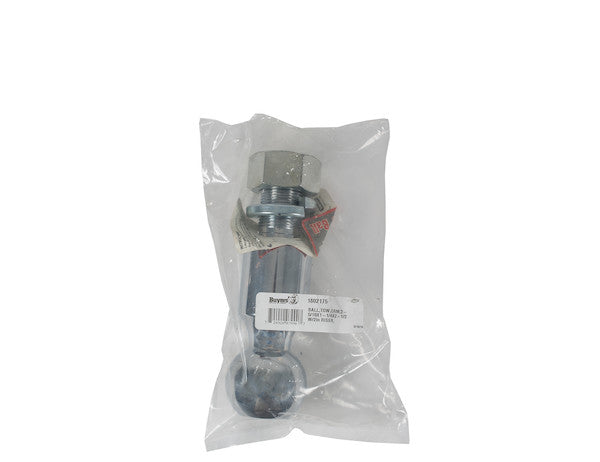
Bulk Hitch Balls from Buyers Products feature either a chrome or zinc-plated finish, making them an attractive, durable option for a wide range of towing applications. The hitch balls are rated to 2,000-10,000 lb depending on model. Choose from a variety of sizes and ball shank lengths for the ideal fit. Each ball is individually bagged, labeled, and UPC bar coded.
Specifications
| Ball Diameter (in.) | 2-5/16 |
|---|---|
| Ball Finish | Chrome |
| M.G.T.W. (lbs) | 5,000 |
| Material | Carbon Steel |
| Shank Diameter (in.) | 1.25 |
| Shank Length (in.) | 2.50 |
Comprehensive Technical Overview: 2-5/16 Inch Bulk Chrome Hitch Ball with 1-1/4" Shank and 2-1/2" Length, Suitable for 2" Riser Applications
The 2-5/16 inch chrome hitch ball, offered in bulk by Buyers Products, represents a meticulously engineered component designed for robust and reliable towing operations. Fabricated from high-grade carbon steel and finished with a durable chrome plating, this hitch ball is specified for a Maximum Gross Trailer Weight (M.G.T.W.) of 5,000 lbs, making it ideally suited for a broad spectrum of light-to-medium duty towing requirements, including utility trailers, small boat trailers, car haulers, and various commercial applications. Its precise dimensional specifications, including a 1-1/4 inch shank diameter and a 2-1/2 inch shank length, ensure optimal compatibility with industry-standard ball mounts, particularly those designed to accommodate a 2-inch rise, thereby facilitating proper trailer leveling and enhanced towing stability. This technical description delves into the material science, manufacturing processes, performance characteristics, installation protocols, and operational advantages that collectively define this superior towing solution.
Advanced Material Selection: Carbon Steel for Structural Integrity and Durability
The foundation of this hitch ball's exceptional strength and longevity lies in its core material: carbon steel. Chosen for its superior mechanical properties, carbon steel provides an optimal balance of high tensile strength, excellent yield strength, and remarkable toughness. These characteristics are paramount in towing applications where components are subjected to significant static and dynamic loads, including tension, compression, shear, and torsional stresses during acceleration, braking, and cornering. The specific grade of carbon steel employed undergoes rigorous quality control and material certification to ensure consistency in composition and metallurgical integrity. The manufacturing process typically involves hot forging, a method that refines the grain structure of the steel, eliminating internal voids and improving the material's fatigue resistance. This forging process aligns the grain flow with the contour of the hitch ball, thereby maximizing its load-bearing capacity and resistance to deformation under extreme stress. Subsequent precision machining ensures that critical dimensions, such as the ball diameter, shank diameter, and thread specifications, adhere to tight tolerances, which are essential for secure coupling and proper fitment within the towing system. The inherent ductility of carbon steel also allows it to absorb sudden impacts and cyclical loading without brittle fracture, further enhancing the safety profile of the hitch ball.
The Superiority of Chrome Plating: Enhanced Durability and Performance Characteristics
Beyond the robust carbon steel core, the external chrome plating significantly elevates the performance and longevity of this hitch ball. Chrome plating is a sophisticated electroplating process that applies a thin, hard layer of chromium to the steel surface. This finish is not merely aesthetic; it imparts several critical functional benefits essential for demanding towing environments. Firstly, it provides exceptional corrosion resistance, acting as a formidable barrier against environmental aggressors such as moisture, road salts, chemicals, and abrasive debris. This protective layer ensures that the hitch ball maintains its structural integrity and appearance over extended periods of outdoor exposure, preventing rust and degradation that could compromise its performance. Secondly, chrome plating substantially increases the surface hardness of the hitch ball, significantly enhancing its wear resistance. This is particularly important at the interface with the trailer coupler, where repetitive engagement and disengagement, coupled with dynamic movements during towing, can lead to abrasive wear. The hard chrome surface minimizes material loss, maintaining the critical ball diameter and ensuring a secure, consistent connection with the coupler. Thirdly, chrome exhibits a lower coefficient of friction compared to untreated steel, which facilitates smoother articulation between the hitch ball and the trailer coupler. This reduced friction mitigates wear on the coupler itself and contributes to quieter, more fluid towing dynamics. Finally, the lustrous chrome finish not only presents a professional appearance but also simplifies cleaning and inspection, allowing for easier detection of any potential surface damage or wear indicators.
Precision Dimensional Engineering: Ball Diameter, Shank, and Thread Specifications
The precise dimensional engineering of this hitch ball is fundamental to its functionality, safety, and compatibility within a diverse array of towing setups. The **2-5/16 inch ball diameter** is a standard size for many medium-duty trailers, ensuring a positive and secure mechanical interlock with compatible couplers. Accurate sizing is paramount to prevent premature wear, reduce "slop" or play between the ball and coupler, and most critically, prevent unintentional disengagement, which can lead to catastrophic failure. Compliance with industry standards, such as SAE J684, dictates the permissible tolerances for ball diameters, guaranteeing interchangeability and safe operation. The **1-1/4 inch shank diameter** is a critical dimension that dictates the compatibility with the hitch ball mount. This shank diameter is engineered to withstand the substantial shear forces and bending moments generated during towing. It must precisely fit into the receiving hole of the ball mount to ensure optimal load distribution and prevent stress concentrations that could lead to material fatigue or catastrophic failure of either the ball or the mount. The **2-1/2 inch shank length** provides ample thread engagement through hitch ball mounts of varying thicknesses. Adequate thread engagement is essential for safely securing the hitch ball to the mount using a robust lock washer and a high-strength hex nut. This length allows for full thread contact, maximizing the clamping force and ensuring that the assembly remains securely fastened even under intense vibratory and dynamic loads encountered during towing. The threaded portion itself is meticulously machined to standard Unified National Coarse (UNC) specifications, ensuring compatibility with readily available high-grade nuts and providing a strong, reliable connection point. An integrated, non-removable flange or collar is also typically designed into the base of the ball, acting as a robust washer that distributes the clamping force across a larger surface area of the ball mount, thereby preventing deformation and enhancing the overall structural integrity of the hitch assembly.
Maximum Gross Trailer Weight (M.G.T.W.) Rating and Safety Protocols
The specified Maximum Gross Trailer Weight (M.G.T.W.) of 5,000 lbs for this hitch ball is a critical performance parameter, representing the maximum permissible total weight of the trailer, including its cargo, that the hitch ball is engineered to safely support and tow. This rating is not an arbitrary figure but is derived from rigorous testing protocols and adheres to established engineering safety factors. These safety factors typically incorporate a significant margin, often a multiple of the stated M.G.T.W. (e.g., 3:1 or 5:1 Ultimate Strength to Working Load), to account for various real-world variables, including dynamic shock loads, fatigue, material imperfections, and environmental conditions. It is imperative that the M.G.T.W. of the hitch ball meets or exceeds the gross trailer weight of the towed unit. Exceeding this rating places undue stress on the hitch ball, the ball mount, and the entire towing system, dramatically increasing the risk of catastrophic failure, which could result in severe accidents, property damage, and personal injury. Furthermore, proper weight distribution is crucial; the Tongue Weight (T.W.), which is the downward force exerted by the trailer coupler onto the hitch ball, is typically recommended to be between 10% and 15% of the M.G.T.W. For a 5,000 lbs M.G.T.W., this translates to a recommended tongue weight of 500-750 lbs. Maintaining this optimal tongue weight ratio is vital for ensuring vehicle stability, effective braking, and controlled steering, mitigating sway and improving overall handling characteristics. Adherence to these M.G.T.W. and T.W. guidelines, in conjunction with industry standards like SAE J684 for connection devices, is fundamental for safe and compliant towing operations.
Critical Installation Procedures and Torque Requirements for Optimal Safety
Correct installation of the hitch ball is paramount to ensuring the integrity and safety of the entire towing system. The process involves inserting the hitch ball shank through the designated hole in the hitch ball mount, placing a high-strength lock washer onto the shank, and then securely fastening it with a high-grade hex nut. The most critical aspect of this installation is achieving the correct torque specification for the retaining nut. For a 1-1/4 inch shank diameter, the required torque typically ranges from 250 to 450 ft-lbs, though users must always consult the specific manufacturer's instructions for both the hitch ball and the ball mount as specifications can vary. Under-torquing the nut can lead to insufficient clamping force, allowing the ball to loosen over time, leading to excessive wear, rattling, and potential disengagement. Conversely, over-torquing can damage the threads of the shank or nut, deform the ball mount, or induce excessive stress concentrations, which may compromise the structural integrity of the components. A calibrated torque wrench is an indispensable tool for achieving precise and consistent fastening. Following the initial installation, it is highly recommended to re-check the torque after the first 50-100 miles of towing and periodically thereafter, as vibrations and dynamic loads can sometimes cause minor settling. The use of the lock washer is essential to prevent the nut from backing off under vibration, maintaining the critical clamping force. Proper thread engagement, achieved by the 2-1/2 inch shank length, ensures maximum holding power and resistance to shear forces, solidifying the connection between the hitch ball and the ball mount.
Understanding the "2 Inch Riser" Compatibility in Towing Systems
The designation "+ 2 Inch Riser" in the product title, when applied to a hitch ball, signifies its suitability for integration with specific hitch ball mounts designed to provide a 2-inch vertical rise. While the hitch ball itself does not intrinsically provide a "rise," its dimensions and strength rating make it an ideal component for towing setups where achieving a level trailer attitude necessitates a ball mount that offsets the hitch receiver's height. Many towing vehicles have receivers positioned relatively low to the ground. If the trailer's coupler height is significantly higher than the vehicle's receiver height, a "drop" ball mount would typically be used to lower the hitch ball. Conversely, if the vehicle's receiver height is lower than the trailer's coupler height, a "rise" ball mount is required to elevate the hitch ball to the appropriate level. A 2-inch riser ball mount lifts the hitch ball 2 inches from the receiver height, enabling the trailer to tow in a level orientation. Achieving a level trailer is critically important for several reasons: it ensures proper weight distribution across all trailer axles, prevents excessive tire wear on one side, optimizes braking performance, and significantly enhances overall towing stability by reducing trailer sway and improving handling dynamics. This 2-5/16 inch chrome hitch ball is therefore ideal for systems that inherently require such a vertical adjustment, complementing riser ball mounts to create a safe, stable, and horizontally aligned towing configuration.
Longevity, Maintenance, and Operational Reliability
The longevity and operational reliability of this 2-5/16 inch chrome hitch ball are directly influenced by diligent maintenance practices and regular inspection. Despite its robust carbon steel construction and protective chrome plating, continuous exposure to harsh towing conditions necessitates periodic checks. Users should routinely inspect the hitch ball for any signs of wear, such as deep grooves or pitting, especially at the contact surface with the coupler. Any deformation, cracks, or excessive corrosion on the ball, shank, or threads warrants immediate replacement. The integrity of the locking washer and nut should also be verified, ensuring they are free from damage and remain securely torqued. A thin layer of high-quality grease applied to the surface of the hitch ball before each towing operation is highly recommended. This lubrication minimizes friction and wear between the ball and the coupler, reducing heat buildup and extending the lifespan of both components, while also preventing galvanic corrosion in dissimilar metal junctions. When not in use, storing the hitch ball in a clean, dry environment, or protecting it with a hitch ball cover, can further preserve its finish and prevent premature degradation. Adherence to these maintenance protocols will ensure the hitch ball maintains its rated capacity and continues to provide a safe and reliable connection for many years of service.
Strategic Procurement: Bulk Packaging and Buyers Products Quality Assurance
The availability of these 2-5/16 inch chrome hitch balls in bulk packaging underscores Buyers Products' commitment to serving a wide range of customers, from individual consumers to large commercial fleets, distributors, and original equipment manufacturers (OEMs). Bulk purchasing offers significant advantages, including enhanced cost-efficiency, reduced shipping complexity, and optimized inventory management for high-volume users. Each hitch ball, despite being part of a bulk order, is individually bagged, labeled, and equipped with a UPC bar code. This meticulous individual packaging serves multiple purposes: it protects the chrome finish during transit and storage, prevents damage to the threads, and facilitates easy identification and inventory tracking. For distributors, it streamlines warehousing, order fulfillment, and point-of-sale operations. For fleet managers and commercial operators, it ensures that replacement parts are readily available, properly identified, and in pristine condition when needed. Buyers Products' reputation for engineering excellence and stringent quality control is consistently applied across its entire product line, ensuring that each bulk hitch ball meets the same high standards of performance, durability, and safety expected from a leading manufacturer of towing and truck equipment. This comprehensive approach to product design, manufacturing, and distribution establishes the 2-5/16 inch chrome hitch ball as a premier choice for demanding towing applications.