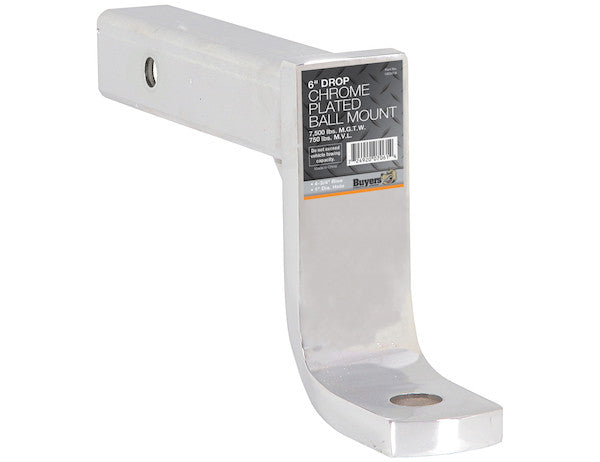
The 2 Inch Chrome-Plated Ball Mount from Buyers Products combines performance and style, and is rated to 7,500 lb. Choose the rise and drop size to fit your trailer height. The chrome-plated mount is durable and corrosion-resistant for years of use. Each mount features two-piece welded steel construction. Both fit 2 in. receiver tubes and accepts 1 in. shank diameter towing balls.
Specifications
| Ball Diameter | - |
|---|---|
| Color | Chrome |
| Finish | Chrome |
| For Ball Shank Size (in.) | 1.00 |
| Length (in.) | 10.00 |
| M.G.T.W. (lbs) | 7500 |
| M.V.L. (lbs) | 750 |
| Material | Carbon Steel |
| Maximum Drop (in.) | 6.00 |
| Maximum Rise (in.) | 4.75 |
| Mount Finish_1 | Chrome |
| Receiver Tube Size | 2.00 |
| Shank Type | Tubular |
Advanced Technical Overview: 2 Inch Ball Mount With 6 Inch Drop x 10 Inch Long Tube Chrome
The Buyers Products 2 Inch Chrome-Plated Ball Mount, featuring a 6-inch drop and a 10-inch long tube, represents a critical component in the integrated towing system for a broad spectrum of utility and recreational applications. Engineered for robust performance and aesthetic integration, this ball mount is meticulously designed to meet the rigorous demands of professional-grade towing. With a substantial Gross Trailer Weight (GTW) rating of 7,500 pounds and a Maximum Vertical Load (MVL) capacity of 750 pounds, this unit is ideally suited for towing medium-duty trailers, including enclosed cargo trailers, landscaping equipment, smaller construction machinery, and various boat and recreational vehicle configurations.
The inherent design philosophy behind this ball mount emphasizes a harmonious blend of strength, durability, and practical adaptability. Its construction from high-grade carbon steel, formed through a precise two-piece welded fabrication process, ensures structural integrity under dynamic load conditions. The application of a high-quality chrome plating serves not only to enhance its visual appeal but, more importantly, to provide an exceptional barrier against environmental corrosion and abrasive wear, thereby extending the operational lifespan of the component in diverse climates and operating conditions.
Receiver Tube Compatibility and Industry Standards
The 2-inch receiver tube compatibility of this ball mount aligns with industry-standard Class III and Class IV hitch receivers. This standardization is pivotal for ensuring broad interoperability across a vast range of light trucks, SUVs, and commercial vehicles equipped with appropriately rated trailer hitches. The internal dimensions of the receiver tube are manufactured to stringent tolerances, minimizing play between the ball mount shank and the receiver, which is crucial for reducing vibration, noise, and premature wear on the hitch assembly. A snug fit, often secured with a high-quality hitch pin and clip (sold separately), contributes significantly to the overall stability and safety of the towing connection. Understanding the classification of hitch receivers is fundamental; a Class III hitch typically supports GTW up to 8,000 lbs and MVL up to 800 lbs, while a Class IV hitch extends these capacities, often to 10,000-12,000 lbs GTW and 1,000-1,200 lbs MVL. The 7,500 lb GTW rating of this ball mount positions it firmly within the upper range of Class III and comfortably within Class IV applications, provided the vehicle's hitch receiver and overall towing capacity are not exceeded.
Precision in Trailer Leveling: Drop, Rise, and Tube Length
A defining feature of this ball mount is its configurable orientation, offering a substantial 6-inch drop and a versatile 4.75-inch rise. This adjustability is absolutely critical for achieving proper trailer leveling, which is a cornerstone of safe and efficient towing. Correct trailer leveling ensures that the trailer rides parallel to the ground, distributing the load evenly across all trailer axles and tires. Improper leveling, such as a nose-high or nose-low condition, can lead to a multitude of adverse effects:
- Uneven Tire Wear: Excessive load on front or rear axles can accelerate tire degradation and increase the risk of blowouts.
- Compromised Braking Performance: Uneven weight distribution can reduce the effectiveness of trailer brakes and destabilize the tow vehicle during deceleration.
- Trailer Sway: A nose-high condition can reduce tongue weight below the recommended 10-15% of GTW, making the trailer prone to dangerous sway, particularly at higher speeds or in crosswinds.
- Reduced Steering Control: Insufficient tongue weight can lighten the front axle of the tow vehicle, impairing steering responsiveness and control.
- Component Stress: Misaligned connections can place undue stress on the hitch, ball mount, and trailer coupler, leading to premature failure.
- Reduced Fuel Efficiency: An unlevel trailer can increase aerodynamic drag, negatively impacting fuel economy.
To determine the precise drop or rise required, a simple measurement protocol is recommended: measure the vertical distance from the ground to the top of the inside edge of the receiver tube opening on the tow vehicle, and then measure the vertical distance from the ground to the bottom of the trailer coupler when the trailer is level. The differential between these two measurements will indicate the necessary drop or rise. The provision of both drop and rise options within a single unit underscores the product's versatility, allowing users to adapt to various trailer heights and tow vehicle configurations without needing multiple specialized ball mounts.
The 10-inch tube length of this ball mount is a deliberate design choice that offers a balance between clearance and maneuverability. A longer tube generally provides greater clearance between the tow vehicle's bumper or tailgate and the trailer's frame or tongue, which is particularly beneficial for vehicles with extended rear overhangs, spare tires mounted on the tailgate, or when towing trailers with short tongues. This added clearance prevents potential contact during tight turns or when traversing uneven terrain. Conversely, while an excessively long tube can slightly increase the turning radius and make backing up more challenging, the 10-inch length is optimized to provide adequate clearance without significantly impeding maneuverability for typical towing scenarios. It also subtly influences tongue weight leverage by extending the pivot point further from the hitch receiver, a factor that is generally accounted for in the ball mount's overall design and ratings.
Gross Trailer Weight (GTW) and Maximum Vertical Load (MVL) Capacities
The articulated capacities of 7,500 pounds GTW and 750 pounds MVL are fundamental performance metrics for this ball mount. The GTW represents the maximum allowable weight of the fully loaded trailer that the ball mount can safely tow. The MVL, often referred to as tongue weight, indicates the maximum downward force that the trailer's coupler can exert on the hitch ball. Maintaining tongue weight within the recommended range—typically 10% to 15% of the GTW for conventional trailers—is paramount for stability and safety.
Exceeding either the GTW or MVL rating of any component in the towing system (including the tow vehicle, hitch, ball mount, hitch ball, and trailer) can lead to catastrophic failure, loss of control, and severe accidents. It is imperative that users always verify that the lowest rated component in their entire towing setup dictates the maximum towing capacity. For example, if a tow vehicle is rated for 6,000 lbs GTW, but the ball mount is rated for 7,500 lbs, the actual towing capacity is limited by the vehicle's 6,000 lbs rating. This principle of matching components to the lowest common denominator is a non-negotiable aspect of safe towing practices. The robust 7,500 lb GTW and 750 lb MVL ratings of this specific ball mount mean it can handle a substantial load, offering a margin of safety for many common towing tasks, provided all other components in the towing chain are equally rated or higher.
Material Science and Construction Integrity
The Buyers Products 2 Inch Ball Mount is constructed from high-quality carbon steel, a material renowned for its excellent strength-to-weight ratio, ductility, and fatigue resistance. Carbon steel is the material of choice for demanding structural applications due to its ability to withstand significant tensile, compressive, and shear stresses encountered during towing. The two-piece welded construction method employed in its manufacturing process is a critical element in its robust design. Precision welding creates a monolithic structure, effectively fusing separate steel components into a single, high-strength unit. This method ensures optimal load transfer and eliminates potential weak points that could arise from bolted or riveted assemblies under dynamic loads. Advanced welding techniques, often involving robotic precision and meticulous quality control, ensure consistent weld penetration and integrity, which are vital for maintaining the ball mount's specified load ratings over its operational life. The inherent properties of carbon steel, coupled with expert welding, provide a ball mount that is not only strong but also resilient against the vibrational stresses and impacts common in towing applications.
The Advantage of Chrome Plating: Durability and Aesthetics
The chrome-plated finish is more than just an aesthetic enhancement; it is a functional coating designed to provide superior protection and longevity. Chrome plating (chromium electroplating) involves depositing a thin layer of chromium onto the carbon steel substrate. This process imparts several key benefits:
- Exceptional Corrosion Resistance: Chrome is highly resistant to oxidation, rust, and chemical degradation from road salts, moisture, and common automotive fluids. This is particularly crucial for towing components that are frequently exposed to harsh outdoor elements and variable weather conditions.
- Enhanced Surface Hardness: The chrome layer increases the surface hardness of the ball mount, providing improved resistance against abrasion, scratching, and minor impacts, which are common occurrences during hitching and towing.
- Durability and Longevity: By protecting the underlying carbon steel from environmental factors and wear, the chrome plating significantly extends the operational lifespan of the ball mount, ensuring its performance and appearance are maintained for many years of use.
- Professional Aesthetic: The highly polished, reflective chrome finish provides a clean, professional, and sophisticated appearance that complements a wide range of tow vehicles and trailers, reflecting a commitment to quality and attention to detail.
Regular cleaning and periodic waxing of the chrome surface can further enhance its longevity and preserve its lustrous finish, making it a low-maintenance yet high-performance choice for discerning users.
Hitch Ball Shank Compatibility and Secure Installation
This ball mount is engineered to accept hitch balls with a 1-inch shank diameter. This specification is crucial for proper and safe installation of the hitch ball. The hole drilled through the ball platform of the mount is precisely sized to accommodate a 1-inch diameter shank, ensuring a snug fit. It is imperative that a hitch ball with a matching shank diameter is used; using a ball with a smaller shank will result in an insecure connection and potential failure under load, while a larger shank simply will not fit. When installing the hitch ball, it is critical to adhere to the manufacturer's torque specifications for the hitch ball nut. Over-tightening can strip threads or deform the ball mount, while under-tightening can lead to loosening and catastrophic detachment. Typically, a high-strength washer (often a lock washer) is used beneath the nut to maintain tension and prevent loosening due to vibration during towing. While the ball mount itself dictates the shank diameter, users must select a hitch ball with the correct ball diameter (e.g., 2 inches, 2-5/16 inches) that matches their trailer's coupler size. This product offers the versatility to use various ball diameters, provided they have the standard 1-inch shank.
Operational Considerations and Best Practices for Towing Safety
Beyond the technical specifications of the ball mount itself, safe towing necessitates adherence to comprehensive operational best practices:
- Pre-Trip Inspection: Always conduct a thorough inspection before each tow, verifying the secure attachment of the ball mount to the receiver with a proper hitch pin and clip, the hitch ball to the ball mount (correct torque), and the trailer coupler to the hitch ball. Ensure safety chains are correctly crossed and attached, all lighting systems (brake lights, turn signals, running lights) are functional, and trailer brakes (if equipped) are operational.
- Load Distribution: Properly balance the load within the trailer. Heavy items should be positioned over or slightly forward of the trailer's axle(s) to maintain adequate tongue weight and prevent sway.
- Speed Management: Reduce speed when towing, especially in adverse weather conditions, on rough terrain, or in strong winds. Excessive speed is a leading cause of towing accidents.
- Increased Stopping Distance: Account for significantly longer stopping distances when towing. Allow ample space between your tow vehicle and other traffic.
- Wider Turns: Remember that trailers track inside the turning radius of the tow vehicle. Make wider turns to avoid striking curbs or other obstacles.
- Regular Maintenance: Periodically inspect all towing components for signs of wear, corrosion, cracks, or deformation. Replace any compromised parts immediately. Ensure hitch pin holes are free of debris and rust.
- Understanding Legal Requirements: Be aware of and comply with all local, state, and federal regulations pertaining to trailer brakes, lighting, safety chains, and maximum permissible weights.
The 2 Inch Ball Mount With 6 Inch Drop x 10 Inch Long Tube Chrome from Buyers Products is more than just an accessory; it is a precision-engineered component designed to provide reliable, safe, and efficient towing capabilities. Its robust construction, thoughtful design elements like adjustable drop/rise, and protective chrome finish ensure it will serve as a high-performance cornerstone of your towing setup for years to come. By integrating this technically superior ball mount into a well-maintained towing system and adhering to established safety protocols, users can confidently transport their valuable assets with peace of mind.