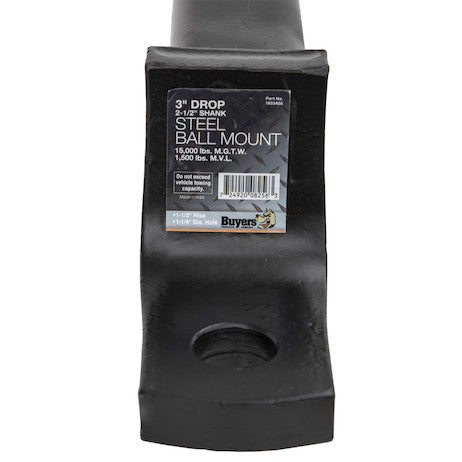
The 2-1/2 Inch Ball Mount from Buyers Products is rated to 15,000 lb. The mount works well with utility and landscape trailers. Choose the length and drop/rise that meets your needs. The mount features a two-piece welded steel construction and a corrosion-resistant black powder-coated finish. It accepts 1-1/4 in. shank diameter towing balls.
Specifications
| Ball Diameter | - |
|---|---|
| Color | Black |
| Finish | Powder-Coat |
| For Ball Shank Size (in.) | 1.25 |
| Length (in.) | 10.00 |
| M.G.T.W. (lbs) | 15,000 |
| M.V.L. (lbs) | 1,500 |
| Material | Carbon Steel |
| Maximum Drop (in.) | 3.00 |
| Maximum Rise (in.) | 1.50 |
| Mount Finish_1 | Powder-Coat |
| Receiver Tube Size | 2.50 |
| Shank Type | Tubular |
Advanced Technical Overview: The Buyers Products 2-1/2 Inch Ball Mount with 3 Inch Drop x 10 Inch Long Tube Black
The Buyers Products 2-1/2 Inch Ball Mount, specified with a 3-inch drop and a 10-inch long tubular shank, finished in black powder-coat, represents a robust and precisely engineered component for demanding towing applications. Designed for heavy-duty functionality, this ball mount integrates seamlessly with vehicles equipped with 2-1/2 inch receiver hitches, a standard typically found on 3/4-ton and 1-ton pickup trucks, as well as various commercial vehicles. Its design is a testament to the meticulous balance of material science, structural integrity, and practical utility, ensuring reliable performance across a broad spectrum of medium to heavy-duty towing scenarios. The following discourse provides an in-depth technical examination of its attributes and operational implications.
Central to this ball mount's capability is its impressive Maximum Gross Trailer Weight (M.G.T.W.) rating of 15,000 lbs. This substantial capacity signifies the maximum permissible total weight of the trailer being towed, inclusive of its cargo. Achieving such a rating necessitates superior design and material selection. This rating ensures that the ball mount can safely accommodate a wide range of trailers, from large utility and landscape trailers to certain construction, agricultural, and recreational vehicles like substantial boat trailers or medium-sized travel trailers. Adherence to this rating is not merely a recommendation but a critical safety imperative, preventing structural failure, instability, and potential accidents during transit. The design implicitly incorporates safety factors, ensuring that the working load is significantly below the material's ultimate tensile and yield strengths.
Complementing its M.G.T.W. is a Maximum Vertical Load (M.V.L.) rating of 1,500 lbs, commonly referred to as tongue weight. Tongue weight is the downward force exerted by the trailer coupler onto the hitch ball. This parameter is exceptionally critical for maintaining stable towing dynamics. An optimal tongue weight typically falls within 10-15% of the M.G.T.W. for conventional trailers. A tongue weight that is too low can lead to dangerous trailer sway, loss of control, and reduced steering effectiveness for the tow vehicle. Conversely, excessive tongue weight can overload the rear axle of the tow vehicle, impair braking performance, and reduce front wheel traction. The 1,500 lb M.V.L. capacity of this ball mount is commensurate with its 15,000 lb M.G.T.W., providing ample margin for proper load distribution and ensuring compliance with industry best practices for safe towing.
The specific configuration of a 3-inch drop is a key functional feature of this ball mount, designed to optimize trailer leveling. Achieving a level trailer is paramount for several reasons: it ensures uniform weight distribution across all trailer axles, prevents premature tire wear on one side, maintains optimal trailer braking effectiveness, and enhances overall stability by keeping the trailer's center of gravity correctly aligned. The requirement for a drop or rise depends on the vertical offset between the tow vehicle's receiver hitch opening and the trailer's coupler height when the trailer is level. A 3-inch drop is particularly suitable for tow vehicles with a relatively high receiver hitch height compared to the trailer's coupler, a common scenario with lifted trucks or heavy-duty vehicles towing standard utility trailers. The inclusion of a 1.5-inch maximum rise also provides versatility, allowing for adaptation to trailers with higher couplers if the ball mount is inverted.
The physical dimensions, including the 2-1/2 inch receiver tube size and 10-inch long tube, are integral to its functionality. The 2-1/2 inch receiver interface provides a substantial increase in cross-sectional area and material thickness compared to the more common 2-inch receivers. This enhanced dimension directly translates to superior bending strength and shear resistance, critical for managing the high stresses associated with heavy loads. The 10-inch length of the tube contributes to practical utility, providing sufficient extension to clear vehicle bumpers, tailgates, or spare tires, particularly on modern trucks with increasingly complex rear designs. While a longer tube can theoretically introduce a greater moment arm on the receiver, this 10-inch length is judiciously chosen to offer necessary clearance without significantly compromising the inherent strength and rigidity of the overall hitch system, when used within its rated capacities.
Material selection is fundamental to the durability and performance of any towing component. This ball mount is constructed from high-grade carbon steel. Carbon steel is chosen for its excellent balance of strength, ductility, and cost-effectiveness. Its inherent properties include a high tensile strength, which refers to the maximum stress it can withstand before fracturing, and a strong yield strength, the point at which it begins to deform permanently. The ductility of carbon steel allows it to absorb significant impact and dynamic loads without catastrophic brittle failure, a crucial characteristic in the variable and demanding environment of towing. Furthermore, the steel's weldability is excellent, facilitating the robust two-piece welded construction that forms the core of this unit's structural integrity.
The two-piece welded steel construction is a deliberate engineering choice that optimizes strength and manufacturing efficiency. Unlike cast or multi-component bolted designs that might introduce potential points of weakness or require periodic torque verification, a welded assembly ensures a monolithic structure where load forces are distributed continuously across the joint. The welding process, when executed to high standards, creates a joint that is often stronger than the parent material itself, provided proper penetration and absence of metallurgical defects. This construction method enhances the rigidity of the ball mount, minimizes flex under load, and contributes significantly to its long-term reliability and resistance to fatigue, an essential consideration for components subjected to repetitive stress cycles during towing.
To protect its robust steel core, the ball mount features a corrosion-resistant black powder-coated finish. Powder coating is an advanced finishing technology that surpasses traditional liquid paint in terms of durability and environmental friendliness. The process involves electrostatically applying a dry powder, typically a thermoset polymer, to the prepared metal surface. The component is then cured under heat, causing the powder to melt and flow into a uniform, hard, and chemically bonded layer. This creates an exceptionally tough finish that is highly resistant to chipping, scratching, abrasion, and fading. Crucially, the powder coat acts as a superior barrier against environmental aggressors such as moisture, road salt, chemicals, and UV radiation, which are significant contributors to corrosion and material degradation in outdoor and automotive applications. The black finish also provides a professional and aesthetically pleasing appearance that complements most vehicle finishes.
Compatibility with a 1-1/4 inch shank diameter towing ball is a critical specification. The ball shank is the threaded portion of the hitch ball that passes through the ball mount and is secured with a nut. The diameter of this shank is directly correlated with the strength and capacity of the hitch ball itself. A 1-1/4 inch shank is typically found on hitch balls rated for heavy-duty capacities, aligning perfectly with the 15,000 lb M.G.T.W. of this ball mount. It is imperative that users select a hitch ball with both the correct ball diameter for their trailer coupler and a shank diameter of 1-1/4 inches to ensure a secure and load-appropriate connection. Furthermore, the hitch ball's individual rating must always meet or exceed the ball mount's M.G.T.W. to prevent the weakest link in the towing chain from failing.
From an engineering perspective, the design of this ball mount incorporates principles of stress analysis and fatigue life. The tubular shank design, while lighter than a solid shank of equivalent strength, is optimized for bending and torsional rigidity. The distribution of material away from the neutral axis in a tubular section provides superior resistance to deformation for a given weight. The angles and dimensions are carefully calculated to distribute loads efficiently from the hitch ball platform to the receiver shank, minimizing stress concentrations. Advanced finite element analysis (FEA) is typically employed during the design phase to simulate various loading conditions and identify potential failure points, ensuring the final product can reliably perform under its rated capacities throughout its intended service life. This attention to detail extends to the weld geometry, where smooth transitions and full penetration are crucial to prevent stress risers.
The inherent durability of this Buyers Products ball mount is further underscored by its resistance to long-term operational stresses. Repeated cycles of acceleration, deceleration, and road shock can induce material fatigue, gradually weakening components over time. The choice of carbon steel with appropriate metallurgical properties, combined with robust welded construction, significantly enhances the mount's fatigue resistance. This ensures that the ball mount maintains its structural integrity and performance characteristics over thousands of miles and years of service, even in challenging environments. This longevity translates into a reliable investment for commercial operators and serious recreational towers alike, reducing the frequency of replacement and minimizing downtime.
Beyond utility and landscape trailers, the versatility of this 2-1/2 inch ball mount extends to a wide array of applications. It is well-suited for light- to medium-duty construction trailers carrying equipment like mini excavators, skid steers, or scissor lifts. In agriculture, it can manage trailers hauling implements, feed, or livestock within its weight class. For recreational use, it's an ideal choice for larger boat trailers, car haulers, or fifth-wheel conversion applications (when paired with appropriate adapters). Its substantial capacity also makes it a strong candidate for various commercial hauling tasks, including equipment rental operations and municipal fleet applications where robust and reliable towing is a daily requirement.
Integrating this ball mount into a complete towing system requires consideration of the tow vehicle's capabilities. Vehicles equipped with 2-1/2 inch receiver hitches are typically factory-rated for significant towing capacities, often exceeding 15,000 lbs, making this ball mount an appropriate component for such systems. However, users must always verify that their vehicle's gross combined vehicle weight rating (GCVWR), gross axle weight ratings (GAWR), and hitch receiver's rating (which may differ from the vehicle's maximum tow rating) are not exceeded. The performance of the ball mount is intrinsically linked to the strength and integrity of the entire towing chain, including the receiver, hitch pin, hitch ball, and trailer coupler. A holistic approach to capacity matching is paramount for safe operation.
Installation of the ball mount is straightforward, involving insertion into the receiver hitch and securing it with a properly rated hitch pin and clip (sold separately). However, precise installation of the hitch ball itself onto the ball mount is critical. The 1-1/4 inch shank ball requires specific torque values to ensure it is securely fastened, preventing any rotation or loosening under dynamic loads. Manufacturers' specifications for hitch ball torque should always be consulted and strictly adhered to, typically requiring a high-strength wrench or torque multiplier to achieve. Proper torque ensures the integrity of the connection, distributes stress effectively, and minimizes wear between the ball and the mount.
Regular inspection and maintenance are crucial for extending the service life and ensuring the safe operation of the ball mount. Users should periodically inspect the ball mount for any signs of wear, deformation, cracking, or excessive corrosion, particularly at welded joints and the receiver shank. The powder-coat finish, while durable, should also be checked for damage, and any deep scratches or chips exposing the bare metal should be addressed to prevent localized rust formation. Keeping the receiver tube interior and the ball mount shank clean and free of debris will facilitate easy insertion and removal, while also minimizing abrasive wear on the components. Adherence to a routine inspection schedule is a fundamental aspect of proactive safety management in towing operations.
Finally, the Buyers Products 2-1/2 Inch Ball Mount embodies a commitment to performance and safety. Its design specifications—15,000 lb M.G.T.W., 1,500 lb M.V.L., 3-inch drop, 10-inch tubular carbon steel shank, and black powder-coat finish—collectively define a product engineered for reliability under demanding conditions. It represents a critical interface in the towing system, designed to efficiently and safely transfer significant forces between the tow vehicle and the trailer. Choosing this ball mount means investing in a component that not only meets rigorous industry standards but also provides the peace of mind that comes from using a robust, well-constructed piece of equipment for your heavy-duty towing requirements, ensuring operational continuity and asset protection. The combination of its technical attributes delivers exceptional value and a strong return on investment through extended service life and unwavering performance.