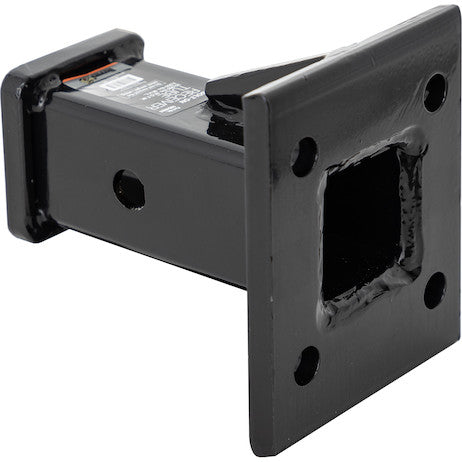
The Bolt-On Receiver Tube from Buyers Products allows towing flexibility in switching from a ball hitch to a pintle hook. It bolts directly into any hitch plate that has standard pintle hook hole patterns. This receiver tube (available for 2 in. and 2-1/2 in. receivers) is welded to a 1/2 in. steel mounting plate, and black powder-coated for corrosion resistance. It features a sturdy cast steel collar and a standard 5/8 in. hitch pin hole. The bolt-on tube is 7 inches long and is rated to 20,000 lb. The tube requires Buyers Products hardware kit 8520 for mounting.
Specifications
| Color | Black |
|---|---|
| Finish | Powder-Coat |
| M.G.T.W. (lbs) | 20,000 |
| M.V.L. (lbs) | 2,000 |
| Material | Carbon Steel |
| Receiver Size (in.) | 2.00 |
Advanced Technical Overview: Bolt-On Receiver Tube for 2-Inch Receivers
The Buyers Products Bolt-On Receiver Tube represents a robust and versatile solution for dynamic towing applications, meticulously engineered to optimize adaptability and operational efficiency within commercial and heavy-duty towing environments. This product is specifically designed to integrate seamlessly into existing hitch plate configurations, offering a critical upgrade for vehicles requiring multifaceted towing capabilities. Its primary function is to facilitate the rapid and secure transition between distinct trailer coupling mechanisms, namely traditional ball hitches and robust pintle hooks, without the need for extensive equipment overhaul.
Engineering and Design Principles
At its core, the Bolt-On Receiver Tube is a testament to rigorous engineering principles, focusing on structural integrity, universal compatibility, and long-term durability. The design centers around a robust 2-inch receiver tube, a standardized dimension ensuring broad interoperability with a vast array of common towing accessories and drawbars. This tube is meticulously welded to a substantial 1/2-inch thick steel mounting plate, a critical design element that distributes applied forces effectively across the vehicle's hitch structure, thereby mitigating localized stress concentrations and enhancing overall system resilience. The choice of carbon steel as the primary construction material underscores a commitment to high tensile strength and fatigue resistance, properties indispensable for applications involving significant dynamic loads.
Material Specification: Carbon Steel
The utilization of carbon steel for the primary components – the receiver tube itself and the mounting plate – is a strategic engineering decision driven by its superior mechanical properties. Carbon steel, known for its high strength-to-weight ratio and excellent weldability, provides the foundational rigidity necessary to withstand the extreme longitudinal and vertical forces inherent in heavy-duty towing. Its inherent toughness ensures resistance to impact and abrasion, common occurrences in demanding operational settings. Furthermore, carbon steel's predictable metallurgical characteristics allow for consistent manufacturing quality, ensuring each unit meets stringent performance criteria. The material's ability to undergo heat treatment and forming processes contributes to the final product's dimensional accuracy and structural consistency, critical factors for reliable performance under maximum rated loads.
Protective Coating: Black Powder-Coat Finish
To counteract the pervasive threat of environmental degradation, particularly corrosion, the Bolt-On Receiver Tube undergoes a comprehensive black powder-coating process. This advanced surface treatment is far superior to conventional liquid paints in terms of durability, chip resistance, and environmental impact. The powder-coating process involves electrostatically applying a dry powder material, composed of finely ground particles of pigment and resin, onto the metal substrate. The component is then cured under heat, causing the powder to melt and flow into a uniform, hard finish. This creates a resilient barrier that effectively seals the carbon steel from moisture, road salts, chemicals, and abrasive elements encountered during operation. The black aesthetic provides a professional, low-profile appearance while simultaneously offering exceptional protection against oxidation and galvanic corrosion, thereby extending the operational lifespan of the unit and preserving its structural integrity over years of service.
Structural Components and Load Bearing Capabilities
The design of the Bolt-On Receiver Tube incorporates several key structural features that collectively contribute to its impressive 20,000 lb. Gross Trailer Weight (M.G.T.W.) rating and 2,000 lb. Vertical Load (M.V.L.) rating. Each component plays a vital role in ensuring safe and efficient load transfer.
The 1/2-Inch Steel Mounting Plate
The robust 1/2-inch thick steel mounting plate serves as the interface between the receiver tube and the vehicle's hitch structure. Its substantial thickness is critical for several reasons. Firstly, it provides a large surface area for secure attachment, distributing the immense forces exerted during towing across a wider section of the vehicle's frame or hitch plate. This reduces localized stress concentrations, preventing deformation or fatigue failures in the mounting points. Secondly, the plate’s rigidity ensures that the receiver tube maintains its precise alignment under load, preventing any unwanted angular deflection that could compromise the integrity of the hitch connection or the trailer’s stability. The pre-drilled holes in the plate conform to standard pintle hook hole patterns, ensuring direct and hassle-free integration with a wide range of commercial and heavy-duty vehicles without the need for custom fabrication.
Welded Construction and Cast Steel Collar
The receiver tube is permanently welded to the mounting plate, creating an integral, monolithic structure. This welding process is executed to high industrial standards, ensuring full penetration and robust metallurgical bonds capable of enduring severe dynamic stresses. A critical enhancement to the receiver tube's structural integrity is the sturdy cast steel collar. This collar is strategically positioned at the opening of the receiver tube, where the drawbar or accessory inserts. Cast steel is selected for its superior strength and wear resistance, especially under compressive forces. The collar reinforces the tube's mouth, preventing deformation, ovalization, or stress cracks that could otherwise occur from repeated insertion and removal of towing accessories, or from the continuous pounding forces experienced during heavy-duty towing. It also ensures a precise fit for accessories, minimizing play and enhancing the security of the hitch connection.
Standard 5/8-Inch Hitch Pin Hole
The integration of a standard 5/8-inch hitch pin hole is a testament to the product's commitment to universal compatibility and ease of use. This dimension is the industry standard for 2-inch receiver tubes, allowing for the immediate utilization of a vast array of hitch pins, locks, and security devices readily available in the market. The precise drilling and finishing of this hole are critical to ensure a snug fit for the pin, thereby minimizing movement between the receiver tube and the inserted accessory. This reduction in play is crucial for towing stability, preventing jarring and premature wear on both the hitch components and the trailer's coupling system. The strategic placement of this hole optimizes the effective length of the receiver for various accessory types while maintaining optimal leverage and load distribution.
Receiver Tube Dimensions: 7-Inch Length
The 7-inch effective length of the receiver tube is an intentional design choice that balances several operational considerations. This length provides sufficient engagement depth for various hitch accessories, ensuring secure attachment and proper load transfer. It also offers adequate clearance from the vehicle's bumper or other rear components, accommodating a wide range of trailer tongue designs and allowing for proper articulation during turns. The carefully selected length contributes to the system's overall rigidity without introducing excessive leverage that could induce unwanted torsional stresses on the hitch plate or vehicle frame. This optimized length ensures that the towing point is positioned effectively for stability and maneuverability across diverse towing scenarios.
Performance Ratings and Safety Parameters
The specified load ratings for the Bolt-On Receiver Tube are crucial indicators of its capacity and the types of applications it is designed for.
Maximum Gross Trailer Weight (M.G.T.W.) of 20,000 lbs
The M.G.T.W. rating of 20,000 lbs signifies the maximum permissible total weight of the fully loaded trailer that this receiver tube is engineered to safely tow. This substantial rating positions the product firmly within the heavy-duty segment of the towing equipment market. Applications necessitating such capacity typically involve:
- Large commercial utility trailers
- Construction equipment transport (e.g., skid steers, mini excavators)
- Industrial flatbed trailers
- Agricultural implements and livestock trailers
- Heavy marine trailers
Maximum Vertical Load (M.V.L.) of 2,000 lbs
The M.V.L., also known as tongue weight, specifies the maximum downward force that the trailer's tongue can exert on the receiver tube. A rating of 2,000 lbs is commensurately high, reflecting the M.G.T.W. and indicating the receiver's capacity to handle significant static and dynamic vertical loads. Proper tongue weight is critical for maintaining towing stability, preventing trailer sway, and ensuring safe vehicle handling. Too little tongue weight can lead to dangerous sway, while excessive tongue weight can overload the vehicle's rear suspension and compromise braking and steering. The 2,000 lb M.V.L. rating ensures compatibility with a broad spectrum of heavy trailers, allowing for proper weight distribution within the recommended 10-15% of the M.G.T.W. for conventional towing. This robust M.V.L. capacity is directly supported by the structural integrity of the 1/2-inch mounting plate and the welded connection.
Operational Flexibility and Application Versatility
The core advantage of the Bolt-On Receiver Tube lies in its unparalleled operational flexibility, allowing for seamless interchangeability between different hitch types. This capability is indispensable for fleets and individual operators who manage diverse towing requirements.
Ball Hitch Compatibility
When coupled with a standard ball mount, the receiver tube facilitates traditional towing with trailers equipped with a coupler. This is ideal for a vast array of conventional trailers, offering a secure and widely accepted connection method. The 2-inch receiver size ensures compatibility with most common ball mount shanks, accommodating various drop/rise requirements and ball sizes.
Pintle Hook Integration
The ability to switch to a pintle hook configuration significantly expands the towing capabilities, making the unit suitable for applications involving lunette eye trailers. Pintle hooks are particularly advantageous for off-road operations, construction sites, and military applications due to their robust design and ability to handle greater articulation and shock loads compared to ball hitches. The bolt-on design, utilizing standard pintle hook hole patterns, allows for direct attachment of a pintle hook or a combination pintle/ball hitch, providing a rugged and reliable connection for heavy equipment and utility trailers that often feature a lunette ring.
Industries and Applications
The adaptability of this receiver tube makes it an invaluable asset across numerous demanding industries:
- Construction: Transporting material trailers, portable generators, air compressors, and small to medium-sized machinery.
- Landscaping & Tree Service: Hauling chippers, stump grinders, equipment trailers, and material delivery.
- Municipal & Utility: Supporting aerial lift trailers, cable pullers, emergency service equipment, and general utility maintenance.
- Agricultural: Moving various farm implements, grain wagons, and specialized agricultural trailers.
- Fleet Operations: Standardizing equipment across a diverse fleet that might encounter varying trailer types on a daily basis, reducing downtime for hitch changes.
- Rental Fleets: Providing versatile towing options for customers renting vehicles or trailers with different coupling needs.
Installation and Maintenance Protocol
Installation of the Bolt-On Receiver Tube is designed to be straightforward, leveraging standard pintle hook mounting patterns. It requires the Buyers Products hardware kit 8520, which is specifically engineered to provide the correct grade and dimensions of fasteners for a secure and load-bearing connection. Proper installation is critical for realizing the full rated capacity of the product and ensuring safety.
Installation Procedure (General Guidelines):
- Preparation: Ensure the vehicle's hitch plate is clean, free of debris, and structurally sound. Verify that the mounting surface dimensions match the receiver tube's plate.
- Positioning: Align the mounting plate of the receiver tube with the pre-drilled holes on the vehicle's hitch plate. The standard pintle hook hole patterns ensure a precise fit.
- Hardware Application: Insert the bolts from Buyers Products hardware kit 8520 through the aligned holes. Secure them with appropriate washers and nuts. It is imperative to use the specified hardware kit as its components are rated for the loads involved.
- Torque Specification: Crucially, tighten all fasteners to the torque specifications provided with the hardware kit or the vehicle's hitch plate manufacturer guidelines. Using a calibrated torque wrench is essential to prevent undertightening (which can lead to loosening and failure) or overtightening (which can stretch bolts and compromise their integrity).
- Final Inspection: After installation, visually inspect all connections to ensure proper seating and engagement. Conduct a load-free test to confirm stability and absence of abnormal noises.
Maintenance and Longevity:
While the black powder-coat finish offers excellent corrosion resistance, routine inspection and minor maintenance will significantly extend the operational life of the Bolt-On Receiver Tube:
- Regular Cleaning: Periodically clean the receiver tube and mounting plate to remove dirt, mud, salt, and other corrosive agents.
- Finish Inspection: Inspect the powder-coat for any signs of chipping or deep scratches. Minor abrasions can be touched up with corrosion-resistant paint to prevent rust initiation.
- Fastener Check: Regularly verify that all mounting bolts remain torqued to specification. Vibration and continuous load cycles can occasionally cause fasteners to loosen.
- Pin Hole & Collar: Keep the 5/8-inch hitch pin hole clear of debris. Lubricate the inner surface of the receiver tube and the cast collar lightly with grease or a dry lubricant to facilitate accessory insertion and minimize wear.
- Structural Integrity: Periodically inspect the welds for any signs of cracking or fatigue. Any structural damage should prompt immediate replacement of the unit.
Conclusion
The Buyers Products Bolt-On Receiver Tube for 2-inch receivers is a meticulously engineered, heavy-duty towing component designed for professional applications demanding versatility, strength, and durability. Its strategic use of carbon steel, advanced powder-coat finish, and robust structural components like the 1/2-inch mounting plate and cast steel collar, all contribute to its impressive 20,000 lb M.G.T.W. and 2,000 lb M.V.L. ratings. By providing seamless interchangeability between ball hitches and pintle hooks, it empowers operators across construction, utility, agriculture, and commercial transport sectors to manage diverse towing requirements with a single, reliable solution. This product is not merely an accessory; it is a fundamental enhancement to any heavy-duty towing system, offering a blend of flexibility, safety, and longevity that sets a benchmark in the industry.