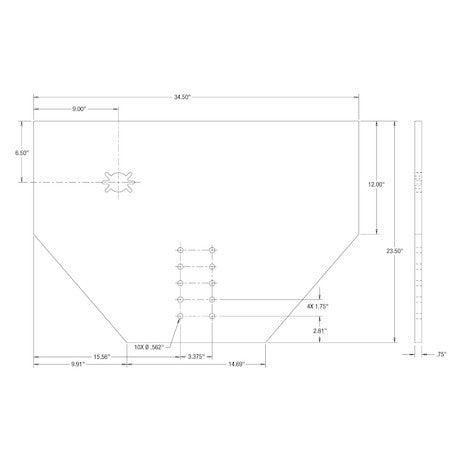
The Fabricators Hitch Plate from Buyers Products lets you build your hitch plate to meet your specific vehicle and needs. Available in thicknesses of 1/2 in., 5/8 in., 3/4 in., or 1 in., the hitch plate features multiple pintle hook mounting positions and a pre-punched hole for electrical connectors. The hitch plate is welded to the frame. Included are two D-rings and weld-on gussets for custom placement. Hole Diameter: .56??? for 1809027A, 1809040, 1809042, 1809043 .812??? for 1809029 Vertical Hole Spacing: 1.75??? for 1809027A, 1809040, 1809042, 1809043 2.25??? for 1809029 Horizontal Hole Spacing: 3.38??? for 1809027A, 1809040, 1809042, 1809043, 4.5??? for 1809029
Specifications
| Application Specific (Y/N) | No |
|---|---|
| Application Summary | Dump Truck |
| Finish | Plain |
| Height (in.) | 23.50 |
| Hitch Plate or Bumper | Fabricators Kit |
| M.G.T.W. (lbs.) | Not Rated |
| M.V.L. (lbs.) | - |
| Material | Carbon Steel |
| Receiver Size (in.) | - |
| Thickness (in.) | 3/4 |
| Width (in.) | 34.50 |
The Fabricators Hitch Plate, with its specific dimensions of 3/4 x 34-1/2 x 23-1/2 inches, represents a foundational component engineered for the most demanding heavy-duty towing and recovery applications. Manufactured by Buyers Products, this hitch plate is designed not as a standalone, pre-configured solution, but as a critical building block within a comprehensive custom fabrication project. Its robust construction, versatility, and adherence to industry-standard dimensions make it an indispensable asset for professional fabricators seeking to integrate high-strength towing capabilities onto commercial vehicles, particularly dump trucks and similar heavy equipment platforms. The emphasis on customizability allows end-users to precisely tailor the final hitch system to their unique operational requirements, load characteristics, and vehicle specifications, ensuring optimal performance and safety under extreme conditions.
Material selection is paramount for components subjected to significant dynamic and static loads, and this Fabricators Hitch Plate excels in this regard by utilizing high-grade carbon steel. Carbon steel is chosen for its exceptional tensile strength, yield strength, and inherent durability, properties that are critical for absorbing and distributing the substantial forces generated during towing operations. The specific formulation of carbon steel used is optimized for weldability, allowing for robust and reliable attachment to the vehicle’s frame. This metallurgical characteristic is crucial for a product explicitly designated as a "Fabricators Kit," where the integrity of the welded joints directly impacts the overall structural stability and safety of the final assembly. The material's resistance to fatigue under cyclic loading ensures a prolonged service life, even in environments characterized by constant heavy use, vibrations, and varying stress profiles.
A defining characteristic of this particular model is its substantial thickness of 3/4 inch (0.75 inches). This dimension is not arbitrary; it represents a carefully calculated balance between material strength, weight, and manufacturing feasibility. The 3/4-inch thickness provides superior rigidity and load-bearing capacity compared to thinner alternatives, effectively preventing deformation, bending, or fracturing under the high shear and tensile stresses experienced during heavy towing. While other thicknesses such as 1/2 inch, 5/8 inch, and 1 inch are available for different load profiles and application-specific requirements, the 3/4-inch variant offers a robust solution for a wide range of heavy-duty tasks, including those typically encountered by dump trucks. This substantial gauge material contributes significantly to the plate's ability to act as a secure anchor point for pintle hooks and other towing attachments, ensuring that the primary connection to the trailer remains uncompromised.
The physical dimensions of 34-1/2 inches in width and 23-1/2 inches in height provide a generous mounting area, facilitating the integration of various towing accessories and ensuring compatibility with a broad spectrum of heavy-duty vehicle chassis. These dimensions are crucial for accommodating multiple pintle hook mounting positions, which are a key feature of this plate. The ample surface area allows fabricators the flexibility to drill additional holes or modify existing patterns if specific non-standard attachments are required, further enhancing its adaptability. The precision with which these dimensions are maintained during the manufacturing process, through advanced cutting and forming techniques, ensures a consistent and high-quality product that integrates seamlessly into custom builds, minimizing the need for extensive on-site modification prior to installation.
A critical feature enhancing the versatility of this Fabricators Hitch Plate is the provision for multiple pintle hook mounting positions. This design element acknowledges the diverse requirements of heavy-duty towing, where different trailers may possess varying tongue heights, articulation needs, and weight distribution characteristics. By offering a selection of mounting points, fabricators can achieve optimal trailer leveling, improve towing dynamics, and enhance overall operational safety. The specified hole diameters and spacing are meticulously engineered to conform to common industry standards for pintle hook attachments. For instance, the .56-inch hole diameter with 1.75-inch vertical and 3.38-inch horizontal spacing typically accommodates smaller to medium-duty pintle hooks, while the larger .812-inch hole diameter with 2.25-inch vertical and 4.5-inch horizontal spacing is designed for heavier-duty pintle hooks that require more substantial mounting hardware. This foresight in design significantly streamlines the fabrication process, reducing the need for custom drilling in critical load-bearing areas and ensuring secure attachment of towing mechanisms.
Beyond mechanical connections, modern towing operations necessitate reliable electrical integration. The pre-punched hole for electrical connectors on the Fabricators Hitch Plate is a testament to its comprehensive design. This feature simplifies the routing and protection of trailer wiring harnesses, which are essential for trailer lighting, braking systems, and auxiliary power. By providing a dedicated, factory-punched aperture, the risk of improper field modifications that could compromise the plate's structural integrity or expose wiring to damage is significantly reduced. This hole is strategically positioned to allow for a clean, professional installation of standard electrical connectors (e.g., 7-pin round, 6-pin round, or similar heavy-duty connections), ensuring compliance with vehicle lighting and safety regulations while safeguarding electrical components from environmental hazards and mechanical stress.
The inclusion of two D-rings and weld-on gussets underscores the product's commitment to both safety and structural reinforcement. D-rings serve as indispensable auxiliary attachment points for safety chains, clevis hooks, or recovery straps, providing redundant connection points that are critical for mitigating hazards in the event of primary hitch failure or for vehicle recovery scenarios. Their weld-on design allows for custom placement, enabling fabricators to position them optimally based on the vehicle’s specific geometry and intended use. The weld-on gussets are equally vital; these triangular reinforcing plates are designed to be strategically welded to the hitch plate and the vehicle frame, distributing localized stresses over a broader area and significantly enhancing the structural rigidity and fatigue resistance of the entire assembly. This reinforcement is particularly important at critical load transfer points, preventing potential stress cracks and increasing the overall longevity and safety factor of the custom-fabricated hitch system.
The installation method specified for this product is welding to the vehicle frame. This approach offers distinct advantages over bolt-on solutions, particularly in heavy-duty applications. Welding creates a monolithic connection between the hitch plate and the chassis, ensuring superior load transfer, exceptional rigidity, and minimal deflection under extreme towing forces. This method eliminates the potential for fastener loosening, shearing, or fatigue that can occur with bolted connections over time in high-stress environments. For professional fabricators, welding provides the highest level of structural integration and strength, allowing the hitch plate to become an integral, load-bearing extension of the vehicle's frame. Proper welding procedures, executed by certified welders using appropriate techniques and filler materials, are paramount to harness the full structural benefits of this design, ensuring the safety and long-term reliability of the completed towing system.
The product's classification as "Not Application Specific" with an "Application Summary" of "Dump Truck" highlights its unique positioning in the market. While designed with the robust demands of dump trucks in mind—vehicles known for their heavy loads, rugged operating conditions, and frequent towing of trailers like pup trailers or equipment haulers—its "No" for application specificity means it is not confined to a single make or model. Instead, it serves as a universal, high-strength blank slate. This provides unparalleled design freedom for fabricators, enabling them to adapt the plate to virtually any heavy-duty vehicle requiring a custom rear hitch solution. This flexibility is invaluable for fleets with diverse equipment, allowing for standardization of core components while accommodating individual vehicle nuances.
Crucially, the "M.G.T.W. (Maximum Gross Trailer Weight)" is listed as "Not Rated." This designation is standard for fabricator's kits and reflects a fundamental principle: the ultimate towing capacity of the finished assembly is not solely determined by the hitch plate itself, but by the weakest link in the entire system. This includes the strength of the vehicle’s frame, the quality and integrity of the welds, the specifications of the pintle hook or receiver chosen, and the overall design and engineering of the complete custom hitch system. Consequently, the responsibility for rating the final towing capacity rests with the professional fabricator or vehicle modifier, who must ensure that the completed installation complies with all applicable federal, state, and local regulations, as well as industry safety standards. This requires comprehensive engineering analysis, proper welding certification, and potentially load testing of the final assembly.
The "Plain" finish further reinforces the product's role as a fabricator's component. A plain, uncoated surface is ideal for welding, as it allows for direct metal-to-metal fusion without the need for extensive pre-grinding or removal of protective coatings. After welding and any subsequent fabrication, the plain finish provides a perfect substrate for the application of custom protective coatings, such as industrial-grade primers, paints, powder coatings, or galvanization. This allows the fabricator to select the most appropriate corrosion protection system based on the intended operating environment, aesthetic requirements, and budget, ensuring maximum longevity and resistance to elements like road salt, moisture, and abrasive debris. This custom finishing capability contributes to the product's overall adaptability and value proposition in professional fabrication settings.
From an engineering perspective, the design of this Fabricators Hitch Plate incorporates principles of robust structural mechanics. The strategic placement of mounting holes and the inclusion of gussets are critical for ensuring efficient load distribution. When a trailer is attached and subjected to dynamic forces (acceleration, braking, cornering, and vertical impacts), the forces are transmitted through the pintle hook to the hitch plate. The plate must effectively transfer these forces to the vehicle's frame without localized stress concentrations that could lead to material failure. The substantial thickness of 3/4 inch ensures a large cross-sectional area to resist bending moments and shear forces, while the weld-on gussets reinforce the areas most prone to stress, particularly where the plate transitions into the vehicle's main frame rails. This holistic approach to design minimizes stress risers and enhances the fatigue life of the entire towing system, which is paramount for safety and operational reliability in commercial heavy-duty applications.
Adherence to and understanding of industry standards, while not directly assigned to an unrated component, is implicitly integrated into the design and intended use of this Fabricators Hitch Plate. Standards such as those promulgated by the Society of Automotive Engineers (SAE), particularly SAE J684 for trailer hitches, and various governmental regulations concerning vehicle modifications and towing capacities, provide a framework within which fabricators operate. While this specific plate is a component, its dimensions, material properties, and design features are conducive to building systems that can ultimately meet these rigorous standards. Fabricators utilizing this product are expected to possess the expertise to design and construct a complete hitch system that complies with all relevant safety and performance criteria, ensuring that the finished vehicle is legally operable and safe for its intended purpose.
The process of integrating this Fabricators Hitch Plate involves several critical steps that demand professional expertise. Initially, careful planning and precise measurements are necessary to determine the optimal placement on the vehicle frame, considering factors such as departure angle, ground clearance, and clearance for existing vehicle components (e.g., spare tire carriers, exhaust systems). Following placement, meticulous surface preparation of both the hitch plate and the vehicle frame is required to ensure clean, strong welds. The welding process itself must be executed by certified welders employing techniques appropriate for carbon steel, such as MIG (Gas Metal Arc Welding), TIG (Gas Tungsten Arc Welding), or Stick (Shielded Metal Arc Welding), depending on the fabricator's preference and equipment. Post-welding inspection, including visual and potentially non-destructive testing, is essential to verify weld integrity. Finally, the application of a protective coating not only enhances aesthetics but critically prevents corrosion, extending the operational lifespan of the entire assembly.
In conclusion, the Fabricators Hitch Plate 3/4 x 34-1/2 x 23-1/2 Inch from Buyers Products is an exemplary core component for heavy-duty vehicle customization. Its construction from high-quality, weldable carbon steel, combined with a substantial 3/4-inch thickness, ensures exceptional strength and durability. The thoughtful integration of multiple pintle hook mounting positions and a pre-punched electrical connector hole provides unparalleled versatility and convenience for professional fabricators. With included D-rings and weld-on gussets, and an installation method focused on welding to the frame, this product offers the highest degree of structural integrity and safety for custom towing solutions, particularly for demanding applications like dump trucks. While "Not Rated" for M.G.T.W. as a standalone component, its design facilitates the creation of robust, compliant, and high-capacity towing systems when properly integrated by skilled professionals. This hitch plate empowers fabricators to engineer bespoke towing solutions that meet the specific, stringent demands of commercial and industrial operations, guaranteeing reliability and performance over years of rigorous service.