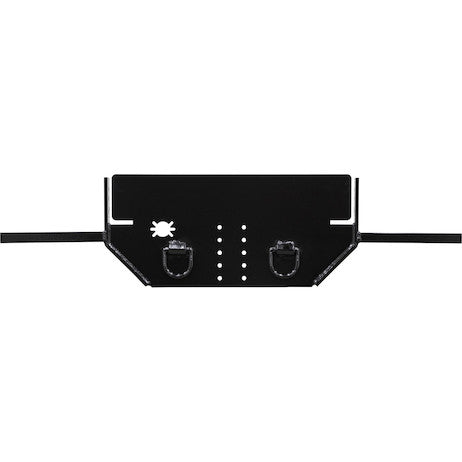
The Hitch Plate for Pintle Mounting with Side Channel from Buyers Products features multiple pintle hook mounting positions, two forged D-rings, and a pre-punched hole that fits most trailer electrical connectors. The hitch plate is pre-fabricated and ready to use. The 1/2 in. thick hitch plate includes ICC bumper protection and features a black powder-coated finish for corrosion resistance. It should be both welded and bolted to the frame. Available in several chassis-specific models (not for pickups). Please consult the vehicle/chassis owner's manual before installing. For use with cab and chassis trucks with a nominal 34 in. frame width.
Specifications
| Application Specific (Y/N) | Yes |
|---|---|
| Application Summary | Chevy?? 3500 Cab & Chassis |
| Color | Black |
| Finish | Powder-Coat |
| Height (in.) | 15.50 |
| Hitch Plate or Bumper | Hitch Plate |
| M.G.T.W. (lbs.) | 20,000 |
| M.V.L. (lbs.) | - |
| Make | Chevy?? |
| Material | Carbon Steel |
| Model | 3500 |
| Receiver Size (in.) | - |
| Style | Cab & Chassis |
| Thickness (in.) | 1/2 |
| Width (in.) | 34.12 |
The Hitch Plate with Pintle Mount for Chevy/GM 3500 Cab & Chassis - Side Channel represents a critical component in the heavy-duty towing infrastructure, specifically engineered for the demanding applications inherent to commercial and industrial operations. This robust hitch plate is not merely an accessory but a foundational element designed to provide a secure, compliant, and highly versatile towing interface for Class 3 and 4 trailers. Its design and construction are meticulously tailored to meet the rigorous performance requirements of heavy-duty cab and chassis trucks, offering a maximum gross trailer weight (M.G.T.W.) rating of 20,000 lbs.
Precision Engineering and Application Specificity
At the core of this product's value proposition is its application-specific design. Unlike generic towing solutions, this hitch plate is precisely engineered for Chevy/GM 3500 Cab & Chassis models with a nominal 34-inch frame width. This specificity ensures optimal fitment, load distribution, and structural integrity, crucial for maintaining vehicle warranty and operational safety. The designation "Side Channel" in the product title refers to the integrated structural elements that facilitate a robust, multi-point connection to the vehicle's frame. This design method enhances torsional rigidity and sheer strength, distributing towing forces efficiently across the chassis frame rails. The precise pre-fabrication minimizes installation time and potential for error, allowing for direct integration into the specified vehicle architecture. It is imperative to note its explicit exclusion for pickup trucks, as their frame designs and load-bearing capacities differ significantly from dedicated cab and chassis platforms, which are built to accommodate diverse upfit bodies and heavier tongue weights.
Advanced Material Science and Durability
The structural integrity of this hitch plate is primarily derived from its material composition and thickness. Fabricated from 1/2 inch thick carbon steel, the plate offers an exceptional balance of strength, ductility, and fatigue resistance. Carbon steel, known for its high tensile strength and ability to withstand significant static and dynamic loads, is the material of choice for demanding structural components in the automotive and heavy equipment industries. The 1/2-inch thickness is critical for handling the stresses associated with a 20,000 lb. M.G.T.W., providing ample cross-sectional area to resist bending, twisting, and shear forces during acceleration, braking, and cornering. This material selection ensures prolonged service life even under arduous operating conditions, resisting deformation and failure over thousands of towing cycles.
Corrosion Resistance through Powder-Coating Technology
Beyond its inherent material strength, the Hitch Plate is further enhanced by a black powder-coated finish. Powder coating is a dry finishing process that employs finely ground particles of pigment and resin, which are electrostatically charged and sprayed onto a grounded surface. The charged powder particles adhere to the electrically grounded surfaces until melted and fused into a smooth coating in a curing oven. This process yields a finish that is significantly more durable and environmentally friendly than conventional liquid painting methods. The benefits of powder coating are manifold:
- Superior Corrosion Resistance: The thick, uniform coating acts as an impermeable barrier against moisture, road salts, chemicals, and other corrosive agents, preventing rust and preserving the underlying carbon steel. This is particularly vital for vehicles operating in harsh environments or regions with significant seasonal weather variations.
- Enhanced Abrasion and Impact Resistance: Powder-coated surfaces are notably resistant to chipping, scratching, and general wear and tear, maintaining their aesthetic and protective qualities even after repeated exposure to road debris and operational impacts.
- Chemical Resistance: The finish provides protection against common automotive fluids, greases, and industrial solvents, ensuring the integrity of the coating is maintained throughout its operational lifespan.
- UV Stability: The black powder coat is formulated to resist fading and degradation from ultraviolet (UV) radiation, ensuring long-term color retention and protective performance.
Integrated Safety and Functionality Features
The design of this hitch plate incorporates several key features that underscore its commitment to operational safety, versatility, and ease of use:
Multiple Pintle Hook Mounting Positions
The provision of multiple pintle hook mounting positions is a significant design advantage, offering unparalleled versatility for diverse towing scenarios. Pintle hooks are widely used in commercial and military applications for their robust coupling mechanism, particularly effective with heavy, off-road, or articulated trailers that may experience significant vertical movement. The various mounting positions allow operators to:
- Optimize Trailer Leveling: Adjusting the pintle hook height ensures the trailer remains level during transit, which is critical for proper load distribution across trailer axles, tire wear, and stability. An unlevel trailer can lead to increased tongue weight, reduced braking efficiency, and compromised handling.
- Accommodate Different Trailer Coupler Heights: Commercial fleets often operate a variety of trailers with varying coupler heights. Multiple mounting positions eliminate the need for specialized adapters or modified drawbars, streamlining operations and improving fleet flexibility.
- Enhance Towing Dynamics: Correct pintle height minimizes vertical oscillation and improves overall vehicle-trailer dynamics, contributing to safer and more comfortable towing experiences, especially over uneven terrain.
Forged D-Rings for Securement
Integral to the hitch plate are two forged D-rings. These D-rings serve as primary attachment points for trailer safety chains, a mandatory safety feature in most jurisdictions to prevent runaway trailers in the event of a primary coupling failure. The "forged" designation is crucial: forging is a manufacturing process that involves shaping metal using localized compressive forces, resulting in a grain structure that follows the shape of the part. This process significantly enhances the material's strength, toughness, and fatigue resistance compared to cast or machined components. Forged D-rings are therefore exceptionally strong and reliable, capable of withstanding the sudden and extreme forces that could be exerted during an accidental trailer detachment. Their robust design ensures compliance with stringent safety regulations and provides peace of mind for operators.
Pre-Punched Electrical Connector Hole
A pre-punched hole for trailer electrical connectors is a thoughtful inclusion that simplifies installation and ensures a professional finish. This feature is designed to accommodate most standard trailer electrical connectors, such as 7-way RV blade connectors or 6-way round connectors, which are essential for transmitting power to trailer lights (tail, brake, turn signals), auxiliary power, and electric trailer brakes. The pre-punched nature eliminates the need for field modifications, which can compromise material integrity or introduce potential points of failure. It ensures proper routing and protection of electrical wiring, preventing damage from road debris or environmental exposure, and thereby maintaining reliable communication between the truck and trailer for critical safety functions.
ICC Bumper Protection Integration
The inclusion of ICC bumper protection is a critical safety feature, aligning this product with strict federal safety standards. ICC bumper, more accurately referred to as a Rear Underride Protection Device (RUPD) in modern terminology (e.g., FMVSS 223/224 in the U.S., CMVSS in Canada), is designed to prevent passenger vehicles from underriding the rear of a larger truck or trailer during a rear-end collision. Such underride collisions can result in severe occupant injuries or fatalities in the striking vehicle. The Hitch Plate's design actively contributes to meeting these underride protection standards by providing a robust, low-mounted structural barrier at the rear of the vehicle. This integration means that the towing apparatus not only facilitates load transport but also enhances overall vehicle safety by mitigating collision risks, a paramount concern for fleet operators and regulatory bodies.
Performance Specifications and Structural Integrity
The stated Maximum Gross Trailer Weight (M.G.T.W.) of 20,000 lbs. is a testament to the robust engineering and high-strength materials utilized in this hitch plate. This rating signifies the maximum combined weight of a fully loaded trailer that the hitch plate is certified to safely tow. Achieving such a high rating requires meticulous attention to material selection, structural design, and attachment methods. The 15.50-inch height and 34.12-inch width (nominal 34-inch frame width) are precisely dimensioned to integrate seamlessly with the specified Chevy/GM 3500 Cab & Chassis frame, ensuring that the substantial towing forces are distributed effectively across the vehicle's structural members without causing undue stress concentrations. The absence of a "M.V.L. (lbs.)" (Maximum Vertical Load or Tongue Weight) specification implies that the tongue weight capacity is directly correlated with the vehicle's manufacturer-specified limits for vertical load on the chassis frame, which should always be consulted.
Installation Protocol: Welded and Bolted for Ultimate Security
A distinctive and crucial aspect of this hitch plate's design is its prescribed installation method: it "should be both welded and bolted to the frame." This dual-attachment strategy is engineered for maximum structural integrity and long-term reliability in heavy-duty applications.
- Welding: Permanent welds create a monolithic connection between the hitch plate and the chassis frame. This fusion process eliminates any possibility of movement between the components, offering superior shear strength and torsional rigidity. Welding provides the highest level of structural integration, ensuring that the towing forces are directly transferred to the vehicle's main frame without reliance on friction alone.
- Bolting: High-strength bolts provide additional clamping force, distributing load over a wider area and acting as a fail-safe redundancy. Bolted connections are inspectable and, if necessary, serviceable, allowing for maintenance or removal. The combination of welding and bolting leverages the strengths of both connection types, creating an exceptionally strong, secure, and compliant installation. This approach is standard practice in heavy-duty commercial vehicle upfitting, designed to withstand the dynamic stresses and vibrations inherent in towing heavy loads over varied terrain.
Operational Considerations and Safety Compliance
Before installation, users are explicitly advised to "consult the vehicle/chassis owner's manual." This directive is not merely a formality; it is a critical safety and compliance measure. The vehicle's manual contains vital information regarding frame specifications, weight limits, specific installation instructions or warnings, and potential warranty implications of aftermarket modifications. Adherence to these guidelines ensures that the combined vehicle and hitch system operates within its engineered parameters, preventing overstressing of the chassis, braking systems, or other vehicle components. Proper installation and operation are key to ensuring compliance with all applicable federal, state, and local towing regulations, which often cover aspects like safety chain requirements, lighting, and braking systems.
Conclusion: A Robust Solution for Commercial Towing
The Hitch Plate with Pintle Mount for Chevy/GM 3500 Cab & Chassis - Side Channel from Buyers Products is an expertly engineered solution for heavy-duty commercial towing. Its precision design, robust 1/2-inch carbon steel construction, advanced powder-coated finish, and integration of critical safety features like multiple pintle mounting positions, forged D-rings, electrical connector provision, and ICC bumper protection, all culminate in a product of exceptional reliability and durability. With an impressive M.G.T.W. of 20,000 lbs. and a mandate for both welded and bolted installation, this hitch plate stands as a testament to uncompromising performance and safety in demanding operational environments. It empowers fleet managers and operators with a dependable and compliant towing interface, specifically tailored for the rigors of commercial cab and chassis applications.