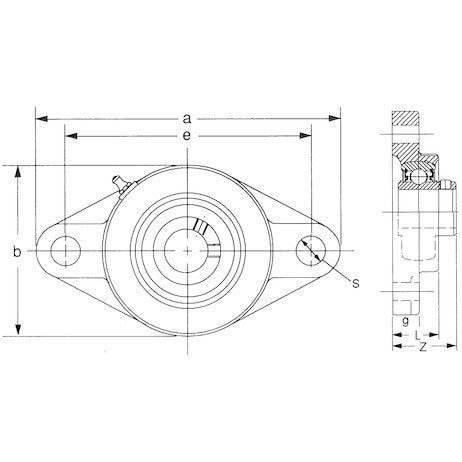
Buyers Products Set Screw Locking Flange Bearing (2 Bolt) is built for long life with simple installation and maintenance. The driveline-grade steel bearing is mounted in a cast iron housing, which helps make the flanges rugged and durable. The included grease fitting ensures ease of maintenance for continual smooth operation. The standard 2 bolt mounting design makes installation easy even in tight places. Its set screw design helps avoid shaft slippage.
Specifications
| Bearing Insert Material | Carbon Steel |
|---|---|
| Bearing Insert Type | Self Aligning |
| Bi (Diagram) | 1.500 |
| Bolt Hole Center to Center | 4.609 |
| Bolt Pattern | 2 Hole |
| Bolt Size | 0.500 |
| Bore Diameter | 1.250 |
| G (diagram) | 0.50 |
| Greasable (y/n) | Yes |
| Housing Material | Cast Iron |
| I (diagram) | 0.70 |
| L (diagram) | 1.22 |
| Locking Type | Set Screw |
| Overall Depth | 1.59 |
| Overall Height | 3.16 |
| Overall Width | 5.41 |
| S (diagram/Bolt Hole Diameter) | 0.625 |
Advanced Technical Overview: Replacement 2-Hole 1-1/4 Inch Upper Spinner Shaft Set Screw Locking Flanged Bearing
The 2-Hole 1-1/4 Inch Upper Spinner Shaft Set Screw Locking Flanged Bearing represents a precision-engineered component meticulously designed to meet the rigorous demands of industrial and agricultural applications, particularly those involving high-speed rotational elements such as upper spinner shafts. This replacement unit is not merely a component; it is a critical element in maintaining operational integrity, efficiency, and longevity of machinery where reliable rotational support is paramount. Engineered for seamless integration and robust performance, this flanged bearing is a testament to superior material science, advanced manufacturing processes, and thoughtful design focused on extended service life and simplified maintenance.
At its core, the flanged bearing assembly serves as a robust mounting solution for shafts, providing both radial and axial support while accommodating potential misalignments. The "flanged" designation refers to the housing design, which features a flat mounting surface with bolt holes, enabling secure attachment to a machine frame or structure. This particular unit, with its 2-hole configuration, offers a widely recognized and easily installed mounting standard, making it an ideal choice for direct replacement in a multitude of systems. Its primary function is to facilitate the smooth, low-friction rotation of a 1-1/4 inch diameter shaft, critical for the consistent operation of spinner mechanisms found in various spreading and material handling equipment.
Precision Engineering: The Bearing Insert
The heart of this flanged bearing lies in its bearing insert, which is crafted from high-quality carbon steel. Carbon steel is selected for its advantageous mechanical properties, including excellent hardness, tensile strength, and wear resistance, especially when heat-treated. These characteristics are indispensable for applications involving continuous rotation under varying loads, ensuring the bearing raceways can withstand the cyclical stresses and prevent premature fatigue. The use of "driveline-grade" steel further underscores its robust construction. Driveline components, by their very nature, are subjected to dynamic loads, torsional stresses, and often shock impacts. Consequently, driveline-grade materials are engineered to exhibit superior fatigue life, impact resistance, and overall durability compared to general-purpose steels. This ensures the bearing insert can reliably perform in environments where torque transmission and load variability are significant factors, directly contributing to the bearing's 'long life' as highlighted in the initial description.
A critical technical feature of this bearing insert is its "Self Aligning" capability. In many industrial applications, perfect alignment between the shaft and the bearing housing cannot always be guaranteed due to manufacturing tolerances, frame flex under load, or installation inaccuracies. A self-aligning bearing, such as this unit, incorporates a spherical outer surface on the bearing insert that mates with a similarly spherical inner bore in the housing. This design allows the bearing insert to pivot slightly within the housing, effectively compensating for angular misalignment between the shaft and the housing structure. For an upper spinner shaft, where dynamic forces and potential structural deformation are common, self-alignment is paramount. It prevents undue stress concentrations on the bearing and shaft, significantly reducing wear, lowering operating temperatures, and ultimately extending the service life of both the bearing and the associated machinery. Without this feature, even minor misalignment could lead to edge loading on the rolling elements, resulting in premature failure and costly downtime.
The "Bi (Diagram)" specification of 1.500 inches likely refers to a key dimensional aspect of the bearing insert, such as the width of the inner ring or the overall axial thickness of the bearing element. This dimension is crucial for understanding the load distribution capabilities and the potential for axial displacement within the housing, contributing to the precision fit and stable operation of the rotating shaft.
Robust Protection: The Cast Iron Housing
Complementing the high-performance bearing insert is a rugged housing constructed from cast iron. Cast iron is a time-tested material for bearing housings due to its unique combination of mechanical properties. It possesses excellent compressive strength, high rigidity, and superior vibration dampening characteristics. The inherent microstructure of cast iron, with its graphite flakes or nodules, effectively absorbs and dissipates vibrations generated during machine operation, reducing noise levels and minimizing dynamic stresses on the bearing components and the overall machinery. This is particularly beneficial in applications like spinner shafts, which can operate at high RPMs and generate considerable vibration.
Furthermore, cast iron offers good machinability, allowing for precise manufacturing of the housing bore and mounting surfaces. Its corrosion resistance is adequate for many industrial environments, and its mass contributes to the stability of the mounted unit. The robust nature of the cast iron housing, as noted in the description, ensures the "flanges are rugged and durable," capable of withstanding external impacts and the considerable forces exerted during operation without deformation or structural fatigue. The "G (diagram)" of 0.50 inches could signify the thickness of the flange itself, emphasizing its structural integrity, while "I (diagram)" at 0.70 inches might indicate the distance from the mounting surface to a critical point on the bearing, aiding in precise fitment and clearance calculations. The "L (diagram)" dimension of 1.22 inches likely denotes a significant length or depth measurement, crucial for overall housing geometry and integration.
Secure Shaft Retention: The Set Screw Locking Mechanism
The "Set Screw Locking" type is a fundamental aspect of this flanged bearing's design, crucial for securely fastening the bearing to the 1-1/4 inch shaft. This mechanism employs one or more set screws threaded into the inner ring of the bearing, which are tightened directly against the shaft. The pointed or cupped ends of the set screws bite into the shaft surface, creating a positive interference fit that prevents axial movement and rotational slippage between the shaft and the bearing's inner ring. This ensures synchronous rotation of the shaft and bearing, critical for consistent performance.
The primary advantage of the set screw design, particularly for upper spinner shafts, is its reliability in preventing shaft slippage under varying load conditions, including sudden starts, stops, and rotational reversals. It provides a robust, positive lock that is relatively simple to install and adjust. While other locking mechanisms exist (e.g., eccentric locking collars, concentric locking collars), the set screw method offers a balance of simplicity, effectiveness, and cost-efficiency suitable for a broad range of industrial applications, especially where moderate to high speeds and thrust loads are present. Its ease of installation, requiring only an Allen wrench, contributes to the "simple installation and maintenance" described, reducing downtime during replacement or adjustment procedures.
Optimized Mounting and Dimensional Precision
The "2 Hole" bolt pattern is a ubiquitous standard in industrial mounted bearings, offering a stable and secure attachment point for the bearing unit. This design ensures that the unit can be easily integrated into existing machinery, often as a direct replacement without requiring modifications to the mounting structure. The specified "Bolt Hole Center to Center" distance of 4.609 inches is a critical dimension for ensuring interchangeability and proper fit. Precision in this measurement is vital; even minor deviations can lead to misalignment during installation, negating the benefits of the self-aligning feature or introducing unwanted stresses into the system.
Further emphasizing the ease of installation and replacement, the "Bolt Size" is specified as 0.500 inches, and the "S (diagram/Bolt Hole Diameter)" is 0.625 inches. The slightly larger bolt hole diameter provides necessary clearance for the 0.500-inch bolts, allowing for minor adjustments during mounting and preventing binding. This thoughtful design consideration simplifies the mounting process, especially "even in tight places," ensuring that installation is straightforward and less prone to errors.
The overall dimensions – "Overall Depth" of 1.59 inches, "Overall Height" of 3.16 inches, and "Overall Width" of 5.41 inches – provide a comprehensive spatial footprint of the unit. These measurements are essential for design engineers and maintenance technicians to confirm proper fitment within confined spaces or as part of a larger assembly. Accurate dimensional data guarantees that the replacement bearing will occupy the same physical envelope as the original, preventing interference with other machine components and ensuring the structural integrity of the mounting point.
Proactive Maintenance and Extended Service Life
A key attribute contributing to the bearing's "long life" and "continual smooth operation" is its "Greasable" design, indicated by the inclusion of a grease fitting. Routine lubrication is fundamental to the longevity and performance of any rolling element bearing. The grease fitting provides a convenient port for introducing fresh lubricant into the bearing, typically using a grease gun. This process serves multiple critical functions:
- Reduces Friction and Wear: A continuous film of lubricant between the rolling elements and raceways minimizes direct metal-to-metal contact, drastically reducing friction, heat generation, and wear.
- Prevents Contamination: Fresh grease purges old, contaminated lubricant, pushing out abrasive particles, moisture, and other foreign substances that can degrade bearing performance and accelerate wear. The grease acts as a protective barrier against environmental ingress.
- Dissipates Heat: Lubricant helps to carry away heat generated by friction, maintaining optimal operating temperatures within the bearing.
- Corrosion Protection: Grease provides a protective coating that shields internal bearing components from corrosion, which is particularly important in outdoor or humid environments where spinner shafts often operate.
Regular maintenance, guided by the manufacturer's recommended lubrication schedule, is thus not merely good practice but a critical operational imperative for maximizing the lifespan and reliability of this bearing. The ease of maintenance afforded by the integrated grease fitting ensures that this essential task can be performed quickly and effectively, minimizing downtime and maximizing productivity.
Application Specificity: Upper Spinner Shafts
The designation "Upper Spinner Shaft" in the product title provides crucial context for the specialized demands this bearing is designed to address. Upper spinner shafts are common in equipment used for spreading granular materials such as fertilizer, sand, salt, gravel, or feed. These applications present a unique set of challenges for bearings:
- High Rotational Speeds: Spinner discs often rotate at high RPMs to achieve effective material distribution, demanding bearings capable of sustaining these speeds without overheating or excessive vibration.
- Abrasive Environment: The presence of granular materials means the bearing is constantly exposed to dust, dirt, and potentially abrasive particles, necessitating robust sealing (though not explicitly detailed, the greasable nature helps create a positive pressure barrier) and durable materials.
- Dynamic and Vibratory Loads: The uneven distribution of material on the spinner disc, as well as the inherent vibrations of the machine, impose dynamic and shock loads on the bearing, requiring superior fatigue resistance and load-carrying capacity.
- Corrosive Elements: Spreading fertilizers or road salt exposes components to corrosive chemicals, making material choice and maintenance crucial.
- Potential for Misalignment: The structural frames of agricultural or spreading equipment can flex under load, making the self-aligning feature indispensable.
This 2-hole 1-1/4 inch flanged bearing is meticulously engineered to thrive in such conditions. The driveline-grade carbon steel insert offers the necessary strength and wear resistance. The cast iron housing provides structural rigidity and vibration dampening. The set screw locking mechanism ensures the spinner shaft remains securely engaged, preventing slippage that could lead to inconsistent spreading patterns or catastrophic failure. The self-aligning capability accommodates structural deflections, and the greasable feature ensures continuous optimal performance and protection against environmental contaminants. All these attributes converge to make this bearing an ideal, high-performance replacement solution, directly contributing to the consistent and reliable operation of critical spreading machinery.
Conclusion
In summary, the Replacement 2-Hole 1-1/4 Inch Upper Spinner Shaft Set Screw Locking Flanged Bearing is a technically sophisticated and robust component engineered to deliver exceptional performance and longevity in demanding industrial applications. Its combination of a driveline-grade carbon steel, self-aligning bearing insert, a durable cast iron housing, and a secure set screw locking mechanism ensures reliable rotational support, even under challenging conditions. Coupled with its standard 2-bolt mounting pattern and integrated grease fitting for simplified maintenance, this bearing stands as an optimal choice for engineers and maintenance professionals seeking a high-quality replacement solution that guarantees operational efficiency, reduced downtime, and extended service life for critical machinery, particularly those incorporating upper spinner shafts.