Buyers Products Set Screw Locking Flange Bearing (2 Bolt) is built for long life with simple installation and maintenance. The driveline-grade steel bearing is mounted in a cast iron housing, which helps make the flanges rugged and durable. The included grease fitting ensures ease of maintenance for continual smooth operation. The standard 2 bolt mounting design makes installation easy even in tight places. Its set screw design helps avoid shaft slippage.
Specifications
| Bearing Insert Material | Carbon Steel |
|---|---|
| Bearing Insert Type | Self Aligning |
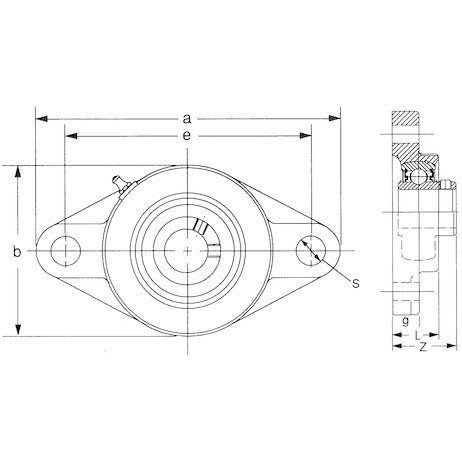
| Bi (Diagram) | 1.937 |
| Bolt Hole Center to Center | 5.672 |
| Bolt Pattern | 2 Hole |
| Bolt Size | 0.500 |
| Bore Diameter | 1.500 |
| G (diagram) | 0.56 |
| Greasable (y/n) | Yes |
| Housing Material | Cast Iron |
| I (diagram) | 0.83 |
| L (diagram) | 1.41 |
| Locking Type | Set Screw |
| Overall Depth | 2.03 |
| Overall Height | 3.94 |
| Overall Width | 6.88 |
| S (diagram/Bolt Hole Diameter) | 0.625 |
Advanced Technical Overview: Replacement 2-Hole 1.5 Inch Set Screw Locking Flanged Auger Bearing
The Replacement 2-Hole 1.5 Inch Set Screw Locking Flanged Auger Bearing represents a cornerstone component in a myriad of industrial, agricultural, and commercial rotational systems, particularly within auger and conveyor applications. Engineered for optimal performance, durability, and ease of maintenance, this bearing assembly integrates robust material science with a precision mechanical design to deliver reliable operational integrity. Its designation as a "replacement" part underscores its conformity to industry standards, ensuring seamless integration into existing machinery and offering an economical yet high-performance solution for extending equipment lifespan.
Precision Engineering and Material Selection for Enhanced Durability
At the heart of this flanged auger bearing lies a commitment to engineering excellence, evident in the meticulous selection of its core materials. The bearing insert itself is fabricated from high-grade Carbon Steel, specifically chosen for its superior mechanical properties. Carbon steel offers an exceptional balance of hardness, tensile strength, and fatigue resistance, essential for enduring the dynamic radial and axial loads inherent in auger operations. Its inherent ability to resist wear and deformation under continuous stress ensures a prolonged operational lifespan, even in demanding environments. This driveline-grade steel bearing insert is precision-machined to achieve the specified 1.500-inch bore diameter, guaranteeing a precise fit with corresponding shafts, thereby minimizing play and vibrational excursions that could otherwise lead to premature failure or reduced efficiency.
Encasing this robust bearing insert is a Housing crafted from Cast Iron. The selection of cast iron for the housing material is a deliberate engineering choice, capitalizing on its unique metallurgical characteristics. Cast iron is renowned for its excellent compressive strength, superior vibration dampening capabilities, and inherent rigidity. In high-stress applications, the cast iron housing effectively absorbs and dissipates vibrational energy, protecting the internal bearing components from excessive stresses and contributing to smoother, quieter operation. Furthermore, the inherent mass and stiffness of cast iron provide a stable mounting platform, resisting deformation under load and maintaining critical alignment over time. This combination of a high-strength carbon steel insert within a rigid cast iron housing creates a synergistic system, optimized for enduring harsh operational conditions and delivering consistent performance.
The Critical Role of the Set Screw Locking Mechanism
A pivotal feature distinguishing this bearing assembly is its Set Screw Locking mechanism. This design provides a secure and reliable method for attaching the bearing to a rotating shaft, effectively preventing axial and rotational slippage. The mechanism typically involves two or more set screws strategically positioned on the inner ring of the bearing, which are tightened against the shaft. When properly torqued, these set screws exert localized pressure, creating an interference fit that firmly locks the bearing to the shaft. This method offers several advantages, including relatively straightforward installation and removal compared to other locking mechanisms like eccentric locking collars or adapter sleeves, which can be more complex or require specialized tools.
The efficacy of the set screw locking system is particularly crucial in applications where varying loads or directional changes could otherwise induce relative motion between the shaft and the bearing's inner race. Preventing this slippage is paramount for maintaining bearing integrity, minimizing fretting corrosion, and ensuring the efficient transmission of power. The precise engagement of the set screws ensures that the shaft and the bearing rotate as a unified assembly, thereby extending the service life of both components and safeguarding against costly downtime associated with shaft damage or bearing failure due to inadequate locking.
Flanged Design: Structural Integrity and Mounting Efficiency
The flanged configuration, specifically a 2-Hole Bolt Pattern, is integral to the structural integrity and mounting versatility of this bearing. A flange bearing provides a robust mounting surface that allows for secure attachment to a flat structural component or machine frame. This design distributes the load over a wider area, reducing localized stress on the mounting surface and enhancing overall stability. The 2-hole bolt pattern is a commonly adopted standard, offering a balance between mounting stability and ease of installation. Its simplicity facilitates quick alignment and attachment, making it a preferred choice in many industrial settings, particularly where space might be constrained, as indicated by the description's mention of "tight places."
The specified Bolt Hole Center to Center dimension of 5.672 inches, combined with a Bolt Size of 0.500 inches and a Bolt Hole Diameter (S) of 0.625 inches, provides critical parameters for compatibility and installation. These dimensions ensure that the bearing can be precisely integrated into existing equipment designs or new fabrications that adhere to these common industrial standards. The accurate sizing of the bolt holes to accommodate standard fasteners ensures a snug, vibration-resistant mount, crucial for maintaining bearing alignment and minimizing operational noise and wear.
Self-Aligning Capability: Accommodating Real-World Imperfections
A significant technical advantage of this particular bearing is its Self Aligning capability. In any mechanical system, achieving perfect alignment between a shaft and its bearings can be challenging due due to manufacturing tolerances, structural deflections under load, or installation inaccuracies. A rigid, non-self-aligning bearing subjected to even minor misalignment will experience concentrated stresses at its edges, leading to premature wear, increased friction, higher operating temperatures, and ultimately, accelerated failure.
The self-aligning design of this bearing insert effectively mitigates these risks. It allows the inner ring (which rotates with the shaft) to pivot slightly within the stationary outer ring and housing, thereby accommodating angular misalignment between the shaft and the bearing's housing. This pivotal action ensures that the load is distributed evenly across the entire contact surface of the rolling elements, preventing localized stress concentrations. The result is significantly reduced internal friction, lower operating temperatures, extended bearing life, and improved overall system reliability. This feature is especially beneficial in auger systems where shafts can sometimes experience slight deflections or where initial installation alignment might not be absolutely perfect.
Proactive Maintenance through Greasability
Longevity and consistent performance are intrinsically linked to effective lubrication, and this bearing assembly is designed with proactive maintenance in mind, featuring a Greasable mechanism with an included grease fitting. Lubrication serves several vital functions within a bearing: it reduces friction between moving parts, dissipates heat generated by friction, prevents wear, and creates a protective barrier against contaminants like dust, moisture, and corrosive agents. The ability to regularly introduce fresh lubricant through a grease fitting ensures that these functions are continuously maintained throughout the bearing's operational life.
Regular greasing schedules, tailored to the specific application's load, speed, and environmental conditions, are essential for maximizing bearing lifespan. The use of a high-quality, appropriate grease—selected based on viscosity, temperature range, and extreme pressure characteristics—further enhances the bearing's performance. The ease of access provided by the grease fitting simplifies routine maintenance tasks, encouraging adherence to lubrication schedules and significantly reducing the likelihood of bearing failure due to insufficient lubrication. This design aspect directly contributes to lower total cost of ownership by extending service intervals and reducing the need for premature replacements.
Detailed Dimensional Analysis for Seamless Integration
Beyond the fundamental design principles, the precise dimensional specifications are critical for ensuring proper fitment and functionality within a mechanical system. The provided specifications offer a comprehensive geometric profile:
- Bore Diameter (1.500 inches): This is the internal diameter of the bearing, dictating the shaft size it accommodates. Precision in this dimension is paramount for a secure and true-running fit.
- Overall Width (6.88 inches), Overall Height (3.94 inches), Overall Depth (2.03 inches): These external dimensions define the physical footprint of the assembled unit, crucial for designers and technicians to ensure adequate clearance and integration within the machinery's framework.
- Bi (1.937), G (0.56), I (0.83), L (1.41) (Diagrammatic): These represent specific internal and external reference dimensions, often critical for determining shaft shoulder clearances, housing interference, or component spacing. For instance, 'Bi' typically refers to the width of the inner ring or the bearing's total width, which is relevant for axial positioning. 'G' might denote a grease fitting location or housing thickness. 'I' and 'L' often relate to the distance from the housing face to the bearing centerline or mounting hole details, providing vital information for complex assemblies and CAD modeling. These detailed measurements highlight the engineering precision embedded in the product, enabling accurate selection and design verification.
Such comprehensive dimensional data allows engineers to meticulously plan the integration of this bearing into new or existing systems, guaranteeing optimal alignment, minimal interference, and efficient operation.
Broad Spectrum of Industrial Applications
While specifically highlighted for auger systems, the design robustness and versatility of this 2-Hole 1.5 Inch Set Screw Locking Flanged Bearing extend its utility across a wide array of industrial and commercial applications. Its characteristics make it ideal for:
- Auger Conveyors: Essential for supporting the rotating screw in grain augers, feed systems, cement mixers, and other bulk material handling auger conveyors, where continuous, heavy-duty operation is common.
- Belt Conveyors: Providing support for idler rollers and drive shafts in various conveyor systems, ensuring smooth and reliable material transport.
- Agricultural Machinery: Used extensively in combines, planters, balers, and tillage equipment, where components are subjected to harsh environmental conditions and cyclical loading.
- Material Handling Equipment: Integral to forklifts, stackers, and other lifting or moving equipment that rely on robust rotational support.
- Mixers and Blenders: Supporting shafts in industrial mixing equipment for food processing, chemical, and pharmaceutical industries, where hygiene and reliability are paramount.
- Textile and Packaging Machinery: Facilitating the smooth operation of rollers and drive mechanisms in production lines.
- General Industrial Machinery: Any application requiring a dependable mounted bearing solution for shafts of 1.5 inches diameter, where a flanged housing is suitable for mounting.
The bearing's capability to accommodate minor misalignment, coupled with its robust construction and ease of lubrication, positions it as a highly adaptable and reliable component in demanding operational contexts.
Performance and Operational Advantages
The deliberate design and material choices of this flanged auger bearing translate into several tangible performance advantages for the end-user:
- Exceptional Durability: The combination of carbon steel and cast iron, along with precise manufacturing, ensures a long service life, even under continuous heavy loads and challenging environments.
- Enhanced Reliability: The set screw locking mechanism and self-aligning insert minimize common causes of bearing failure, leading to more consistent uptime and reduced unscheduled maintenance.
- Reduced Friction and Energy Consumption: Proper lubrication and self-alignment contribute to lower operational friction, which in turn reduces power consumption and heat generation.
- Vibration Dampening: The cast iron housing effectively absorbs operational vibrations, contributing to smoother, quieter machinery operation and protecting adjacent components from fatigue.
- Ease of Maintenance: The inclusion of a grease fitting simplifies routine lubrication, empowering maintenance personnel to extend bearing life proactively with minimal effort.
- Cost-Effectiveness: As a high-quality replacement part, it offers an economical solution for restoring machinery functionality without compromising on performance or longevity, thereby reducing the total cost of ownership over the equipment's lifespan.
Installation and Maintenance Protocols
While designed for simple installation, adhering to proper protocols is crucial for maximizing the bearing's lifespan and performance. When installing the Replacement 2-Hole 1.5 Inch Set Screw Locking Flanged Auger Bearing, it is essential to ensure that the shaft surface is clean, free of burrs, and dimensionally accurate. The bearing should be slid onto the shaft without excessive force, confirming the correct fit. Once positioned, the mounting bolts should be secured to the flange, ensuring even torque distribution to avoid distorting the housing. The set screws then need to be tightened progressively and alternately to the manufacturer's recommended torque specifications. This progressive tightening ensures a balanced grip on the shaft, preventing localized stress concentrations and ensuring the bearing is squarely seated.
For maintenance, a regular lubrication schedule, typically involving the injection of a compatible, high-quality grease through the zerk fitting, is paramount. The frequency of lubrication depends on factors such as operating speed, load, temperature, and environmental contamination levels. Over-greasing should be avoided as it can lead to increased operating temperatures and seal damage, while under-greasing results in premature wear. Inspection for signs of wear, unusual noise, or excessive heat should also be part of a routine preventative maintenance program, allowing for early detection and mitigation of potential issues before they lead to catastrophic failure.
Technical Considerations for Optimal Bearing Selection
Selecting the correct bearing for an application is critical, and while this product is a direct replacement, understanding the underlying technical considerations is beneficial. Beyond the 1.5-inch bore diameter and 2-hole flanged mount, factors such as the anticipated maximum radial and axial loads must be within the bearing's design limits. The operating temperature range, rotational speed, and the presence of corrosive or abrasive contaminants in the environment also influence bearing life and lubricant selection. For particularly aggressive environments, additional sealing mechanisms or specialized coatings might be necessary, though the robust cast iron housing offers a good baseline for general industrial use.
The self-aligning feature addresses a common source of stress, but it's important not to assume it compensates for severe or dynamic misalignment. Initial accurate alignment remains the best practice for optimal performance. The set screw locking type is excellent for applications where shock loads are moderate; for extremely heavy or vibratory shock loads, other locking mechanisms might be considered, but for typical auger and conveyor applications, this system offers an ideal balance of security and practicality.
Conclusion: A Reliable and Technically Sound Replacement Solution
In summary, the Replacement 2-Hole 1.5 Inch Set Screw Locking Flanged Auger Bearing is a meticulously engineered component designed to deliver sustained performance and reliability in demanding industrial applications. Its foundation in high-grade carbon steel for the bearing insert and robust cast iron for the housing, coupled with a precision 1.5-inch bore, secure set screw locking, and a practical 2-hole flanged mounting, makes it an exceptionally durable and efficient solution. The self-aligning capability extends its operational envelope by gracefully accommodating minor misalignments, while the greasable design facilitates straightforward and effective preventative maintenance.
As a product from Buyers Products, this bearing reflects a commitment to quality and functional excellence. It stands as an ideal replacement part, promising to restore critical rotational support with minimal downtime and maximum operational efficiency. For engineers, maintenance professionals, and equipment operators, investing in this technically superior flanged auger bearing signifies a commitment to prolonging equipment life, enhancing productivity, and ensuring the uninterrupted flow of operations within any system where it is deployed.