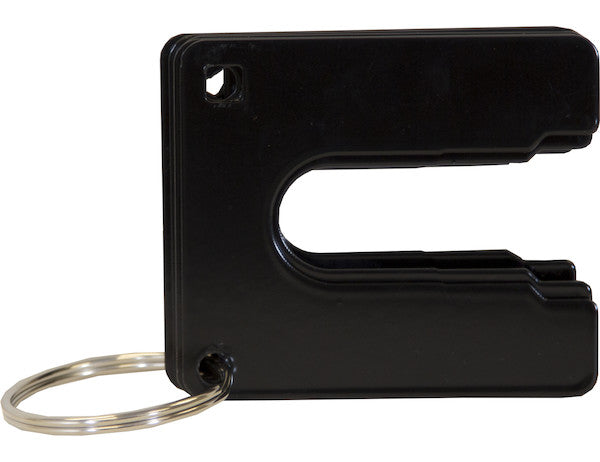
Buyers Products Drawbar Gauge is a tool to measure drawbar or lunette ring wear. It uses color-coded indicators to show when the ring needs replaced.
Specifications
| Color | Black |
|---|---|
| Finish | Powder-Coat |
| M.G.T.W. (lbs) | - |
| M.V.L. (lbs) | - |
| Material | Carbon Steel |
The Criticality of Drawbar Integrity and Advanced Wear Assessment
In the demanding world of heavy-duty towing and transport, the integrity of every component in the coupling system is paramount. The drawbar, or more specifically, the lunette ring system, serves as the critical mechanical interface between a prime mover and its towed implement or trailer. Its function extends far beyond simple connection; it is a dynamic component subjected to immense and varied stresses, directly influencing operational safety, efficiency, and regulatory compliance. The Buyers Products Drawbar Wear Gauge emerges as an indispensable precision instrument engineered to provide a definitive, quantifiable assessment of lunette ring wear, thereby enabling proactive maintenance and mitigating the catastrophic risks associated with compromised coupling systems.Understanding the Dynamics of Wear in Heavy-Duty Towing Systems
The lunette ring, a robust circular component typically forged or cast, is designed to articulate within a pintle hook assembly. This seemingly simple mechanical interaction is, in reality, a complex interplay of forces that inevitably lead to material degradation over time. Understanding these wear mechanisms is fundamental to appreciating the necessity of precise wear measurement.Frictional Wear: This is the most prevalent form of wear. As the prime mover and trailer navigate varying terrains and operational maneuvers, the lunette ring constantly pivots and slides within the pintle hook's jaw. This continuous relative motion, particularly under significant load, generates friction, leading to abrasive wear. Microscopic asperities on both surfaces interlock and shear, progressively removing material from the ring's interior diameter. The rate of abrasive wear is influenced by factors such as applied normal force (vertical load), lubrication (or lack thereof), material hardness, and the presence of abrasive contaminants like dust, grit, and road debris.
Impact and Shock Loading: Heavy-duty towing is inherently dynamic. Sudden accelerations, decelerations, road imperfections, and off-road applications introduce significant impact forces and shock loads into the coupling system. These forces can cause the lunette ring to forcefully strike the pintle hook's inner surfaces, leading to localized plastic deformation, pitting, and even material spalling. Repeated impact loading contributes to fatigue, initiating micro-cracks that can propagate over time, accelerating material loss and compromising structural integrity.
Corrosion: Environmental factors play a significant role in material degradation. Exposure to moisture, road salts, chemicals, and extreme temperatures can accelerate corrosion, particularly in unprotected or damaged areas of the lunette ring. Rust, an iron oxide, is less dense and less structurally sound than the parent metal. Its formation can lead to surface irregularities, increased friction, and a reduction in the load-bearing cross-section, making the ring more susceptible to other forms of wear and ultimate failure.
Fatigue Wear: The cyclical nature of towing — constant tension, compression, shear, and bending stresses — subjects the lunette ring to material fatigue. Even stresses below the material's yield strength can, over millions of cycles, lead to the formation and propagation of microscopic cracks. These cracks progressively weaken the material, eventually leading to macroscopic failure without obvious signs of severe plastic deformation. Fatigue wear is particularly insidious as it often provides little visual warning until the point of catastrophic failure.
Galling and Adhesion: In instances of inadequate lubrication or excessively high contact pressures, localized cold welding can occur between the lunette ring and pintle hook surfaces. As these welded junctions are subsequently torn apart during motion, material is transferred from one surface to another, often creating rough, gouged surfaces that accelerate further wear. This phenomenon, known as galling, can significantly degrade the operational smoothness and structural integrity of the coupling.
The Critical Implications of Exceeding Wear Tolerances
Neglecting the progressive wear on a lunette ring carries severe consequences, impacting not only operational efficiency but, more critically, safety and regulatory compliance.Compromised Safety: The most dire consequence of excessive lunette ring wear is the increased risk of trailer detachment. A worn ring possesses an enlarged internal diameter, creating excessive slack or "play" within the pintle hook. This slack allows for greater angular and translational movement, exacerbating impact forces, and potentially leading to the ring "jumping out" of the pintle hook. Such an event on a public roadway can result in severe accidents, property damage, injuries, or fatalities.
Reduced Towing Capacity and Stability: As the lunette ring's material degrades, its effective load-bearing cross-section diminishes, directly reducing its inherent strength and capacity to withstand the rated maximum gross trailer weight (M.G.T.W.) and maximum vertical load (M.V.L.). Furthermore, the increased play in a worn system introduces dynamic instability. Excessive slop can cause trailer sway, unpredictable handling characteristics, and a reduction in overall control, especially during braking, cornering, or adverse road conditions. This places undue stress on other towing components, accelerating their wear and potential failure.
Accelerated Wear on Companion Components: A worn lunette ring is not an isolated problem; it creates a cascade effect on the entire towing system. The increased shock loading and imprecise fit transmit amplified forces to the pintle hook, mounting brackets, chassis, and even the prime mover's drivetrain and suspension. This can lead to premature wear and failure of these expensive components, translating into higher maintenance costs and increased downtime.
Regulatory Non-Compliance and Legal Liability: Regulatory bodies such as the Department of Transportation (DOT) and Federal Motor Carrier Safety Administration (FMCSA) have stringent requirements for commercial vehicle safety, including the condition of coupling devices. Exceeding specified wear limits, often defined by industry standards like SAE J847 for lunette eyes, can lead to violations, fines, and out-of-service orders. In the event of an accident caused by a worn coupling, the operating entity faces significant legal liability, reputational damage, and potentially crippling financial penalties.
The Buyers Products Drawbar Wear Gauge: Engineered Precision for Preventive Maintenance
The Buyers Products Drawbar Wear Gauge is a purpose-built precision instrument designed to eliminate the subjectivity and inherent inaccuracies of visual inspections or rudimentary measurement techniques. It transforms a critical safety check into a quantifiable, repeatable process, facilitating proactive maintenance strategies.Precision Engineering: The gauge itself is a robust, calibrated tool meticulously manufactured to exacting dimensional tolerances. Its design mirrors the critical internal geometry of an ideal lunette ring. When inserted into a lunette ring, the gauge physically assesses the internal diameter and detects any significant deviations from the manufacturer's specifications. This direct physical measurement is inherently more accurate and reliable than subjective visual cues or less precise tools like calipers, which can be difficult to use consistently on curved surfaces and within confined spaces.
Intuitive Color-Coded Indicators: The hallmark feature of the Buyers Products Drawbar Wear Gauge is its clear, unambiguous color-coded indicator system. This system simplifies the complex task of dimensional tolerance assessment into an easily interpretable format, suitable for operators and technicians of varying experience levels.
- Green Zone: Indicates that the lunette ring's internal diameter is within acceptable operational limits. While wear may be present, it has not progressed to a point that compromises safety or performance according to established industry benchmarks. Routine inspections should continue.
- Yellow Zone (Warning): Signals that the lunette ring is approaching its maximum allowable wear tolerance. While not immediately critical, this indicates a strong recommendation for proactive planning for replacement. Continued operation should be accompanied by increased monitoring and adherence to reduced load or speed parameters if applicable. This zone represents a critical window for scheduled maintenance before the component becomes a safety hazard.
- Red Zone (Critical): Denotes that the lunette ring has exceeded its maximum safe wear limit. Operation with a ring in this condition is unequivocally unsafe and non-compliant with most regulatory standards. Immediate replacement of the lunette ring is mandatory before the vehicle can be returned to service.
Simplifying Complex Standards: Industry standards for lunette ring wear, such as those published by the Society of Automotive Engineers (SAE J847), often specify precise dimensional limits in millimeters or inches. The Drawbar Wear Gauge internally incorporates these critical thresholds, translating complex technical data into an easily digestible visual indicator. This capability empowers fleet managers and maintenance personnel to quickly ascertain compliance without needing to consult technical manuals or perform intricate calculations for every inspection.
Technical Design and Material Excellence
The effectiveness and longevity of the Drawbar Wear Gauge itself are contingent upon its own design and material properties.Material (Carbon Steel): The selection of carbon steel for the gauge's construction is a deliberate choice rooted in material science principles. Carbon steel offers an optimal balance of strength, hardness, and wear resistance, ensuring the gauge maintains its dimensional integrity over countless applications. This robustness is crucial because the gauge, while not a load-bearing component in the towing system, must itself withstand the rigors of repeated insertion and removal in potentially harsh shop or field environments without deforming or wearing out prematurely. Its inherent stiffness prevents flexing during measurement, guaranteeing accurate readings. The specific grade of carbon steel would be selected for its high yield strength and resistance to plastic deformation, vital for a precision measuring instrument.
Finish (Powder-Coat): The application of a powder-coat finish to the carbon steel body provides a multi-faceted enhancement to the gauge's functionality and durability.
- Corrosion Resistance: Powder coating forms a dense, continuous barrier that effectively seals the carbon steel from moisture, road salts, and corrosive chemicals, preventing rust and preserving the gauge's surface integrity, which is essential for accurate measurement.
- Abrasion Resistance: The robust nature of powder coatings provides excellent resistance to chipping, scratching, and general abrasion, ensuring the clear markings and critical measuring surfaces remain intact and legible over time.
- Longevity and Durability: This finish contributes significantly to the overall lifespan of the tool, maintaining its aesthetic and functional characteristics even with heavy use in demanding conditions.
- Enhanced Visibility and Readability: The black color of the powder coat provides a high-contrast background for the color-coded indicators, enhancing their visibility and making interpretation instantaneous and error-free, even in suboptimal lighting conditions.
- Non-Reactive Surface: A smooth, consistent powder-coated surface ensures that the gauge interacts minimally with any contaminants on the lunette ring, preventing interference with the measurement process.
Precision Manufacturing: The efficacy of a wear gauge hinges on its own manufacturing precision. Buyers Products employs advanced manufacturing techniques to ensure that each gauge conforms to extremely tight dimensional tolerances. This meticulous approach guarantees that the gauge's internal contours accurately reflect the critical wear limits, providing reliable and repeatable measurements every time.
M.G.T.W. (lbs) and M.V.L. (lbs) - Distinction: It is important to note the absence of "M.G.T.W. (lbs)" and "M.V.L. (lbs)" specifications for the Drawbar Wear Gauge itself. This is because these ratings (Maximum Gross Trailer Weight and Maximum Vertical Load) apply to the actual towing components – the lunette ring, pintle hook, and overall hitch assembly – not to the diagnostic tool used to assess their condition. The gauge's purpose is to determine if these *components* remain within their rated capacities by virtue of their physical integrity, as excessive wear would compromise those inherent ratings.
Operational Protocols and Integration into Fleet Management
The optimal utilization of the Buyers Products Drawbar Wear Gauge requires integration into a comprehensive preventative maintenance and safety program.When to Measure:
- Pre-Trip Inspections: Mandated by regulations for commercial vehicles, a quick gauge check ensures immediate safety before departure.
- Routine Maintenance Schedules: Incorporate gauge checks into scheduled service intervals (e.g., every 5,000 or 10,000 miles, or quarterly), establishing a consistent monitoring regimen.
- After Heavy Use or Impact Events: Following operations involving exceptionally heavy loads, challenging terrain, or any incident of severe impact or jarring, an immediate inspection is warranted.
- During Component Replacement: Always verify the fit of a new lunette ring using the gauge to ensure it meets specifications before commissioning.
How to Measure: The process is straightforward, designed for efficiency without sacrificing accuracy. The gauge is inserted into the internal diameter of the lunette ring. Its design allows it to seat naturally against the worn surfaces. The operator then simply observes which color-coded section of the gauge is visible or aligns with the interior circumference of the ring. No complex readings, dials, or digital interfaces are required, making it highly practical for field use.
Interpretation and Decision-Making:
- Green: Document the satisfactory condition and proceed with normal operations.
- Yellow: Document the warning condition. Schedule the lunette ring for replacement in the near future. Monitor usage carefully and consider reducing load or speed if operations cannot be immediately ceased for replacement.
- Red: Immediately remove the vehicle from service. Replace the lunette ring before any further towing operations are conducted. Document the critical finding and the replacement action.
Documentation and Trending: Maintain detailed records of all drawbar wear gauge readings. This data is invaluable for several reasons:
- Compliance: Provides proof of adherence to safety regulations and maintenance schedules for audits.
- Predictive Maintenance: Trending wear patterns can help predict when replacements will be necessary, allowing for proactive parts ordering and scheduling, minimizing downtime.
- Warranty Claims: Documented wear data can support warranty claims for prematurely failing components.
Operator Training: While the gauge is intuitive, proper training ensures consistent application. Operators and maintenance staff should understand the implications of each color zone, the correct insertion technique, and the importance of documenting findings. This standardization of practice across a fleet is crucial for overall safety.
Compliance with Industry Safety Standards and Regulations
The Buyers Products Drawbar Wear Gauge is an essential tool for enabling compliance with a myriad of industry safety standards and governmental regulations governing heavy-duty towing equipment.SAE Standards: The Society of Automotive Engineers (SAE) develops numerous standards pertinent to towing components. Specifically, SAE J847, "Coupling — Fifth Wheel Kingpin and Drawbar Eye," provides critical dimensional specifications and wear limits for lunette eyes (drawbar eyes). The Drawbar Wear Gauge is engineered to effectively translate these complex dimensional limits into its simple color-coded system, allowing operators to quickly determine if a lunette ring still adheres to SAE J847 requirements. Similarly, SAE J849 covers pintle hooks, and the integrity of the lunette ring directly impacts the safe operation of the pintle hook within these standards.
DOT and FMCSA Regulations: In the United States, the Department of Transportation (DOT) and the Federal Motor Carrier Safety Administration (FMCSA) enforce stringent regulations for commercial motor vehicles (CMVs), including their coupling devices. FMCSA 49 CFR Part 393, "Parts and Accessories Necessary for Safe Operation," specifically addresses coupling devices, requiring them to be "in safe operating condition" and free from excessive wear or damage. The Drawbar Wear Gauge provides a direct and objective method for verifying compliance with these critical safety requirements during pre-trip inspections, roadside checks, and scheduled maintenance audits. Failing to meet these standards can result in vehicles being placed out of service, significant fines, and even criminal charges in the event of an accident.
Occupational Safety and Health Administration (OSHA): While OSHA primarily focuses on workplace safety, the condition of equipment used in operations, particularly heavy machinery and towing apparatus, falls under its purview. Ensuring that all towing components are free from excessive wear and are in safe operating condition aligns with OSHA's general duty clause, which requires employers to provide a workplace free from recognized hazards. The Drawbar Wear Gauge directly supports this objective by identifying and quantifying a critical hazard before it can lead to an incident.
Economic Justification and Return on Investment
Investing in the Buyers Products Drawbar Wear Gauge yields significant economic benefits that far outweigh its initial cost, providing a strong return on investment (ROI) for any fleet or heavy equipment operator.Reduced Downtime: Proactive identification of worn lunette rings allows for scheduled replacements during planned maintenance windows, avoiding unexpected breakdowns and emergency repairs. Unscheduled downtime is incredibly costly, encompassing lost revenue from idle assets, expedited shipping fees for replacement parts, and potentially overtime labor costs.
Extended Equipment Life: By ensuring that lunette rings are replaced before they cause excessive stress on companion components, the lifespan of pintle hooks, trailer tongues, and even the vehicle's chassis can be significantly extended. This reduces the frequency of major component replacements and associated labor costs.
Prevention of Catastrophic Failures: The cost of a trailer detachment incident – including property damage, cargo loss, environmental cleanup, injury claims, legal fees, and increased insurance premiums – can be astronomical. The Drawbar Wear Gauge is an inexpensive insurance policy against such devastating events, providing a tangible return on investment through risk mitigation.
Optimized Parts Inventory: Consistent wear monitoring provides data that allows fleet managers to predict parts demand more accurately. This optimizes inventory levels, reducing capital tied up in spare parts while ensuring critical components are available when needed, avoiding delays due to backorders.
Enhanced Operational Efficiency: A well-maintained coupling system performs optimally, reducing trailer sway and improving fuel efficiency by minimizing drag and inconsistent forces. This contributes to smoother operations and reduced operational expenses.
Lower Insurance Premiums and Liability: A documented commitment to safety and preventative maintenance, demonstrated through the use of tools like the Drawbar Wear Gauge, can positively influence insurance providers, potentially leading to lower premiums. Furthermore, in the event of an incident, robust maintenance records significantly strengthen a company's defense against liability claims.
Conclusion
The Buyers Products Drawbar Wear Gauge is far more than a simple tool; it is a critical component of a modern, safety-conscious, and economically viable heavy-duty towing operation. By providing a precise, easy-to-interpret, and repeatable method for assessing lunette ring wear, it empowers operators and fleet managers to move beyond reactive repairs to a proactive maintenance paradigm. Its robust carbon steel construction, durable powder-coat finish, and intuitive color-coded indicators make it an indispensable asset in the fight against component failure, unscheduled downtime, and the profound risks associated with compromised towing integrity. In an industry where safety and reliability are non-negotiable, the Drawbar Wear Gauge stands as a testament to intelligent engineering designed to protect assets, personnel, and reputation.