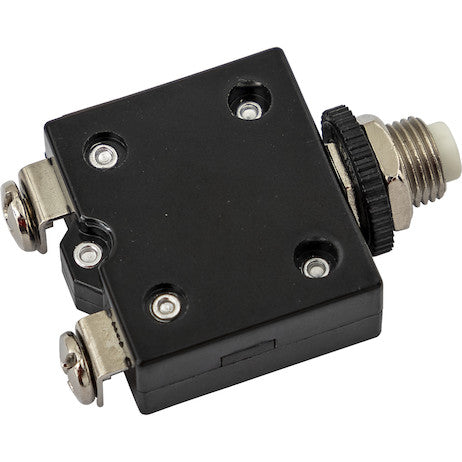
Buyers Products Manual Reset 40 Amp Circuit Breaker offers universal fit for all tarp system brands. Mount to a bracket or to the dash with the included mounting hardware. Push button manual reset for ease of use.
Specifications
| Color | Black |
|---|---|
| Reset | Manual |
| Trip Current | 40 |
In demanding heavy-duty vehicular and industrial applications, reliable electrical circuit protection is a critical safety and operational imperative. The Buyers Products Manual Reset 40 Amp Circuit Breaker is engineered to meet these rigorous demands, providing robust overcurrent protection for a wide array of DC electrical systems. This specialized component safeguards valuable equipment and prevents potential hazards like wiring damage, component failure, and fire.
Fundamentals of Circuit Protection
A circuit breaker serves as an automatic electrical switch designed to protect a circuit from damage caused by excess current, typically resulting from an overload or short circuit. Its primary advantage over a fuse lies in its reusability; once an overcurrent condition is cleared, a circuit breaker can be reset to resume normal operation, whereas a fuse requires replacement. This inherent reusability makes circuit breakers a cost-effective and operationally efficient solution, particularly in applications where transient fault conditions might occur or where rapid restoration of power is desirable after troubleshooting.
Thermal Tripping Mechanism
The core function of this 40 Amp circuit breaker is the detection and interruption of excessive electrical current. The "40 Amp" designation refers to its nominal trip current – the maximum current it is designed to continuously carry without tripping under specified conditions. When the current flowing through the breaker exceeds this threshold for a predetermined duration, the internal tripping mechanism is activated. For many DC circuit breakers of this type, a thermal element, typically a bimetallic strip, is employed. This strip is composed of two different metals bonded together, each possessing a unique coefficient of thermal expansion. As excessive current flows through the strip, it generates heat. Upon reaching a critical temperature, the differential expansion of the metals causes the strip to bend, physically breaking the electrical connection and opening the circuit. This thermal tripping mechanism provides a time-current characteristic, meaning it trips faster for higher overcurrents and slower for smaller overcurrents just above its rated value, which is beneficial for loads with temporary inrush currents like electric motors.
The Significance of a 40 Amp Rating
The 40 Amp rating is strategically chosen for specific categories of electrical loads requiring substantial power. It signifies the breaker's suitability for protecting circuits typically found in 12V or 24V DC systems common in heavy-duty vehicles and equipment. In a 12V DC system, a 40 Amp breaker can protect a circuit delivering up to 480 watts (P = V x I). In a 24V DC system, this capacity doubles to 960 watts. This substantial power threshold makes it ideal for protecting a range of high-current accessories and systems:
- Tarp System Motors: Electric tarp systems on dump trucks and trailers utilize powerful DC motors that draw significant current, especially under load or during initial start-up. A 40 Amp breaker is essential to protect these motors and their associated wiring from damaging overcurrents.
- Winch Motors: Automotive and utility winches, whether for vehicle recovery or material handling, demand considerable current, making a 40 Amp breaker a suitable protective device.
- Power Inverters: Smaller to medium-sized power inverters (e.g., 500W to 1000W) that convert DC to AC power often require robust DC input protection.
- Auxiliary Power Circuits: Circuits supplying multiple high-draw accessories in RVs, boats, or commercial vehicles benefit from this level of protection.
- Hydraulic Pump Motors: For systems requiring moderate hydraulic power, the motor and control circuitry can be effectively protected.
Correct amperage selection is paramount. An undersized breaker will lead to nuisance tripping under normal operating conditions, causing unnecessary downtime. Conversely, an oversized breaker will fail to provide adequate protection, potentially allowing excessive current to flow and cause severe damage to wiring or connected components.
Manual Reset Functionality: Operational Advantages
The "Manual Reset" feature is a defining characteristic of this circuit breaker, providing distinct operational and safety advantages compared to automatic reset types. When an overcurrent condition occurs and the breaker trips, it remains in an open (tripped) state until an operator manually presses the reset button. This design choice is critical for several reasons:
- Mandated Fault Identification: A manual reset compels the operator to acknowledge that an electrical fault has occurred. This necessitates an investigation into the root cause of the trip before power can be restored, thereby preventing potential recurrence of the problem or further damage. For example, if a tarp motor is binding, a manual reset ensures the operator checks for obstructions before re-energizing, preventing motor damage.
- Enhanced Safety Protocols: In scenarios where an unexpected restoration of power could pose a safety risk (e.g., machinery suddenly restarting), a manual reset prevents this by requiring conscious human intervention. This is particularly vital in mobile equipment where personnel might be working in proximity to the electrical system or connected machinery.
- Prevention of Repetitive Cycling: An automatic reset breaker will repeatedly attempt to re-energize a faulty circuit as long as the fault persists. This continuous "cycling" can generate excessive heat, further damage components, and rapidly drain batteries. A manual reset breaker eliminates this detrimental cycling, keeping the circuit safely de-energized until the fault is identified and rectified.
The push-button mechanism for manual reset ensures straightforward operation and immediate tactile feedback, making it user-friendly even in challenging environments. The reset button is typically designed for easy access and clear identification on the breaker housing.
Universal Fit and Application Versatility
The description "offers universal fit for all tarp system brands" highlights the design's emphasis on broad compatibility and ease of integration. This is achieved through standardized mounting options and electrical connection points. While primarily optimized for electric tarp systems, its robust design and common electrical interface enable seamless integration into a wide range of heavy-duty DC electrical circuits, including those found in:
- Commercial Vehicles: Dump trucks, semi-trucks, utility trucks, and delivery vans for various auxiliary circuits, lighting systems, liftgates, and power take-offs (PTOs).
- Construction Equipment: Excavators, loaders, bulldozers, and other heavy machinery requiring protection for starter circuits, auxiliary power, and control systems.
- Agricultural Machinery: Tractors, combines, sprayers, and other farm equipment for protecting motors, sensors, and electronic control units.
- Marine Vessels: Boats, yachts, and workboats for bilge pumps, navigation electronics, anchor winches, and auxiliary power distribution.
- Recreational Vehicles (RVs): Protecting slide-outs, leveling systems, power steps, and inverter circuits.
- Specialty Vehicles: Emergency vehicles, service vehicles, and customized utility platforms that require robust circuit protection.
The "universal fit" also implies compatibility with common DC wiring standards and voltage ranges (typically 12V to 32V DC), ensuring it can effectively replace or be installed alongside components from various manufacturers without significant modification.
Installation and Mounting Considerations
The included mounting hardware simplifies installation, allowing the breaker to be mounted "to a bracket or to the dash." This flexibility is crucial for optimal placement within a vehicle or equipment:
- Accessibility: Dash mounting ensures the reset button is readily accessible to the operator, which is vital for a manual reset breaker. Bracket mounting allows for strategic placement within an engine bay, control panel, or power distribution box, protecting the breaker from direct exposure while maintaining accessibility for servicing.
- Environmental Protection: While inherently robust, positioning the breaker in a location that minimizes exposure to direct water spray, excessive vibration, or extreme temperatures will contribute significantly to its longevity and reliable performance.
- Proper Wiring Practices: Correct wire gauge selection is paramount. The wire connected to a 40 Amp circuit breaker must be appropriately sized to continuously carry 40 amps without overheating, adhering to applicable electrical codes (e.g., SAE standards for automotive wiring). Electrical connections must be clean, secure, and properly crimped or torqued to prevent resistance, which can generate heat and lead to false trips or connection failure. In high-moisture environments, dielectric grease or heat-shrink tubing on terminals can enhance corrosion resistance.
It is always recommended that installation be performed by a qualified technician in accordance with all local and national electrical codes and manufacturer instructions.
Construction, Durability, and Environmental Performance
Designed for the harsh realities of mobile and industrial operations, the Buyers Products 40 Amp Circuit Breaker is constructed with durability at its core. The external housing, typically crafted from high-grade thermoset plastics or durable composite materials, is engineered to withstand mechanical shock, vibration, and exposure to common automotive fluids and mild chemicals. Its robust internal components are precisely calibrated to ensure consistent performance across a wide operating temperature range, which is critical in outdoor and vehicular applications where temperatures fluctuate significantly. The inherent design aims for resistance against dust and moisture, essential for operational integrity in non-climate-controlled environments. The specified black color often indicates the use of UV-stabilized materials, which resist degradation from prolonged sunlight exposure, contributing to the breaker's overall lifespan.
Key Technical Specifications Deep Dive
Beyond the fundamental "40 Amp" and "Manual Reset" characteristics, understanding additional technical parameters is vital for comprehensive system design and safety:
- Voltage Rating (e.g., 12-32V DC): While the primary application implies 12V/24V systems, most automotive-grade DC breakers are rated for voltages ranging from 12V up to 32V or 48V. Ensuring the breaker's voltage rating matches or exceeds the system voltage is crucial. Using an AC-only breaker in a DC circuit, or vice-versa, can lead to severe safety issues due to differing arc extinguishing mechanisms.
- Interrupting Capacity (AIC - Amperes Interrupting Capacity): This is a critical safety specification, defining the maximum short-circuit current the breaker can safely interrupt without destruction or causing damage to its surroundings. For DC systems, typical AIC ratings range from 1,500A to 5,000A or higher, depending on the potential fault current available from the battery bank. In vehicle electrical systems, large battery banks can deliver thousands of amperes during a direct short circuit. An undersized AIC breaker could weld shut or explode, failing to clear the fault and leading to catastrophic consequences. Reputable manufacturers ensure appropriate AIC for intended applications.
- Operating Temperature Range: Circuit breaker performance is influenced by ambient temperature. Extreme heat can cause a breaker to trip prematurely (nuisance tripping), while extreme cold might require higher overcurrents to trip. Automotive-grade breakers are designed for reliable operation across the broad temperature spectrum encountered in vehicles, typically from -40°C to +85°C.
- Mechanical and Electrical Life: These specifications denote the number of times the breaker can be mechanically operated (reset) or electrically operated (trip and reset) while maintaining its specified performance. A high cycle life ensures long-term reliability, particularly in applications that may experience frequent fault conditions or require periodic testing.
- Terminal Type: Common terminal types for these breakers often include stud terminals (e.g., #10-32 or 1/4"-20) or blade terminals, designed to accommodate heavy-gauge wiring securely.
- Compliance and Standards: Reputable circuit breakers often comply with industry standards such as SAE (Society of Automotive Engineers) J1171 (Ignition Protection), UL (Underwriters Laboratories), or CE (European Conformity). Adherence to these standards signifies that the product has undergone rigorous testing for safety, performance, and environmental compliance, providing an added layer of assurance.
Maintenance and Troubleshooting Best Practices
The Buyers Products Manual Reset 40 Amp Circuit Breaker is engineered for minimal maintenance. However, periodic inspection is recommended to ensure its continued reliable operation:
- Visual Inspection: Regularly check the breaker and its terminals for signs of corrosion, physical damage, loose connections, or discoloration, which can indicate overheating.
- Cleanliness: Keep the breaker free from excessive dirt, dust, and moisture, which can impede operation or accelerate corrosion.
- Troubleshooting a Trip: If the breaker trips, always identify the cause of the overcurrent before resetting it. This may involve checking the connected load (e.g., tarp motor) for mechanical binding, inspecting wiring for shorts or frayed insulation, or verifying that the connected components are not drawing more current than anticipated. Only after the fault has been identified and corrected should the breaker be manually reset. Repeated tripping without addressing the underlying fault can lead to more significant system damage.
Always disconnect the power source before performing any inspection or maintenance on the electrical system.
Conclusion
The Buyers Products Manual Reset 40 Amp Circuit Breaker is an indispensable component for safeguarding high-current DC electrical systems across a multitude of heavy-duty applications, with particular efficacy for tarp systems. Its precise 40 Amp trip rating ensures accurate overcurrent protection, while the manual reset functionality provides critical fault awareness and enhances operational safety. Engineered for universal fit, ease of installation, and exceptional durability, this circuit breaker delivers reliable performance even in the most challenging environments. By integrating this advanced protection device, operators can significantly mitigate the risks of electrical faults, extend the lifespan of their valuable equipment, and ensure continuous, safe operation. It represents a prudent investment in system integrity, efficiency, and personnel safety, making it an essential part of any meticulously designed heavy-duty electrical circuit.