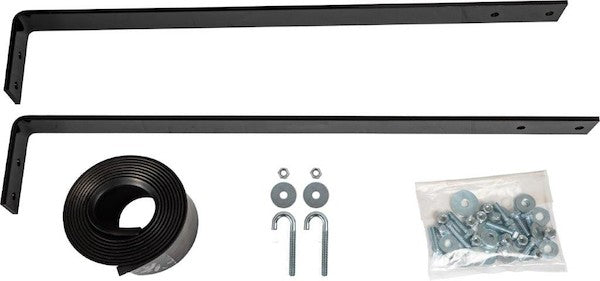
Mounting hardware for Buyers Products Lo-Sider Truck Toolboxes. The kit contains: two powder-coated steel leg brackets, j-bolts with fasteners, and a rubber pad to protect the truck bed rails.
Specifications
| ForQuickOrderPad | True |
|---|
Advanced Technical Overview: Mounting Hardware for Buyers Products Lo-Sider Truck Tool Boxes
This comprehensive technical overview details the essential mounting hardware kit specifically designed for Buyers Products Lo-Sider Truck Tool Boxes. Engineered to provide secure, stable, and durable installation, this kit ensures the optimal performance and longevity of your toolbox investment. It comprises meticulously selected components, including powder-coated steel leg brackets, robust J-bolts with accompanying fasteners, and a protective rubber pad, all designed to integrate seamlessly with the structural dynamics of modern truck beds.
1. Introduction to the Lo-Sider Truck Tool Box Mounting System
The Buyers Products Lo-Sider Truck Tool Box mounting hardware represents a critical interface between the storage unit and the vehicle's cargo bed. Its primary function is to secure the toolbox firmly against the truck bed rails, preventing movement, vibration, and potential detachment during vehicle operation. This is particularly vital for commercial and heavy-duty applications where tools and equipment are regularly transported across varying terrains and conditions. The design ethos behind this hardware focuses on achieving maximum stability, ease of installation, and long-term reliability while minimizing potential damage to the truck's finish or structure.
2. Component Breakdown and Technical Specifications
2.1. Powder-Coated Steel Leg Brackets
The core structural elements of this mounting kit are the two powder-coated steel leg brackets. These components are engineered from high-strength steel, selected for its superior tensile strength, yield strength, and resistance to fatigue. The specific steel alloy is chosen to provide a robust framework capable of supporting the static load of the toolbox and its contents, as well as dynamic loads encountered during vehicle acceleration, deceleration, and cornering.
- Material Composition: Typically, a high-grade mild steel or a low-alloy high-strength steel (e.g., ASTM A36 or equivalent) is utilized, offering an optimal balance of strength, ductility, and weldability. The precise gauge of the steel is calculated to provide adequate stiffness and load-bearing capacity without introducing excessive weight.
- Manufacturing Process: The brackets are precision-formed through processes such as stamping, laser cutting, and bending, ensuring dimensional accuracy and consistent fit. Edges are deburred to prevent sharp points and enhance safety.
-
Powder Coating: A critical feature of these brackets is the electrostatically applied powder coating. This finish serves multiple engineering purposes:
- Corrosion Resistance: The primary benefit is exceptional protection against environmental corrosion. The thermoset polymer resin, typically polyester or epoxy-polyester, forms a dense, continuous film that is highly resistant to moisture, road salts, chemicals, UV radiation, and abrasive particles. This significantly extends the operational lifespan of the brackets, especially in harsh outdoor conditions.
- Abrasion Resistance: The durable nature of powder coating provides superior resistance to scratching and chipping compared to conventional liquid paints, maintaining aesthetic integrity and protective capabilities over time.
- Impact Resistance: The resilient nature of the coating offers enhanced protection against minor impacts that could otherwise compromise the steel substrate.
- Adhesion: Proper surface preparation, including degreasing, cleaning, and sometimes phosphating, ensures excellent adhesion of the powder coat to the steel substrate, preventing peeling or flaking.
- Design Geometry: The leg brackets are specifically contoured to interface with the bottom structure of Buyers Products Lo-Sider toolboxes and the inner lip of the truck bed rails. Their design optimizes load distribution, preventing stress concentrations on both the toolbox and the truck bed. Integrated mounting points are precisely drilled or punched to accommodate the J-bolts, ensuring correct alignment and ease of assembly.
2.2. J-Bolts with Fasteners
The J-bolts constitute the primary clamping mechanism, providing the necessary mechanical force to secure the toolbox. These components are selected for their strength, thread integrity, and resistance to environmental degradation.
- Material and Grade: J-bolts are typically manufactured from high-strength steel, often conforming to SAE J429 Grade 5 or equivalent metric standards (e.g., ISO 898-1 Class 8.8). This material choice provides a minimum tensile strength and proof load sufficient to withstand the clamping forces and dynamic stresses without yielding or fracturing.
- Thread Specification: The threads are precision-rolled or cut to common specifications (e.g., UNC or UNF), ensuring compatibility with standard nuts and washers. The thread form is designed to resist stripping under high torque and to maintain clamping force over time.
-
Corrosion Protection: To ensure long-term functionality, J-bolts and their accompanying fasteners (nuts and washers) are typically galvanized or zinc-plated.
- Zinc Plating: A thin layer of zinc acts as a sacrificial coating, corroding preferentially to the underlying steel and providing cathodic protection. Electroplated zinc offers good protection in moderately corrosive environments.
- Hot-Dip Galvanizing: For superior corrosion resistance, particularly in marine or highly corrosive industrial environments, hot-dip galvanizing may be employed. This process creates a metallurgically bonded zinc-iron alloy layer, offering robust protection.
-
Fastener Set: Each J-bolt is accompanied by a nut and a washer.
- Nuts: Hexagonal nuts, often with a prevailing torque feature (e.g., nylon insert lock nuts) or split lock washers, are used to prevent loosening due to vibration. The grade of the nut matches or exceeds that of the bolt for optimal performance.
- Washers: Flat washers distribute the clamping load over a larger surface area, reducing localized stress on the bracket and preventing marring. Depending on the application, additional lock washers (e.g., split lock or external tooth lock) may be included to further enhance resistance to vibration-induced loosening.
- J-Hook Geometry: The distinctive J-shape of the bolt is engineered to hook securely underneath the lip of the truck bed rail. The curvature and length are optimized to accommodate various truck bed rail designs and thicknesses, providing a robust anchor point without requiring drilling into the truck bed, thus preserving the vehicle's structural integrity and warranty.
2.3. Rubber Pad for Bed Rail Protection
The inclusion of a rubber pad is a critical detail that addresses both vehicle preservation and system stability.
-
Material Properties: The pad is manufactured from high-density rubber, typically EPDM (Ethylene Propylene Diene Monomer) or a high-durometer SBR (Styrene Butadiene Rubber). These materials are chosen for:
- Damping Characteristics: The rubber absorbs vibrations transmitted from the vehicle chassis, reducing noise and preventing fatigue damage to both the toolbox and the truck bed.
- Coefficient of Friction: The high coefficient of friction between the rubber and the painted truck bed surface helps to prevent slippage of the toolbox, even under dynamic loads. This creates a secure, non-marring interface.
- Weather Resistance: EPDM is particularly noted for its excellent resistance to UV radiation, ozone, extreme temperatures, and general weathering, ensuring the pad remains pliable and effective over long periods without degradation.
- Compressibility: The pad provides a degree of compressibility, allowing for minor variations in truck bed rail dimensions and ensuring uniform pressure distribution across the contact area.
-
Protective Function: The primary role of the rubber pad is to act as a buffer between the steel leg brackets and the truck bed rails. This prevents direct metal-on-metal contact, which would otherwise lead to:
- Scratching and Abrasions: Protecting the painted finish of the truck bed rails from cosmetic damage.
- Galvanic Corrosion: Preventing dissimilar metal contact (steel bracket vs. aluminum truck bed, or steel bracket vs. steel truck bed with different coatings) that could accelerate corrosion in the presence of moisture.
- Noise Reduction: Minimizing squeaks and rattles that can occur from friction between rigid surfaces.
- Placement: The rubber pad is positioned between the J-bolt assembly and the top surface of the truck bed rail, acting as a buffer and grip enhancer.
3. Installation Methodology and Best Practices
The design of this mounting hardware facilitates a non-invasive installation process, preserving the structural integrity and resale value of the truck. Proper installation is paramount for safety and product longevity.
- Positioning: The Lo-Sider toolbox should be carefully positioned on the truck bed rails, ensuring it is centered and properly aligned with the cab and tailgate. The leg brackets are then aligned with the pre-drilled holes in the toolbox and the inner lip of the truck bed rails.
- J-Bolt Engagement: The J-bolts are inserted through the leg brackets and hooked under the truck bed rail lip. It is crucial to ensure full engagement of the hook to provide a secure anchor.
- Fastener Tightening Sequence: Nuts should be tightened incrementally and alternately on both sides to ensure even clamping pressure. Over-tightening can deform the truck bed rails or strip threads, while under-tightening can lead to instability. A torque wrench set to the manufacturer's specified torque values (if provided) is highly recommended. The goal is to achieve a firm, secure attachment without causing deformation.
- Rubber Pad Integration: The rubber pad should be positioned to provide complete coverage between the clamping mechanism and the truck bed rail, ensuring both protection and enhanced grip.
- Post-Installation Inspection: After initial installation, a thorough inspection should be conducted to confirm the stability of the toolbox. It is recommended to re-check the tightness of the fasteners after the first few miles of driving, and periodically thereafter, to account for any settlement or vibration-induced loosening.
4. Advantages and Engineering Benefits
- Non-Drill Installation: A key advantage is the non-invasive clamping mechanism, which eliminates the need to drill into the truck bed. This preserves the vehicle's finish, prevents potential corrosion points, and maintains the factory warranty.
- Enhanced Security: The robust J-bolt design provides a strong mechanical bond, significantly reducing the risk of theft or detachment of the toolbox, even under severe road conditions.
- Vibration Damping: The combination of steel brackets and rubber pads effectively dampens vibrations, protecting both the toolbox contents and the truck structure from fatigue.
- Corrosion Resistance: Multi-layer protection (powder coating on brackets, zinc plating/galvanizing on fasteners) ensures long-term resistance to environmental elements, extending the lifespan of the hardware.
- Ease of Maintenance: The durable finishes require minimal maintenance, typically only periodic cleaning.
- Optimized Load Distribution: The engineered design of the brackets and clamping system distributes the weight and forces evenly, preventing localized stress concentrations on the truck bed rails.
- Compatibility: Specifically designed for Buyers Products Lo-Sider Toolboxes, ensuring a perfect fit and optimal performance.
5. Conclusion
The Mounting Hardware for Buyers Products Lo-Sider Truck Tool Boxes is an expertly engineered system designed for maximum security, durability, and vehicle preservation. Every component, from the powder-coated steel leg brackets to the J-bolts and protective rubber pads, has been meticulously selected and manufactured to meet rigorous performance standards. This kit not only ensures the steadfast attachment of your toolbox but also safeguards your truck's integrity against wear, corrosion, and damage, representing a critical investment in the functional longevity of your equipment and vehicle.