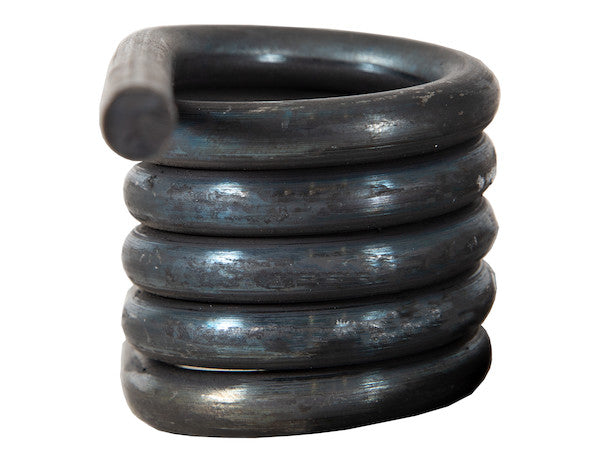
Buyers Products Torsion Ramp Spring acts as a "lift assist" for ramps that require manual deployment. Available as a right- or left-hand coil. 9.689 lb. Spring Rate.
Specifications
| Bar Dia. (in.) | .311 |
|---|---|
| Bar Ends (in.) | 3.00 |
| Coil Length (in.) | 1.87 |
| Description | Right Hand |
| I.D. (in.) | 1.18 |
| Material | Spring Steel |
| Max Deflection (??) | - |
| No. of Coils | 5 |
| O.D. (in.) | 1.87 |
| Spring Rate (in-lbs/deg) | 23 |
Precision Engineering for Enhanced Trailer Ramp Functionality: The Right Hand Torsion Ramp Spring
In the demanding world of commercial and recreational towing, the efficiency and safety of equipment operation are paramount. Trailer ramps, essential for loading and unloading heavy machinery, vehicles, or cargo, often present a significant challenge during manual deployment and retraction due to their inherent weight. This can lead to operator strain, potential injury, and decreased operational efficiency. Buyers Products addresses this critical need with its precisely engineered Right Hand Torsion Ramp Spring, a sophisticated mechanical component designed to provide substantial "lift assist" for manual deployment ramps, thereby optimizing user experience and extending the operational lifespan of the associated equipment. This detailed exposition delves into the engineering principles, material science, and practical benefits that position this torsion spring as an indispensable component for modern trailer systems.
Understanding Torsion Spring Mechanics and the Lift Assist Principle
A torsion spring is a mechanical device that stores and releases rotational energy. It operates by exerting a torque or rotational force when its ends are deflected angularly. Unlike compression or tension springs which are designed to resist linear forces, torsion springs are engineered to twist around their axis, with the applied load attempting to wind them up further. When the load is removed, the spring returns to its original position, delivering the stored energy as torque. In the context of trailer ramps, this fundamental principle is leveraged to counteract the ramp's gravitational force.
The "lift assist" function provided by the Buyers Products Torsion Ramp Spring is achieved by pre-loading the spring during installation. As the ramp is lowered, the spring is wound, storing potential energy. When the operator begins to lift the ramp, the stored energy in the spring is released, applying an upward torque that significantly reduces the effective weight the operator needs to lift. This effectively transforms a heavy, cumbersome lifting task into a manageable and ergonomic operation. The specified 9.689 lb. "Spring Rate" in the initial description can be understood as a nominal lift assist force achieved under typical operational deflection, serving as a practical indicator of the spring's aid in overcoming the ramp's dead weight. The more precise engineering parameter, 23 in-lbs/deg, defines the spring's rotational stiffness, dictating the torque generated per degree of angular deflection. This allows for precise calculations to match the spring’s output with the specific ramp weight and pivot geometry.
Detailed Examination of Technical Specifications and Their Implications
The efficacy and longevity of a torsion spring are inherently linked to its precise dimensional and material characteristics. The Buyers Products Right Hand Torsion Ramp Spring is meticulously specified to ensure optimal performance and durability. Let’s dissect the provided specifications and their engineering significance:
Material: Spring Steel
The selection of "Spring Steel" as the core material is critical. Spring steel is a high-carbon or alloy steel engineered specifically for its high yield strength, excellent elastic limit, and fatigue resistance. These properties allow the steel to be significantly deformed and then return to its original shape without permanent deformation, even after millions of cycles. Common grades include ASTM A228 (music wire), A229 (oil-tempered carbon steel), A230 (valve spring quality), A231 (chrome vanadium), and A232 (chrome silicon). While the specific grade is not listed, the designation "Spring Steel" implies a material chosen for optimal elastic performance and durability in dynamic applications.
The manufacturing process for spring steel typically involves specific heat treatments, such as hardening and tempering, to achieve the desired balance of strength and toughness. Furthermore, surface treatments like shot peening are often employed to induce compressive residual stresses, which significantly enhance fatigue life by mitigating the propagation of surface cracks. For outdoor applications like trailer ramps, corrosion resistance is also a crucial factor. While the base material is spring steel, protective coatings such as zinc plating, phosphating, or powder coating are often applied to prevent rust and extend service life, especially in environments exposed to moisture, road salt, and abrasive elements. Buyers Products’ commitment to quality ensures that the material selected and any subsequent treatments are appropriate for the harsh conditions faced by trailer components.
Geometric Parameters: Precision in Form
-
Bar Diameter (Bar Dia.): 0.311 inches (7.9 mm)
The wire or bar diameter is one of the most fundamental parameters defining a torsion spring's strength and performance. A larger bar diameter generally results in a stiffer spring and greater load-bearing capacity, but also increases manufacturing complexity and material cost. At 0.311 inches, this spring is designed to provide substantial torque for heavy-duty ramp applications without being overly bulky. The bar diameter directly influences the spring's stress levels and its spring rate; increasing the wire diameter significantly increases the spring's stiffness (proportional to the fourth power of the wire diameter, D^4, in simplified formulas for torsional stress). -
Inner Diameter (I.D.): 1.18 inches (29.97 mm) and Outer Diameter (O.D.): 1.87 inches (47.5 mm)
The inner and outer diameters define the space occupied by the coiled body of the spring and are crucial for proper fitment over a shaft or into a bore. An I.D. of 1.18 inches suggests it is designed to fit snugly over a shaft of slightly smaller diameter, allowing for free rotation while minimizing play. The O.D. of 1.87 inches indicates the overall envelope of the spring, essential for clearance within the ramp mechanism. The difference between the O.D. and I.D., relative to the bar diameter, also informs the coil pitch and potential for coils to bind under maximum deflection, a critical consideration for durability. -
Coil Length: 1.87 inches (47.5 mm) and Number of Coils: 5
The coil length refers to the axial dimension of the coiled body of the spring. Combined with the number of active coils, these parameters directly influence the spring rate and the angular deflection capability. A greater number of active coils (for a given wire diameter and mean coil diameter) typically results in a softer spring and greater angular deflection capacity before reaching solid height or exceeding material stress limits. With 5 coils and a length of 1.87 inches, this spring configuration balances compactness with effective torque generation and a reasonable operational deflection range. -
Bar Ends (End Length): 3.00 inches (76.2 mm)
The length of the bar ends refers to the straight extensions from the main coil body, which are critical for anchoring the spring and transferring torque. A length of 3.00 inches provides sufficient leverage and flexibility for attachment to the ramp and its stationary pivot point. The configuration of these ends (e.g., straight, hooked, offset, hinged) is paramount for robust and reliable installation, ensuring the spring can apply its torque effectively and withstand the cyclical stresses at these connection points. The precision in forming these ends minimizes stress concentrations and ensures proper alignment within the ramp system. -
Description: Right Hand
The "Right Hand" designation is exceptionally important for torsion springs. It describes the direction in which the wire is coiled. A right-hand wound spring will generate torque in a clockwise direction when viewed from one end, or when the load causes it to "wind up" or decrease its internal diameter. Conversely, a left-hand wound spring generates torque in a counter-clockwise direction. For ramp applications, the handedness must match the direction of ramp movement and the desired lift assist. If a right-hand ramp system requires a clockwise torque to assist lifting, a right-hand spring is necessary. Installing a spring with the incorrect handedness would either provide no assist or actively resist the desired movement, potentially causing severe damage or rendering the assist mechanism ineffective. This specific product is designed for applications requiring a right-hand wound spring to provide optimal assistance.
Performance Parameters: Quantifying the Assist
-
Spring Rate (in-lbs/deg): 23
The spring rate, precisely specified as 23 inch-pounds per degree (in-lbs/deg), is the most critical performance metric for a torsion spring. It quantifies the amount of torque generated for each degree of angular deflection. A rate of 23 in-lbs/deg means that for every degree the spring is rotated from its free position, it will exert a torque of 23 in-lbs. This value is essential for engineers to calculate the total torque the spring can provide at a given deflection angle, and thus determine its suitability for a ramp of a specific weight and geometry. For instance, if a ramp requires 1000 in-lbs of torque for lift assist at a certain angle, the spring would need to be deflected by approximately 1000/23 ≈ 43.5 degrees from its initial installed pre-load. This precise spring rate allows for meticulous system design, ensuring that the lift assist provided is adequate without over-stressing the spring or the ramp mechanism. -
Maximum Deflection (Max Deflection): -
The absence of a specific "Max Deflection" value in the specifications for a torsion spring is common, as this parameter is often application-dependent. However, it is an essential design consideration. Maximum deflection refers to the maximum angular rotation the spring can undergo without yielding or experiencing permanent deformation. It is typically limited by the material's elastic limit, the number of active coils, and the potential for the coils to "solid" (i.e., touching each other). Engineers designing the ramp system would calculate the required angular travel of the ramp and ensure that the spring’s maximum operating deflection remains well within its safe elastic limit, usually with a safety factor to prevent fatigue failure. While not explicitly stated as a fixed value, the spring is designed to operate safely within typical trailer ramp angular travel requirements, considering the given material and geometry. Exceeding the material's yield strength under excessive deflection would result in plastic deformation, reducing or eliminating the spring's effectiveness.
Engineering Design and Application Considerations
The successful integration of the Right Hand Torsion Ramp Spring into a trailer system requires careful consideration of several engineering aspects:
Matching Spring to Ramp System
Proper spring selection is paramount. The weight of the ramp, its length, and the position of its pivot point directly influence the torque required for effective lift assist. An under-sprung system will still require significant manual effort, while an over-sprung system could cause the ramp to aggressively spring upward, posing a safety hazard. The 23 in-lbs/deg spring rate allows for precise calculations to achieve the desired balance. Typically, multiple springs may be used in parallel for heavier ramps, or a single spring with specific pre-load. The goal is often to counterbalance approximately 80-90% of the ramp's weight, leaving a slight downward force when the ramp is closed to ensure it stays securely stowed.
Stress Analysis and Fatigue Life
Torsion springs are subjected to significant torsional stress in the wire during operation, particularly near the tangent points where the wire transitions from the coil body to the end sections. Buyers Products utilizes high-quality spring steel to ensure the spring can withstand repeated loading cycles without fatigue failure. The design accounts for potential stress concentrations, especially at the bends of the spring ends, which are critical failure points if not properly formed. The fatigue life of a spring is quantified by the number of cycles (deployments and retractions) it can endure before failure, and reputable manufacturers like Buyers Products employ design principles and manufacturing processes (e.g., proper heat treatment, shot peening) to maximize this life cycle.
Environmental Durability and Maintenance
Trailer components are frequently exposed to harsh environmental conditions, including moisture, extreme temperatures, road salt, dirt, and UV radiation. The use of robust spring steel, often complemented by protective coatings, is crucial for mitigating corrosion. Regular inspection for signs of rust, deformation, or wear is recommended. Lubrication of the spring coils and pivot points, as per manufacturer guidelines, can further extend its operational life and ensure smooth, quiet operation. Should a spring fail or show signs of significant wear, prompt replacement with an identical specification spring (especially regarding handedness and spring rate) is essential to maintain safety and functionality.
Installation and Safety
Installation of torsion springs, especially pre-loaded ones, can be hazardous if not performed correctly. Due to the stored energy, improper handling can lead to sudden, uncontrolled release of force. It is imperative that installation be performed by qualified personnel following manufacturer instructions, utilizing appropriate tools and personal protective equipment. The correct pre-loading of the spring is vital for achieving the intended lift assist and ensuring the ramp operates safely and predictably.
Applications Across Various Trailer Types and Industries
The Right Hand Torsion Ramp Spring is an indispensable component across a broad spectrum of trailer applications, significantly enhancing operational safety and efficiency in diverse industries:
- Utility Trailers: For landscapers, contractors, and homeowners transporting equipment like lawnmowers, ATVs, or construction materials, a heavy ramp can be a daily struggle. Torsion springs alleviate this burden, making loading and unloading seamless.
- Equipment Trailers: Transporting skid steers, mini excavators, or other heavy machinery necessitates robust ramp systems. Torsion springs ensure these substantial ramps can be deployed by a single operator, reducing the need for multiple personnel or mechanical aids.
- Car Haulers and Enclosed Trailers: Whether for classic cars, race cars, or general vehicle transport, these trailers often feature long, heavy ramps. Torsion springs are critical for their safe and effortless operation.
- Agricultural Trailers: Moving farming implements, livestock, or produce often involves ramps, where ease of use directly translates to improved productivity in time-sensitive operations.
- Powersports Trailers: Enthusiasts transporting motorcycles, UTVs, or snowmobiles benefit from easy-to-operate ramps, preventing damage to equipment and ensuring a hassle-free experience.
In each of these scenarios, the spring's ability to provide reliable lift assist translates into tangible benefits: reduced worker's compensation claims due to back injuries, faster turnaround times at job sites, enhanced user satisfaction, and a generally safer working environment.
Buyers Products: Commitment to Quality and Performance
Buyers Products is renowned for its dedication to producing high-quality components for the truck and trailer industry. The Right Hand Torsion Ramp Spring is a testament to this commitment, benefiting from rigorous design, material selection, and manufacturing processes. From the initial coiling of the spring steel wire to the precise forming of the bar ends and subsequent heat treatment, every stage is controlled to ensure the final product meets stringent performance and durability standards. Quality control checks, including spring rate testing and dimensional verification, ensure that each spring performs exactly as specified, providing consistent and reliable lift assist throughout its service life. The investment in superior materials and manufacturing excellence minimizes premature wear and failure, offering users a long-lasting and dependable solution.
Conclusion: Elevating Ramp Operations with Precision Engineering
The Right Hand Torsion Ramp Spring from Buyers Products is far more than a simple metal coil; it represents a meticulously engineered solution to a pervasive challenge in trailer operations. By precisely counteracting the gravitational forces of heavy ramps, it transforms a strenuous, potentially hazardous task into an efficient, ergonomic, and safe process. Its robust spring steel construction, coupled with precise geometric and performance specifications (such as the 0.311 in. bar diameter, 1.18 in. I.D., 1.87 in. coil length, 5 coils, 3.00 in. bar ends, and a critical 23 in-lbs/deg spring rate), ensures exceptional durability, consistent performance, and seamless integration into diverse trailer systems. For any application requiring manual ramp deployment in a clockwise assist direction, this right-hand torsion spring is an indispensable component, delivering unparalleled operational benefits and solidifying Buyers Products' reputation as a leader in providing high-performance, reliable solutions for the commercial and recreational towing sectors. Investing in this precision-engineered spring is an investment in safety, efficiency, and the long-term operational integrity of your trailer equipment.