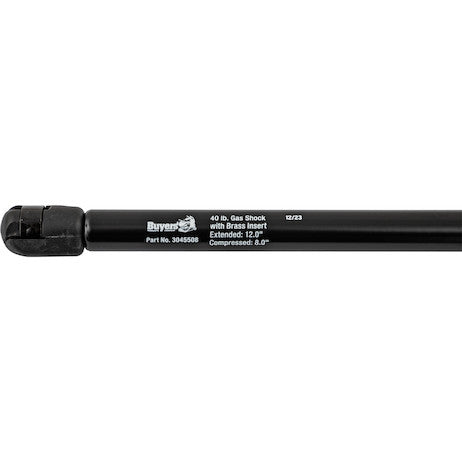
These heavy-duty shocks are used in the production of Buyers Products Truck Tool Boxes, and can be used as a universal aftermarket part to replace broken or damaged shocks on a variety of applications like cabinets, chests, trucks, trailers, and RVs.
Select the length and strength rating best suited to your application. Note: Part number 3028786 includes a 10 mm ball stud. Ball studs are sold separately on all other models (see "Accessories" below).
Specifications
| Ball Socket Diameter (mm) | 10.00 |
|---|---|
| Compressed Length (in.) | 8.00 |
| Cylinder Diameter (mm) | 15.00 |
| Extended Length (in.) | 12.00 |
| Force Rating (lbs) | 40 |
| Rod Diameter (mm) | 6.00 |
| Stroke | 4.00 |
This highly engineered gas spring, specifically the 40 Pound Gas Spring with a 10mm Ball Stud, featuring an extended length of 12 inches and a compressed length of 8 inches, represents a robust and versatile solution for controlled motion applications across a broad spectrum of industries. As an integral component within the Buyers Products Universal Heavy-Duty Gas Springs series, this particular model is designed to deliver consistent, reliable performance in demanding environments. Its construction and operational characteristics are optimized to provide not just mechanical support, but also a sophisticated dampening effect that significantly enhances user experience and equipment longevity.
At its core, a gas spring functions as a self-contained, hydropneumatic energy storage device. It consists of a precisely manufactured cylinder, a piston rod, a piston assembly, and high-pressure inert nitrogen gas, often supplemented by a small volume of hydraulic oil. When compressed, the piston rod forces the nitrogen gas into a smaller volume, increasing the internal pressure and storing potential energy. This stored energy is then released to extend the rod, providing a controlled lifting or opening force. The specific characteristics of this 40-pound gas spring are meticulously balanced to ensure optimal performance for its intended applications. The 40-pound force rating signifies the nominal force exerted by the spring when it is nearly fully extended. This force is crucial for determining its suitability for lifting or counterbalancing loads. For instance, a 40-pound force implies that the spring can effectively assist in lifting a load up to 40 pounds, or provide a constant counter-force against such a load, minimizing manual effort. The precise selection of force rating is paramount in application engineering to prevent excessive strain on hinges, latches, and structural components, while also ensuring the desired ease of operation.
The dimensional specifications of this gas spring are equally critical. With an extended length of 12 inches (304.8 mm) and a compressed length of 8 inches (203.2 mm), this unit provides a total stroke of 4 inches (101.6 mm). The stroke length dictates the travel distance of the piston rod, which directly correlates to the range of motion an application can achieve. This 4-inch stroke is ideal for applications requiring a moderate opening or closing distance, such as various types of lids, access panels, or smaller doors on utility vehicles and equipment. The specific lengths must be carefully matched to the geometry of the application to ensure that the spring operates within its designed stroke limits, preventing over-extension or over-compression, which could lead to premature failure or damage to the application itself.
The inclusion of a 10mm ball stud is a significant feature that defines the mounting interface of this particular gas spring. Ball studs and sockets are a common and highly effective method for attaching gas springs, offering a degree of rotational freedom that can accommodate slight misalignments during installation and operation. The 10mm diameter ensures compatibility with a wide range of standard ball sockets found on existing equipment or available as aftermarket accessories. This universal compatibility, highlighted by its designation as a "Universal Heavy-Duty Gas Spring," makes it an excellent choice for replacing damaged or worn-out shocks on a diverse array of equipment, including various truck toolbox doors, cargo chests, industrial cabinets, and access panels on recreational vehicles (RVs) and utility trailers. The standard ball stud mounting simplifies the replacement process, often requiring only basic tools for removal and installation.
Engineering and Performance Characteristics
The operational integrity of this gas spring is underpinned by its sophisticated dampening characteristics. It features dampened extension and undampened compression. The "dampened extension" refers to the controlled, smooth outward movement of the piston rod. This control is achieved through the hydraulic oil within the cylinder, which is forced through a small orifice in the piston assembly as the rod extends. The resistance generated by the oil flow provides a braking effect, preventing the rapid, uncontrolled "slamming" open of lids or doors. This controlled motion is vital for user safety, preventing injury from rapidly opening panels, and also for protecting the equipment itself by reducing stress on hinges and other mechanical components. Conversely, "undampened compression" means that the rod can be pushed inward with relatively little resistance from the hydraulic fluid. This design choice prioritizes ease of closure, allowing the user to push down a lid or door smoothly and without excessive force, which is highly desirable in applications where quick and easy closing is important.
The "heavy-duty" designation of this gas spring is not merely a descriptive term but reflects its robust construction and selection of materials. The cylinder, with its 15.00 mm diameter, is typically constructed from high-strength steel, precision-drawn and internally polished to ensure minimal friction and optimal sealing. The internal surface finish is critical for the longevity of the seals and the consistent operation of the piston. The piston rod, with a diameter of 6.00 mm, is generally made from hardened steel, often surface-treated with processes such as chrome plating. Chrome plating provides several advantages: it significantly enhances corrosion resistance, especially important in outdoor or harsh environments; it creates an extremely smooth, low-friction surface for the dynamic seals to operate against, minimizing wear and tear; and it contributes to the overall structural integrity of the rod, allowing it to withstand compressive and tensile forces without buckling or bending.
The internal components, though unseen, are equally crucial. The piston assembly incorporates sophisticated sealing mechanisms designed to prevent the escape of high-pressure nitrogen gas and hydraulic oil. High-quality elastomeric seals, often made from specialized compounds like NBR (nitrile butadiene rubber) or FKM (fluoroelastomer), are selected for their resistance to temperature extremes, chemical degradation, and long-term elasticity. These seals operate in conjunction with guide bearings that ensure the piston rod maintains precise alignment within the cylinder, preventing side-loading that could compromise the seals or bend the rod. The nitrogen gas, being an inert and non-combustible element, provides a stable and consistent spring force across a wide range of operating temperatures, albeit with some minor fluctuations that are inherent to gas physics. The hydraulic oil serves the dual purpose of providing the dampening medium and lubricating the internal moving parts, further extending the operational life of the unit.
Application and Selection Guidelines
When selecting a gas spring for a particular application, several critical factors must be considered beyond the simple force rating and dimensions. Understanding these parameters ensures optimal performance, longevity, and user satisfaction.
- Load Analysis: The primary consideration is the weight of the object to be lifted or counterbalanced. While this 40-pound gas spring provides 40 pounds of force, the effective lifting capability is influenced by the leverage ratio of the mounting points. For instance, if the spring is mounted closer to the hinge of a lid, it will require a higher force rating to lift the same weight than if it were mounted further away. Engineering calculations involving torque and moment arms are often necessary to precisely match the gas spring's force to the application's requirements. It's common practice to select a gas spring with slightly less force than the theoretical requirement, allowing for a small amount of residual closing force to ensure the lid remains securely shut when closed.
- Mounting Geometry: The location and angle of the mounting points significantly impact the gas spring's performance. Proper geometry ensures that the spring operates within its optimal range, minimizes side-loading on the rod and seals, and maximizes the efficiency of the force transfer. Incorrect mounting can lead to premature wear, binding, or even failure. The 10mm ball stud offers flexibility in mounting angles, but careful consideration of the arc of motion of the lid/door relative to the spring's extension/compression path is essential.
- Number of Springs: For wider or heavier lids, or to enhance stability and symmetry, two gas springs are often used in parallel. When using two springs, the combined force rating should be considered, and it's generally advisable to use two identical springs to ensure balanced operation and prevent twisting or uneven stress on the application's structure.
- Environmental Conditions: The operating environment plays a significant role in the lifespan and performance of gas springs. This heavy-duty model is designed to withstand typical outdoor and industrial conditions. However, extreme temperatures can affect the internal gas pressure (and thus the force output) and the viscosity of the hydraulic oil, impacting damping characteristics. High humidity, exposure to corrosive chemicals, or abrasive dust can also accelerate wear on the rod and seals if the unit is not adequately protected. While the chrome-plated rod offers good corrosion resistance, applications in marine or highly corrosive industrial settings may benefit from further protective measures or specialized materials.
- Temperature Effects: As a gas-filled device, the internal pressure of a gas spring is subject to the Ideal Gas Law. This means that its force output will vary with temperature. Typically, the force increases with higher temperatures and decreases with lower temperatures. While the effect is usually minor for most applications, it's a critical consideration for equipment operating in extreme climates where consistent force is absolutely paramount. Engineers designing for such conditions factor in a temperature compensation margin.
- Cycle Life: The expected operational life of a gas spring is measured in cycles (one full extension and compression). High-quality gas springs like this Buyers Product unit are designed for tens of thousands, if not hundreds of thousands, of cycles under normal operating conditions. Factors influencing cycle life include the quality of seals, the smoothness of the piston rod, the internal lubrication, and the avoidance of excessive side-loading or impact forces.
Installation, Maintenance, and Safety
Proper installation is paramount to achieving the intended performance and longevity of this 40-pound gas spring. It is crucial to ensure that the gas spring is installed with correct alignment, minimizing any angular stress or side-loading on the piston rod. Side-loading, which occurs when a force is applied perpendicular to the rod's axis, can cause premature wear on the rod seals and guide bearings, leading to gas leakage and eventual failure. The ball stud mounting system inherently offers some tolerance for angular misalignment, but direct axial loading is always preferred. Fasteners should be torqued to specifications appropriate for the mounting hardware to ensure secure attachment without over-tightening, which could deform the mounting points.
Gas springs are generally considered maintenance-free components. Their sealed nature prevents the need for lubrication or adjustments. However, periodic visual inspections are recommended, especially for units operating in harsh environments. Users should look for signs of wear, such as rust or pitting on the piston rod, oil leakage around the seals, or any physical damage to the cylinder or mounting points. A clean piston rod surface is vital for the integrity of the seals; thus, keeping the rod free from accumulated dirt, paint, or debris is a simple yet effective maintenance practice. If a gas spring begins to lose force, becomes sluggish in its operation, or exhibits visible leaks, it indicates that the unit is reaching the end of its service life and requires replacement.
Safety considerations are also paramount. Gas springs are pressurized components. Under no circumstances should attempts be made to open, modify, or puncture a gas spring. The sudden release of high-pressure gas can cause serious injury. When replacing gas springs, always ensure the equipment or lid is safely supported to prevent unexpected movement. Always wear appropriate personal protective equipment (PPE), such as safety glasses, during installation or replacement.
Conclusion
The 40 Pound Gas Spring with a 10mm Ball Stud, boasting 12 inches extended and 8 inches compressed dimensions, is a sophisticated electromechanical component designed for superior performance and durability. Its integration of a precise force rating, controlled dampening, heavy-duty construction, and universal mounting interface makes it an exceptionally valuable asset for a wide array of applications. From enhancing the functionality and safety of truck toolboxes and utility trailer lids to improving the ergonomics of cabinets and access panels in RVs, this gas spring embodies reliable engineering. Its design prioritizes smooth, controlled operation during extension and effortless compression, delivering tangible benefits in terms of user convenience, equipment protection, and overall operational efficiency. By understanding its technical specifications and adhering to proper selection and installation guidelines, users can leverage the full potential of this high-quality Buyers Products gas spring to elevate the performance and longevity of their mechanical systems. This specific model, with its robust 40lb force and precise 4-inch stroke, stands as a testament to industrial-grade engineering tailored for demanding applications requiring consistent, controlled, and effortless motion assistance.