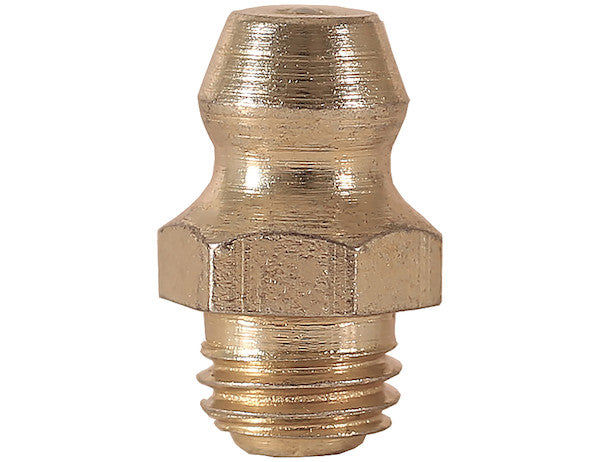
Buyers Products Taper Thread Grease Fittings feature a 1/4 in.-28 tapered thread to seal in the grease. They install into a standard 1/4 in.-28 straight thread hole. Ball checks keep out dirt and unwanted debris.
Specifications
| Angle | 0 |
|---|---|
| Ball Check (y/n) | Yes |
| Finish | Zinc Plated |
| Hole Size | - |
| Material | Carbon Steel |
| Overall Size | 0.609 |
| Thread Size | 1/4-28 |
| Type | Threaded |
The Buyers Products 1/4-28 Inch Taper Thread Grease Fittings, engineered for optimal lubrication delivery and superior sealing integrity, represent a critical component in the preventative maintenance regimen of mechanical systems. These straight fittings are meticulously designed to facilitate the efficient transfer of lubricants into bearing surfaces and friction points, simultaneously preventing the egress of grease and the ingress of detrimental contaminants. The amalgamation of precision threading, robust material selection, and an integrated ball check mechanism renders these fittings indispensable for ensuring the longevity and operational reliability of machinery across a diverse spectrum of applications.
At the core of this product's efficacy is its specialized 1/4-28 inch taper thread. The numerical designation "1/4" refers to the nominal major diameter of the thread in inches, while "28" indicates the thread pitch, specifically 28 threads per inch (TPI). This fine pitch thread form is engineered to provide a robust mechanical connection and, crucially, an exceptional seal. Unlike parallel (straight) threads that rely on external sealing methods such as O-rings or thread sealants to prevent leakage, taper threads achieve their sealing capability through an interference fit. As the tapered male thread of the fitting is driven into a standard 1/4-28 straight thread hole, the flanks and crests of the male thread progressively engage with the roots and flanks of the female thread, creating an increasingly tight, metal-to-metal seal. This controlled deformation and intimate contact at the thread interfaces effectively obstruct the helical path that grease or other fluids might otherwise exploit for leakage, especially under the high pressures typically associated with grease gun operation.
The intentional design for installation into a "standard 1/4 in.-28 straight thread hole" is a critical distinction. While the fitting itself possesses a tapered thread profile, this taper is specifically calibrated to create a self-sealing engagement within a corresponding straight female thread, rather than requiring a tapered female port as is common with traditional NPT (National Pipe Taper) connections. This design simplifies machining requirements for equipment manufacturers, as straight thread holes are often easier and more cost-effective to produce while still yielding a high-integrity seal when paired with a purpose-built tapered fitting like this one. The precision engineering ensures that sufficient thread engagement is achieved for mechanical strength, preventing thread stripping, while the taper simultaneously compresses to form a pressure-tight seal, safeguarding against lubricant loss and contamination.
A fundamental feature enhancing the utility of these grease fittings is the integrated ball check mechanism. This internal component consists of a small metallic ball, typically made of hardened steel, housed within the fitting body and held against a precision-machined seat by a spring. During the lubrication process, when a grease gun coupler is engaged and lubricant is injected, the pressure exerted by the grease overcomes the spring force, momentarily unseating the ball and allowing grease to flow into the component. Once the injection pressure subsides, the spring promptly forces the ball back onto its seat, creating a positive seal. This one-way valve functionality serves two paramount purposes: firstly, it prevents the backflow or egress of grease from the lubricated cavity, especially when the machinery is operating under vibration or varying pressures; secondly, and equally important, it acts as a formidable barrier against the ingress of external contaminants. Dirt, dust, moisture, and abrasive particles, which are ubiquitous in industrial and mobile equipment environments, are effectively blocked from entering the critical bearing surfaces, thereby preventing premature wear, corrosion, and catastrophic failure. The integrity of this ball check is paramount to the overall health of the lubricated system, as even minute particles can compromise bearing life and operational efficiency.
The material selection for these grease fittings underscores their robustness and suitability for demanding applications. Fabricated from high-quality carbon steel, these fittings offer an exceptional balance of mechanical strength, ductility, and cost-effectiveness. Carbon steel, primarily an alloy of iron and carbon (with carbon content typically up to 2.1%), is renowned for its high tensile strength and resistance to mechanical deformation under stress. This makes it an ideal material for components that are subjected to high pressures during lubrication, as well as the mechanical stresses associated with repeated coupling and uncoupling of grease guns. The specific grade of carbon steel chosen would likely be a low to medium carbon steel, providing sufficient hardness for wear resistance at the ball seat and thread surfaces, while retaining enough toughness to resist brittle fracture. This inherent strength ensures that the fitting maintains its structural integrity throughout its operational lifespan, even in challenging environments characterized by shock, vibration, and heavy use.
Further enhancing the durability and protective qualities of these fittings is their zinc plated finish. Zinc plating is a widely adopted electrochemical coating process wherein a thin layer of zinc is deposited onto the surface of the carbon steel substrate. This finish serves a dual function: it provides a sacrificial galvanic coating that protects the underlying steel from corrosion, and it improves the aesthetic appeal of the fitting. In the presence of corrosive agents (e.g., moisture, salt, industrial chemicals), the zinc coating preferentially corrodes before the steel, acting as an anode in an electrochemical cell. This sacrificial action significantly extends the service life of the fitting by preventing rust and preserving the integrity of the threads and the fitting body. Common zinc plating specifications often include a chromate conversion coating (e.g., clear or yellow chromate passivation) over the zinc layer, which further enhances corrosion resistance by forming a protective barrier and self-healing properties. This multi-layered defense mechanism ensures that the fittings remain functional and aesthetically sound even when exposed to harsh environmental conditions typical of heavy machinery, agricultural equipment, and outdoor industrial installations.
The "Straight" configuration, indicated by an "Angle" specification of 0 degrees, denotes a direct, in-line design. This form factor is the most common and versatile type of grease fitting, ideal for applications where direct access to the lubrication point is readily available and perpendicular to the component surface. Straight fittings simplify the lubrication process by minimizing geometric complexities during grease gun attachment and manipulation. While angled fittings (e.g., 45-degree, 90-degree) are crucial for restricted access areas, the straight design provides maximum flow efficiency and reduced pressure drop, making it the preferred choice for numerous standard lubrication points. Its compact "Overall Size" of 0.609 inches indicates the total length or height of the fitting when installed, providing valuable information for engineers designing or maintaining systems where space constraints might be a factor. This dimension ensures that the fitting does not unduly protrude, reducing the risk of accidental damage or interference with surrounding components.
The "Hole Size" specification, listed as '-', is typically omitted or implicitly derived from the thread size for grease fittings, as the primary concern is the external thread engagement. For a 1/4-28 thread, the corresponding tap drill size for the female straight thread hole would be specified according to thread manufacturing standards (e.g., #3 drill for 75% thread engagement). This technical detail is crucial for proper installation, as an incorrectly sized hole can lead to insufficient thread engagement and leakage, or excessive material removal weakening the female port. The "Type: Threaded" further reinforces the mechanical attachment method, emphasizing the secure, screwed-in connection that ensures both structural integrity and a leak-proof seal under operational pressures.
These grease fittings adhere to stringent industry standards to ensure interchangeability and reliable performance. While specific standards like SAE J534 for lubricating grease fittings outline dimensions, thread forms, and material requirements, the general design principles employed in these Buyers Products fittings align with such benchmarks for quality and compatibility. Adherence to these standards guarantees that the fittings will seamlessly integrate with standard grease guns and that their threads will correspond correctly with existing tapped holes in machinery components, facilitating universal application and maintenance practices.
The utility of these 1/4-28 taper thread straight grease fittings spans an extensive range of industrial and mobile applications. In heavy construction equipment, such as excavators, bulldozers, and loaders, they are vital for lubricating pivot points, bushings, and bucket pins, which are subjected to immense cyclical loads and abrasive conditions. Agricultural machinery, including tractors, harvesters, and implements, relies on these fittings to maintain the smooth operation of drive shafts, linkages, and bearing housings that operate in dusty and often wet environments. In the transportation sector, from commercial trucks to trailers and utility vehicles, these fittings are found on chassis components, universal joints, and suspension systems, ensuring safety and reducing wear from continuous road vibration and exposure. General industrial machinery, including conveyors, pumps, electric motors, and manufacturing equipment, also extensively utilizes such fittings for routine maintenance to prevent premature bearing failure and extend machine uptime. Marine applications also benefit, where the zinc plating provides a critical layer of protection against saltwater corrosion for fittings on deck machinery, steering mechanisms, and engine components.
Proper installation and maintenance practices are crucial to maximizing the benefits offered by these high-quality grease fittings. When installing, it is imperative to ensure that the threads of the fitting and the receiving port are clean and free from debris. While taper threads are designed for self-sealing, a small amount of appropriate thread sealant can be used in some cases for added assurance, though often not strictly necessary for this specific type of grease fitting designed for pressure sealing. The fitting should be threaded in carefully by hand to avoid cross-threading, then tightened with a wrench to the manufacturer's recommended torque specifications. Over-tightening can strip the threads or distort the fitting, compromising the seal and structural integrity, while under-tightening will lead to leakage. Regular inspection of fittings for damage, corrosion, or clogging is also advised. A damaged fitting, particularly one with a compromised ball check, can allow contaminants in or grease out, negating its protective function and necessitating prompt replacement.
In conclusion, the Buyers Products 1/4-28 Inch Taper Thread Grease Fittings – Straight are engineered precision components designed to uphold the highest standards of lubrication efficacy and system protection. Their tapered thread design ensures a reliable, self-sealing connection, eliminating the need for supplementary sealants in many applications. The robust carbon steel construction, fortified by a zinc-plated finish, guarantees exceptional durability and corrosion resistance, enabling prolonged service life in harsh operational conditions. The integrated ball check valve is a critical barrier, preventing lubricant backflow and, more importantly, blocking the ingress of detrimental particulates. With their straightforward 0-degree angle and optimized overall size, these fittings are universally applicable for a vast array of machinery and vehicles, streamlining maintenance procedures and significantly contributing to reduced downtime, extended equipment lifespan, and improved operational efficiency. Investing in these meticulously crafted grease fittings is a proactive step towards safeguarding valuable mechanical assets and ensuring their uninterrupted, high-performance operation.