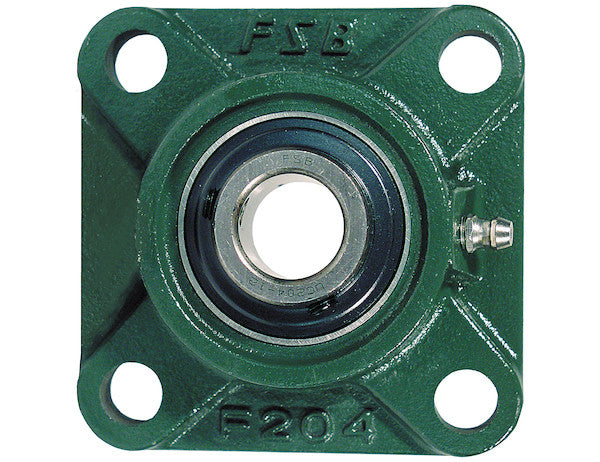
Buyers Products Eccentric Locking Collar Style Flange Bearings are equipped to handle high-speed applications without risking drive shaft slippage. The driveline-grade steel bearing is mounted in a cast iron housing, which helps make the flanges rugged and durable. The included grease fitting ensures ease of maintenance for continual smooth operation. The standard 4 bolt mounting design provides a secure attachment for the bearing. The eccentric locking collar means that the drive shaft will not slip, even at high RPMs. The flange bearing has a self-aligning design that allows for a small amount of shaft misalignment.
Specifications
| Bearing Insert Material | Carbon Steel |
|---|---|
| Bearing Insert Type | Self Aligning |
| Bi (Diagram) | 2.011 |
| Bolt Hole Center to Center | 3.625 |
| Bolt Pattern | Square |
| Bolt Size | 0.438 |
| Bore Diameter | 1.250 |
| G (diagram) | 0.50 |
| Greasable (y/n) | Yes |
| Housing Material | Cast Iron |
| I (diagram) | 0.88 |
| K (Diagram) | 2.188 |
| L (diagram) | 1.50 |
| Locking Type | Eccentric Lock Collar |
| Overall Depth | 2.16 |
| Overall Height | 4.63 |
| Overall Width | 4.63 |
| S (diagram/Bolt Hole Diameter) | 0.516 |
The 1-1/4 Inch Shaft Diameter Eccentric Locking Collar Style Flange Bearing - 4 Hole represents a critical component in robust power transmission and rotary motion systems across diverse industrial applications. Engineered for optimal performance in demanding operational environments, this bearing integrates advanced design principles and material science to ensure exceptional durability, stability, and ease of maintenance. The detailed technical specifications provided underscore its precision engineering and suitability for professional applications requiring stringent reliability.
Advanced Locking Mechanism: Eccentric Locking Collar Technology
At the core of this flange bearing's superior performance is its eccentric locking collar mechanism. Unlike conventional set screw locking systems, which rely on localized pressure points that can lead to shaft damage or slippage under dynamic loads, the eccentric locking collar provides a concentric grip around the shaft. The inner ring of the bearing features an eccentric extension, while the locking collar has a corresponding eccentric bore. When the collar is rotated relative to the inner ring, the eccentricities engage, creating a camming action that tightly clamps the bearing onto the shaft. This design generates a true 360-degree grip, distributing clamping forces uniformly around the shaft circumference.
The advantages of this locking method are manifold and critical for high-performance applications. Firstly, the uniform clamping action minimizes shaft distortion and fretting corrosion, which can occur with localized clamping methods. This significantly extends both the shaft's and the bearing's operational life. Secondly, the eccentric locking collar provides substantially greater holding power compared to set screws, making it exceptionally resistant to axial movement and rotational slippage, even under severe vibration, shock loads, and high RPM conditions. The product’s title highlights its 1-1/4 inch shaft diameter, indicating a design optimized for shafts of this specific dimension, ensuring a precise and secure fit when the eccentric collar is properly engaged. This robust locking mechanism is paramount in applications where drive shaft slippage could lead to catastrophic equipment failure or costly downtime, reinforcing the bearing's reliability in critical power transmission pathways.
Bearing Insert Composition and Self-Aligning Capability
The heart of any bearing lies in its insert, and for this unit, a high-quality carbon steel bearing insert is employed. Carbon steel is selected for its excellent balance of hardness, strength, wear resistance, and cost-effectiveness. The precise metallurgy of "driveline-grade steel" ensures that the bearing races and rolling elements (typically deep groove ball bearings within the insert) can withstand the rigorous demands of continuous operation, including significant radial and axial loads. Carbon steel's inherent properties provide a robust platform for the rolling elements, ensuring smooth rotation and minimizing friction, even under heavy operational stresses. Its ability to be heat-treated allows for tailored hardness profiles, optimizing both the fatigue life of the rolling contact surfaces and the structural integrity of the entire insert.
Furthermore, the bearing insert is of a "Self Aligning" type, a crucial feature that enhances its operational flexibility and longevity. A self-aligning bearing possesses an outer spherical race that allows the inner ring, rolling elements, and shaft to pivot slightly within the housing. This inherent flexibility compensates for static or dynamic shaft misalignment, which can arise from manufacturing tolerances, structural deflection, or installation inaccuracies. By accommodating up to a small degree of angular misalignment (typically 2-3 degrees), the self-aligning design prevents edge loading on the rolling elements and races. Edge loading, a common cause of premature bearing failure, occurs when misalignment concentrates stress on a small portion of the contact area. By mitigating this, the self-aligning feature significantly extends the bearing's fatigue life, reduces operational noise and vibration, and minimizes heat generation, contributing to overall system efficiency and reliability. The integration of a self-aligning carbon steel insert within a robust housing represents a carefully engineered solution for demanding mechanical systems.
Robust Housing Construction: Cast Iron Flange Design
The integrity of any mounted bearing is heavily reliant on its housing, and this product features a cast iron housing, recognized for its exceptional mechanical properties suitable for industrial environments. Cast iron, particularly gray cast iron, offers a unique combination of high compressive strength, excellent vibration damping characteristics, and good machinability. The material's microstructure, rich in graphite flakes, effectively dampens vibrations and absorbs shock loads, protecting the precision bearing insert from excessive dynamic stresses. This inherent damping capability is vital in applications experiencing intermittent or fluctuating loads, where excessive vibration could lead to noise, premature wear, and structural fatigue.
The "flange bearing" designation refers to its mounting style, characterized by a flat base with bolt holes designed for direct attachment to a machine frame or support structure. This specific model employs a "4 Hole" configuration with a "Square" bolt pattern, providing a stable and secure mounting platform. The critical dimensions for mounting are precisely defined: "Bolt Hole Center to Center" at 3.625 inches, "Bolt Size" at 0.438 inches, and "S (diagram/Bolt Hole Diameter)" at 0.516 inches. These specifications ensure compatibility with standard industrial fasteners and mounting plates, facilitating straightforward installation and replacement. The square bolt pattern maximizes the contact area between the flange and the mounting surface, distributing operational loads evenly and resisting rotational forces, thereby enhancing the overall rigidity and stability of the bearing assembly within the application. The rugged nature of the cast iron, combined with this robust mounting design, ensures the bearing can withstand significant static and dynamic forces without deformation or compromise to its internal components.
Precision Shaft Compatibility and Dimensional Accuracy
The "Bore Diameter" of 1.250 inches is a critical specification, indicating that this bearing is precisely engineered for shafts with a nominal diameter of 1-1/4 inches. Achieving an accurate fit between the shaft and the bearing bore is paramount for optimal performance and extended bearing life. An undersized shaft could lead to insufficient grip by the eccentric locking collar, resulting in slippage and fretting. Conversely, an oversized shaft would prevent proper installation and could damage the bearing during assembly. The precise bore diameter, coupled with the eccentric locking mechanism, ensures that when correctly installed, the shaft is held firmly and concentrically within the bearing, facilitating smooth rotation and efficient power transmission.
Further dimensional data is provided, which is essential for engineers and designers integrating this bearing into complex machinery. "Overall Depth" at 2.16 inches, "Overall Height" at 4.63 inches, and "Overall Width" at 4.63 inches define the bearing's external envelope. These measurements are crucial for space allocation, interference checking, and ensuring adequate clearance within machine designs. Additionally, diagrammatic references like "Bi (Diagram)" at 2.011 inches, "G (diagram)" at 0.50 inches, "I (diagram)" at 0.88 inches, "K (Diagram)" at 2.188 inches, and "L (diagram)" at 1.50 inches provide further detailed insights into the specific geometry of the bearing. While specific diagram interpretations vary by manufacturer, 'Bi' commonly refers to the total width of the inner ring or bearing insert, critical for axial positioning. 'G' might represent the flange thickness or bolt face thickness, affecting mounting stability. 'I' often denotes the bolt hole edge distance or a similar radial dimension. 'K' typically indicates the height from the mounting surface to the center of the bore, vital for shaft alignment and system geometry. 'L' could represent the overall length of the housing in one axis. These detailed dimensions empower engineers to ensure precise integration and predictable performance within their machinery designs, minimizing costly rework and optimizing assembly processes.
Maintenance and Lubrication for Extended Service Life
Proper lubrication is fundamental to the longevity and efficient operation of any rolling element bearing. This flange bearing is explicitly designated as "Greasable (y/n): Yes" and includes a conveniently located "grease fitting." This design feature underscores its suitability for continuous, long-term industrial service where regular maintenance is anticipated and critical. The grease fitting allows for periodic re-lubrication with appropriate industrial grease, ensuring that the rolling elements and raceways are consistently coated with a protective film. This film serves several vital functions: it reduces friction between moving parts, dissipates heat generated during operation, prevents corrosion, and acts as a barrier against ingress of contaminants such as dust, moisture, and abrasive particles. The ability to re-grease effectively purges old, degraded lubricant and any accumulated contaminants from the bearing cavity, replacing it with fresh, clean grease.
The selection of the correct grease type and adherence to a disciplined re-lubrication schedule are paramount. The specific operating environment (temperature, speed, load, presence of water or chemicals) will dictate the optimal grease viscosity and additive package (e.g., EP additives for heavy loads, rust inhibitors for wet environments). Regular re-lubrication, as opposed to "lubricated-for-life" designs, significantly extends the operational lifespan of the bearing, minimizes downtime associated with premature failure, and contributes to the overall predictive maintenance strategy of an industrial facility. This commitment to maintainability ensures that the bearing can sustain "continual smooth operation" under demanding conditions, delivering consistent performance throughout its extended service life.
Performance Characteristics and Operational Reliability
This 1-1/4 inch eccentric locking collar flange bearing is engineered to deliver exceptional performance characteristics, particularly in applications demanding high reliability. The combination of a robust carbon steel bearing insert, a self-aligning design, and the high-integrity eccentric locking collar makes it inherently suitable for "high-speed applications without risking drive shaft slippage." The uniform grip of the eccentric collar ensures that the rotational forces are effectively transmitted from the shaft to the bearing without relative motion, even when subjected to rapid accelerations, decelerations, or sustained high RPMs. This eliminates the risk of wear and damage that can arise from fretting or slippage, thereby maintaining consistent operational parameters.
The self-aligning feature, as previously discussed, plays a crucial role in mitigating the stresses caused by minor misalignments, which often lead to localized overheating, increased power consumption, and premature fatigue failure. By distributing loads evenly across the rolling elements, the bearing can sustain higher load capacities—both radial and a moderate degree of axial—than non-aligning counterparts under similar misalignment conditions. The cast iron housing further augments operational reliability by providing excellent structural support, heat dissipation capabilities, and vibration damping, collectively contributing to a quieter and more stable operating environment. The inherent "rugged and durable" nature of the cast iron housing also protects the internal bearing components from external impacts and environmental factors, ensuring sustained performance in harsh industrial settings. The design reflects a commitment to minimizing friction, enhancing load distribution, and maximizing the operational envelope under various challenging conditions, culminating in a product that delivers consistent, dependable service.
Versatile Applications Across Industries
The technical specifications and robust design of this 1-1/4 inch shaft diameter eccentric locking collar style flange bearing position it as a highly versatile component suitable for a broad spectrum of industrial applications. Its ability to handle high speeds, resist slippage, and accommodate minor misalignment makes it indispensable in sectors where reliability and operational efficiency are paramount. Common applications include:
- Material Handling Systems: Conveyor belts, roller systems, and package sorting machinery frequently rely on flange bearings to support shafts transmitting power or carrying loads. The eccentric locking collar ensures secure shaft attachment despite continuous starts, stops, and varying loads.
- Agricultural Machinery: Equipment such as harvesters, seeders, and tillage machinery operates in challenging environments with dust, dirt, and vibrations. The robust cast iron housing, greasable design, and self-aligning capability make this bearing ideal for these demanding conditions.
- Food and Beverage Processing: While this particular bearing's materials (cast iron, carbon steel) might not be suitable for direct contact with food, it can be used in machinery supporting power transmission outside the direct processing zones, where robust and reliable shaft support is required.
- Industrial Fans and Blowers: High-speed rotating equipment like industrial fans and blowers benefit from the secure shaft locking and vibration damping properties of this bearing, ensuring smooth and quiet operation.
- Pumps and Compressors: In certain types of pumps and compressors, particularly those used in non-corrosive environments, these bearings provide essential shaft support, accommodating the radial and thrust loads generated during fluid movement or gas compression.
- Textile Machinery: Equipment in textile manufacturing, often involving high-speed spindles and rollers, requires precise and stable shaft support to maintain product quality and operational continuity.
- General Industrial Power Transmission: Anywhere a rotating shaft needs reliable support and secure attachment to a machine frame, such as in gearboxes, mixers, or small machine tools, this flange bearing provides a dependable solution.
Quality Assurance and Engineering Standards
The emphasis on "driveline-grade steel" for the bearing insert and a "rugged and durable" cast iron for the housing speaks to a commitment to high manufacturing standards. Driveline-grade steel implies material selection and heat treatment processes optimized for applications involving significant torque transmission and dynamic loads, ensuring resistance to fatigue and wear. The precision manufacturing required for the 1.250-inch bore diameter and the intricate geometry of the eccentric locking collar underlines adherence to tight dimensional tolerances. Such precision is critical for the proper functioning of the locking mechanism and the overall smooth operation of the bearing. Furthermore, the explicit provision for a grease fitting and the "Greasable (y/n): Yes" designation highlight a design philosophy centered on maintainability and extended service life, aligning with best practices in industrial asset management. This attention to material quality, dimensional accuracy, and serviceability collectively contributes to a product that not only meets but often exceeds the demanding performance expectations of professional industrial environments.
Conclusion
The 1-1/4 Inch Shaft Diameter Eccentric Locking Collar Style Flange Bearing with a 4-hole mounting configuration is a precisely engineered solution designed for superior performance in challenging industrial applications. Its core attributes—the secure and concentric grip of the eccentric locking collar, the durable and wear-resistant carbon steel self-aligning bearing insert, and the robust cast iron housing with a square bolt pattern—converge to deliver unparalleled reliability and operational efficiency. The meticulous design, incorporating a self-aligning mechanism, mitigates common issues like shaft misalignment and edge loading, thereby extending the bearing's service life and reducing maintenance requirements. With its integral grease fitting, routine maintenance is simplified, ensuring continuous smooth operation even under high-speed and demanding load conditions. This bearing is a testament to advanced engineering, offering a dependable, long-lasting component essential for power transmission systems across a myriad of industrial sectors, ensuring optimal performance and minimizing costly downtime.