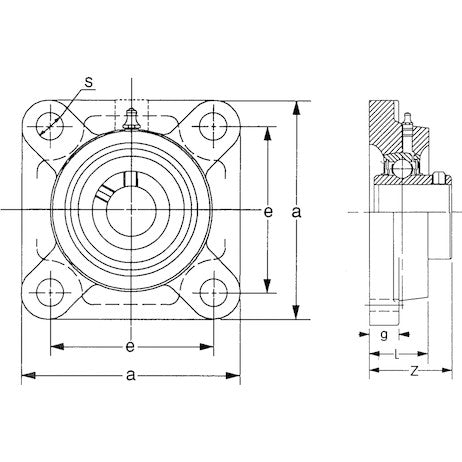
Buyers Products 2 Inch Set Screw Locking Flange Bearing (4 Bolt) is built for long life with simple installation and maintenance. The driveline-grade steel bearing is mounted in a cast iron housing, which helps make the flanges rugged and durable. The included grease fitting ensures ease of maintenance for continual smooth operation. The standard 4 bolt mounting design makes installation easy even in tight places. Its set screw design helps avoid shaft slippage.
Specifications
| Bearing Insert Material | Carbon Steel |
|---|---|
| Bearing Insert Type | Self Aligning |
| Bi (Diagram) | 1.500 |
| Bolt Hole Center to Center | 3.516 |
| Bolt Pattern | Square |
| Bolt Size | 0.375 |
| Bore Diameter | 1.250 |
| G (diagram) | 0.56 |
| Greasable (y/n) | Yes |
| Housing Material | Cast Iron |
| I (diagram) | 0.70 |
| L (diagram) | 1.22 |
| Locking Type | Set Screw |
| Overall Depth | 1.59 |
| Overall Height | 4.25 |
| Overall Width | 4.25 |
| S (diagram/Bolt Hole Diameter) | 0.469 |
Technical Overview: 1-1/4 Inch Shaft Diameter Set Screw Style Flange Bearing - 4 Hole
This detailed technical description provides an in-depth analysis of the 1-1/4 Inch Shaft Diameter Set Screw Style Flange Bearing with a 4-hole mounting configuration. Designed for robust performance in demanding industrial applications, this component embodies a synergy of precision engineering, durable material selection, and user-centric design principles. It serves as a critical interface for transmitting rotational motion while providing unwavering support to rotating shafts, ensuring system stability and operational longevity.
Precision Engineering for Optimal Shaft Support
At the core of this bearing's utility is its precisely engineered 1-1/4 inch (1.250 inch) bore diameter, meticulously machined to provide an exact fit for corresponding shaft dimensions. The accuracy of this bore is paramount for several reasons: it minimizes radial play, thus reducing vibration and noise, and it ensures uniform distribution of radial and thrust loads across the bearing surfaces. An improperly sized bore can lead to excessive friction, premature wear, and even catastrophic failure of the shaft or bearing, highlighting the importance of this critical dimension in industrial power transmission systems. The self-aligning bearing insert further refines this precision by allowing for minor angular misalignments that inevitably occur during installation or due to structural deflections in machinery. This inherent flexibility reduces stress concentrations on the shaft and bearing, extending the operational life of the entire assembly and mitigating the risk of fretting corrosion or fatigue.
Robust Construction: Materials and Metallurgy
The superior durability and reliability of this flange bearing are directly attributable to its judicious selection of construction materials: a rugged cast iron housing and a high-performance carbon steel bearing insert. Each material plays a distinct, yet complementary, role in the overall integrity and functionality of the unit.
Cast Iron Housing: Strength, Stability, and Vibration Damping
The housing of this flange bearing is constructed from high-grade cast iron, a material celebrated in mechanical engineering for its exceptional compressive strength, rigidity, and inherent vibration damping capabilities. Cast iron, specifically grey cast iron often used for bearing housings, possesses a microstructure characterized by graphite flakes embedded within a metallic matrix. These graphite flakes act as microscopic stress concentrators and also contribute to its damping properties, effectively absorbing kinetic energy and reducing resonant vibrations that can otherwise destabilize rotating machinery. This characteristic is particularly vital in applications where dynamic loads and intermittent impacts are prevalent. Furthermore, cast iron offers excellent dimensional stability over a wide range of operating temperatures, ensuring that the bearing's mounting and alignment are maintained even under varying thermal conditions. Its resistance to deformation under heavy static and dynamic loads provides a stable platform for the internal bearing element, safeguarding the precision of the rotating assembly and extending service intervals in harsh industrial environments.
Carbon Steel Bearing Insert: Wear Resistance and Load Capacity
The internal bearing insert is fabricated from driveline-grade carbon steel. Carbon steel is chosen for its superior hardness, wear resistance, and high load-bearing capacity, particularly after appropriate heat treatment processes. The specific composition and heat treatment regimen impart a microstructure that offers an optimal balance of toughness and surface hardness. This enables the bearing to withstand the high contact stresses and abrasive wear inherent in continuous rotation, even under significant radial and axial loads. The 'driveline-grade' designation implies that the steel meets stringent specifications for applications involving power transmission, where high torque, shock loads, and cyclic fatigue are common. This ensures the bearing maintains its structural integrity and functional performance over extended operational periods, minimizing friction and optimizing energy efficiency within the mechanical system. The interface between the carbon steel bearing and the rotating shaft is where the majority of frictional forces are managed, making the material's properties critical for sustained smooth operation.
The Set Screw Locking Mechanism: Secure Shaft Retention
A distinctive feature of this flange bearing is its set screw locking mechanism. This design provides a highly effective and positive means of securing the bearing onto the shaft, preventing axial movement and rotation relative to the shaft. The mechanism typically involves two or more set screws strategically positioned on the inner ring of the bearing. These screws are tightened against the shaft, creating a localized high-pressure contact point that generates sufficient frictional force to resist slippage. The advantages of a set screw design are multifaceted:
- Positive Shaft Retention: It ensures a secure fit, even under conditions of high vibration, shock loads, or reversing torque, which could cause alternative locking methods to loosen.
- Ease of Installation and Removal: Compared to interference fits or specialized adapter sleeves, set screws simplify installation, requiring fewer specialized tools and less time. They also facilitate straightforward removal for maintenance or replacement.
- Cost-Effectiveness: This locking method is generally more economical than some other shaft locking solutions, without compromising on performance for many applications.
- Minimized Shaft Damage: While set screws do create small indentations on the shaft, proper tightening procedures and periodic inspection can minimize undue wear or stress concentrations on the shaft itself. The benefit of robust shaft retention often outweighs this minor consideration in most industrial contexts.
The set screw locking mechanism is particularly well-suited for applications where quick assembly and reliable shaft attachment are paramount, making it a preferred choice in many material handling, agricultural, and general industrial machinery sectors.
Enhanced Maintenance and Operational Longevity: The Greasable Design
The inclusion of a grease fitting, designating the bearing as 'greasable,' is a critical aspect of its design, specifically engineered to maximize operational lifespan and facilitate routine preventative maintenance. Lubrication is the lifeblood of any rolling element bearing, serving several vital functions:
- Friction Reduction: A layer of lubricant separates the rolling elements from the raceways, drastically reducing friction, wear, and heat generation.
- Heat Dissipation: The circulating grease helps to carry away heat generated by friction, preventing thermal expansion and material degradation.
- Contamination Protection: The grease forms a protective barrier, preventing the ingress of dust, moisture, and other particulate contaminants that can cause abrasive wear and corrosion.
- Corrosion Prevention: Lubricants often contain additives that inhibit corrosion on the metallic surfaces of the bearing.
The integrated grease fitting, typically a Zerk fitting, allows for direct, controlled injection of fresh lubricant into the bearing cavity using a standard grease gun. This straightforward maintenance procedure replenishes the grease supply, purges old, contaminated grease, and ensures that the bearing operates under optimal lubrication conditions. This feature significantly contributes to the bearing's 'long life' by mitigating the primary causes of premature bearing failure and sustaining smooth, efficient operation across extended service intervals.
Standardized 4-Hole Mounting for Versatility
The 4-hole (4-bolt) mounting design with a square bolt pattern is a ubiquitous standard in industrial bearing installations, offering exceptional stability, load distribution, and ease of integration into diverse machinery. With a bolt hole center-to-center distance of 3.516 inches and suitable for 0.375 inch bolts, this configuration provides a robust attachment to machine frames or structural components. The square pattern ensures even distribution of mounting forces, reducing localized stress concentrations on the housing and the mounting surface. Its inherent symmetry simplifies alignment during installation. Furthermore, the standardized nature of this mounting pattern means that it can be readily interchanged with other industry-standard components, offering flexibility in design and maintenance. The design's compact footprint, with an overall height and width of 4.25 inches and an overall depth of 1.59 inches, facilitates installation even in spatially constrained environments, aligning with the practical demands of industrial equipment design.
Dimensional Specifications and Their Engineering Significance
Understanding the detailed dimensional specifications is crucial for design engineers and maintenance professionals to ensure proper fit, function, and interchangeability. Each specified dimension plays a role in the bearing's application suitability:
- Bore Diameter (1.250 inches): This is the internal diameter of the bearing, dictating the shaft size it can accommodate. Precise fit is critical for performance.
- Overall Height (4.25 inches), Overall Width (4.25 inches), Overall Depth (1.59 inches): These external dimensions define the physical envelope of the bearing, essential for space planning, interference checking, and ensuring adequate clearance within machinery designs.
- Bolt Hole Center to Center (3.516 inches) and Bolt Hole Diameter (S) (0.469 inches): These dimensions are vital for creating accurate mounting patterns on mating surfaces, ensuring the bearing can be securely bolted into place without misalignment or undue stress.
- Bi (Diagram) (1.500 inches): This dimension typically refers to the width of the inner ring or the bearing insert itself, influencing the bearing's load capacity and stability on the shaft.
- G (Diagram) (0.56 inches): Often related to the distance from the mounting surface to a specific point on the bearing, crucial for shaft positioning and alignment relative to other components.
- I (Diagram) (0.70 inches): This dimension might indicate the depth of the inner ring or the projection of the bearing from the housing face, important for accommodating shaft shoulders or seals.
- L (Diagram) (1.22 inches): This could represent the length of the housing through the bore or a similar critical housing dimension that affects mounting or component integration.
These precise measurements enable engineers to accurately model and integrate the bearing into complex mechanical assemblies, ensuring functional integrity and reliable performance across the product's lifespan.
Self-Aligning Capability: Accommodating Dynamic Conditions
The 'Self Aligning' attribute of the bearing insert is a sophisticated design feature that significantly enhances the operational robustness of the flange bearing. In real-world industrial applications, perfect alignment between the shaft and the bearing housing is challenging to achieve and maintain. Structural deflections, thermal expansion, imprecise machining, or even settling of foundations can introduce angular misalignments. A self-aligning bearing possesses an outer race that is spherically ground, allowing the inner ring and rolling elements to pivot slightly within the housing. This angular freedom compensates for initial mounting misalignments and dynamic shaft deflections, preventing edge loading on the rolling elements which would otherwise lead to premature fatigue and failure. By distributing loads evenly, the self-aligning feature dramatically extends the bearing's service life, reduces power consumption by minimizing frictional losses, and significantly improves the overall reliability of the machinery, particularly in long shaft applications or where structural flexibility is a design consideration.
Applications and Industries
The specific combination of features—1-1/4 inch bore, set screw locking, cast iron housing, carbon steel insert, self-aligning design, and 4-hole mounting—makes this flange bearing exceptionally versatile and indispensable across a broad spectrum of industrial applications. Common industries and machinery where this component excels include:
- Material Handling Systems: Essential for conveyor systems, roller beds, and sorters where shafts need reliable support under continuous operation and varying loads.
- Agricultural Equipment: Used in tractors, harvesters, and other farm machinery, providing durable shaft support in demanding, often dusty and wet, outdoor conditions.
- Power Transmission Equipment: Integral to gearboxes, drive shafts, and pulley systems, ensuring smooth and efficient transfer of rotational energy.
- Industrial Fans and Blowers: Providing stable support for impellers and fan shafts, crucial for preventing vibration and ensuring quiet operation.
- Pumps and Compressors: Supporting rotating shafts in various fluid handling and air compression systems, where reliability is paramount.
- Textile Machinery: Offering precise and consistent shaft support for rollers and spindles, critical for product quality and machine efficiency.
- Food Processing Machinery: Where robust and easily maintainable components are required, though material suitability for direct food contact would need further evaluation for specific applications.
- General Industrial Machinery: Any application requiring reliable, fixed-position shaft support with a standard mounting pattern, accommodating moderate to heavy loads and speeds.
Its rugged construction and ease of maintenance are particularly valued in environments where downtime is costly and operational continuity is critical.
Conclusion: A Benchmark in Industrial Bearing Technology
The 1-1/4 Inch Shaft Diameter Set Screw Style Flange Bearing with a 4-hole configuration represents a meticulously engineered solution for providing robust and reliable shaft support in diverse industrial settings. From its driveline-grade carbon steel bearing insert offering superior wear resistance and load capacity, to its heavy-duty cast iron housing providing structural integrity and vibration dampening, every aspect of its design is optimized for longevity and performance. The set screw locking mechanism ensures positive shaft retention, while the self-aligning feature deftly manages minor misalignments, extending the life of both the bearing and the associated shafting. Coupled with the crucial greasable design for simplified maintenance and the industry-standard 4-bolt mounting for versatile installation, this flange bearing is more than just a component; it is a critical investment in the operational efficiency, reliability, and sustained productivity of industrial machinery. Its robust specifications and thoughtful design make it an exemplary choice for engineers seeking a high-performance bearing solution that delivers exceptional value and minimizes total cost of ownership over its extensive service life.