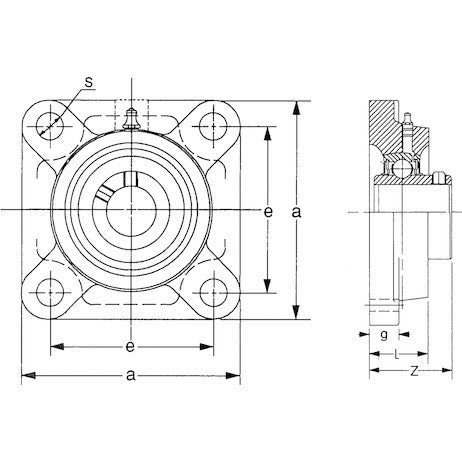
Buyers Products 2 Inch Set Screw Locking Flange Bearing (4 Bolt) is built for long life with simple installation and maintenance. The driveline-grade steel bearing is mounted in a cast iron housing, which helps make the flanges rugged and durable. The included grease fitting ensures ease of maintenance for continual smooth operation. The standard 4 bolt mounting design makes installation easy even in tight places. Its set screw design helps avoid shaft slippage.
Specifications
| Bearing Insert Material | Carbon Steel |
|---|---|
| Bearing Insert Type | Self Aligning |
| Bi (Diagram) | 1.937 |
| Bolt Hole Center to Center | 4.016 |
| Bolt Pattern | Square |
| Bolt Size | 0.500 |
| Bore Diameter | 1.500 |
| G (diagram) | 0.63 |
| Greasable (y/n) | Yes |
| Housing Material | Cast Iron |
| I (diagram) | 0.83 |
| L (diagram) | 1.41 |
| Locking Type | Set Screw |
| Overall Depth | 2.03 |
| Overall Height | 5.13 |
| Overall Width | 5.13 |
| S (diagram/Bolt Hole Diameter) | 0.625 |
The Replacement 4-Hole 1-1/2 Inch Set Screw Locking Flange Bearing represents a cornerstone component in a multitude of industrial and mechanical power transmission systems. Engineered for robust performance and extended operational life, this particular bearing unit is meticulously designed to meet the rigorous demands of various applications, from heavy-duty industrial machinery to essential agricultural equipment. Its integrated design, combining a durable housing with a high-performance bearing insert, ensures reliable shaft support and rotational precision under diverse operating conditions. The emphasis on "long life with simple installation and maintenance" is not merely a marketing claim but an intrinsic aspect of its design philosophy, aiming to minimize downtime and operational costs for end-users.
At the core of this bearing's structural integrity is its Housing Material, specified as Cast Iron. Cast iron is a widely recognized material in bearing housing manufacturing due to its exceptional properties. Firstly, its inherent rigidity and compressive strength provide a stable platform for the rotating bearing insert, effectively absorbing radial and axial loads. This material also exhibits excellent vibration damping characteristics, which is crucial in applications where machinery generates significant operational vibrations. By attenuating these vibrations, cast iron housings help to protect the internal bearing components from premature wear and reduce operational noise. Furthermore, cast iron offers a high degree of resistance to deformation, ensuring that the bearing's alignment is maintained over its service life, even under static or dynamic stresses. The casting process allows for complex geometries, contributing to the overall strength and efficient load distribution of the flange. The specific dimensions of the housing, including an Overall Height of 5.13 inches, an Overall Width of 5.13 inches, and an Overall Depth of 2.03 inches, signify a compact yet robust form factor, suitable for integration into various equipment designs without requiring excessive space.
The mounting configuration for this flange bearing is a critical design element contributing to its versatility and ease of installation. Featuring a 4 Bolt mounting design with a Square Bolt Pattern, it adheres to widely accepted industrial standards. The Bolt Hole Center to Center dimension of 4.016 inches, coupled with a Bolt Size of 0.500 inches and a Bolt Hole Diameter (S) of 0.625 inches, indicates precise engineering for secure attachment to machine frames or structural components. This standard four-bolt pattern provides balanced load distribution across the mounting surface, preventing localized stress concentrations and ensuring the bearing remains firmly affixed, even during high-speed rotation or impact loads. The precision in these dimensions guarantees interchangeability with existing mounting points, simplifying replacement and upgrade processes. The "easy installation even in tight places" attribute is directly supported by this standardized and practical bolt pattern, allowing for efficient mounting in confined mechanical envelopes.
Contained within this robust cast iron housing is the Bearing Insert, specifically identified by its Material as Carbon Steel and its Type as Self Aligning. Carbon steel is an excellent choice for bearing inserts due to its high hardness, wear resistance, and capacity to handle significant radial and axial loads. The careful heat treatment and metallurgical composition of driveline-grade steel ensure that the races and rolling elements possess the necessary fatigue life and structural integrity to endure continuous operation under demanding conditions. This material selection is paramount for applications subjected to dynamic loading, impact, and abrasive environments, ensuring that the bearing maintains its performance characteristics over an extended period. The "driveline-grade steel" designation specifically implies a material quality suitable for transmitting power efficiently and reliably, often found in automotive, agricultural, and industrial drive systems where resilience and durability are non-negotiable.
The "Self Aligning" characteristic of the bearing insert is a sophisticated feature that significantly enhances the bearing's operational flexibility and longevity. This design allows the inner ring of the bearing to pivot slightly within the outer ring, compensating for minor misalignments between the shaft and the bearing housing. Such misalignments can arise from manufacturing imperfections, structural deflections under load, or assembly errors. Without a self-aligning capability, these misalignments would induce bending moments and uneven stress distributions within the bearing, leading to premature wear, increased friction, higher operating temperatures, and ultimately, bearing failure. The self-aligning feature mitigates these risks by allowing the bearing to accommodate angular deviations dynamically, thereby reducing internal stresses, lowering friction, and extending the operational life of both the bearing and the connected machinery. This is particularly advantageous in field installations where perfect alignment is challenging to achieve and maintain over time.
The locking mechanism employed is a Set Screw Locking Type, a popular and practical method for securing the bearing insert onto the shaft. The set screw design involves one or more screws threaded into the inner ring of the bearing. These screws are tightened against the shaft, creating a localized high-pressure contact point that generates frictional forces sufficient to prevent relative rotation between the shaft and the inner ring. This method is highly effective in avoiding "shaft slippage," a critical function to ensure that power is transmitted efficiently and consistently. The primary advantages of set screw locking include its simplicity, cost-effectiveness, and ease of installation and removal. It does not require any special shaft preparation beyond ensuring the shaft surface is clean and free of burrs. While generally suited for applications with moderate loads and speeds, proper tightening of the set screws to the manufacturer-recommended torque specifications is crucial for optimal performance and to prevent loosening during operation. The Bore Diameter of 1.500 inches indicates the specific shaft size this bearing is designed to accommodate, ensuring a precise fit for applications requiring this standard shaft dimension.
Maintenance and lubrication are vital for any rotating machinery component, and this flange bearing integrates features to simplify this process. The product is "Greasable (y/n): Yes," prominently featuring an included grease fitting. This grease fitting serves as an access point for the periodic replenishment of lubricant, which is fundamental for maintaining the bearing's optimal performance. Lubrication performs several critical functions: it reduces friction between the rolling elements and raceways, minimizes wear, dissipates heat generated by friction, and protects the internal components from corrosion and contamination. Regular greasing, typically performed with a grease gun, ensures a continuous film of lubricant is present, which is essential for "continual smooth operation" and extending the bearing's service life. The type of grease and the frequency of lubrication will depend on the operating conditions (temperature, speed, load, environmental factors) and should align with manufacturer recommendations or industry best practices. Proper lubrication dramatically extends the Mean Time Between Failures (MTBF) of the bearing, contributing to overall system reliability.
Beyond the core components, specific diagrammatic dimensions such as Bi (1.937 inches), G (0.63 inches), I (0.83 inches), and L (1.41 inches) provide critical information for engineers and designers integrating this bearing into their systems. These measurements correspond to specific geometric features of the bearing and its housing, often relating to the flange thickness, shoulder dimensions, or clearance requirements. For instance, 'L' often refers to the housing's length or overall dimension along the shaft axis, while 'Bi' and 'I' might denote specific radial or axial offsets. These precise dimensions are indispensable for accurate CAD modeling, interference checking, and ensuring correct fitment within a larger assembly. Understanding these parameters ensures that the bearing not only fits physically but also functions optimally within its designated mechanical environment.
The operational envelope of this 4-hole flange bearing is broad, catering to a diverse range of industrial sectors. In agricultural machinery, it supports shafts in implements like cultivators, harvesters, and sprayers, where dusty, demanding environments and intermittent loading are common. Its rugged cast iron housing and robust carbon steel bearing are well-suited to withstand these challenging conditions. In conveyor systems, these bearings are critical for supporting idler and drive shafts, facilitating the smooth and continuous movement of materials. Their durability and ease of maintenance are highly valued in environments where continuous operation is essential and unscheduled downtime can be costly. Construction equipment, such as concrete mixers, material handlers, and certain types of compactors, also benefits from the reliability of these bearings, providing stable support for rotating components under heavy loads and vibrations. General industrial applications, including various types of processing machinery, pumps, fans, and textile equipment, also extensively utilize such flange bearings for power transmission and motion control. The combination of self-aligning capabilities and effective shaft locking makes it a versatile choice for scenarios where minor shaft imperfections or dynamic operating conditions might otherwise compromise bearing integrity.
When considering the installation of this Replacement 4-Hole 1-1/2 Inch Set Screw Locking Flange Bearing, several professional practices are recommended to maximize its lifespan and performance. Prior to mounting, the shaft should be thoroughly cleaned and inspected for burrs, nicks, or other surface irregularities that could interfere with the set screw locking or cause excessive wear. The mounting surface for the flange bearing should also be clean, flat, and structurally sound to ensure proper alignment and support. When securing the housing, bolts should be tightened incrementally and evenly, following a crisscross pattern, to prevent distortion of the housing and ensure uniform pressure distribution. The recommended torque specifications for the mounting bolts should be strictly adhered to. Once the housing is securely mounted, the shaft can be inserted into the bearing bore. The set screws should then be tightened against the shaft. It is often recommended to tighten the first set screw to a specified torque, then the second (if applicable) to the same torque, and then return to the first for a final check, as tightening one screw can sometimes slightly reduce the clamping force of the other. This ensures maximum grip and minimizes the risk of shaft slippage. Post-installation, a preliminary lubrication cycle and a brief test run are advisable to confirm smooth operation and detect any anomalies.
In summary, the Replacement 4-Hole 1-1/2 Inch Set Screw Locking Flange Bearing is an expertly crafted component designed for reliability, durability, and ease of serviceability in demanding industrial environments. Its specifications—including a robust cast iron housing, a high-performance carbon steel self-aligning bearing insert, a secure set screw locking mechanism, and comprehensive dimensions—all coalesce to provide a superior solution for shaft support and power transmission. The integral greasable feature underscores its commitment to prolonged operational life through effective maintenance. This bearing offers a compelling combination of technical prowess, operational efficiency, and value, making it an indispensable part of countless mechanical systems requiring steadfast rotational support and resistance to challenging operational stressors. For engineers, maintenance personnel, and original equipment manufacturers, selecting this product ensures a dependable, high-quality solution that contributes significantly to the overall reliability and performance of their machinery. Its adherence to industry-standard dimensions and mounting configurations further simplifies integration and replacement, reinforcing its position as a go-to choice for critical applications.