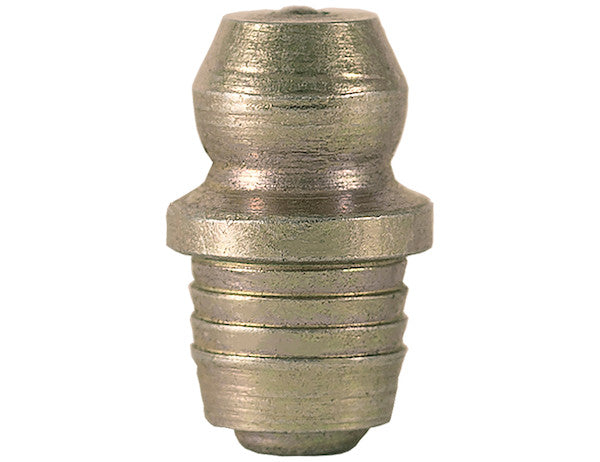
Buyers Products Drive Type Grease Fittings allow for fast and simple grease fitting installation. They are a cost effective, assembly line-friendly solution to replace worn out or damaged grease fittings with serrated shanks and oversized holes.
Specifications
| Angle | 0 |
|---|---|
| Ball Check (y/n) | No |
| Finish | Zinc Plated |
| Hole Size | 0.188 |
| Material | Carbon Steel |
| Overall Size | 0.625 |
| Thread Size | - |
| Type | Press In |
Advanced Technical Overview: 5/8 Inch Drive-In Type Grease Fitting with 3/16 Inch Hole
The 5/8 Inch Drive-In Type Grease Fitting with a 3/16 Inch Hole, as supplied by Buyers Products, represents a critical component in the preventive maintenance and lubrication strategies across diverse industrial and mechanical applications. This specific type of grease fitting is engineered for scenarios demanding rapid, secure, and cost-effective installation, particularly in environments where threaded connections are impractical or where existing bores have sustained wear. Understanding the precise specifications and design characteristics of this fitting is paramount for optimizing machinery lifespan, ensuring operational efficiency, and adhering to rigorous maintenance schedules.
Fundamental Role of Grease Fittings in Lubrication Systems
Grease fittings, also known as Zerk fittings or grease nipples, serve as the interface between a grease gun and a lubrication point on machinery. Their primary function is to facilitate the injection of lubricant (grease) into bearings, bushings, universal joints, and other moving parts that require regular lubrication to reduce friction, prevent wear, dissipate heat, and inhibit corrosion. Proper lubrication is fundamental to the reliability and longevity of mechanical systems, preventing catastrophic failures and minimizing downtime.
Drive-In vs. Threaded Grease Fittings: A Comparative Analysis
Grease fittings are broadly categorized into two main types: threaded and drive-in (or press-in). While threaded fittings are secured via a screw-in mechanism, offering a highly robust and often high-pressure connection, drive-in fittings employ a different installation principle. The 5/8 Inch Drive-In Type Grease Fitting is designed to be pressed or driven into a pre-drilled or existing bore, relying on an interference fit and specialized shank features to achieve retention. This distinction informs their respective application domains and installation methodologies.
Technical Merits of Drive-In Grease Fittings
The drive-in fitting, such as the one described, offers several distinct advantages:
- Speed of Installation: Drive-in fittings eliminate the need for tapping threads into a bore, significantly reducing installation time. This makes them exceptionally "assembly line-friendly" and ideal for high-volume manufacturing processes or rapid field repairs.
- Cost-Effectiveness: The manufacturing process for drive-in fittings is often simpler than for threaded equivalents, leading to lower unit costs. Furthermore, the absence of threading operations during installation reduces labor costs and tool wear.
- Tolerance for Imperfect Bores: A key advantage, explicitly highlighted in the product description, is their utility in "oversized holes" or those that are worn. The design, particularly with serrated shanks, allows for a secure fit even when the bore diameter is slightly larger than ideal, providing a viable repair solution where re-tapping for a threaded fitting might be impractical or impossible without drilling to a larger size.
- Reduced Risk of Cross-Threading: Without threads, the risk of cross-threading during installation is entirely eliminated, simplifying the process and reducing potential damage to the component being lubricated.
Detailed Analysis of Specifications
The provided specifications offer a comprehensive understanding of the fitting's design and intended performance characteristics.
Overall Size: 5/8 Inch (0.625)
The "Overall Size" of 0.625 inches (5/8 inch) refers to the nominal diameter of the fitting's shank that is driven into the mating bore. This dimension is crucial for bore preparation. For a secure interference fit, the bore in the component should typically be slightly smaller than the nominal shank diameter, often specified with tight tolerances. The interference fit creates radial compressive stress between the fitting shank and the bore wall, which, combined with the serrations, provides the necessary retention force to withstand the pressures encountered during greasing operations and resist accidental dislodgement from vibration or impact.
Hole Size: 3/16 Inch (0.188)
The internal "Hole Size" of 0.188 inches (3/16 inch) dictates the internal diameter through which the grease flows from the grease gun coupler into the lubrication point. This dimension influences several operational factors:
- Grease Flow Rate: A larger internal diameter generally allows for higher grease flow rates at a given pressure, which can be beneficial for quickly lubricating large bearings or reservoirs. Conversely, a smaller hole might restrict flow but allow for higher injection pressures to overcome stubborn blockages.
- Compatibility with Grease Types: The internal diameter must accommodate the viscosity and consistency of the grease being used. Extremely thick greases or those with large solid additives might experience flow resistance or clogging in very small bores, though a 3/16 inch hole is quite standard and generally accommodates a wide range of common industrial greases.
- Pressure Drop: The internal bore contributes to the pressure drop across the fitting. While this is typically minor compared to the pressure drop within the lubrication point itself, it's a factor in critical high-pressure systems.
Material: Carbon Steel
The selection of "Carbon Steel" as the base material is a testament to its optimal balance of mechanical properties, cost-effectiveness, and widespread applicability in industrial settings. Carbon steel typically refers to steel alloys where carbon is the primary alloying element, up to about 2.1% by weight. Key characteristics include:
- High Tensile Strength: Carbon steel exhibits excellent tensile strength, allowing the fitting to withstand significant internal pressures generated during grease injection without deformation or failure.
- Durability: It offers robust resistance to mechanical stresses, impacts, and general wear and tear, ensuring a long service life in demanding environments.
- Machinability: Carbon steel is relatively easy to machine, which facilitates the creation of precise features like serrations and the internal bore, contributing to consistent product quality and cost-efficient manufacturing.
- Cost-Effectiveness: Compared to alloy steels or stainless steels, carbon steel is more economical, making it a preferred choice for high-volume components like grease fittings where specific corrosion resistance or extreme temperature performance is not the primary driver.
Finish: Zinc Plated
The "Zinc Plated" finish is a crucial protective layer applied to the carbon steel base material. Zinc plating is an electroplating process where a thin layer of zinc is deposited onto the surface of the steel. This finish serves several vital functions:
- Corrosion Resistance: Zinc acts as a sacrificial coating, corroding preferentially to the underlying steel when exposed to moisture, oxygen, and other corrosive agents. This significantly extends the life of the fitting, particularly in outdoor, humid, or mildly corrosive industrial environments. This is essential for maintaining the integrity of the fitting and ensuring reliable lubrication over time.
- Enhanced Appearance: Zinc plating provides a clean, bright metallic appearance, which is aesthetically pleasing and indicative of a quality component.
- Wear Resistance: While not its primary function, the zinc layer can offer some minor improvement in surface hardness and abrasion resistance.
- Hydrogen Embrittlement Mitigation (Post-Plating Bake): For high-strength carbon steels, a post-plating baking process is often employed to mitigate the risk of hydrogen embrittlement, which can occur during the plating process. This ensures the fitting maintains its mechanical integrity.
Angle: 0
The "Angle: 0" specification indicates that this is a straight grease fitting. This means the grease gun coupler engages directly along the axis of the fitting. Straight fittings are the most common type and are used when there is ample clearance for direct access to the lubrication point. Angled fittings (e.g., 45-degree, 90-degree) are employed when access is obstructed, requiring the grease gun to approach the fitting from an angle. The 0-degree design promotes straightforward installation and operation in accessible locations.
Ball Check (y/n): No
The "Ball Check: No" specification is a significant design feature. Most conventional grease fittings incorporate a spring-loaded ball check valve. This valve serves two primary purposes:
- Preventing Backflow: It closes after grease injection, preventing the grease from flowing back out of the fitting, thereby maintaining pressure within the lubrication point and keeping contaminants out.
- Sealing the Fitting: It provides a seal against the ingress of dirt, dust, and moisture into the bearing or component.
The absence of a ball check in this particular fitting implies a design choice driven by specific application requirements. Potential reasons for omitting a ball check include:
- Cost Reduction: Eliminating the ball, spring, and associated internal machining simplifies the manufacturing process and reduces cost.
- Pressure Relief: In certain specialized applications, the ability for some backflow or pressure relief through the fitting might be desired, although this is less common for standard lubrication.
- Specific Lubrication Needs: For very low-pressure applications, or where the lubrication point itself provides sufficient sealing, a ball check might be deemed unnecessary.
- Simplicity: A simpler design means fewer moving parts, potentially reducing failure points in specific, less demanding environments.
It is crucial for users to understand that without a ball check, the lubrication point might be more susceptible to contamination ingress when not actively being greased, and there is no inherent mechanism within the fitting itself to prevent grease backflow. Therefore, its application should be carefully considered based on the environmental conditions and the criticality of preventing contamination in the lubricated component.
Thread Size: -
The absence of a "Thread Size" specification, denoted by "-", directly reinforces that this is a drive-in or press-in type fitting, not a threaded one. This confirms its installation method relies purely on an interference fit within a smooth bore rather than screw threads.
Type: Press In
The "Type: Press In" explicitly confirms the installation mechanism. This terminology is synonymous with "drive-in," indicating that the fitting is installed by applying axial force to drive its serrated shank into a prepared bore. This process mechanically deforms the bore material and/or the serrations, creating a robust, interference-based connection.
The Role of Serrated Shanks and Oversized Holes
The original description highlights the fitting's ability to replace worn out or damaged grease fittings "with serrated shanks and oversized holes." This is a critical design attribute:
- Serrated Shanks: The serrations are circumferential ridges or knurling along the shank of the fitting. When driven into a bore, these serrations bite into the surrounding material, creating multiple points of mechanical interlock. This significantly increases the pull-out resistance and rotational stability of the fitting, ensuring it remains securely in place even under high injection pressures and operational vibrations.
- Oversized Holes: Over time, repeated greasing, vibration, or general wear can cause the bore in the component to enlarge, making it difficult for standard drive-in fittings to achieve a secure fit. This 5/8 Inch Drive-In fitting is specifically engineered to compensate for these "oversized holes." The combination of its precise nominal size and the aggressive bite of its serrations allows it to establish a firm, reliable connection even in bores that are marginally larger than ideal for standard press-fits, effectively rehabilitating worn lubrication points without requiring costly re-machining or component replacement. This extends the service life of existing machinery and simplifies field repairs.
Applications and Industry Relevance
The 5/8 Inch Drive-In Type Grease Fitting with a 3/16 Inch Hole is widely utilized across numerous sectors due to its robust design and ease of installation:
- Agricultural Equipment: Tractors, harvesters, plows, and various implements often use drive-in fittings for ease of maintenance in demanding, dirty environments.
- Construction Machinery: Excavators, loaders, bulldozers, and cranes frequently employ these fittings for chassis lubrication points, pins, and bushings.
- Automotive Chassis and Suspension: Older vehicle models or specific aftermarket applications might use drive-in fittings for suspension components, tie rods, and steering linkages.
- Industrial Machinery: Conveyor systems, material handling equipment, and some types of manufacturing machinery where regular, accessible lubrication is required.
- Marine Applications: Although zinc plating offers corrosion resistance, specific marine-grade coatings or stainless steel might be preferred for constant saltwater exposure, but for freshwater or occasional splash zones, these fittings can be suitable.
- Trailer Axles and Hitches: Common on heavy-duty trailers for wheel bearings and articulation points.
Its suitability for "assembly line-friendly" installation also makes it a prime choice for original equipment manufacturers (OEMs) looking for efficient, high-volume production without compromising on essential lubrication points.
Installation Best Practices
While designed for "fast and simple" installation, adhering to best practices ensures optimal performance and longevity:
- Bore Preparation: Ensure the bore is clean and free from burrs, rust, or debris. While the fitting accommodates slightly oversized holes, a consistently sized and clean bore is always preferred for the best interference fit.
- Tooling: Use an appropriate installation tool, typically a drive-in fitting punch or a soft-faced hammer, to apply axial force. Avoid using tools that could deform the head of the fitting or cause it to buckle.
- Alignment: Ensure the fitting is aligned squarely with the bore before driving it in to prevent damage to the fitting or the component.
- Inspection: After installation, visually inspect the fitting to ensure it is seated flush and securely. Perform a test greasing to confirm proper flow and seal.
Maintenance and Replacement
Grease fittings are wear items and should be inspected regularly. Damage can occur from impacts, corrosion, or repeated attachment/detachment of grease gun couplers. The 5/8 Inch Drive-In Type Grease Fitting from Buyers Products is an ideal replacement solution for such scenarios, especially when the original bore has become slightly enlarged or damaged. Its design facilitates quick replacement, restoring the lubrication pathway efficiently.
Conclusion
The 5/8 Inch Drive-In Type Grease Fitting with a 3/16 Inch Hole, manufactured from zinc-plated carbon steel, stands as a robust, efficient, and cost-effective solution for a wide array of lubrication needs. Its drive-in installation methodology, coupled with serrated shanks designed to secure even in worn or oversized bores, provides significant advantages in terms of speed, ease of repair, and overall operational efficiency. While lacking a ball check, its design is optimized for specific applications where simplicity and rapid deployment are paramount. Buyers Products' commitment to quality ensures that this fitting will deliver reliable performance, contributing directly to the extended lifespan and sustained operational integrity of critical machinery across numerous industrial landscapes. Understanding its precise technical specifications allows engineers, maintenance professionals, and procurement specialists to make informed decisions, ensuring the right lubrication solution is applied for optimal mechanical performance and asset longevity.