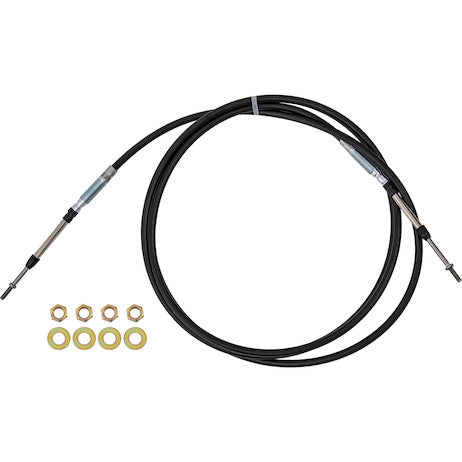
The 5200 Series Universal Mount Control Cable from Buyers Products is a universal mount, push-pull style cable for most medium duty PTO and hoist applications. With an 8 in. minimum bend radius and a 40-100 lb load range, the cable is the flexible choice for many jobs. All cables include bulkhead nuts and washers for fast connectivity.
Specifications
| Cable Length (in.) | 144 " |
| Conduit Material | PVC |
| Conduit Color | Black |
| Total Travel (in.) | 3 " |
| Cable Series | 5200 Series |
| Bulkhead Thread Size | 5/8-18 " |
| End Type | Rod |
| Cable Core Material | Stainless Steel |
| Cable Diameter (in.) | 0.125 " |
| Conduit Diameter (in.) | .41 " |
| Rod End Thread Size | 1/4-28 " |
The 144 Inch 5200 Series Universal Mount Control Cable represents a pinnacle of engineering for mechanical actuation systems in a broad spectrum of industrial and mobile equipment. Manufactured by Buyers Products, a recognized leader in commercial truck and trailer equipment, this control cable is meticulously designed to deliver reliable, precise, and durable performance in demanding environments. As a universal mount, push-pull style cable, its versatility is a cornerstone of its design, making it an indispensable component for numerous medium-duty applications, particularly those involving Power Take-Off (PTO) systems and various hoisting mechanisms.
At its core, the 5200 Series cable operates on a fundamental mechanical principle: the push-pull action. This mechanism translates linear motion from an input device, such as a lever or a knob, to a remote output, like a valve, clutch, or linkage. Unlike complex electrical or hydraulic systems, push-pull cables offer a direct, tactile connection, providing the operator with immediate feedback and precise control. This direct mechanical linkage enhances operational safety and simplifies troubleshooting, as potential issues are often visually evident or felt. The robust design of the 5200 Series ensures that this push-pull action is consistently smooth, minimizing friction and maximizing the efficiency of force transmission across its impressive 144-inch length.
Detailed Examination of Key Specifications
The efficacy and suitability of any control cable are best understood through a thorough analysis of its technical specifications. The 144 Inch 5200 Series Universal Mount Control Cable boasts a set of meticulously chosen attributes that collectively define its superior performance and adaptability.
Cable Length (144 inches)
A generous length of 144 inches, or 12 feet, provides significant flexibility in installation, allowing for complex routing paths in large vehicles or machinery where control points are geographically separated from the actuated components. This extended reach is crucial for applications such as controlling remote PTO units on vocational trucks, operating winches on tow trucks, or manipulating hydraulic valves on agricultural equipment. Proper routing is paramount; while the length offers freedom, installers must adhere to the specified minimum bend radius to ensure optimal performance and longevity. This length allows for installation around obstacles and through chassis without requiring multiple cable segments, thus reducing potential points of failure and simplifying the overall system architecture. It minimizes the need for intricate mechanical linkages that could introduce backlash or increased friction, providing a clean and direct path for control input.
Conduit Material (PVC, Black)
The external conduit, constructed from high-quality PVC (Polyvinyl Chloride) in a black finish, serves as the primary protective sheath for the cable core. PVC is selected for its excellent balance of flexibility, durability, and environmental resistance. It offers superior protection against abrasion, impacts, and exposure to a wide range of chemicals, including oils, greases, and many industrial solvents commonly found in operational environments. The black color specifically enhances UV resistance, preventing material degradation and embrittlement when the cable is exposed to direct sunlight, which is a critical consideration for outdoor and mobile applications. Beyond protection, the smooth internal surface of the PVC conduit facilitates low-friction movement of the stainless steel core, ensuring consistent and effortless operation throughout the cable's lifespan. This robust conduit ensures that the precise mechanical action of the core is maintained even in challenging conditions, preventing ingress of dirt, moisture, and other contaminants that could impair performance.
Total Travel (3 inches)
With a total travel of 3 inches, this cable is engineered for applications requiring a moderate yet precise range of linear movement. This stroke length is ideal for actuating standard PTO engagement mechanisms, controlling a significant range of motion in hydraulic valves, or providing adequate throttle modulation. The 3-inch travel ensures that the actuated component receives sufficient displacement to fully engage or disengage, open or close, or adjust to various operational settings without requiring excessive force from the operator. It strikes an optimal balance between responsiveness and the ability to control mechanisms with substantial operational throws. This specific travel dimension is critical for designers and installers to match the cable's capabilities with the requirements of the intended application, ensuring that the control input translates directly and accurately to the desired output without over-extension or insufficient actuation.
Cable Series (5200 Series)
The designation "5200 Series" by Buyers Products signifies a particular engineering standard and performance category. Cables within this series are characterized by their robust construction, enhanced durability, and suitability for medium-duty applications where reliability is paramount. The 5200 Series is distinguished by its optimized design that balances flexibility with load-bearing capacity and fatigue resistance. It is engineered to withstand the continuous operational cycles and environmental stresses typical of vocational vehicles and industrial machinery. This series typically incorporates design features that minimize internal friction, enhance sealing against contaminants, and ensure a long service life, setting it apart from lighter-duty or less robust control cable offerings. The series number acts as a quality assurance benchmark, indicating that the cable has been designed and tested to meet specific performance criteria for demanding, commercial-grade use cases.
Bulkhead Thread Size (5/8-18)
The 5/8-18 bulkhead thread size refers to the standardized threading on the cable's housing that allows it to be securely mounted through a panel or bulkhead. This robust thread size provides a stable and strong attachment point, capable of withstanding operational forces and vibrations without loosening. The "5/8" denotes the nominal diameter in inches, and "18" indicates 18 threads per inch, a common fine thread standard ensuring a tight, secure fit. This feature is critical for professional installations, as it ensures the cable remains fixed at its entry point, preventing axial movement and providing a consistent fulcrum for the push-pull action. The inclusion of bulkhead nuts and washers facilitates quick and reliable connectivity, ensuring a sealed and secure installation that resists environmental ingress and maintains structural integrity over time. This standardization also means easy replacement or integration into existing systems designed for common thread sizes.
End Type (Rod)
The "Rod" end type signifies a specific termination style for the cable core, typically featuring a threaded rod section designed for direct connection to various mechanical linkages. Rod ends are highly valued for their strength, rigidity, and the precision they offer in transmitting linear force. Unlike clevises or loop ends, a rod end allows for direct threading into a mating component, providing a solid, low-backlash connection. This design is particularly advantageous in applications where precise alignment and minimal play are crucial, such as throttle controls, critical valve actuations, or clutch engagements. The inherent robustness of a rod end ensures that the connection point is capable of handling the specified load range (40-100 lb) without deformation or premature wear, contributing significantly to the overall reliability and longevity of the control system. Its design facilitates easy adjustment and secure attachment to a wide range of operational levers and mechanisms.
Cable Core Material (Stainless Steel)
The selection of stainless steel for the cable core material is a testament to the cable's intended use in harsh and corrosive environments. Stainless steel offers exceptional resistance to rust and corrosion, making it ideal for outdoor applications, marine settings, and environments exposed to moisture, road salts, or aggressive chemicals. Beyond its corrosion resistance, stainless steel possesses high tensile strength and excellent fatigue resistance, allowing it to withstand repeated push-pull cycles over extended periods without material degradation or breakage. This ensures a consistent and reliable performance throughout the cable's operational life. The multi-strand construction of the stainless steel core (inherent in cable design, though not explicitly stated as 'multi-strand,' it's implied for flexibility and strength) provides the necessary flexibility for routing while maintaining its load-bearing capabilities. This material choice significantly contributes to the low-maintenance profile and extended service interval of the 5200 Series cable.
Cable Diameter (0.125 inches)
A cable core diameter of 0.125 inches (1/8 inch) represents an optimal balance between strength and flexibility for medium-duty applications. This diameter ensures the core is robust enough to transmit forces within the 40-100 lb range effectively, resisting stretching or compression that could lead to imprecise control. Concurrently, it maintains sufficient flexibility to navigate the specified 8-inch minimum bend radius without kinking or experiencing undue internal friction. The precise sizing of the core within the conduit is critical for smooth operation, minimizing slop and preventing binding. A smaller diameter might compromise strength, while a larger one could reduce flexibility and increase friction within the conduit, making this 0.125-inch dimension a carefully engineered choice for performance and durability.
Conduit Diameter (.41 inches)
The conduit diameter of 0.41 inches is specifically engineered to provide an optimal clearance around the 0.125-inch cable core. This precise internal dimension minimizes the potential for contaminants to enter and accumulate within the conduit, while also allowing the core to move freely with minimal friction. The gap between the core and the conduit is crucial: too tight, and friction increases; too loose, and slop or vibration can degrade control precision. This diameter also contributes to the cable's overall structural integrity, providing a robust outer casing that protects the core from external physical damage. The exact fit ensures that the conduit can adequately support the cable, prevent kinking, and maintain its intended bend radius, thereby contributing significantly to the cable's operational longevity and consistent performance.
Rod End Thread Size (1/4-28)
The 1/4-28 thread size on the rod end refers to the standardized threading used for connecting the cable to various control linkages and components. "1/4" indicates a quarter-inch nominal diameter, and "28" signifies 28 threads per inch, typically a fine thread (UNF) standard. Fine threads are preferred in applications requiring secure fastening, resistance to loosening from vibration, and precise adjustment. This thread size is widely compatible with common industrial and automotive linkages, clevises, ball joints, and custom-fabricated connectors, facilitating straightforward integration into diverse mechanical systems. The use of a standardized thread size simplifies installation, maintenance, and replacement, ensuring that the cable can be reliably attached to the actuating mechanism, translating the push-pull force accurately to the controlled device.
Minimum Bend Radius (8 inches)
The minimum bend radius of 8 inches is a critical design and installation parameter. It specifies the tightest curve the cable can reliably negotiate without sustaining damage, increasing friction, or compromising its operational integrity. Exceeding this limit by forcing the cable into a sharper bend can lead to:
- Increased internal friction, making operation stiff or sticky.
- Premature wear of both the core and conduit, drastically shortening lifespan.
- Kinking or permanent deformation of the core, leading to binding or complete failure.
- Reduced efficiency of force transmission, requiring greater input force for actuation.
Adhering to the 8-inch minimum bend radius ensures the cable operates smoothly, extends its service life, and maintains its specified load range. Proper routing is essential for optimal performance and safety, emphasizing gradual curves and secure fastening points along the cable's path.
Load Range (40-100 lb)
The specified load range of 40-100 lb indicates the optimal operating force for this control cable. This range signifies that the cable is designed to effectively transmit forces from 40 pounds to 100 pounds for its intended applications. It's crucial for installers and engineers to match this load range with the actual force requirements of the system being controlled.
- **Minimum Load (40 lb):** While cables can operate below this, maintaining a minimum operational force often ensures smoother, more consistent actuation and helps overcome any minor static friction within the system.
- **Maximum Load (100 lb):** This is the upper limit of the force the cable is designed to consistently handle without compromising its integrity or leading to accelerated wear. Operating consistently above 100 lb can result in premature fatigue of the core, stretching, deformation of the rod ends, or damage to the conduit.
This load range makes the 5200 Series suitable for a variety of medium-duty tasks where precise and consistent force transmission is required, such as engaging medium-sized PTOs, operating hydraulic directional control valves, or managing engine throttles. It provides a clear guideline for selecting the appropriate control cable to prevent under-engineering or over-engineering the mechanical linkage.
Expanded Applications
The "universal mount" characteristic, combined with the robust specifications, makes this cable exceptionally adaptable. While primarily intended for medium-duty PTO and hoist applications, its capabilities extend to a variety of other mechanical control systems:
- **Power Take-Off (PTO) Control:** Essential for vocational trucks (dump trucks, refuse vehicles, service trucks) to engage and disengage auxiliary equipment like hydraulic pumps for lift gates, cranes, or snowplows. The push-pull action provides reliable activation.
- **Hoist and Winch Control:** Critical for tow trucks, utility vehicles, and light-duty cranes to manage the raising, lowering, and tensioning of loads. Direct mechanical linkage offers precise and safe operation.
- **Throttle Control:** Provides reliable and direct engine RPM adjustment for stationary engines, generators, or custom vehicle applications where electronic throttles are impractical or undesirable.
- **Valve Actuation:** Ideal for operating various hydraulic or pneumatic control valves in agricultural machinery, construction equipment, or industrial processing plants, facilitating remote control of fluid flow.
- **Damper and Vent Control:** Can be used in HVAC systems in large vehicles or industrial settings to manually adjust air dampers or vents.
- **Choke Control:** For carbureted engines, offering a dependable mechanical linkage for cold-start enrichment.
- **Latch and Release Mechanisms:** In heavy equipment, for remotely operating latches, locking pins, or emergency release systems.
- **Agricultural Equipment:** For controlling implements, engaging drivelines, or adjusting settings on tractors and other farm machinery.
Installation Best Practices and Longevity
To maximize the service life and performance of the 144 Inch 5200 Series Universal Mount Control Cable, adherence to professional installation practices is crucial.
- **Adhere to Minimum Bend Radius:** As detailed, never force the cable into curves tighter than 8 inches. Use smooth, gradual bends.
- **Secure Routing:** Ensure the cable is securely fastened along its entire length using appropriate clamps or brackets, preventing sagging, chafing against sharp edges, or interference with moving parts.
- **Bulkhead Integrity:** The included bulkhead nuts and washers are vital for a secure and sealed installation at the penetration point, preventing movement and protecting against environmental ingress.
- **Proper Lubrication (if applicable):** While modern control cables often feature low-friction internal liners, periodic inspection and, if recommended by the manufacturer, light lubrication of the core or end connections can further reduce friction and extend life.
- **Inspect Connections:** Regularly check that the rod end and bulkhead connections remain tight and free of corrosion or damage.
- **Avoid Contaminants:** While the PVC conduit offers excellent protection, avoiding direct exposure to abrasive materials or extreme heat sources is always advisable.
By following these guidelines, operators can ensure that the cable delivers consistent, reliable performance for years, minimizing downtime and maintenance costs.
The Buyers Products Advantage
The 144 Inch 5200 Series Universal Mount Control Cable is a testament to Buyers Products' commitment to quality and functional design. With decades of experience in manufacturing robust components for the commercial and industrial sectors, Buyers Products ensures that each control cable meets stringent performance and durability standards. Choosing a Buyers Products cable means investing in a component that has been engineered for reliability, ease of installation, and long-term performance in the most demanding applications. The precise manufacturing, selection of premium materials like stainless steel and durable PVC, and the inclusion of necessary hardware like bulkhead nuts and washers, underscore the brand's dedication to delivering superior products that professional users can depend on for critical mechanical control tasks.