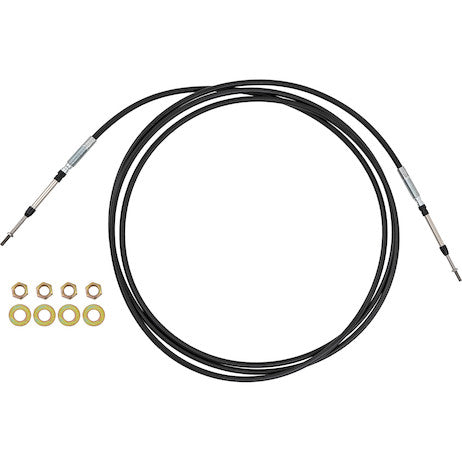
The 5200 Series Universal Mount Control Cable from Buyers Products is a universal mount, push-pull style cable for most medium duty PTO and hoist applications. With an 8 in. minimum bend radius and a 40-100 lb load range, the cable is the flexible choice for many jobs. All cables include bulkhead nuts and washers for fast connectivity.
Specifications
| End Type | Rod |
| Rod End Thread Size | 1/4-28 " |
| Cable Core Material | Stainless Steel |
| Cable Length (in.) | 240 " |
| Bulkhead Thread Size | 5/8-18 " |
| Conduit Diameter (in.) | .41 " |
| Cable Diameter (in.) | 0.125 " |
| Conduit Color | Black |
| Cable Series | 5200 Series |
| Conduit Material | PVC |
| Total Travel (in.) | 3 " |
Advanced Technical Overview: 240 Inch 5200 Series Universal Mount Control Cable
Introduction to Precision Control Cable Systems
The 240 Inch 5200 Series Universal Mount Control Cable represents a critical component in the precise operation of various medium-duty mechanical systems, specifically designed for demanding Power Take-Off (PTO) and hoist applications. Manufactured by Buyers Products, a recognized leader in commercial vehicle components, this control cable embodies a confluence of robust engineering, material science, and application-specific design, ensuring reliable and efficient remote mechanical actuation. This extended technical description delves into the construction, operational principles, performance characteristics, and installation considerations of this essential component, providing a comprehensive understanding for engineers, technicians, and procurement specialists.
Core Design Philosophy and Application Suitability
At its core, the 5200 Series cable is engineered as a universal mount, push-pull style mechanism. This design choice is fundamental to its versatility and widespread applicability. A push-pull cable system effectively transmits linear motion from an input device (e.g., a lever, knob, or pedal) to a remote output device, overcoming obstacles such as turns, vibration, and misalignments that would impede rigid linkages. The "universal mount" designation signifies its adaptability across a broad spectrum of equipment configurations, facilitated by standard mounting hardware and flexible routing capabilities.
The primary target applications for this cable include medium-duty PTO engagements and hoist system controls. In PTO systems, the cable enables the operator to remotely engage or disengage power transfer from the vehicle's engine to auxiliary equipment (e.g., hydraulic pumps, generators, compressors). For hoist applications, it provides precise control over lifting and lowering mechanisms, critical for material handling and utility operations. The specified 40-100 lb load range indicates its capacity to handle typical actuation forces encountered in these environments, balancing responsiveness with mechanical durability.
Detailed Construction and Material Science
Cable Core: The Heart of the System
The integrity and performance of any control cable are largely determined by its core. The 240 Inch 5200 Series cable features a stainless steel cable core with a nominal diameter of 0.125 inches. Stainless steel is chosen for several compelling reasons:
- Corrosion Resistance: Essential for outdoor and harsh operating environments where exposure to moisture, road salts, and chemicals is common. This prevents degradation of the core, maintaining smooth operation and extending service life.
- High Tensile Strength: Provides the necessary robustness to transmit significant push-pull forces without stretching or fracturing, ensuring reliable actuation under load.
- Fatigue Resistance: The core is designed to withstand repeated bending and linear motion cycles characteristic of control cable operation, minimizing the risk of premature failure due to material fatigue.
- Low Friction Characteristics: While the primary friction reduction comes from the conduit liner, the smooth surface finish of stainless steel contributes to overall operational efficiency.
The multi-strand construction of the core, typical for control cables, enhances flexibility and distributes stress across multiple wires, further improving fatigue life and reliability compared to a solid wire.
Conduit System: Protection and Performance
Encasing the stainless steel core is a robust conduit system, crucial for protecting the core, guiding its motion, and providing the necessary rigidity for effective force transmission. The conduit has a diameter of 0.41 inches and is constructed from PVC (Polyvinyl Chloride), finished in black.
- PVC Conduit: PVC is selected for its excellent balance of mechanical properties, environmental resistance, and cost-effectiveness.
- Durability: Offers good abrasion resistance and protection against minor impacts.
- Flexibility: Allows for routing around obstructions while maintaining sufficient stiffness to prevent buckling under push loads.
- Environmental Resistance: Provides a barrier against water, dirt, dust, and many industrial chemicals, preserving the internal components.
- UV Resistance: The black PVC formulation often includes UV stabilizers to mitigate degradation from prolonged sun exposure, a common concern for exterior vehicle components.
- Internal Liner: While not explicitly detailed, it is standard for high-quality control cables like the 5200 Series to incorporate an internal low-friction liner (e.g., HDPE or PTFE) within the conduit. This liner significantly reduces the sliding friction between the stainless steel core and the conduit, ensuring smooth, precise operation and minimizing operator effort. It also prevents metal-on-plastic wear, extending the cable's lifespan.
End Terminations and Connectivity
The functionality and ease of installation are greatly influenced by the cable's end terminations. The 5200 Series cable features a "Rod" end type, characterized by a specific thread size and the inclusion of bulkhead nuts and washers.
- Rod End Thread Size: 1/4-28 inches. This standardized thread size ensures compatibility with a wide array of existing mechanical linkages, bell cranks, and operating levers, simplifying integration into diverse systems. The fine thread pitch (28 threads per inch) offers precise adjustability and secure fastening, resisting loosening under vibration.
- Bulkhead Thread Size: 5/8-18 inches. This larger thread size is used for mounting the conduit assembly through a panel or bulkhead. The robust thread allows for secure fastening, creating a stable point of leverage for the cable's push-pull action.
- Bulkhead Nuts and Washers: The inclusion of these components directly with the cable streamlines installation, eliminating the need for separate procurement and ensuring proper fitment. These components are typically made of plated steel for corrosion resistance and durability, providing a secure and stable mounting point that withstands operational forces and vibrations.
Performance Parameters and Operational Characteristics
Cable Length and Total Travel
With a substantial cable length of 240 inches (20 feet), this cable provides extensive reach, enabling remote control over significant distances common in large vehicles or complex machinery layouts. The total travel of 3 inches signifies the maximum linear displacement the cable core can achieve from its fully retracted to its fully extended position. This travel range is carefully selected to accommodate the typical throw requirements of PTO engagement mechanisms and hoist control valves, ensuring full actuation without over-travel or binding.
Minimum Bend Radius: A Critical Flexibility Metric
The specified minimum bend radius of 8 inches is a crucial performance parameter. It defines the smallest radius to which the conduit can be bent without causing internal damage to the core, excessive friction, or premature wear. Adhering to this specification during installation is paramount for:
- Optimizing Efficiency: Bending the cable beyond its minimum radius increases friction between the core and the conduit, leading to higher operating effort, reduced responsiveness, and accelerated wear.
- Preventing Damage: Excessive bending can kink the core, deform the internal liner, or compromise the integrity of the conduit, leading to irreversible damage and system failure.
- Ensuring Longevity: Proper routing within the specified bend radius significantly contributes to the cable's rated service life by minimizing localized stress concentrations.
Engineers designing cable routes must meticulously plan paths that respect this 8-inch minimum bend radius, often requiring strategic use of cable clamps and routing guides.
Load Range: Force Transmission Capability
The stated load range of 40-100 lbs (pounds-force) specifies the operational force the cable is designed to transmit effectively. This range is critical for matching the cable to the application's requirements:
- Minimum Load (40 lbs): Ensures the cable maintains sufficient stiffness and responsiveness even for lighter actuation forces, preventing excessive slack or unintended movement.
- Maximum Load (100 lbs): Defines the upper limit of the continuous operating force. Exceeding this limit can lead to accelerated wear, core stretch, or even catastrophic failure. This parameter is particularly relevant for applications where the PTO or hoist mechanism presents significant resistance during engagement or disengagement.
The load range is a testament to the robust design of both the stainless steel core and the surrounding conduit system, ensuring consistent performance under expected operational stresses.
Technical Considerations for Installation and Maintenance
Routing and Mounting Best Practices
- Adherence to Bend Radius: As highlighted, strictly observe the 8-inch minimum bend radius. Avoid sharp corners or kinks. Gradual, sweeping curves are always preferred.
- Secure Mounting Points: Utilize the bulkhead nuts and washers to firmly secure the cable at its entry/exit points through panels. Additional cable clamps should be used along the run to prevent sagging, chafing, and vibration-induced damage.
- Clearance: Ensure adequate clearance from moving parts, exhaust systems (heat sources), and sharp edges. High temperatures can degrade PVC and internal lubricants, while abrasion can compromise the conduit.
- Accessibility: Route cables to allow for inspection and future maintenance without requiring extensive disassembly of surrounding components.
- Alignment: Ensure the rod ends are properly aligned with the clevises or levers they connect to, minimizing side loads on the cable ends which can lead to premature wear.
Lubrication and Environmental Protection
While modern control cables are often supplied with a factory-applied, long-life lubricant within the conduit, periodic inspection and potential re-lubrication (following manufacturer guidelines) can extend service life, especially in exceptionally dirty or wet environments. The PVC conduit provides excellent environmental protection, but ensuring the integrity of the end seals and bulkhead connections is crucial to prevent ingress of contaminants into the conduit system.
Troubleshooting Common Issues
- Stiff Operation: Can be caused by exceeding the minimum bend radius, lack of lubrication, contaminant ingress, or internal damage (e.g., kinked core).
- Excessive Slop/Play: May indicate a stretched core, loose end connections, or wear in the mating linkages.
- Cable Binding: Often results from improper routing, conduit damage, or foreign objects within the conduit.
Systematic inspection and adherence to installation guidelines are key to preventing these issues.
Compliance and Quality Assurance
As a product from Buyers Products, the 5200 Series Universal Mount Control Cable is manufactured under stringent quality control standards. These standards typically encompass material sourcing, manufacturing tolerances, assembly processes, and final product testing. While specific certifications (e.g., ISO, SAE) are not explicitly listed, reputable manufacturers like Buyers Products adhere to industry best practices to ensure their products meet or exceed performance expectations for their intended applications. This commitment to quality assures users of reliable performance, safety, and longevity in demanding commercial and industrial environments.
Conclusion
The 240 Inch 5200 Series Universal Mount Control Cable is a testament to sophisticated engineering in the realm of mechanical actuation. Its robust stainless steel core, durable PVC conduit, precise end terminations, and carefully calibrated performance specifications (including its 8-inch minimum bend radius and 40-100 lb load range) make it an indispensable component for medium-duty PTO and hoist applications. By understanding its detailed construction, operational characteristics, and proper installation protocols, users can leverage this cable to achieve highly reliable, efficient, and precise remote control over critical vehicle and equipment functions. Its design emphasizes durability, flexibility, and ease of integration, positioning it as a premier choice for professionals seeking high-performance control solutions.