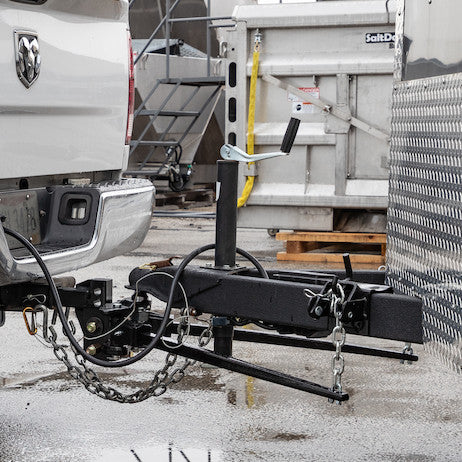
The Weight Distributing Hitch from Buyers Products transfers a portion of the tongue weight to the vehicle's front axle, which results in a more level ride. The Weight Distributing Hitch's two arms bolt onto your trailer tongue and its other end fits into a 2 in. receiver tube on your vehicle. The hitch features a raised platform that gives the trailer coupler more clearance. The hitch is black powder-coated for rust and corrosion resistance.
Specifications
| Color | Black |
|---|---|
| Finish | Powder-Coat |
| Material | Carbon Steel |
| Maximum Gross Trailer Weight (M.G.T.W.) | 12000 |
| Maximum Vertical Load (M.V.L.) | 1200 |
The Weight Distributing Hitch - Trunnion Bar-Black Powder Coated, engineered by Buyers Products, represents a critical advancement in towing stability and safety for a diverse range of hauling applications. Designed to mitigate the inherent challenges associated with conventional towing, this system significantly enhances the dynamic performance of the tow vehicle and trailer combination. Traditional ball-mount hitches often result in excessive tongue weight being applied directly to the rear axle of the tow vehicle, leading to undesirable effects such as rear-end squat, reduced steering authority, compromised braking efficiency, and an increased propensity for trailer sway. These phenomena collectively contribute to an unsafe and uncomfortable towing experience.
A weight distributing hitch, fundamentally, is a sophisticated mechanical system designed to leverage the principle of distributed forces. By employing a set of robust spring bars, in this case, a trunnion bar configuration, it effectively redistributes a significant portion of the trailer's tongue weight from the rear axle of the tow vehicle to both the front axle of the tow vehicle and the axles of the trailer. This redistribution restores the original vehicle geometry, ensuring all axles bear an appropriate load, thereby optimizing tire contact with the road, improving steering responsiveness, and stabilizing the entire towing ensemble. The outcome is a more level ride, enhanced control, and a substantial improvement in overall towing safety and comfort, particularly when hauling heavy or extended loads.
The Trunnion Bar System: An Engineering Perspective
The choice of a trunnion bar system, as featured in this Buyers Products hitch, offers distinct advantages over alternative weight distribution designs, such as round bar systems. Trunnion bars are characterized by their robust, typically square or rectangular cross-section, which inserts into the hitch head assembly and pivots on hardened pins or 'trunnions'. This design facilitates a more compact and streamlined hitch head, often providing superior ground clearance compared to round bar systems, which can be crucial for vehicles with lower rear clearances or when traversing uneven terrain. Furthermore, trunnion bar hitches are frequently engineered for higher weight capacities, making them the preferred choice for larger travel trailers, industrial cargo trailers, and other demanding applications where maximum gross trailer weight (M.G.T.W.) and maximum vertical load (M.V.L.) are substantial.
The core components of this Trunnion Bar Weight Distributing Hitch system are meticulously designed for durability and performance:
- Head Assembly: This critical component serves as the interface between the tow vehicle's 2-inch receiver tube and the weight distribution spring bars. It is crafted from heavy-duty carbon steel, ensuring structural integrity under immense loads. The head assembly incorporates an adjustable tilt mechanism, crucial for setting the precise angle required to achieve optimal weight distribution. This adjustability allows for fine-tuning the amount of leverage applied to the spring bars, ensuring that the desired front axle weight restoration is achieved without over-tensioning. The raised platform design, as noted, offers enhanced trailer coupler clearance, preventing potential interference during articulation or when navigating varied gradients.
- Trunnion Spring Bars: These are the primary force-distributing elements of the system. Manufactured from high-strength carbon steel, these bars are subjected to rigorous heat treatment processes to achieve exceptional tensile strength and fatigue resistance. Their design allows them to flex under load, acting as torsion springs that transfer upward force to the hitch head. This upward force is then translated through the adjustable head to the tow vehicle's chassis, effectively lifting the rear of the tow vehicle and lowering its front, thereby distributing the tongue weight more evenly across all axles. The specific design of trunnion bars ensures robust engagement with the head, minimizing movement and maximizing the efficiency of weight transfer.
- Sway Control Brackets (Arm Attachment Points): The "two arms that bolt onto your trailer tongue" refer to the lift brackets, often L-brackets, which attach to the trailer frame. These brackets provide the anchoring points for the spring bars, enabling the application of tension. The design of these brackets is crucial for secure attachment and ease of operation. They are typically adjustable along the trailer frame to accommodate varying trailer configurations and allow for precise positioning relative to the hitch head and spring bars. The tensioning mechanism, often involving a cam or snap-up action, allows the user to incrementally apply leverage to the spring bars, effectively lifting the trailer tongue and distributing weight.
- Shank (Receiver Bar): While not explicitly detailed in the existing description, a complete weight distributing hitch system includes a shank, or receiver bar, which inserts into the vehicle's 2-inch receiver tube. This component allows for vertical adjustment of the head assembly to achieve a perfectly level towing platform, irrespective of the tow vehicle's hitch height or the trailer's coupler height. Multiple adjustment holes and a robust locking pin secure the shank in place, providing the necessary foundation for the entire system.
Technical Specifications: Performance and Durability
The performance capabilities and material integrity of this Weight Distributing Hitch are underscored by its detailed specifications:
- Maximum Gross Trailer Weight (M.G.T.W.): 12,000 lbs: This metric represents the absolute maximum weight of the fully loaded trailer that the hitch system is rated to handle. A rating of 12,000 lbs positions this hitch squarely in the heavy-duty category, suitable for a vast array of recreational and commercial trailers. This includes large travel trailers, fifth-wheel conversions (with appropriate adapters), multi-axle utility trailers, car haulers, and various commercial equipment trailers. Adhering strictly to this M.G.T.W. is paramount for safety and to prevent structural failure of the hitch components or the tow vehicle’s chassis. It is critical that the combined weight of the trailer and its cargo does not exceed this rating, nor the tow vehicle's specified towing capacity.
- Maximum Vertical Load (M.V.L.): 1,200 lbs: Also known as tongue weight, the M.V.L. refers to the downward force exerted by the trailer coupler onto the hitch ball. An M.V.L. of 1,200 lbs is indicative of the hitch's capacity to manage substantial downward forces, which are characteristic of heavier trailers. For safe towing, tongue weight should typically fall within 10-15% of the M.G.T.W. for conventional trailers. For a 12,000 lb trailer, this implies an ideal tongue weight range of 1,200 lbs to 1,800 lbs. The 1,200 lbs M.V.L. rating ensures the spring bars and head assembly are capable of effectively managing and distributing this significant load, preventing excessive rear squat and maintaining crucial steering control. Exceeding this M.V.L. can compromise the hitch's structural integrity and the effectiveness of the weight distribution mechanism.
- Material: Carbon Steel: The selection of carbon steel for the primary structural components of this hitch system is a deliberate choice rooted in its superior mechanical properties. Carbon steel offers an exceptional balance of high tensile strength, yield strength, and toughness, making it highly resistant to the static and dynamic stresses encountered during towing. Its inherent rigidity minimizes flex under load, ensuring efficient transfer of forces. Furthermore, carbon steel exhibits good weldability and machinability, allowing for the precise fabrication of complex geometries required for optimal hitch performance. The consistent quality and reliability of carbon steel ensure that the hitch maintains its structural integrity over extended periods of demanding use, providing long-term safety and performance.
-
Finish: Powder-Coat, Color: Black: The application of a black powder-coat finish to the carbon steel components is not merely for aesthetic appeal but represents a significant engineering enhancement for durability and longevity. Powder coating is a dry finishing process where finely ground particles of pigment and resin are electrostatically charged and sprayed onto electrically grounded parts. The parts are then cured in an oven, where the powder melts and flows into a smooth, uniform coating. This process creates a finish that is considerably more durable and resistant to various environmental factors than traditional liquid paint.
- Corrosion Resistance: The powder-coat acts as a formidable barrier against rust and corrosion, protecting the underlying carbon steel from moisture, road salts, chemicals, and other corrosive agents that are prevalent in towing environments. This is particularly crucial for components exposed to the elements, ensuring the hitch maintains its structural integrity and appearance over many years of service.
- Abrasion and Impact Resistance: The cured powder-coat forms a resilient surface that is highly resistant to chipping, scratching, and general abrasion. This protects the hitch from wear and tear during installation, coupling/uncoupling, and regular use, which often involves contact with other metal components or road debris.
- UV Resistance: Modern powder coatings often incorporate UV stabilizers, preventing fading and degradation from prolonged exposure to sunlight.
- Environmental Benefits: Powder coating is an environmentally friendly process, as it releases negligible volatile organic compounds (VOCs) into the atmosphere, aligning with contemporary sustainability practices.
Benefits of Employing a Weight Distributing Hitch
The integration of the Buyers Products Trunnion Bar Weight Distributing Hitch into a towing setup yields a multitude of operational advantages:
- Enhanced Safety: The primary benefit is a profound improvement in towing safety. By restoring appropriate weight distribution, the hitch drastically reduces trailer sway, a dangerous phenomenon caused by insufficient weight on the tow vehicle's front axle. It also ensures that the vehicle's headlights remain properly aimed, preventing blinding of oncoming traffic and maintaining optimal nighttime visibility. Braking effectiveness is significantly improved as all four tires of the tow vehicle maintain proper contact with the road, preventing the rear wheels from lifting and reducing traction.
- Superior Control and Stability: Drivers experience significantly improved steering control and responsiveness. The front tires of the tow vehicle regain their designed traction, allowing for more precise handling, especially during evasive maneuvers or strong crosswinds. The entire tow rig feels more planted and stable, reducing driver fatigue on long journeys.
- Optimized Ride Comfort: The level ride achieved by weight distribution eliminates the "porpoising" or bouncing sensation often associated with heavily loaded trailers. This translates to a much smoother and more comfortable experience for both the driver and passengers, reducing stress on the tow vehicle’s suspension system and prolonging its service life.
- Protection of Tow Vehicle: By preventing excessive squat, the WDH protects the tow vehicle's rear suspension, chassis, and drivetrain from undue stress and premature wear. It ensures that the vehicle operates within its design parameters, even when towing near its maximum capacity.
- Increased Towing Confidence: With the inherent stability and control offered by a weight distributing hitch, drivers gain greater confidence in their towing abilities, making complex maneuvers and long-distance travel less daunting.
Installation, Adjustment, and Maintenance Considerations
Proper installation and adjustment are paramount to the effective and safe operation of any weight distributing hitch. While the Buyers Products Trunnion Bar system is designed for straightforward setup, professional installation is always recommended to ensure optimal performance and safety. Key steps and considerations include:
- Measuring Baseline: Before installation, critical measurements of the tow vehicle's front and rear fender heights (from the ground to the fender lip through the wheel center) must be recorded. These serve as a baseline for restoring the vehicle's original unhitched attitude.
- Tongue Weight Assessment: Accurate measurement of the trailer's tongue weight is crucial for determining the correct class of WDH and for ensuring the system is not overloaded.
- Shank Selection and Height Adjustment: The correct shank drop or rise must be chosen to ensure the trailer tows perfectly level when loaded and hitched, with the weight distribution engaged. Multiple adjustment holes allow for precise height setting.
- Hitch Head Angle Adjustment: The tilt of the hitch head is critical. Too little tilt, and the spring bars won't engage effectively; too much, and they may be over-tensioned. Washers or adjustable cam systems are typically used to set this angle.
- Spring Bar Tensioning: This is the final and most critical step. Using a snap-up bracket or similar tool, the spring bars are lifted and secured to the frame brackets, applying the necessary leverage. The tension is incrementally adjusted until the front fender height of the tow vehicle is restored to its unhitched measurement, or as close as practically possible. Re-measuring fender heights after tensioning confirms proper weight distribution.
- Routine Maintenance: Regular inspection of all components for wear, damage, or loose fasteners is essential. Lubrication of pivot points and hitch ball (if applicable) helps ensure smooth operation and longevity. The powder-coat finish should also be inspected for any chips or deep scratches that could expose the underlying steel to corrosion.
Target Applications
This Weight Distributing Hitch is ideally suited for a broad spectrum of towing requirements, particularly those involving:
- Large Travel Trailers: Essential for stability and control when towing recreational vehicles that inherently have significant tongue weights and can be prone to sway.
- Heavy Cargo and Equipment Trailers: Provides the necessary support and distribution for industrial or commercial trailers carrying substantial loads, protecting the tow vehicle and ensuring safe transport.
- Boat Trailers: For larger boats with tandem or triple axles, especially when the overall length and weight contribute to considerable tongue loads.
- Any Towing Setup with Significant Rear-End Sag: If your tow vehicle experiences noticeable squat with a conventional hitch, this WDH is the definitive solution to restore balance and improve driving dynamics.
In conclusion, the Buyers Products Weight Distributing Hitch - Trunnion Bar-Black Powder Coated is a meticulously engineered, robust, and essential accessory for any serious towing endeavor. Its high M.G.T.W. and M.V.L. capacities, combined with the strength of carbon steel and the protective durability of a black powder-coat finish, ensure superior performance and longevity. By effectively distributing trailer tongue weight, it transforms the towing experience, providing unparalleled safety, control, and comfort. This investment in a quality weight distributing hitch is an investment in the security and efficiency of your towing operations, safeguarding your vehicle, your cargo, and ultimately, your peace of mind on the road.