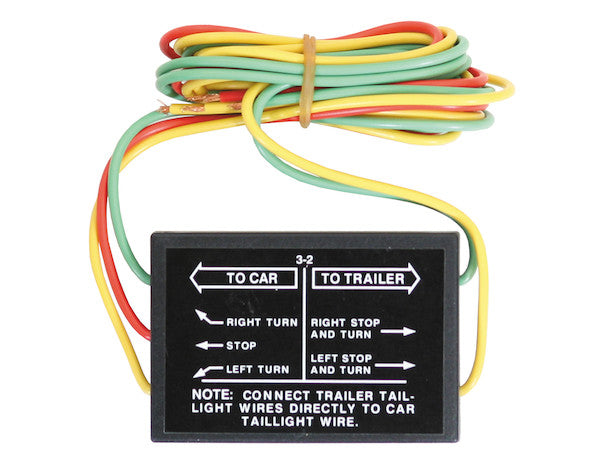
The Heavy Duty Tail Light Converter from Buyers Products converts a 3 wire tail light vehicle system to a 2 wire tail light trailer system. This 6A solid state converter features color-coded wires for easier installation.
Specifications
| End Way (Number of Pins) | - |
|---|---|
| Pin Style | - |
| Start Way (Number of Pins) | - |
| Truck Side/Trailer Side | Truck Side |
The 6 Amp 3-2 Solid State Heavy-Duty Tail Light Converter is a critical interface component designed to ensure safe and compliant towing operations. This sophisticated device is engineered to bridge the fundamental electrical discrepancy between modern vehicle lighting systems and conventional trailer wiring, specifically converting a 3-wire vehicle tail light output to a 2-wire trailer system. Manufactured by Buyers Products, a reputable name in vehicle accessories, this converter prioritizes robust performance and unwavering reliability, essential for both commercial and recreational towing.
At its core, the primary function of this converter is signal interpretation and re-routing. Modern vehicles often employ a 3-wire system for their rear lighting, where brake light, turn signal, and tail light functions are driven by distinct, separate electrical circuits. This allows independent illumination, offering clarity and precise communication to following drivers. For example, when a driver applies the brakes, only the dedicated brake light circuit illuminates, with tail lights remaining on and turn signals off. Many trailers, particularly older or basic models, utilize a 2-wire system. In this configuration, the brake light and turn signal functions are combined onto a single wire, often referred to as a "stop/turn" signal, while the tail light function operates on a separate wire. Without a converter, directly connecting a 3-wire vehicle to a 2-wire trailer would result in incorrect or non-functional lighting, creating unsafe conditions and violating traffic regulations. The Buyers Products converter intelligently processes the discrete 3-wire signals from the vehicle—identifying the independent brake, left turn, right turn, and tail light inputs—and then outputs the appropriate combined stop/turn signals for the left and right sides, along with a separate tail light signal, perfectly compatible with a 2-wire trailer system. This internal logic circuit ensures that when the vehicle's brake pedal is pressed, the converter sends a brake signal to both stop/turn wires on the trailer. If the left turn signal is activated while braking, the converter sends a turn signal to the left stop/turn wire and a brake signal to the right stop/turn wire, maintaining proper functionality and clarity. This precise signal management is paramount for road safety, accurately conveying the towing vehicle's intentions to other road users.
The "Solid State" designation is a pivotal feature distinguishing this converter from traditional, relay-based units. Solid-state technology utilizes semiconductor devices, such as transistors and microcontrollers, to manage electrical signals and current flow, rather than electro-mechanical relays. This modern approach confers numerous advantages. Firstly, solid-state converters possess no moving parts. Traditional relays rely on physical contacts that open and close, making them susceptible to wear and tear, vibration fatigue, and eventual failure due to arcing or sticking contacts. The absence of moving parts in solid-state designs drastically improves reliability and extends operational lifespan, particularly in the demanding, vibration-prone environment of vehicle towing. Secondly, solid-state devices offer significantly faster response times. Electrical signals are processed almost instantaneously, ensuring the trailer's lights react concurrently with the vehicle's, minimizing any lag that could compromise safety. Thirdly, solid-state converters are inherently more power-efficient. They consume less quiescent current and convert power with greater efficiency, reducing strain on the vehicle's electrical system and minimizing heat generation. This reduced thermal output enhances the longevity of the device and surrounding components. Furthermore, solid-state electronics are typically more compact, allowing for a smaller form factor, which facilitates easier installation in confined spaces. They are also less susceptible to environmental contaminants like moisture and dust, and less prone to interference from external electromagnetic sources. The advanced internal circuitry often includes integrated protection features such as short-circuit protection and thermal overload protection, which safeguard both the converter and the vehicle's sensitive electrical systems from potential damage caused by faulty trailer wiring or excessive current draw. This makes the solid-state design not just a feature, but a fundamental enhancement in performance, durability, and safety over older technologies.
The "Heavy-Duty" designation is not merely a label but reflects the robust construction and engineering principles of this converter. Designed for rigorous use, the Buyers Products converter withstands harsh towing conditions, including extreme temperatures, moisture, dust, road salt, and persistent vibration and shock. The housing is typically constructed from durable, high-impact resistant materials, often sealed to provide superior resistance against environmental ingress. This level of protection ensures that internal sensitive electronics remain operational regardless of the weather conditions or road grime encountered. The internal wiring connections are engineered for resilience, often employing crimped and sealed terminals to prevent corrosion and maintain secure electrical contact over time. Thermal management is also critical for heavy-duty applications. While solid-state devices are more efficient, high current loads can still generate heat. The design accounts for this, potentially incorporating heat sinks or optimizing component layout to dissipate heat effectively, ensuring stable operation even under continuous heavy loads. This heavy-duty characteristic makes the converter ideal for frequent haulers, commercial fleets, construction vehicles, or anyone demanding uncompromising performance and longevity from their towing accessories. It ensures the investment provides reliable service through demanding work cycles and challenging environmental exposures, mitigating the risk of inconvenient and costly electrical failures on the road.
The "6 Amp" current rating signifies the maximum continuous current the converter can safely handle for each output circuit. This rating is crucial when considering the type and number of lights on the trailer. A 6 Amp capacity per output channel (e.g., left stop/turn, right stop/turn, tail light) provides substantial headroom for powering a wide array of trailer lighting configurations. For context, a typical incandescent brake/turn signal bulb draws between 1.5 to 2.5 Amps, while a typical incandescent tail light bulb draws 0.5 to 1.5 Amps. With a 6 Amp rating, the converter can easily power multiple incandescent bulbs per circuit, such as found on larger utility trailers, boat trailers with numerous marker lights, or small RVs. More importantly, this rating offers excellent compatibility with modern LED trailer lighting systems. While LEDs consume significantly less current than incandescent bulbs, an ample current rating ensures compatibility with even extensive LED setups or combinations of LED and incandescent lights. Furthermore, a higher current rating provides a safety margin, accommodating potential current spikes during bulb activation or accounting for minor electrical anomalies without triggering internal protection mechanisms prematurely. This generous current handling capability ensures the converter remains robust and reliable, providing consistent power to the trailer lights even under varied load conditions, thereby guaranteeing optimal visibility and regulatory compliance.
Installation of the 6 Amp 3-2 Solid State Heavy-Duty Tail Light Converter is streamlined by its thoughtful design, particularly the inclusion of color-coded wires. This feature significantly simplifies the wiring process, reducing the likelihood of errors and speeding up installation time for both professional installers and experienced DIY enthusiasts. Each wire is distinctly colored according to industry-standard conventions, allowing for quick and unambiguous identification of its function (e.g., vehicle brake input, left turn input, right turn input, tail light input, ground, and corresponding trailer output wires). The typical installation process involves:
- Identifying Vehicle Wires: Locating the vehicle's brake, left turn, right turn, and tail light wires, as well as a reliable chassis ground and a power source (usually directly from the vehicle battery, protected by an inline fuse, for powering the converter's internal electronics). Accessing vehicle wiring diagrams or using a circuit tester is often necessary for accurate identification.
- Connecting Input Wires: Splicing the converter's input wires to their respective vehicle signal wires. Proper splicing techniques, such as soldering and heat-shrinking, or using high-quality crimp connectors, are critical for ensuring secure, corrosion-resistant, and weatherproof connections.
- Connecting Output Wires: Connecting the converter's output wires to the corresponding wires of the trailer's electrical connector or harness. Again, secure and sealed connections are paramount.
- Power and Ground Connection: Connecting the converter's power wire to a fused 12V power source and its ground wire to a clean, unpainted metal chassis point on the vehicle. The dedicated power connection ensures the converter draws power directly for the trailer lights, bypassing and protecting the vehicle's potentially sensitive lighting circuits.
- Mounting: Securely mounting the converter in a dry, protected location, away from direct exposure to road spray, heat, or moving parts. Zip ties or screws are commonly used for this purpose.
- Testing: Thoroughly testing all trailer lighting functions (tail lights, brake lights, left turn, right turn, hazard lights) to confirm correct operation before towing.
This converter boasts broad compatibility with a wide array of vehicles and trailers. It is essential for any vehicle equipped with a 3-wire lighting system (separate turn and stop signals) that intends to tow a trailer with a 2-wire lighting system (combined turn and stop signals). This includes a vast majority of modern passenger cars, SUVs, light trucks, and vans from various manufacturers. On the trailer side, it accommodates utility trailers, boat trailers, cargo trailers, many recreational vehicles (RVs), and certain commercial trailers. The "Truck Side" designation in the specifications indicates that this unit is designed to be installed on the towing vehicle, tapping into its existing wiring harness to provide the necessary conversion output for the trailer. This placement is strategic, as it centralizes the conversion logic on the vehicle, ensuring consistent performance across different trailers that might be towed. By isolating the trailer's electrical system from the vehicle's sensitive electronics, the converter provides an additional layer of protection, preventing potential damage to the vehicle's BCM (Body Control Module) or other complex wiring systems that might be caused by faulty trailer wiring or excessive current draw from the trailer. This protection is increasingly vital as modern vehicles integrate more sophisticated and sensitive electrical architectures. The robust design and high current rating ensure it can handle the diverse electrical demands of various trailer types, from a small single-axle utility trailer with basic incandescent lights to a larger dual-axle cargo trailer with a full complement of LED marker and signal lights.
The benefits to the user or operator are multifaceted. Fundamentally, this converter enhances towing safety by ensuring that all vital signaling lights on the trailer function correctly and consistently, accurately communicating the driver's intentions (braking, turning, hazards) to other road users. This adherence to proper signaling protocols significantly reduces the risk of accidents. Beyond safety, it ensures compliance with national and local traffic regulations, avoiding potential fines or legal complications associated with improperly lit trailers. From a convenience standpoint, the Buyers Products converter offers a reliable and essentially maintenance-free solution for electrical compatibility, granting peace of mind to the driver. The heavy-duty, solid-state construction guarantees long-term reliability, minimizing unexpected breakdowns or troubleshooting needs during critical towing operations. For those who frequently tow different trailers or require their equipment to withstand demanding use, the durability and performance of this unit translate into reduced downtime and increased operational efficiency. It protects the vehicle's delicate electrical system, which can be expensive to repair or replace, from the potentially harsh electrical environment of trailer wiring. This preventative measure alone can justify the investment in a high-quality converter. In essence, it simplifies the complex electrical interaction between a towing vehicle and its trailer, making towing safer, more reliable, and compliant.
In conclusion, the 6 Amp 3-2 Solid State Heavy-Duty Tail Light Converter from Buyers Products is an indispensable component for any towing setup requiring conversion from a 3-wire vehicle system to a 2-wire trailer system. Its solid-state technology ensures unparalleled reliability, rapid response, and superior longevity compared to traditional relay-based alternatives. The heavy-duty construction is engineered to withstand the most challenging towing environments, offering exceptional resistance to vibration, shock, moisture, and temperature extremes. With a robust 6 Amp current rating, it capably supports a wide range of trailer lighting configurations, from multiple incandescent bulbs to extensive LED arrays. The color-coded wiring simplifies installation, making it accessible while maintaining professional-grade connections. Beyond its technical specifications, this converter delivers critical benefits in terms of enhanced safety, regulatory compliance, protection for the vehicle's electrical system, and overall operational peace of mind for drivers who demand dependable performance from their towing equipment. It represents a smart, durable, and essential investment for safe and efficient trailer towing.