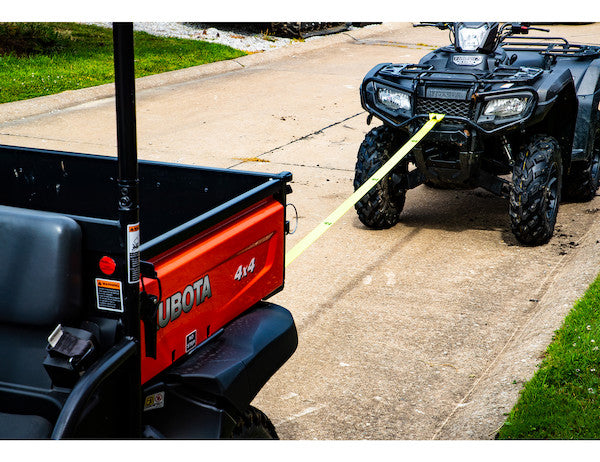
Buyers Products 12 Foot Tow Strap Kit is designed to free stuck ATVs and UTVs. The heavy duty 2 in. wide polyester strap is extremely durable with a working load limit of 2000 lb. An essential for any off-roader, the kit includes everything you need in one package - the strap, a steel shackle, and a convenient storage bag so you can keep the kit with you while you ride. The shackle features a zinc-plated finish for superior corrosion resistance. Loop ends make it easy to hook-up and release your ATV or UTV. This product is for recovery purposes only and is not intended for towing.
Specifications
| Break Strength (lbs.) | 6,000 |
|---|---|
| Handle Type | - |
| Hook Type | - |
| Length (ft) | 12 |
| Material | Polyester |
| W.L.L. (lbs.) | 2,000 |
| Width (in.) | 2 |
The Buyers Products 12 Foot UTV/ATV Tow Strap Kit represents an indispensable component of any off-road vehicle's recovery equipment inventory. Engineered for robust performance and unwavering reliability, this kit is specifically designed to facilitate the safe and efficient extraction of ATVs and UTVs from challenging entrapment scenarios. Comprising a meticulously constructed heavy-duty polyester strap, a high-strength zinc-plated steel shackle, and a durable storage bag, this comprehensive solution addresses the critical requirements of vehicle recovery in diverse and often arduous off-road environments.
Advanced Material Science: The Polyester Tow Strap
At the core of this recovery system is the 2-inch wide, 12-foot long polyester strap, selected for its exceptional material properties. Polyester (Polyethylene Terephthalate) is a synthetic polymer renowned for its high tensile strength-to-weight ratio, making it an ideal choice for heavy-duty applications such as vehicle recovery. Unlike some other synthetic fibers, polyester exhibits minimal elongation under load, typically around 3% at its Working Load Limit (WLL). This characteristic is crucial for a tow strap, as it provides a firm, controlled pull, preventing excessive "snapping" or recoil that can be associated with higher-stretch kinetic recovery ropes. While kinetic ropes are designed to absorb and release energy, tow straps like this one are engineered for a steady, direct pull to extricate a stuck vehicle, aligning perfectly with the "recovery purposes only" mandate.
Beyond its strength, polyester offers a suite of advantageous physical and chemical properties essential for the demanding conditions of off-road use. It demonstrates superior resistance to abrasion, a critical factor given the potential for contact with rough terrain, rocks, and debris during recovery operations. This inherent resistance helps to prolong the service life of the strap, maintaining its structural integrity over repeated uses. Furthermore, polyester exhibits excellent resistance to ultraviolet (UV) radiation degradation, which is paramount for equipment frequently exposed to sunlight. Prolonged UV exposure can weaken other materials, but the molecular structure of polyester confers a high degree of stability, ensuring the strap retains its performance characteristics even after extensive outdoor storage and use.
The chemical inertness of polyester is another significant benefit. It resists mildew, rot, and a wide range of common chemicals, including mild acids, alkalis, and oils often encountered in automotive and natural environments. Its low water absorption rate (typically less than 0.5%) means the strap does not gain significant weight when wet, dries quickly, and maintains its strength properties even when submerged. This comprehensive resistance package ensures the strap's durability and reliability across various weather conditions, from arid deserts to muddy trails and snowy landscapes. The meticulously stitched loop ends of the strap are reinforced to provide secure, robust connection points, designed to distribute load stresses efficiently and prevent localized wear, facilitating easy and dependable hook-up and release from recovery points.
Engineering for Safety: Working Load Limit (WLL) and Break Strength
Understanding the critical specifications of the tow strap, particularly its Working Load Limit (WLL) and Break Strength, is fundamental to safe operation. The WLL of 2,000 lbs signifies the maximum static load that can be safely applied to the strap under normal operating conditions. This value is not merely an arbitrary number but is derived through rigorous engineering calculations and testing, incorporating a substantial safety factor. The Break Strength, also known as the Minimum Breaking Strength (MBS), is specified at 6,000 lbs, representing the minimum force at which a new strap is expected to fail. The ratio between the Break Strength and the WLL (6,000 lbs / 2,000 lbs = 3:1) defines the safety factor embedded in the product's design. A 3:1 safety factor is a common and highly recommended standard for lifting and rigging equipment, providing a significant margin of safety against unforeseen dynamic loads, shock forces, and potential degradation from wear or environmental factors.
It is imperative to distinguish between static loads and the dynamic forces encountered during a vehicle recovery. While the WLL is based on a static load, the act of pulling a stuck vehicle introduces dynamic forces that can momentarily exceed the vehicle's actual weight. For instance, resistance from mud, sand, or an incline, combined with the momentum of the recovery vehicle, can generate forces significantly greater than the static weight of the stuck ATV/UTV. The conservative WLL and robust safety factor account for these variables, ensuring that even under typical dynamic recovery stresses, the strap operates well within its design limits. Adhering strictly to the WLL is not merely a recommendation but a critical safety protocol to prevent catastrophic failure, which could result in severe injury or damage to equipment.
The Steel Shackle: Strength, Durability, and Corrosion Resistance
Complementing the robust strap is the included steel shackle, a vital link in the recovery chain. Fabricated from high-strength steel, this shackle is designed to withstand the substantial forces involved in vehicle recovery, ensuring its WLL is commensurate with or exceeds that of the strap itself. The design typically incorporates a screw pin, allowing for secure and quick attachment and detachment from vehicle recovery points. The strength characteristics of the shackle are paramount, as it serves as the primary connection interface between the strap and the vehicle's anchor points.
A key feature of the shackle is its zinc-plated finish, a surface treatment applied for superior corrosion resistance. Zinc plating functions as a sacrificial coating, providing cathodic protection to the underlying steel. When exposed to corrosive elements such as water, salt, mud, or chemicals, the zinc corrodes preferentially to the steel, thus protecting the structural integrity of the shackle. This electrochemical process significantly extends the shackle's lifespan, preventing the formation of rust that could compromise its strength or hinder its operation. In the unpredictable and often harsh conditions of off-road recovery, where equipment is routinely exposed to moisture and abrasive contaminants, this level of corrosion protection is not merely a convenience but a necessity for maintaining operational safety and equipment longevity.
Proper application of the shackle is essential. It should always be threaded securely through designated recovery points, such as factory-installed tow hooks, frame-mounted D-ring mounts, or a properly rated hitch receiver pin. The shackle pin should be tightened firmly by hand, then backed off approximately a quarter turn to prevent galling or seizing under load, which can make removal difficult after the recovery operation. Misuse, such as attaching to suspension components, axles, or bumpers not rated for recovery, can lead to equipment failure, vehicle damage, or serious injury. The design and finish of this steel shackle ensure it performs reliably as a critical interface in the recovery process.
The Storage Bag: Protection and Preparedness
The inclusion of a convenient storage bag highlights the kit's emphasis on practicality and long-term utility. This bag, typically constructed from durable synthetic fabric, serves multiple critical functions. Firstly, it protects the strap and shackle from environmental contaminants such as dirt, dust, and moisture when not in use. Keeping the equipment clean and free from abrasive particles helps preserve the integrity of the polyester fibers and the shackle's finish, preventing premature wear and degradation. Secondly, the bag prevents the strap from tangling or becoming damaged by other items stored in the vehicle, ensuring it is always in optimal condition and ready for immediate deployment. Furthermore, it consolidates all components of the kit, preventing individual items from being lost and ensuring that the complete recovery solution is always accessible when needed.
The compact and organized nature of the storage bag makes it effortless to keep the kit readily available within an ATV or UTV. Whether stowed under a seat, in a cargo box, or attached to a rack, its presence provides peace of mind, knowing that a reliable recovery solution is always at hand for unexpected situations. Proper storage, away from direct sunlight and harsh chemicals, further contributes to the longevity and consistent performance of the entire kit.
Operational Guidelines and Safety Protocols for Vehicle Recovery
The effective and safe use of the 12 Foot UTV/ATV Tow Strap Kit hinges on adherence to established operational guidelines and stringent safety protocols. The fundamental principle is that this product is intended for recovery purposes only and is not designed for sustained towing. Towing involves continuous movement, whereas recovery is a singular, high-stress event to free a stuck vehicle.
Pre-Recovery Assessment: Before initiating any recovery attempt, a thorough assessment of the situation is paramount. This includes evaluating the terrain, identifying the cause of entrapment, and ensuring the area is clear of bystanders. It is crucial to use a spotter to guide the recovery vehicle and monitor the strap and connections throughout the process.
Identifying Secure Anchor Points: Always connect the tow strap to designated recovery points on both the stuck and recovery vehicles. These are typically reinforced points on the vehicle's frame, factory-installed tow hooks, or a properly rated hitch receiver with a recovery shackle or loop. Never attach the strap to axles, suspension components, bumpers (unless specifically rated for recovery), or any part not designed to withstand substantial pulling forces, as this can lead to severe structural damage to the vehicle or catastrophic equipment failure.
Connecting the Strap: The loop ends of the polyester strap facilitate direct connection to a shackle. Ensure the strap is not twisted, as twists can significantly reduce its effective strength. When using the shackle, thread the strap's loop through the shackle's bow, and then connect the shackle to the vehicle's recovery point. The shackle pin should be hand-tightened and then backed off a quarter turn to prevent binding. Ensure all connections are secure before proceeding.
Controlled Recovery Technique: For tow straps, the recovery technique involves a steady, gradual pull. The recovery vehicle should apply tension slowly and deliberately, avoiding sudden jerks or rapid acceleration. The objective is to apply a consistent force that overcomes the resistance holding the stuck vehicle. Communication between the drivers of both vehicles is essential to coordinate the effort, ensuring a synchronized and safe recovery. If the vehicle does not move, re-evaluate the situation, check connections, and consider alternative recovery methods or additional equipment, rather than applying excessive, uncontrolled force.
Maintaining a Safety Zone: During recovery operations, a strict safety perimeter must be established and maintained. Bystanders should be kept well clear of the recovery area, especially out of the direct line of pull, as equipment failure can result in dangerous projectile hazards. Both drivers should remain in their vehicles unless absolutely necessary to exit, and even then, extreme caution is advised. Always wear appropriate personal protective equipment (PPE), including gloves and eye protection.
Post-Recovery Inspection and Care: After a successful recovery, all components of the kit—the strap and the shackle—must be thoroughly inspected for any signs of damage. This includes cuts, abrasions, fraying, pulled stitches, chemical exposure, or deformation on the strap, and any bends, cracks, or excessive wear on the shackle. Any damaged equipment should be immediately retired from service. Clean the strap with mild soap and water, rinse thoroughly, and allow it to air dry completely before storing it back in its bag. Store the kit in a dry, dark place, away from chemicals and extreme temperatures, to maximize its lifespan and ensure its readiness for future use.
Environmental Resilience and Longevity
The robust construction and material selection of the 12 Foot UTV/ATV Tow Strap Kit ensure its resilience across a spectrum of environmental challenges. Whether operating in deep mud, soft sand, rocky terrain, or snowy conditions, the polyester strap’s inherent properties of low water absorption and resistance to abrasion allow it to maintain performance. Its resistance to common environmental contaminants and UV degradation further contributes to its longevity, ensuring it remains a dependable tool for many seasons of off-road adventure. The zinc-plated shackle’s corrosion resistance is particularly vital in environments where exposure to moisture and corrosive agents is frequent, such as coastal areas or regions with heavy snowfall and road salt usage.
The engineering behind this kit focuses on providing a durable and reliable recovery solution. From the molecular structure of the polyester fibers to the metallurgical composition and protective finish of the steel shackle, every aspect is considered for optimal performance and safety in challenging conditions. The product’s design directly addresses the practical needs of off-road enthusiasts, providing a compact, powerful, and safe method for addressing common entrapment scenarios. This commitment to quality and safety makes the Buyers Products 12 Foot UTV/ATV Tow Strap Kit an essential investment for anyone venturing off the beaten path, offering the confidence that comes with being prepared for the unpredictable nature of off-road exploration.