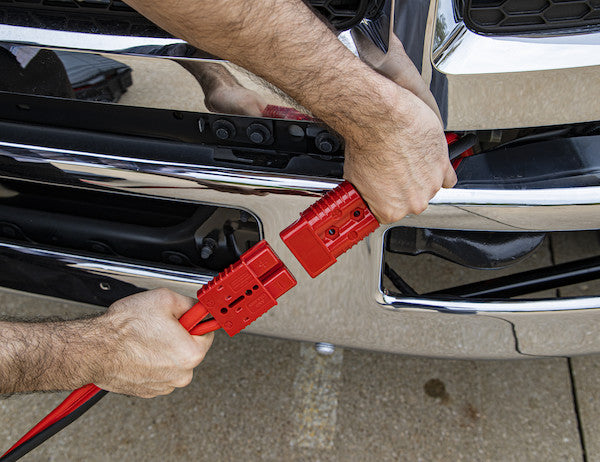
Booster Cables with Quick Connect from Buyers Products make it easy to provide a jump. Just drive up, connect to the disabled vehicle's battery, and plug the other side of the cable into the jumping vehicle. The fully insulated cables are rated to handle 600A to 1000A capacities. The higher amp models are ideal for larger vehicles like medium and heavy-duty diesel trucks and off-road construction equipment. All the quick connect kits include a 6 ft battery side cable with quick connector for easy hook-up and a carrying case. Replacement connector housings with different keys are also available, so you can avoid mismatching your booster cables. See "Accessories" below for more information.
Specifications
| Cable Gauge | 2 |
|---|---|
| Cable Length | 32.5 |
| Connection Type (Vehicle Side) | Red |
| Current Rating | 800 |
Professional-Grade 32.5 Foot, 800 Amp Booster Cables with Red Quick Connect System
In the demanding environments of commercial transportation, heavy construction, agriculture, and fleet maintenance, reliable and efficient vehicle jump-starting capabilities are paramount. Downtime for a single heavy-duty vehicle can incur substantial financial losses, making rapid and safe resolution of battery issues a critical operational imperative. This professional-grade booster cable system, featuring a robust 32.5-foot length, an 800-amp current rating, and an advanced Red Quick Connect interface, is engineered to meet these stringent requirements, providing an unparalleled solution for power transfer in challenging scenarios.
Unpacking the 800 Amp Current Rating: Powering Heavy-Duty Applications
The 800-amp current rating of these booster cables is a pivotal specification, indicating their capacity to deliver substantial electrical current necessary for initiating the most formidable engines. Unlike standard passenger vehicles, heavy-duty diesel trucks, off-road construction equipment, agricultural machinery, and large commercial vehicles are equipped with engines that demand extremely high cold cranking amps (CCA) to overcome their high compression ratios and robust starter motor requirements. An 800-amp rating ensures that sufficient current is available to turn over these large engines, even in adverse conditions such as extreme cold, where battery efficiency is reduced and engine oil viscosity is increased.
Undersized cables for such applications present multiple risks. Inadequate gauge cables attempting to transmit high current over significant distances will experience considerable voltage drop, resulting in insufficient power reaching the starter motor. This leads to slow or failed starts, excessive strain on the donor vehicle's electrical system, and potential overheating of the booster cables themselves, posing a significant safety hazard. The 800-amp capacity of these cables, coupled with their superior construction, guarantees efficient and safe current delivery, mitigating these risks. This rating positions the system squarely within the 600A to 1000A capacity range mentioned in the initial description, confirming its suitability for the most demanding heavy-duty applications.
The Strategic Advantage of 32.5 Feet in Cable Length
The extended length of 32.5 feet is not merely a convenience but a strategic design choice that dramatically enhances operational flexibility and safety in diverse field conditions. Standard booster cables, typically 10 to 20 feet long, often prove insufficient when dealing with large vehicles or challenging environments. The 32.5-foot length addresses common logistical obstacles, allowing the donor and disabled vehicles to be positioned safely and optimally without the need for extensive repositioning.
Consider scenarios frequently encountered in commercial and industrial settings: a heavy-duty truck disabled in a tight loading dock, a piece of construction equipment stuck in a confined job site, or a farm implement stalled in the middle of a field. In such situations, maneuvering a large donor vehicle into close proximity can be impractical, time-consuming, or even hazardous. The 32.5-foot reach enables technicians to connect the vehicles while maintaining a safe distance from traffic, hazardous terrain, exhaust fumes, or moving parts. This extended reach minimizes risks of collision, entanglement, and exposure to harmful emissions, thereby improving overall site safety and operational efficiency. Furthermore, for vehicles with batteries located in less accessible positions, the longer cable provides the necessary slack to make connections without straining or kinking the cables, ensuring a secure and uninterrupted power path.
From a technical perspective, increasing cable length inherently increases electrical resistance, which can lead to greater voltage drop and power loss. However, the selection of a substantial cable gauge (2 AWG, as detailed below) in conjunction with this length is critical. This engineering synergy ensures that despite the extended reach, the voltage drop remains within acceptable limits, allowing the full 800 amps to be effectively delivered to the disabled vehicle's battery and starter motor, preserving the efficiency and power transfer capabilities of the system.
The Red Quick Connect System: Enhancing Efficiency, Safety, and System Integrity
At the heart of this advanced booster cable system is the innovative Red Quick Connect interface. This connection type represents a significant leap forward from traditional clamp-based systems, offering unparalleled advantages in terms of speed, safety, and operational reliability. Quick Connect systems, often based on widely adopted industrial standards like Anderson-style connectors, are characterized by their hermaphroditic design, meaning both ends of the connector are identical and can mate with each other, simplifying connection procedures. The spring-loaded contacts ensure a secure and low-resistance connection.
The designation "Red Quick Connect" is often indicative of specific amperage or voltage ratings within a standardized color-coding system, providing immediate visual identification for compatibility and safety. The key benefits of this system are multifaceted:
- Speed and Ease of Connection: The quick connect system eliminates the need for fumbling with cumbersome, often stiff, and sometimes corroded traditional battery clamps. Instead, a simple push-and-click mechanism provides a positive and secure electrical connection in seconds. This rapid deployment capability is invaluable in emergency situations, minimizing vehicle downtime.
-
Enhanced Safety Features:
- Polarity Protection: Many quick connect designs are engineered with non-reversible keys or profiles, making it virtually impossible to connect positive to negative accidentally. This inherent polarity protection dramatically reduces the risk of dangerous short circuits, battery damage, or harm to vehicle electronics.
- Arcing Mitigation: The fully enclosed housing of the quick connect design ensures that electrical contacts are protected before current transfer begins and after disconnection, significantly reducing the potential for hazardous arcing and sparking, which is a common danger with traditional open-jaw clamps.
- Secure Connection: The robust locking mechanism of the quick connect interface ensures a strong mechanical and electrical bond that resists vibration, accidental dislodgement, and environmental factors, guaranteeing a continuous and stable power flow during the jump-starting process.
- Full Insulation: The connector housings are made from durable, non-conductive materials, providing complete insulation and protection against accidental contact with live terminals.
- Durability and Longevity: Constructed from impact-resistant plastics and featuring corrosion-resistant copper contacts, the quick connect housing is built to withstand the rigors of heavy-duty use in harsh industrial and outdoor environments.
- Modular Design with 6 ft Battery Side Cable: The inclusion of a 6-foot battery side cable with its own quick connector is a crucial design element. This allows for semi-permanent installation of the quick connect terminal directly onto the battery of a frequently-disabled vehicle or a vehicle intended to be a donor. This eliminates the need to access battery terminals with clamps for every jump-start, simplifying the process and reducing wear on battery posts. When a jump-start is needed, the main 32.5-foot booster cable simply plugs into this pre-installed connector, streamlining the operation further.
- Preventing Mismatching and Ensuring System Integrity: The availability of "replacement connector housings with different keys" is a vital safety and compatibility feature. This prevents accidental cross-connection between different amperage or voltage systems, or between incompatible power sources and loads. By ensuring that only correctly matched components can interconnect, the system design reinforces safety protocols and protects both equipment and personnel from potential electrical hazards. This is particularly important in fleets where various types of booster cables or auxiliary power systems might be in use, allowing for dedicated, safe connections.
Engineering for Performance: In-depth on Cable Gauge (2 AWG) and Construction
The internal construction of these booster cables is meticulously engineered to support their high current rating and extended length. The core of this performance lies in the 2 AWG (American Wire Gauge) specification. AWG is a standardized system for denoting the cross-sectional area of a round, solid electrical conductor, where a smaller AWG number corresponds to a larger conductor diameter and thus a greater current carrying capacity. A 2 AWG cable is significantly thicker than the typical 6 AWG or 4 AWG found in consumer-grade booster cables, making it perfectly suited for transmitting 800 amps over 32.5 feet with minimal resistance and heat generation.
The conductor material is invariably high-purity copper, often oxygen-free copper (OFC), selected for its superior electrical conductivity. The copper itself is typically finely stranded. Instead of a single solid conductor, the cable consists of hundreds or thousands of fine copper strands twisted together. This stranding greatly enhances the cable's flexibility, making it easier to coil, deploy, and route around obstacles, especially in cold weather when cable insulation tends to stiffen. Furthermore, stranded conductors are far more resilient to fatigue and breakage from repeated flexing, coiling, and uncoiling compared to solid conductors, ensuring a longer operational lifespan in demanding applications.
The insulation surrounding the copper conductor is equally critical. It is typically constructed from heavy-duty, flexible materials such as PVC (Polyvinyl Chloride) or EPDM (Ethylene Propylene Diene Monomer) rubber compounds. These materials are chosen for their excellent dielectric strength, meaning their ability to withstand high electrical voltages without breaking down. Beyond electrical insulation, these compounds offer robust protection against a myriad of environmental and operational stresses:
- Oil, Grease, and Chemical Resistance: Essential for automotive and industrial environments where exposure to various fluids is common.
- Abrasion Resistance: The outer jacket is designed to resist cuts, nicks, and chafing from contact with rough surfaces, sharp edges, and general wear and tear during deployment and storage.
- Weather Resistance: Capable of performing reliably across a broad temperature range, from extreme cold (which can make lesser cables brittle) to high heat, and resistant to UV radiation and moisture ingress.
- Flexibility: Despite their robust nature, the cables maintain a high degree of flexibility, which is vital for ease of handling, especially given their 32.5-foot length. This flexibility prevents kinking and makes storage in the included carrying case straightforward.
The overall cable assembly is engineered for maximum durability, ensuring that this investment will withstand the rigorous demands of professional use over many years.
Comprehensive Applications and Target Environments
The technical specifications and features of these 32.5-foot, 800-amp booster cables make them indispensable across a wide spectrum of commercial, industrial, and public service sectors:
- Commercial Transportation Fleets: Essential for jump-starting Class 8 semi-trucks, long-haul buses, delivery vehicles, and other heavy-duty transport vehicles. Reduces roadside service calls and maximizes uptime.
- Construction and Mining Operations: Critical for restarting heavy machinery such as excavators, bulldozers, wheel loaders, dump trucks, large generators, and drilling rigs. Ensures continuous operation on remote and challenging job sites.
- Agricultural Sector: Ideal for large tractors, combines, harvesters, irrigation pumps, and other powerful farm equipment that require substantial current for starting, particularly during peak seasons.
- Emergency Services: A vital tool for fire departments, ambulance services, and police forces operating heavy-duty vehicles with complex electrical systems and high power demands. Reliable starting can be life-critical.
- Marine and Industrial Applications: Suitable for large marine engines, stationary industrial generators, backup power systems, and heavy-duty material handling equipment.
- Fleet Maintenance and Repair Facilities: An essential piece of equipment for internal maintenance shops and mobile service units, enabling quick and safe resolution of battery issues without specialized service vehicles.
- Utility Companies: For maintaining and restarting heavy-duty utility trucks and equipment used for power line, gas line, and telecommunications infrastructure.
Operational Best Practices and Maintenance for Longevity
To maximize the performance, safety, and lifespan of these premium booster cables, adherence to best operational practices and routine maintenance is highly recommended:
- Connection Sequence: While the quick connect system significantly enhances safety by preventing polarity reversal at the connection point, proper connection to the battery terminals remains crucial. Always connect the positive (+) cable to the positive (+) battery terminal on both the disabled and donor vehicles first. Then, connect the negative (-) cable to the negative (-) terminal of the donor vehicle's battery, and finally, connect the other end of the negative (-) cable to a clean, unpainted metal ground point on the engine block or chassis of the disabled vehicle, away from the battery and moving parts. This sequence minimizes the risk of sparking near the battery, where hydrogen gas can accumulate.
- Pre-use Inspection: Before each use, visually inspect the entire length of both cables for any signs of damage, including cuts, abrasions, cracks in the insulation, or exposed conductors. Check the quick connect housings for any physical damage, ensuring the contacts are clean and free of corrosion or debris. Any compromised cables or connectors should be replaced immediately.
- Cleaning and Storage: After each use, wipe down the cables and connectors to remove any dirt, moisture, oil, or battery acid residue. Ensure connectors are clean and dry before storage. The included carrying case is designed to protect the cables from environmental damage, prevent kinking, and keep them organized and ready for the next use. Proper storage in the case prevents unnecessary wear and tear, extends cable life, and maintains the integrity of the insulation and connectors.
- Environmental Considerations: Be mindful of operating conditions. Avoid laying cables across sharp edges, hot engine parts, or through standing water. While the cables are designed for robustness, unnecessary exposure to extreme conditions should be minimized.
Superiority Over Conventional Booster Cables: A Professional Investment
These 32.5-foot, 800-amp booster cables with the Red Quick Connect system offer a demonstrably superior alternative to conventional booster cables, positioning them as a critical investment for any professional operation. Standard cables often fall short in three key areas:
- Current Capacity: Consumer-grade cables typically range from 10 AWG to 6 AWG, designed for passenger vehicles. They cannot safely or efficiently deliver the sustained 800 amps required by heavy-duty equipment without significant voltage drop, overheating, or potential failure.
- Length and Reach: Shorter, standard cables severely limit operational flexibility, often requiring risky or time-consuming vehicle maneuvers. The 32.5-foot length eliminates these constraints, enhancing safety and efficiency.
- Connection Method: Traditional alligator clamps, while functional, are prone to insecure connections, accidental shorts, arcing, and polarity errors. The Quick Connect system, with its secure, insulated, and polarity-protected design, vastly improves safety and ease of use, reducing the likelihood of costly mistakes or personal injury.
By investing in these professional-grade booster cables, businesses can significantly reduce vehicle downtime, mitigate the costs associated with external service calls, protect valuable vehicle electronics from power surges or incorrect connections, and enhance overall operational safety. This product represents a commitment to reliability, efficiency, and the highest standards of safety in power transfer solutions.