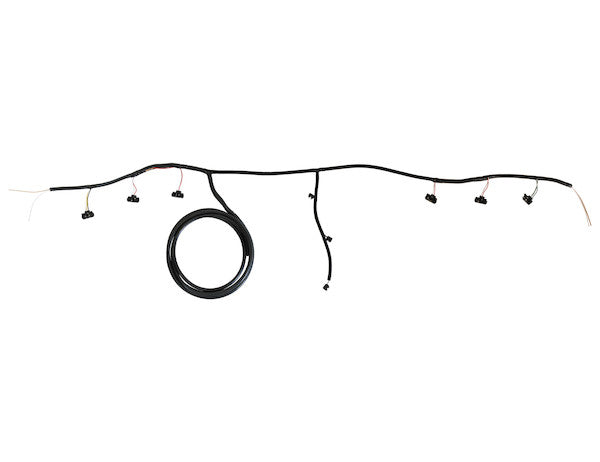
Buyers Products Wiring Harness is designed to be an accessory for light bar installations on municipal spreaders. It features a 12 ft lead and matches up to light bars that feature seven to nine lights each, in either round or oval formats. It features blunt cut end wires for side markers at either end.
Specifications
| For Use With | Spreader Lightbar Kits |
|---|---|
| Number of Wires | (7) with (4) Stripped Ends |
| Termination 1 | PL10 |
| Termination 2 | PL3 |
| Wire Gauge | 16 |
The 12 Foot Universal DOT Rear Wiring Harness represents an essential component in the secure and compliant electrical integration of auxiliary lighting systems on a wide array of commercial, municipal, and heavy-duty vehicles. Engineered with precision and robust materials, this harness is specifically designed to meet or exceed the stringent requirements set forth by the Department of Transportation (DOT) for rear vehicle lighting, ensuring optimal visibility, operational safety, and legal adherence on public roadways. Its universal design paradigm facilitates seamless compatibility with numerous vehicle platforms and lighting configurations, making it an indispensable asset for fleet managers, vehicle upfitters, and maintenance professionals who demand reliability and versatility.
At its core, a wiring harness functions as a meticulously organized assembly of electrical conductors, each insulated and bundled together to transmit power and signals to various electrical components. In the context of rear vehicle lighting, this harness is instrumental in providing a consolidated and protected pathway for electrical current to power essential lighting elements such as tail lights, brake lights, turn signals, reverse lights, and auxiliary markers. The "12 Foot" designation signifies a generous lead length, providing substantial flexibility for installation across diverse chassis lengths and mounting positions, accommodating the often complex routing requirements inherent in heavy-duty vehicle modifications without necessitating additional splicing or extension, which can compromise signal integrity and weather resistance.
The "Universal" aspect of this harness is a testament to its broad adaptability. While initially highlighted for municipal spreader light bar installations, its electrical architecture and physical terminations are widely compatible with a spectrum of heavy-duty vehicles including, but not limited to, snowplows, utility trucks, construction equipment, refuse vehicles, commercial trailers, and emergency response vehicles. This universality is achieved through its standardized wire gauge, common connector types, and a comprehensive seven-wire configuration designed to support the full complement of DOT-mandated rear lighting functions. This reduces inventory complexity for fleet operators and ensures a readily available solution for various vehicle applications.
Crucially, the "DOT" compliance of this rear wiring harness underscores its commitment to regulatory standards governing vehicle safety and visibility. The Department of Transportation, through agencies like the National Highway Traffic Safety Administration (NHTSA) and regulations such as Federal Motor Vehicle Safety Standard (FMVSS) 108, establishes minimum performance requirements for all vehicle lighting and associated electrical components. A DOT-compliant harness ensures that the electrical signals transmitted to rear lights are stable, robust, and correctly channeled, allowing the illumination devices to function as intended under all operational conditions. This compliance is not merely a legal formality; it is a fundamental safety imperative, as properly functioning rear lighting is critical for preventing rear-end collisions, especially in adverse weather conditions, low-light environments, or during complex maneuvering on job sites and public roads. Non-compliance can lead to significant safety risks, legal penalties, and operational downtime for commercial fleets.
Delving into the technical specifications, the harness features a "Number of Wires: (7) with (4) Stripped Ends." This seven-wire configuration is a standard architecture for robust multi-function rear lighting systems. Typically, these wires would individually serve distinct purposes:
- Ground Wire: Essential for completing the electrical circuit, providing a return path for current. Without a proper ground, none of the lights will function.
- Tail Light Wire: Powers the steady-burning rear lights that indicate the presence of the vehicle during nighttime or low-visibility conditions.
- Stop Light Wire: Activates the brighter brake lights when the vehicle's brakes are applied, signaling deceleration or a stopped condition.
- Left Turn Signal Wire: Controls the flashing illumination of the left turn indicator, communicating an intended left turn or lane change.
- Right Turn Signal Wire: Controls the flashing illumination of the right turn indicator, communicating an intended right turn or lane change.
- Reverse Light Wire: Powers the white lights that illuminate when the vehicle is in reverse, providing visibility to the rear and indicating reversing action.
- Auxiliary/Accessory Wire: Often designated for additional functions such as license plate lights, clearance lights, or other supplementary lighting as required by specific vehicle configurations or local regulations.
The specified "Wire Gauge: 16" refers to American Wire Gauge (AWG), a standardized system for denoting the cross-sectional area of a conductor. A 16 AWG wire is appropriately sized for vehicle lighting applications, offering an optimal balance between current carrying capacity and physical flexibility. This gauge is robust enough to handle the electrical loads imposed by multiple LED or incandescent light elements without excessive voltage drop over the 12-foot length, which could otherwise lead to dimming or improper light function. Concurrently, it remains flexible enough to be routed through tight spaces and around vehicle components without incurring damage during installation or operation. The insulation surrounding these 16 AWG conductors is typically constructed from high-quality, automotive-grade PVC or similar polymers, engineered to withstand the harsh environmental conditions prevalent in heavy-duty applications, including resistance to abrasion, oils, fuels, road salts, moisture, and extreme temperature fluctuations, thereby ensuring long-term electrical integrity.
Regarding terminations, the harness features "Termination 1: PL10" and "Termination 2: PL3." These are widely recognized and utilized electrical connectors in the heavy-duty trucking and commercial vehicle industry, indicative of the harness's professional-grade design.
- PL10 Connector: This is a common 3-pin pigtail connector, often used for critical rear lighting functions such as tail, stop, and turn signals in a combined unit. It typically features a robust, weather-sealed housing designed to protect the electrical contacts from ingress of moisture, dirt, and corrosive agents. The secure locking mechanism of PL10 connectors ensures a vibration-resistant connection, crucial for vehicles operating in dynamic and challenging environments. Its widespread adoption means easy compatibility with numerous OEM and aftermarket light assemblies, simplifying replacement and upgrades.
- PL3 Connector: Similar in design and robust construction to the PL10 but typically a 2-pin variant. PL3 connectors are frequently employed for simpler lighting applications such as side marker lights, clearance lights, or auxiliary lamps that require power and ground connections. Like the PL10, it offers excellent weather resistance and a secure connection, contributing to the overall reliability of the vehicle's lighting system.
The design philosophy extends beyond mere electrical connectivity to encompass environmental resilience. Heavy-duty vehicles, especially municipal spreaders, operate in extremely demanding conditions characterized by exposure to corrosive road salts, abrasive debris, constant vibration, extreme temperatures (from sub-zero winters to scorching summers), and various chemicals (e.g., de-icing agents, hydraulic fluids). The materials chosen for this harness—from the durable outer jacket to the internal wire insulation and the robust connector housings—are selected to withstand these harsh elements. The harness is engineered for superior resistance to moisture ingress, chemical degradation, and mechanical abrasion, which are common causes of premature failure in lesser quality wiring solutions. This inherent durability translates directly into extended operational lifespan, reduced frequency of repairs, and enhanced safety for the vehicle and its operators.
Installation and maintenance considerations are paramount for commercial operations. A pre-fabricated, universal wiring harness like this simplifies the often-complex task of integrating auxiliary lighting. By providing labeled wires, standardized connectors, and appropriate length, it dramatically reduces the potential for wiring errors, short circuits, and improper connections. For fleet technicians, this means less time spent on custom wiring and troubleshooting, allowing for quicker vehicle turnaround times and more efficient resource allocation. The robustness of the harness also contributes to a lower total cost of ownership over the vehicle's lifespan, as fewer electrical faults equate to reduced maintenance expenditure and prolonged component reliability. In the event of damage, the modular nature afforded by the connectors allows for easier identification and replacement of specific sections, rather than requiring extensive re-wiring of the entire system.
While the initial context specifies "spreader light bar installations," the "universal" and "DOT" aspects broaden its applicability significantly. Consider the diverse fleet of a municipal public works department: snowplows requiring enhanced forward and rear visibility, sanitation trucks demanding robust signaling for frequent stops and starts, utility vehicles necessitating specialized lighting for roadside operations, and various trailers used for equipment transport. Each of these applications benefits immensely from a wiring harness that offers reliable power distribution to critical lighting elements. For commercial trailers, this harness facilitates the necessary DOT-compliant lighting connections, which are vital for interstate transport and safety. In construction settings, where vehicles operate in dusty, rugged environments, the durability and secure connections of this harness ensure that essential safety lighting remains operational despite challenging conditions.
In conclusion, the 12 Foot Universal DOT Rear Wiring Harness is more than just an assembly of wires; it is a meticulously engineered electrical subsystem designed to be the backbone of compliant and reliable rear lighting for commercial and heavy-duty vehicles. Its generous 12-foot length, universal compatibility, and unwavering adherence to DOT standards underscore its value. The technical composition, including the robust 16 AWG wire, the versatile seven-wire configuration with stripped ends, and the industry-standard PL10 and PL3 connectors, collectively contribute to its superior performance, ease of installation, and exceptional durability. For fleet operators, vehicle upfitters, and maintenance personnel, investing in this harness translates into tangible benefits: enhanced vehicle safety through consistently operational lighting, ensured legal compliance, minimized downtime due to electrical failures, and a reduced total cost of ownership. This harness represents a critical investment in operational efficiency and the safety of personnel and the public on our roadways.