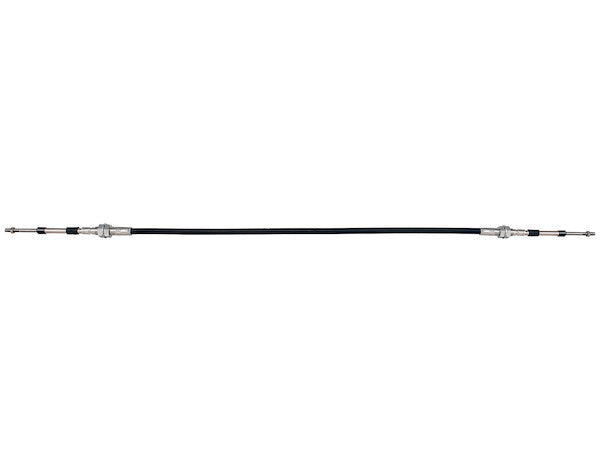
The 6200 Series Universal Mount Control Cable from Buyers Products is a push-pull style cable for heavier duty PTO and hoist applications. With an 10 in. minimum bend radius and a 110-200 lb load range, the cable is a flexible choice for many jobs. All cables include bulkhead nuts and washers for fast and easy connectivity.
Specifications
| Cable Length (in.) | 168 " |
| Conduit Material | PVC |
| Total Travel (in.) | 3 " |
| End Type | Rod |
| Cable Core Material | Stainless Steel |
| Conduit Diameter (in.) | .51 " |
| Cable Diameter (in.) | 0.188 " |
| Cable Series | 6200 Series |
| Conduit Color | Black |
| Bulkhead Thread Size | 11/16-16 " |
| Rod End Thread Size | 5/16-24 " |
Advanced Technical Overview: 168 Inch 6200 Series Universal Mount Control Cable
The 168 Inch 6200 Series Universal Mount Control Cable by Buyers Products represents a pinnacle of engineering in mechanical control systems, specifically designed for robust and demanding applications in industrial and commercial environments. This detailed technical exposition will delve into the design philosophy, material science, operational characteristics, and application suitability of this particular control cable, providing a comprehensive understanding for engineers, procurement specialists, and system integrators.
Core Functionality and Design Philosophy
At its heart, the 6200 Series control cable operates on a fundamental push-pull mechanism, a highly reliable method for transmitting linear force over a distance. This design is particularly advantageous in scenarios where precise and consistent actuation is critical, often found in power take-off (PTO) engagements, hydraulic hoist controls, throttle linkages, and various valve actuation systems. The push-pull configuration ensures positive control in both directions, eliminating the need for return springs in many applications and offering superior responsiveness compared to single-action systems.
The "Universal Mount" designation underscores the product's adaptability. While specific mounting hardware would depend on the application, the cable itself is designed with common interface standards, facilitated by the inclusion of bulkhead nuts and washers. This universal compatibility simplifies integration into diverse equipment designs, reducing customization requirements and accelerating deployment times.
Material Science and Construction
The selection of materials for the 6200 Series cable is a critical factor in its performance and longevity. The core component, the cable itself, is constructed from high-grade Stainless Steel. Stainless steel is chosen for its exceptional resistance to corrosion, particularly important in outdoor, marine, or otherwise harsh environments where exposure to moisture, chemicals, and abrasive particles is common. Its high tensile strength ensures reliability under significant axial loads, and its inherent fatigue resistance contributes to a longer operational lifespan, even under repetitive cycling. The specified cable diameter of 0.188 inches strikes an optimal balance between flexibility and load-bearing capacity, a testament to thoughtful engineering.
Encasing this robust core is a conduit made from Polyvinyl Chloride (PVC), a material renowned for its durability, flexibility, and protective qualities. The PVC conduit, with a diameter of 0.51 inches, serves several vital functions: it protects the inner stainless steel core from external contaminants such as dirt, dust, and moisture; it minimizes friction during operation, ensuring smooth push-pull action; and it provides an essential structural element that contributes to the cable's specified minimum bend radius. The black color of the conduit often indicates UV resistance, further enhancing its suitability for outdoor use by preventing degradation from solar radiation.
Performance Characteristics and Operational Parameters
The 6200 Series cable is engineered for demanding applications, as evidenced by its robust performance specifications. The most significant of these is the load range of 110-200 lbs. This range indicates the typical operating force the cable is designed to transmit, placing it firmly in the "heavier duty" category as described. This capacity makes it suitable for actuating components that require substantial force, such as engagement clutches for PTOs or the lifting mechanisms of hydraulic hoists, where mechanical advantage may be limited.
A crucial geometric parameter for any control cable is its minimum bend radius, specified here at 10 inches. This figure dictates the tightest curve the cable can reliably negotiate without experiencing kinking, excessive friction, or premature wear. A 10-inch minimum bend radius signifies a good degree of flexibility for a heavy-duty cable of this diameter, allowing for routing around obstacles within equipment chassis without compromising performance or integrity. Proper adherence to this specification during installation is paramount to ensure smooth operation and prevent cable damage.
The total travel of 3 inches is another critical specification, defining the maximum linear displacement of the cable's rod end. This travel distance must be carefully matched to the stroke requirements of the actuated mechanism. A 3-inch travel is sufficient for many industrial control applications, offering enough throw to fully engage or disengage clutches, open or close valves, or adjust throttle settings across their full operational range.
End Configuration and Connectivity
The connectivity solutions for the 6200 Series cable are designed for ease of installation and secure attachment. The cable features a Rod End type, which is a common and versatile termination for mechanical control cables. Rod ends typically consist of a spherical plain bearing integrated into a threaded housing, allowing for angular misalignment between the cable and the controlled component. This flexibility is crucial in dynamic systems where perfect axial alignment may be difficult to achieve or maintain due to vibration or component movement. The Rod End Thread Size is specified as 5/16-24 inches, a standard fine-thread size often found in linkages requiring precise adjustment and secure fastening.
For mounting the conduit to a panel or bulkhead, the cable includes bulkhead nuts and washers. The Bulkhead Thread Size is 11/16-16 inches. This robust threading ensures a stable and durable attachment point, preventing the conduit from shifting or pulling out under operational loads. The washers distribute the clamping force evenly, further enhancing the integrity of the mounting point. This universal mounting approach simplifies installation across various equipment types, from agricultural machinery to construction vehicles and industrial process controls.
Application Specifics and Suitability
The 168-inch length of this control cable (equivalent to 14 feet) provides ample reach for a multitude of applications where the control input is situated a significant distance from the actuated component. This extended length is often necessary in larger vehicles or complex machinery where engine compartments, hydraulic systems, and operator cabins are spatially separated. For instance, in a large truck, the PTO engagement lever in the cab might be several feet from the transmission-mounted PTO unit, making a 168-inch cable an ideal choice.
Key applications where the 6200 Series Universal Mount Control Cable excels include:
- Power Take-Off (PTO) Systems: Essential for engaging auxiliary equipment on vehicles, such as hydraulic pumps for dump trucks, spreaders, or cranes. The push-pull action and heavy-duty load range ensure reliable engagement and disengagement.
- Hydraulic Hoist Controls: Used in dump body trucks, tow trucks, and other lifting equipment. The cable provides direct and reliable control over hydraulic valve actuators, ensuring precise operation of lifting and lowering functions.
- Throttle Controls: For industrial engines or specialized equipment where precise engine speed control is required from a remote location.
- Choke Controls: Though less common in modern vehicles, certain industrial engines or older equipment still utilize cable-actuated chokes for cold starting.
- Valve Actuation: In hydraulic or pneumatic systems, the cable can be used to open and close control valves, directing fluid flow or pressure.
- Industrial Machinery: General-purpose control linkages in various manufacturing equipment, material handling systems, and specialized off-road vehicles.
Maintenance and Longevity
While the 6200 Series cable is designed for minimal maintenance due to its robust construction and material choices, a few considerations can further extend its operational life. Periodic inspection for signs of conduit damage, wear on the rod end, or fraying of the inner cable is recommended, especially in high-cycle applications. Ensuring that the cable adheres to its minimum bend radius during installation and throughout its operational life is critical to prevent internal stress and wear. Lubrication of the rod end and, where possible, the internal cable core with appropriate lubricants can reduce friction and extend component life, though the PVC conduit and stainless steel core are inherently low-friction and corrosion-resistant.
Conclusion
The 168 Inch 6200 Series Universal Mount Control Cable from Buyers Products stands as a meticulously engineered component, offering superior performance and reliability for demanding heavy-duty applications. Its strategic material selection, including a stainless steel core and PVC conduit, combined with a robust push-pull design and versatile mounting options, makes it an indispensable element in countless industrial and commercial control systems. Understanding its technical specifications—from load range and travel to bend radius and end types—is crucial for proper selection, installation, and long-term operational success, ensuring that equipment functions safely, efficiently, and consistently even in the most challenging environments.