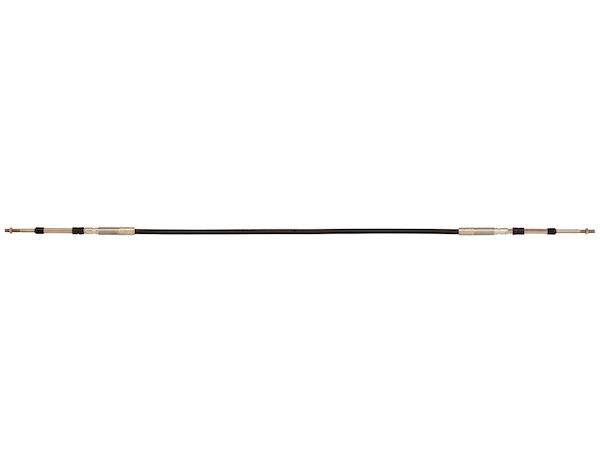
The 6200 Series Control Cable with Clamp Mount from Buyers Products is a universal mount, push-pull style cable for heavier duty PTO and hoist applications. With a 10 in. minimum bend radius and a 110-200 lb load range, the cable is the flexible choice for many jobs. All cables have a clamp mount at both ends to secure them in place. It's available in lengths from 3 ft to 20 ft to fit your exact need.
Specifications
| Cable Diameter (in.) | 0.188 " |
| Total Travel (in.) | 3 " |
| Cable Series | 6200 Series |
| Conduit Diameter (in.) | .51 " |
| Cable Core Material | Stainless Steel |
| Conduit Color | Black |
| End Type | Rod |
| Bulkhead Thread Size | 11/16-16 " |
| Rod End Thread Size | 5/16-24 " |
| Conduit Material | PVC |
| Cable Length (in.) | 120 " |
Advanced Technical Overview: 120 Inch 6200 Series Control Cable with Clamp Mount
The 120 Inch 6200 Series Control Cable with Clamp Mount from Buyers Products represents a robust and versatile solution for demanding mechanical control applications. Engineered for universal compatibility and designed as a push-pull style mechanism, this control cable is specifically optimized for integration into heavier duty Power Take-Off (PTO) and hoist systems, where reliable and precise force transmission is paramount. This detailed technical description will elaborate on the design philosophy, material science, operational characteristics, and application suitability of this critical component.Design Philosophy and Operational Principle
The core design principle of the 6200 Series control cable revolves around delivering consistent and efficient force transmission in a push-pull configuration. This mechanism allows for precise manipulation of remote equipment, providing operators with direct control over functions such as engaging or disengaging PTOs, raising or lowering hoist systems, or actuating various valves and linkages in industrial and mobile hydraulic applications. The "universal mount" designation signifies its adaptability across a broad spectrum of equipment types and mounting configurations, enhancing its utility in diverse operational environments. The push-pull operation is achieved through a precisely engineered cable core housed within a protective conduit. When tension is applied at one end of the cable (pull), the corresponding force is transmitted along its length to actuate the remote mechanism. Conversely, when the cable is pushed, it transmits compressive force, allowing for bidirectional control. This dual-action capability is fundamental to its application in systems requiring both activation and deactivation, or movement in two opposing directions.Material Science and Construction Excellence
The selection of materials for the 6200 Series control cable is critical to its performance, durability, and longevity, particularly given its intended use in heavier duty applications.Cable Core Material: Stainless Steel
At the heart of the cable's operational integrity is its stainless steel core. Stainless steel is chosen for several key properties:- Corrosion Resistance: In environments where moisture, chemicals, or abrasive substances are present, stainless steel provides exceptional resistance to corrosion, preventing degradation of the cable's mechanical properties over time. This is especially crucial for outdoor equipment or applications exposed to harsh industrial conditions.
- High Tensile Strength: Stainless steel offers a superior strength-to-weight ratio, enabling the cable to withstand substantial tensile and compressive loads, aligning with the specified 110-200 lb load range. This ensures reliable force transmission without premature stretching or breaking.
- Fatigue Resistance: Repeated push-pull cycles can induce material fatigue. Stainless steel's inherent metallurgical properties contribute to excellent fatigue resistance, extending the operational lifespan of the cable even under continuous use.
- Flexibility: While robust, the multi-strand construction of the stainless steel core, combined with its inherent material flexibility, contributes to the cable's ability to navigate complex routings, facilitated by its 10-inch minimum bend radius.
Conduit Material: PVC
The cable core is encapsulated within a PVC (Polyvinyl Chloride) conduit, which serves multiple protective and functional roles:- Environmental Protection: The PVC conduit acts as a robust barrier against external contaminants such as dirt, dust, water, and debris, which could otherwise impede the smooth operation of the cable core or accelerate wear.
- Abrasion Resistance: PVC offers good resistance to abrasion, protecting the internal components from friction against surrounding structures or other components within the equipment.
- Chemical Resistance: While not universally impervious, PVC exhibits good resistance to many common industrial chemicals, oils, and greases, further safeguarding the cable in diverse operating environments.
- Lubrication Retention: The smooth internal surface of the conduit helps to retain internal lubricants, ensuring low friction operation between the cable core and the conduit, which is essential for smooth push-pull action and minimizing control effort.
- Flexibility and Durability: The specified conduit diameter of 0.51 inches provides sufficient structural integrity to protect the cable while maintaining the required flexibility for installation. The black conduit color is a standard choice for industrial applications, often signifying durability and UV resistance.
Mechanical Specifications and Performance Parameters
The precise technical specifications provided are instrumental in understanding the operational capabilities and suitability of this control cable for specific applications.Total Travel: 3 Inches
The 3-inch total travel indicates the maximum linear displacement of the cable core relative to the conduit. This parameter is critical for matching the cable to the throw requirements of the actuated mechanism. For instance, a PTO engagement lever or a hoist valve may require a specific linear movement to fully actuate or deactuate. The 3-inch travel provides sufficient range for many common heavy-duty applications, ensuring full engagement or disengagement without over-travel or insufficient actuation.Minimum Bend Radius: 10 Inches
The 10-inch minimum bend radius is a crucial design and installation parameter. It defines the tightest curve the cable can form without compromising its structural integrity or operational efficiency. Exceeding this limit can lead to:- Increased Friction: Tighter bends increase friction between the cable core and the conduit, leading to higher operating effort and potential binding.
- Accelerated Wear: Excessive bending stress can cause premature wear or fatigue failure of the cable core or conduit.
- Reduced Lifespan: Sustained operation beyond the minimum bend radius will significantly reduce the service life of the cable.
Load Range: 110-200 lb
The stated load range of 110-200 lbs refers to the maximum sustained force the cable is designed to transmit effectively in both push and pull modes. This broad range highlights its capacity for heavier duty applications where significant force is required to actuate mechanisms against resistance. It underscores the robust construction and material selection, making it suitable for hydraulic valves, clutch mechanisms, or heavy-duty linkage systems found in construction, agricultural, or utility vehicles.Clamp Mount at Both Ends
The integration of a clamp mount at both ends is a significant feature for secure and stable installation. These mounts facilitate:- Positive Retention: Clamps provide a robust mechanical connection, preventing axial movement of the conduit relative to the mounting point. This ensures that all transmitted force directly contributes to the actuation of the target mechanism rather than being lost to cable slippage.
- Ease of Installation: Clamp mounts typically offer straightforward installation, allowing the cable to be securely fastened to bulkheads, brackets, or chassis members.
- Reduced Vibration and Stress: Secure clamping minimizes cable vibration, which can lead to fatigue over time, and distributes stress more evenly across the mounting point.
End Type: Rod End
The "Rod" end type is a common and highly effective termination for control cables. Rod ends, often incorporating spherical bearings, offer:- Angular Misalignment Compensation: Rod ends are excellent at accommodating minor angular misalignments between the cable and the actuated lever or linkage, preventing binding and ensuring smooth operation even if the connection points are not perfectly collinear.
- Reduced Friction at Pivot Points: The design of a rod end minimizes friction at the connection point, translating into a lighter operating feel and more efficient force transmission.
- Durability: Typically constructed from hardened steel, rod ends are highly durable and resistant to wear, even under oscillating loads.
Bulkhead Thread Size: 11/16-16 Inches and Rod End Thread Size: 5/16-24 Inches
These specific thread sizes are crucial for ensuring compatibility with existing systems and components.- Bulkhead Thread Size (11/16-16): This refers to the threading on the conduit end designed to pass through a panel or bulkhead and be secured with a corresponding nut. The 11/16-inch diameter indicates a robust connection point, while the 16 threads per inch (TPI) ensure a secure, fine-pitched engagement, suitable for industrial applications requiring strong mechanical stability.
- Rod End Thread Size (5/16-24): This specifies the threading on the rod end itself, which connects to the external linkage or lever of the controlled mechanism. The 5/16-inch diameter and 24 TPI (fine thread) provide a strong, precise connection, minimizing play and ensuring accurate control.
Cable Length: 120 Inches (10 Feet)
The specific cable length of 120 inches (10 feet) is one of the many available lengths (ranging from 3 ft to 20 ft). This particular length provides a versatile option for applications where the control point is moderately distant from the actuated mechanism. Proper cable length selection is crucial to avoid excessive slack, which can lead to sluggish response, or insufficient length, which can result in installation difficulties and undue stress on the cable. The availability of various lengths ensures that engineers and technicians can select the optimal cable for precise routing and operational efficiency within their system designs.Applications and Industry Suitability
The 120 Inch 6200 Series Control Cable is ideally suited for a wide array of heavy-duty applications across various industries:Power Take-Off (PTO) Systems
In trucks, tractors, and other heavy equipment, PTOs transfer power from the vehicle's engine or transmission to auxiliary equipment such as hydraulic pumps, air compressors, or winches. The 6200 Series cable provides a reliable and direct means to engage and disengage these critical systems, offering precise control for operators. Its robust construction and high load capacity are perfectly matched to the demands of these systems.Hoist Applications
For vehicle-mounted hoists, cranes, and material handling systems, this cable facilitates the control of lift and lower functions. Whether it's activating a hydraulic valve for a dump body or controlling a winch brake, the push-pull action ensures responsive and secure operation.Agricultural Equipment
Tractors and other farm machinery often utilize control cables for various functions, including implement hitch control, spreader gate operation, and auxiliary hydraulic valve actuation. The 6200 Series' durability and resistance to environmental factors make it well-suited for the challenging conditions of agricultural environments.Construction Vehicles
Excavators, bulldozers, loaders, and other construction equipment require robust control solutions for functions like bucket tilt, boom articulation, and auxiliary attachments. The 6200 Series can withstand the continuous heavy use and harsh conditions typical of construction sites.Utility and Municipal Vehicles
Service trucks, snowplows, and street sweepers rely on robust control cables for operating specialized equipment. This includes controlling plow angles, spreader mechanisms, and various hydraulic systems crucial for municipal operations.Marine and Offshore Applications
Given its stainless steel core and PVC conduit, the cable also finds utility in marine environments where resistance to saltwater corrosion and harsh weather is paramount for controlling engine throttles, gear shifts, or steering mechanisms on smaller vessels and auxiliary equipment.Installation and Maintenance Considerations
Proper installation is paramount to achieving the full performance and lifespan of the 6200 Series control cable.- Routing: Always adhere to the 10-inch minimum bend radius. Avoid sharp corners, kinks, or areas where the cable could be pinched or subjected to excessive abrasion. Utilize cable clamps or routing guides along the path to prevent sagging and maintain proper alignment.
- Lubrication: While the cable is designed for low friction, periodic inspection and, if necessary, re-lubrication of the internal core (using manufacturer-recommended lubricants) can further extend its life and ensure smooth operation.
- End Connections: Ensure that the bulkhead and rod end connections are securely fastened and properly torqued to specifications. Any looseness can introduce play, reduce control precision, and accelerate wear.
- Environmental Protection: While the PVC conduit offers protection, avoiding direct prolonged exposure to extreme heat sources or highly aggressive chemicals will maximize conduit longevity.
- Inspection: Regular visual inspections for signs of wear, fraying of the cable core at the ends, cracking of the conduit, or corrosion at connection points are recommended. Any signs of damage should prompt immediate replacement to prevent operational failure.
Conclusion
The 120 Inch 6200 Series Control Cable with Clamp Mount from Buyers Products is a meticulously engineered component, designed to meet the rigorous demands of heavy-duty PTO and hoist applications. Its construction, featuring a stainless steel core within a durable PVC conduit, coupled with precise mechanical specifications such as the 3-inch total travel, 10-inch minimum bend radius, and a 110-200 lb load range, ensures exceptional reliability, durability, and operational precision. The universal clamp mount and standardized thread sizes simplify integration into existing systems, making it a highly adaptable and professional-grade solution for a broad spectrum of industrial, agricultural, and mobile equipment needs. By adhering to specified installation and maintenance practices, users can expect prolonged, trouble-free service from this essential control component.