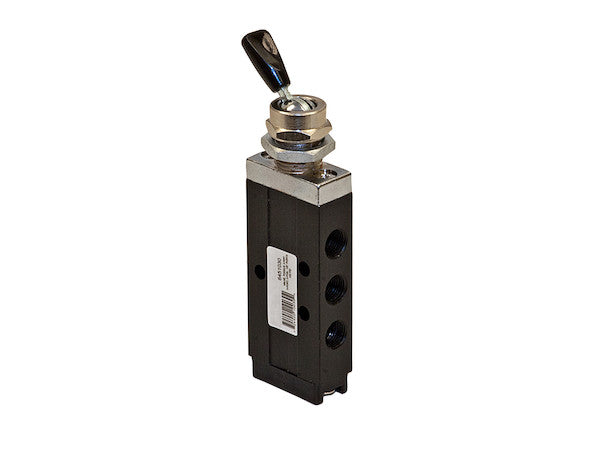
Buyers Products 4-Way, 2-Position Toggle Style Air Valve is rated at 150 PSI and commonly used with lift axle controllers. Designed for universal applications, the air valve has five ports, 1/8 in. NPT and compares to Parker?? #410811000 valve.
Specifications
| Feathering | No |
|---|---|
| Number of Detents | 2 |
| Number of Ports | 5 |
| Port Size | 0.125 |
| Port Type | NPT |
| Rated Pressure | 150 |
| Spring to Neutral / Deadman Control (y/n) | N |
| Valve Action | 4-Way |
| Valve Actuation | Manual Toggle |
| Valve Primary Application | Toggle Air Valve |
Advanced Technical Overview: Buyers Products 4-Way, 2-Position Toggle Style Air Valve
The Buyers Products 4-Way, 2-Position Toggle Style Air Valve represents a critical component in pneumatic control systems, engineered for robust performance and reliable operation across a diverse range of applications. This comprehensive technical description delves into the intricacies of its design, functional principles, and suitability for demanding industrial and mobile environments, particularly highlighting its integral role in lift axle control systems. With a nominal pressure rating of 150 PSI, a five-port configuration featuring 1/8 inch NPT connections, and a mechanical toggle actuation, this valve offers a durable and straightforward solution for precise pneumatic circuit management.
Fundamental Principles of 4-Way, 2-Position Valve Operation
Understanding the designation "4-Way, 2-Position" is foundational to appreciating this valve's operational capabilities. In pneumatic terminology:
-
4-Way (or 4/2-way): Refers to the number of active flow paths the valve can establish. A 4-way valve is designed to control double-acting pneumatic actuators (e.g., cylinders or motors) by directing pressurized air to one side of the actuator while simultaneously exhausting air from the opposite side. The five ports on this valve typically comprise:
- One pressure inlet (P)
- Two work ports (A and B), which connect to the opposing chambers of a double-acting actuator.
- Two exhaust ports (R1 and R2 or E1 and E2), which allow air to vent from the actuator to atmosphere when shifting position. The separation of exhaust ports provides flexibility in system design, allowing for individual muffler attachment or more complex exhaust routing.
- 2-Position: Indicates the number of discrete, stable operating states or flow configurations the valve can assume. For this toggle style valve, these two positions correspond to the two distinct physical states of the toggle handle. When the toggle is moved to one position, it establishes a specific set of flow paths (e.g., P to A, B to R1, R2 blocked). When moved to the other position, it reverses these paths (e.g., P to B, A to R2, R1 blocked). The "Number of Detents: 2" specification confirms that the valve will positively latch and remain in either of these two positions without continuous manual input, providing stable control until the operator intentionally changes its state.
The Toggle Style Actuation Mechanism
The "Manual Toggle" actuation method is a defining characteristic of this valve, offering direct and intuitive control. A toggle mechanism typically consists of a lever or handle that pivots around a central point, switching the internal valve spool or poppet when moved from one extreme position to the other. The advantages of toggle actuation include:
- Simplicity and Reliability: Mechanical toggle valves are inherently simple, reducing potential points of failure often associated with more complex electrical or pilot-actuated systems.
- Direct Operator Feedback: The tactile feedback from the toggle's movement provides operators with immediate confirmation of the valve's state change.
- Durability: Designed for frequent manual interaction, the toggle mechanism is typically constructed from robust materials capable of withstanding repetitive cycles in demanding environments.
- Ease of Operation: Requires minimal training for operation, making it suitable for applications where rapid, on-the-spot control is necessary.
The absence of "Spring to Neutral / Deadman Control" further emphasizes the latching nature of the toggle. Unlike spring-return valves that revert to a default position when released, this valve remains in its selected position, ensuring continuous operation of the pneumatic actuator until manually re-positioned. This characteristic is crucial for applications requiring sustained activation without constant operator engagement, thereby enhancing operational efficiency and reducing operator fatigue.
Pressure Rating and Material Considerations
Rated at 150 PSI (Pounds per Square Inch), this valve is engineered to operate safely and effectively within the typical pressure ranges encountered in mobile and light industrial pneumatic systems. This pressure rating implies:
- Structural Integrity: The valve body and internal components are constructed from materials capable of withstanding the specified pressure without deformation or failure. Common materials for such valves include high-grade aluminum, brass, or engineered thermoplastics, selected for their strength-to-weight ratio, corrosion resistance, and machining properties.
- Sealing Effectiveness: The internal seals (e.g., O-rings, spool seals) are designed to prevent air leakage at 150 PSI, maintaining system efficiency and preventing pressure drops. Materials like Buna-N (nitrile rubber) are frequently used for their excellent resistance to petroleum-based fluids and good mechanical properties within standard temperature ranges.
- Application Suitability: A 150 PSI rating makes this valve ideal for compressed air systems where moderate pressures are standard, such as those found in vehicle auxiliary air systems, small factory automation setups, and pneumatic tooling applications.
The robust design implied by Buyers Products' reputation ensures that the valve can maintain its integrity and performance over extended periods, even under fluctuating pressure conditions and typical environmental stressors.
Port Configuration: The Five-Port System and NPT Standard
The five-port configuration with 1/8 inch NPT connections is a standard and highly practical setup for 4-way valves. The "Port Size: 0.125" (equivalent to 1/8 inch) and "Port Type: NPT" (National Pipe Taper) are significant for several reasons:
- Five Ports Explained: As detailed earlier, the five ports are critical for controlling double-acting cylinders. Two dedicated exhaust ports offer better control over exhaust flow, allowing for independent muffling or speed control if required by restricting one exhaust path. This often leads to smoother actuator movement compared to valves with a single common exhaust port.
-
1/8 inch NPT Threads:
- Standardization: NPT is a widely recognized and utilized standard for tapered threads in North America, ensuring compatibility with a vast array of pneumatic fittings, hoses, and other components.
- Sealing Mechanism: NPT threads achieve a seal by a wedge-like action as the tapered male thread is tightened into the tapered female thread. This mechanical interference, often augmented by pipe sealant (tape or compound), creates a leak-tight connection suitable for pressurized air.
- Flow Capacity: The 1/8 inch size is appropriate for managing the airflow required by smaller to medium-sized pneumatic actuators, balancing between sufficient flow and compact physical dimensions of the valve and associated plumbing.
Primary Application Focus: Lift Axle Systems
The specification noting its common usage with "lift axle controllers" highlights a key application area where this valve's specific characteristics are highly advantageous. Lift axles are supplementary axles on commercial vehicles (trucks, trailers) designed to be raised off the ground when not needed. This mechanism offers several benefits:
- Reduced Tire Wear: Minimizes wear on tires when the axle is not carrying a load.
- Improved Fuel Efficiency: Reduces rolling resistance by lifting unnecessary tires.
- Enhanced Maneuverability: Shortens the effective wheelbase, making tight turns easier.
- Compliance with Weight Regulations: Allows operators to adjust axle configurations to meet varying legal weight limits across different jurisdictions.
In a typical pneumatic lift axle system, this 4-way, 2-position toggle valve serves as the primary operator interface for controlling the air springs that raise and lower the axle. When the toggle is in one position, it directs pressurized air to inflate the air springs, lifting the axle. Simultaneously, it exhausts air from the retraction side (if applicable) or simply holds the "up" position. When the toggle is moved to the second position, it exhausts air from the air springs, allowing the axle to lower, while potentially pressurizing a separate cylinder for controlled lowering or simply allowing gravity to engage the axle with the ground. The detented nature of the valve is critical here, as it allows the operator to set the axle in either the "up" or "down" position and trust that it will remain there without continuous manual intervention, which is essential for safe and efficient vehicle operation.
Versatility Across Industrial and Mobile Applications
While specifically noted for lift axle controllers, the "Designed for universal applications" attribute underscores the valve's adaptability. Its fundamental 4-way, 2-position functionality with manual toggle control makes it suitable for a wide array of pneumatic tasks where direct, positive control of a double-acting cylinder or motor is required. Other potential applications include:
- Industrial Automation: Actuating clamps, gates, stops, or ejectors in manufacturing processes where manual intervention is part of the workflow.
- Material Handling: Operating small pneumatic lifts, pushers, or diverters on conveyor systems.
- Agricultural Equipment: Controlling auxiliary functions on farm machinery, such as small implement adjustments.
- Construction Equipment: Managing non-critical hydraulic or pneumatic auxiliary functions on light construction vehicles.
- Custom Machinery: Serving as a straightforward control element in bespoke equipment designs where cost-effectiveness and reliability are paramount.
Its compact size and 1/8 inch NPT ports make it particularly well-suited for integration into space-constrained applications or systems utilizing smaller pneumatic actuators.
Detailed Examination of Control Characteristics: Detents and Non-Feathering Operation
The specifications "Feathering: No" and "Number of Detents: 2" are critical for defining the operational characteristics and control philosophy of this valve:
- Number of Detents: 2: This confirms that the valve provides positive, latching action in both of its two stable positions. Once the toggle is moved to either the "on" or "off" state (or "extend" or "retract" state for a cylinder), it will physically lock into that position. This eliminates the need for the operator to continuously hold the toggle, which is vital for sustained operations and prevents accidental shifts due to vibration or minor bumps. Detented valves are often preferred for their robustness and clear operational status.
- Feathering: No: Feathering, also known as proportional control or metering, refers to a valve's ability to gradually control the flow rate of air to an actuator, allowing for smooth, intermediate positioning or speed adjustments. The "No" specification for feathering indicates that this valve provides discrete, full-flow switching. When the toggle is moved, the valve transitions directly from one flow path configuration to the other, delivering full pneumatic pressure to the selected port and full exhaust from the other. While this means it cannot provide fine, incremental control of actuator speed or position through the valve itself, it simplifies the valve's design, enhances reliability, and is perfectly suitable for applications where only two distinct states (e.g., fully extended/retracted, on/off) are required. For applications needing speed control, external flow control valves would typically be incorporated into the circuit.
Durability, Construction, and Environmental Resilience
The reliability of pneumatic components, especially in mobile applications like lift axle systems, hinges on their construction and ability to withstand harsh operating conditions. While specific materials are not exhaustively listed, the professional-grade nature of Buyers Products components suggests a commitment to durability:
- Robust Housing: The valve body is likely constructed from a durable material such as anodized aluminum, brass, or a high-strength engineered polymer. These materials provide excellent resistance to corrosion, impact, and vibration.
- Wear-Resistant Internal Components: The spool or poppet mechanism, along with its seals, must be designed for millions of cycles. Materials are chosen for low friction, chemical compatibility with compressed air (including typical lubricants and contaminants), and resistance to wear.
- Temperature Range: Standard industrial pneumatic valves are typically designed to operate effectively across a broad temperature range, often from -20°C to +80°C (-4°F to +176°F), making them suitable for outdoor mobile use in varying climates.
- Ingress Protection: Although not specified, for mobile applications, components often feature a degree of ingress protection (IP rating) against dust and moisture, ensuring reliable operation even when exposed to environmental elements like road spray, dust, and wash-down procedures.
Installation, Integration, and Maintenance
Installation of the Buyers Products 4-Way, 2-Position Toggle Style Air Valve is straightforward, facilitated by its standard NPT ports:
- Mounting: The valve is typically designed with mounting holes for secure attachment to a panel, bulkhead, or bracket, ensuring stability and accessibility for the operator.
- Plumbing: Connections should be made using appropriate 1/8 inch NPT pneumatic fittings and tubing/hose, ensuring proper thread engagement and the use of a suitable thread sealant (e.g., PTFE tape or pipe thread compound) to prevent leaks. Proper torque should be applied to fittings to avoid damage.
- System Integration: The valve integrates seamlessly into pneumatic circuits. The pressure inlet (P) connects to the main air supply, the work ports (A and B) connect to the actuator, and the exhaust ports (R1, R2) can be fitted with mufflers to reduce noise or connected to a common exhaust manifold.
- Maintenance: Due to its mechanical simplicity, this type of valve typically requires minimal maintenance. Regular inspection for leaks, damage to the toggle lever, and ensuring the air supply is clean and dry are usually sufficient to guarantee long-term performance. The use of filtered and lubricated compressed air, as per system design, will extend the life of all pneumatic components.
Interchangeability and Industry Standards (Parker Comparison)
The statement that this valve "compares to Parker #410811000 valve" is a significant indicator for system designers and maintenance personnel. It implies:
- Form, Fit, and Function (FFF) Compatibility: This comparison suggests that the Buyers Products valve is designed to be a direct or near-direct equivalent in terms of physical dimensions, porting configuration, actuation method, and operational performance. This makes it an ideal replacement part for systems currently using the Parker valve, or for new designs seeking a proven performance profile.
- Benchmark for Quality and Performance: Parker Hannifin is a global leader in motion and control technologies. Comparing a product to a Parker part sets a high benchmark, suggesting that the Buyers Products valve meets similar standards of reliability, durability, and operational characteristics.
- Simplified Procurement: For users accustomed to the Parker part, this comparison simplifies the sourcing process, providing a readily available alternative that can be integrated with confidence into existing designs or used for maintenance and repair operations without significant system modifications.
Operational Advantages and System Benefits
The Buyers Products 4-Way, 2-Position Toggle Style Air Valve offers a compelling set of advantages for pneumatic system control:
- Reliable Control: The detented toggle mechanism ensures positive and consistent positioning of the valve, critical for reliable operation of actuators.
- Durability: Built to withstand the rigors of mobile and industrial environments, ensuring a long operational lifespan and reducing downtime.
- Ease of Use: Simple manual operation requires minimal training and provides direct, intuitive control.
- Cost-Effective: Mechanical valves are often more economical than solenoid-operated alternatives, both in terms of initial purchase and ongoing maintenance, especially in applications where electrical control is not strictly necessary.
- Versatile: Suitable for a broad range of applications beyond its primary use in lift axle control, enhancing its value as a general-purpose pneumatic control valve.
- Standardized Connectivity: 1/8 inch NPT ports facilitate easy integration with existing pneumatic infrastructure.
- Optimized for Double-Acting Actuators: The 4-way, 5-port design is purpose-built for efficient and effective control of pneumatic cylinders and motors.
Conclusion
The Buyers Products 4-Way, 2-Position Toggle Style Air Valve stands out as a highly dependable and technically sound solution for manual pneumatic control. Its precise 4-way, 2-position functionality, coupled with robust toggle actuation and a practical five-port, 1/8 inch NPT configuration, makes it exceptionally well-suited for demanding applications such as lift axle controllers in commercial vehicles. With its 150 PSI pressure rating, non-feathering operation, and positive detents, this valve offers straightforward, reliable, and durable performance, providing critical control where discrete pneumatic actions are required. Its design philosophy emphasizes longevity and ease of integration, making it an invaluable component for engineers and technicians seeking efficient and robust pneumatic circuit management in a wide range of industrial and mobile settings.