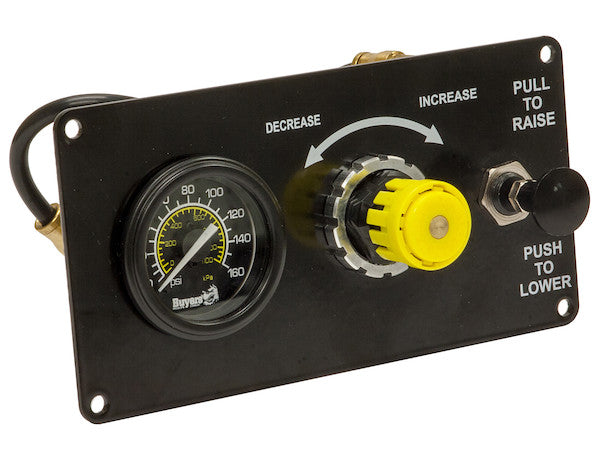
Buyers Products Lift Axle Control Assembly with Push-Pull Air Valve provides in-cab controls for air suspension and lift axle. Each unit comes pre-plumbed and assembled and includes fittings/DOT tubing and a mounting plate. The steel mounting plate is powder coated for corrosion resistance. The assembly is available in single or double acting versions. Individual components are also available.
Specifications
| Feathering | No |
|---|---|
| Number of Ports | 2 |
| Port Size | 0.250 |
| Port Type | Brass Push Lock Fittings |
| Rated Pressure | 150 |
| Spring to Neutral / Deadman Control (y/n) | N |
| Valve Action | Single Acting |
| Valve Actuation | Manual Push/Pull |
| Valve Primary Application | Raise/Lower Lift Axle |
Precision Pneumatic Control: The Lift Axle Control Assembly with Push-Pull Air Valve (Single Acting)
In the demanding world of commercial trucking and heavy-duty transport, operational efficiency, safety, and regulatory compliance are paramount. The Lift Axle Control Assembly with Push-Pull Air Valve, specifically engineered for single-acting applications, represents a critical component in achieving these objectives. This advanced pneumatic control system offers fleet managers, owner-operators, and vehicle manufacturers a robust, reliable, and user-friendly solution for managing auxiliary lift axles directly from the cab. Designed with meticulous attention to detail and manufactured to exacting standards, this assembly streamlines the process of raising and lowering lift axles, optimizing vehicle performance across diverse operational scenarios.
Understanding the Imperative of Lift Axle Management
Lift axles, often referred to as drop axles, tag axles, or pusher axles, are supplemental axles deployed on commercial vehicles to distribute load more effectively, comply with weight regulations (such as bridge formulas), reduce tire wear, improve fuel economy, and enhance maneuverability. Their proper deployment and retraction are not merely conveniences but fundamental aspects of safe and efficient vehicle operation. Incorrect lift axle management can lead to excessive tire wear, increased fuel consumption, reduced traction, and even legal penalties for overweight violations. Therefore, a precise and dependable control mechanism is indispensable. The Lift Axle Control Assembly provides the operator with immediate, tactile control over this vital function, ensuring that the vehicle configuration can be adapted dynamically to prevailing conditions, whether navigating tight urban environments or traversing long stretches of highway with varying payloads.
Technical Deep Dive: The Single-Acting Push-Pull Air Valve
At the core of this sophisticated assembly is the single-acting push-pull air valve, a testament to straightforward yet highly effective pneumatic engineering. This valve is specifically designed to manage air flow to single-acting pneumatic cylinders, which are commonly used for lift axle applications where gravity or a return spring provides the retraction force. Unlike double-acting cylinders that require air pressure for both extension and retraction, a single-acting system simplifies the pneumatic circuit, enhancing reliability and reducing potential points of failure.
Mechanism of Actuation: Manual Push/Pull
The manual push/pull actuation mechanism offers a distinct advantage in environments where positive, intentional control is required. The operator simply pulls the knob to initiate one state (e.g., raising the axle) and pushes it to initiate the other (e.g., lowering the axle). This direct mechanical interaction provides immediate tactile feedback, ensuring the operator is aware of the valve's commanded position. The robust design of a push/pull valve minimizes the risk of accidental activation or deactivation, which is crucial for safety and operational consistency. This deliberate action ensures that the lift axle remains in its chosen state until actively changed by the operator, aligning with the "Spring to Neutral / Deadman Control: N" specification, meaning the valve holds its position without returning to a neutral state.
Single-Acting Valve Action Explained
With a "Valve Action: Single Acting" specification, this control assembly is configured for applications where pneumatic pressure is applied to achieve one state (e.g., lifting the axle), and the return to the default state (e.g., lowering the axle) is facilitated by the absence of pressure, typically through gravity or a dedicated return spring within the lift axle mechanism. The valve, featuring "Number of Ports: 2", effectively functions as an ON/OFF switch for compressed air directed to the lift axle's air bag or cylinder. When the valve is actuated to "raise," air flows from the vehicle's primary air supply through the control assembly and into the lift axle’s air chamber, causing it to extend and lift the axle. When the valve is actuated to "lower," the air supply is cut off, and the trapped air within the lift axle's chamber is exhausted, allowing the axle to retract under its own weight or spring force. This simple yet highly effective pneumatic logic ensures dependable operation with minimal complexity.
Absence of Feathering Capability
The specification "Feathering: No" indicates that this valve is designed for positive, full-on/full-off actuation rather than modulated or proportional control. Feathering refers to the ability to gradually increase or decrease air pressure to achieve an intermediate position or a smooth, controlled motion. For lift axle applications, particularly with single-acting systems, a clear, decisive action is often preferred. The absence of feathering ensures that when the operator commands a raise or lower, the action is immediate and complete, minimizing ambiguity and maximizing operational predictability. This design choice underscores the product’s focus on robust, uncomplicated functionality essential for heavy-duty vehicle operations.
No Spring to Neutral / Deadman Control
The "Spring to Neutral / Deadman Control (y/n): N" specification is a critical design feature. A "deadman" control typically requires continuous operator input to maintain an actuated state and returns to neutral when released, acting as a safety feature against unintentional operation. In contrast, this valve, by not having a spring return to neutral, maintains its last commanded position (either pushed in or pulled out) until manually changed by the operator. This characteristic is advantageous for applications where the lift axle needs to remain in a raised or lowered position for extended periods without continuous manual engagement, contributing to operator convenience and reducing fatigue. However, it also implies that operators must be attentive to the axle's state and manually actuate the valve for any change, promoting deliberate decision-making.
Integrated Assembly: Engineering for Seamless Integration
One of the standout features of this product is its pre-plumbed and assembled design. This engineering choice is driven by a commitment to simplifying installation, ensuring optimal performance, and reducing potential for errors in the field. Every unit arrives ready for integration into the vehicle’s existing air system, significantly cutting down on installation time and labor costs. The meticulous factory assembly includes all necessary fittings and DOT-compliant tubing, eliminating the guesswork and the need for specialized tools often associated with piecing together individual pneumatic components.
Robust Mounting Plate
The assembly is securely mounted on a steel plate, engineered for durability and longevity in the harsh environment of a commercial vehicle cab. Steel, renowned for its high tensile strength and resistance to mechanical stress, provides a stable platform for the control valve and associated plumbing. To further enhance its resilience, the steel mounting plate undergoes a rigorous powder coating process. Powder coating provides a significantly more durable and corrosion-resistant finish compared to traditional liquid paints. This electrostatic application of dry powder, followed by heat curing, creates a hard, uniform, and aesthetically pleasing surface that is highly resistant to chipping, scratching, fading, and the corrosive effects of moisture, chemicals, and road salts. This level of protection ensures the assembly maintains its structural integrity and appearance over the long lifespan of the vehicle.
Premium Pneumatic Connections: Brass Push Lock Fittings and DOT Tubing
The selection of brass push lock fittings and DOT-compliant tubing underscores the commitment to reliability and safety. Brass, an alloy of copper and zinc, is chosen for its excellent corrosion resistance, high strength, and superior machinability, making it ideal for pneumatic applications where longevity and integrity are paramount. Push lock fittings, also known as push-to-connect or instant fittings, allow for quick, tool-free connection and disconnection of tubing, significantly easing installation and maintenance. Their robust design creates a secure, leak-free seal capable of withstanding the specified "Rated Pressure: 150 PSI" while also resisting vibrations commonly encountered in heavy-duty vehicles. The 0.250-inch port size is a standard dimension, ensuring broad compatibility within existing pneumatic systems. Furthermore, the inclusion of DOT (Department of Transportation) approved tubing signifies adherence to stringent safety and performance standards for air brake and auxiliary air systems, guaranteeing the highest level of reliability and regulatory compliance.
Performance Specifications and Reliability Engineering
The performance specifications of this lift axle control assembly reflect its robust design and intended application:
- Rated Pressure: 150 PSI: This rating ensures that the valve can safely and efficiently operate within the typical pressure range of a commercial vehicle's air system, which commonly operates around 120-130 PSI. The 150 PSI rating provides a sufficient safety margin, ensuring reliable function even under peak system pressures or transient spikes.
- Durability and Longevity: Beyond the materials, the internal mechanisms of the push-pull valve are engineered for repeated, long-term cycles. Precision-machined components and high-quality seals are selected to withstand the rigors of continuous use, temperature fluctuations, and potential contaminants in the air supply (though a clean, dry air supply is always recommended for optimal pneumatic system health).
- Minimal Maintenance: The inherent simplicity of the pneumatic design, combined with durable materials and pre-assembly, means this control assembly requires minimal routine maintenance, contributing to lower total cost of ownership.
Operational Benefits and Strategic Applications
Deploying the Lift Axle Control Assembly with Push-Pull Air Valve yields a multitude of operational and economic benefits:
- Optimized Load Distribution: Operators can easily raise the lift axle when the vehicle is lightly loaded or empty, reducing unnecessary tire wear and improving fuel efficiency. When carrying heavy loads, lowering the axle distributes weight over more tires, complying with federal and state weight limits and protecting the primary drive axles from overload stress.
- Enhanced Maneuverability: In tight turning situations, such as navigating loading docks, construction sites, or urban streets, raising the lift axle reduces tire scrubbing and improves the vehicle's turning radius, significantly increasing maneuverability and preventing premature tire degradation.
- Reduced Tire Wear and Fuel Consumption: By lifting axles when not needed, rolling resistance is decreased, directly translating to improved fuel economy. Furthermore, eliminating unnecessary contact between tires and the road surface drastically extends tire life, representing a substantial operational cost saving.
- Compliance Assurance: With immediate control at their fingertips, drivers can ensure their vehicle always adheres to bridge laws and gross vehicle weight regulations, avoiding costly fines and potential downtime.
- Increased Safety: A reliably controlled lift axle contributes to overall vehicle stability and predictability, especially when adjusting to dynamic load conditions. This direct and positive control mechanism prevents accidental engagement or disengagement that could compromise vehicle balance.
- Versatile Application: This control assembly is ideally suited for a wide range of heavy-duty vehicles including dump trucks, refuse haulers, logging trucks, flatbeds, heavy-haul trailers, and any commercial vehicle equipped with single-acting air-lift axles.
Installation and Integration Considerations
The pre-plumbed and assembled nature of this control unit is a significant advantage, reducing the complexity and time required for installation. The unit can be easily mounted in an accessible location within the vehicle cab, requiring only connection to the vehicle's primary compressed air supply and the air line leading to the lift axle's control valve or air bag. While the brass push lock fittings facilitate quick connections, it is crucial to ensure that the air supply to the control assembly is clean and dry. Implementing an air dryer and filter in the vehicle's pneumatic system helps prevent moisture and particulate contamination from entering and potentially damaging the valve components, ensuring its long-term reliability.
The purely pneumatic operation of this assembly offers inherent advantages over electrical control systems in certain applications. By eliminating electrical components, the system is impervious to electromagnetic interference, short circuits, and corrosion associated with electrical connections, making it particularly robust in harsh operating environments and simplifying troubleshooting.
Investment Value and Total Cost of Ownership (TCO)
Investing in the Buyers Products Lift Axle Control Assembly with Push-Pull Air Valve is an investment in long-term operational efficiency and cost savings. The robust construction, premium materials, and pre-assembled design contribute to exceptional durability and reliability, minimizing downtime for repairs and replacements. The operational benefits—reduced tire wear, improved fuel economy, and avoidance of regulatory fines—translate directly into a lower total cost of ownership for the vehicle over its lifespan. Furthermore, the availability of individual components, as highlighted in the general description, offers flexibility for future maintenance or system modifications, ensuring continued support for the product.
Conclusion
The Lift Axle Control Assembly with Push-Pull Air Valve for single-acting systems is more than just a control component; it is an expertly engineered solution designed to enhance the functionality, efficiency, and safety of commercial vehicles. Its combination of a robust, manually actuated push-pull valve, pre-plumbed architecture with high-quality fittings and DOT tubing, and a corrosion-resistant powder-coated steel mounting plate, delivers unparalleled reliability and ease of use. For operations where precise, positive, and durable control over single-acting lift axles is non-negotiable, this assembly stands as the definitive choice, embodying a commitment to performance and longevity in the challenging world of heavy-duty transport.