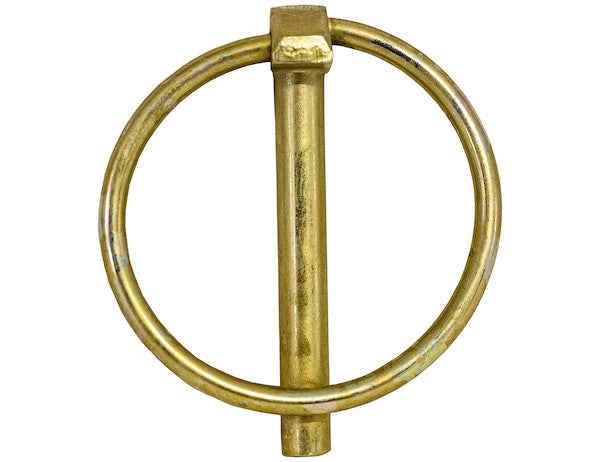
Buyers Products Linch Pin is ideal for utility trailers, cargo trailer doors and windows, and lawn equipment. The linch pin is yellow zinc-plated for corrosion resistance and is available in several sizes to fit your application.
Specifications
| (A) Pin Diameter in. | .44 |
|---|---|
| (B) Pin Length in. | 1.75 |
| (C) Useable Length in. | 1.50 |
| Finish | Zinc Plated Yellow |
| Material | Carbon Steel |
Technical Overview: The Yellow Zinc Plated Linch Pin - 7/16 Diameter x 1-3/4 Inch Long with Ring
This detailed technical description provides an in-depth analysis of the Yellow Zinc Plated Linch Pin, specifying a 7/16-inch diameter, 1-3/4-inch overall length, and 1-1/2-inch usable length, complete with an integrated retention ring. Designed for robust performance and versatile applications, this fastener represents a critical component in securing various mechanical assemblies across diverse industries. Its construction from carbon steel, coupled with a yellow zinc plating, ensures both structural integrity and superior environmental resistance.
The Linch Pin: Principle of Operation and Design Mechanics
A linch pin, also commonly referred to as a quick-release pin, functions as a highly effective and easily deployable fastener for securing components. Unlike permanent fastening solutions such as bolts or rivets, the linch pin is engineered for frequent insertion and removal without the need for specialized tools. Its fundamental design involves a cylindrical shaft, a head or handle, and a unique locking mechanism that prevents accidental disengagement. In the case of this particular model, the integrated ring serves a dual purpose: it acts as a user-friendly pull-handle for effortless manipulation and, more critically, as a secure retaining feature. When the pin is inserted through aligned holes in two or more components, the ring mechanism, often spring-loaded or cam-operated, expands or locks into place, effectively preventing the pin from backing out due to vibration, movement, or external forces.
The specific dimensions of this linch pin are crucial to its functionality. The 7/16-inch (0.4375-inch) diameter is selected to provide adequate shear strength for moderate to heavy-duty applications, ensuring that the pin can withstand significant forces without deforming or breaking. This diameter dictates the minimum bore size required for its application, emphasizing the importance of precise component alignment. The overall length of 1-3/4 inches (1.75 inches) and a usable length of 1-1/2 inches (1.50 inches) are designed to accommodate a range of material thicknesses. The usable length specifically refers to the maximum stack-up of materials that the pin can effectively secure, ensuring that the locking mechanism clears the last component for proper engagement. The inherent design of the linch pin, particularly with its integrated ring, offers a superior level of security and convenience compared to traditional cotter pins, which often require bending and unbending, or clevis pins that necessitate a separate cotter pin for retention.
Material Science: Carbon Steel for Enhanced Durability
The foundation of this linch pin's structural integrity lies in its material composition: carbon steel. Carbon steel is an alloy primarily composed of iron and carbon, with carbon content typically ranging from 0.05% to 2.1% by weight. The specific grade of carbon steel chosen for linch pins is critical, balancing attributes such as tensile strength, yield strength, hardness, and ductility. For applications requiring robust fastening without excessive brittleness, a medium-carbon steel (typically 0.25% to 0.60% carbon) or a low-alloy steel might be employed. This selection ensures that the pin can endure significant shear and bending stresses encountered in dynamic environments without permanent deformation or catastrophic failure.
The inherent properties of carbon steel provide several advantages:
- High Tensile Strength: Carbon steel exhibits excellent resistance to forces that attempt to pull it apart, making it suitable for load-bearing applications.
- Good Yield Strength: It can withstand considerable stress before permanent deformation occurs, ensuring the pin maintains its shape and functionality over time.
- Formability: Despite its strength, carbon steel can be efficiently cold-formed or machined into the intricate shape of a linch pin, including the critical head and locking ring mechanism.
- Cost-Effectiveness: Carbon steel offers a superior strength-to-cost ratio compared to more exotic alloys, making it an economically viable choice for mass-produced components.
- Weldability: While not typically welded in its final application, the material's weldability is an important characteristic in manufacturing processes where components might be joined prior to final shaping or finishing.
The selection of carbon steel ensures that the linch pin can withstand the operational demands of industrial, agricultural, and recreational equipment, providing a reliable mechanical linkage. However, carbon steel is susceptible to corrosion in the presence of moisture and oxygen. This vulnerability necessitates the application of a protective coating, leading to the crucial role of the yellow zinc plating.
Advanced Corrosion Protection: The Yellow Zinc Plating Process
The yellow zinc plating applied to this linch pin is a sophisticated surface treatment designed to provide enhanced corrosion resistance and extend the product's service life, especially in environments exposed to moisture, chemicals, or atmospheric pollutants. Zinc plating is an electroplating process where a thin layer of zinc is deposited onto the carbon steel substrate. Zinc acts as a sacrificial coating, meaning it corrodes preferentially to the underlying steel when exposed to corrosive elements, thereby protecting the steel base metal from rust and oxidation.
The 'yellow' aspect of the plating refers to a subsequent chromate conversion coating applied over the freshly deposited zinc layer. This chromate treatment creates a passive layer on the zinc surface, significantly improving its corrosion resistance beyond that of plain zinc plating. Yellow chromate conversion coatings traditionally contained hexavalent chromium, which provided excellent performance but has been largely phased out due to environmental and health concerns. Modern yellow chromate coatings predominantly utilize trivalent chromium (RoHS compliant), offering comparable corrosion resistance while adhering to stricter regulatory standards. This yellow passivation layer provides:
- Enhanced Barrier Protection: It physically shields the zinc from direct exposure to corrosive agents.
- Self-Healing Properties: In the event of minor scratches or damage to the coating, the chromate layer can reform or slow down corrosion initiation.
- Aesthetic and Identification: The distinct yellow color often serves as an indicator of the specific type of corrosion protection and can aid in component identification.
The combined effect of zinc plating and yellow chromate conversion coating greatly extends the functional life of the linch pin, making it suitable for outdoor applications, marine environments (non-submerged), and areas where chemical exposure is a factor. This finish typically provides several hundred hours of salt spray resistance (e.g., 96-120 hours to white rust and 200-500 hours to red rust, depending on coating thickness and specific chromate used), far surpassing the protection offered by unplated carbon steel. This robust protection is indispensable for equipment stored outdoors or used in demanding conditions, ensuring reliability and reducing maintenance requirements.
Precision Engineering: Dimensional Analysis for Optimal Fit and Performance
The specified dimensions of this linch pin – a 7/16-inch diameter, 1-3/4-inch overall length, and 1-1/2-inch usable length – are critical parameters that define its compatibility, strength, and range of applications. Precision in these measurements is paramount for proper fit and long-term functional integrity.
- 7/16-inch (0.4375-inch) Diameter: This dimension is the most crucial for determining the pin's shear strength and its compatibility with mating components. A diameter of 7/16 inch provides a substantial cross-sectional area, allowing the pin to resist significant shear forces, which are the primary loads encountered in most linch pin applications. The precise diameter ensures a snug fit within corresponding holes (typically nominal 7/16-inch or slightly oversized for clearance), minimizing play and preventing premature wear on both the pin and the connected parts. Too large a diameter would prevent insertion, while too small a diameter would lead to excessive slop, accelerating wear and potentially causing structural instability or failure under load.
- 1-3/4-inch (1.75-inch) Overall Length: This measurement refers to the total axial extent of the pin from its tip to the outer edge of its head or handle, including any part of the locking mechanism. While not directly involved in the primary fastening, this length is important for handling and ensuring that the pin's head clears adjacent structures. It also provides the necessary length for the locking ring mechanism to properly engage.
- 1-1/2-inch (1.50-inch) Useable Length: This is arguably the most critical length dimension for application purposes. The usable length defines the maximum thickness of material (or combined thickness of multiple components) that the linch pin can effectively secure while still allowing its retaining ring to engage fully and securely. If the stack-up of materials exceeds 1-1/2 inches, the ring mechanism would not be able to clear the last component or fully deploy, compromising the pin's locking function. Conversely, if the material stack-up is significantly less than 1-1/2 inches, the pin might protrude excessively, but its function remains unimpaired. Engineers and users must verify that the cumulative thickness of components to be fastened falls within this usable length to guarantee secure engagement.
Adherence to these precise dimensions, often within tight manufacturing tolerances, is essential for ensuring interchangeability, reliable performance, and safety across a wide array of equipment. The careful specification of these dimensions underscores the product's suitability for defined mechanical interfaces.
Expanded Applications and Industry Versatility
Beyond the initial specified applications of utility trailers, cargo trailer doors and windows, and lawn equipment, the Yellow Zinc Plated Linch Pin with its 7/16-inch diameter and 1-1/2-inch usable length finds extensive utility across numerous sectors due to its robust construction and quick-release functionality:
- Agricultural Machinery: Indispensable for securing implements to tractors, adjusting hitch heights, locking PTO (Power Take-Off) shafts, and fastening various attachments on plows, cultivators, balers, and sprayers. The ease of removal is critical for rapid implement changes in the field.
- Construction Equipment: Used in securing scaffolding components, locking pins on mini excavators, skid steers, and other heavy machinery for quick attachment changes (e.g., buckets, forks). Also applied in temporary fencing and material handling equipment.
- Recreational Vehicles (RVs) and Towing: Essential for securing trailer hitches, safety chains, and various components on RVs, campers, and boat trailers, providing reliable connection during transit.
- Marine Applications: While direct saltwater immersion should be avoided for yellow zinc plating, it performs exceptionally well in freshwater environments and in components on boat trailers, docks, and topside marine equipment where splash and humidity are prevalent, but constant submersion is not a factor.
- Industrial and Manufacturing: Employed in jigs and fixtures, temporary machine guards, adjustable work platforms, and securing components on assembly lines where rapid setup and breakdown are necessary.
- Material Handling: Used on hand trucks, carts, dollies, and other transport equipment to secure wheels, handles, or adjustable components.
- Automotive Maintenance and Repair: Frequently used in workshops for securing car jacks, engine stands, and other temporary holding devices.
- DIY and Home Improvement: Applicable for securing gates, temporary structures, adjustable shelves, and various other projects requiring a strong, easily removable fastener.
The versatility of this linch pin stems from its combination of strength, corrosion resistance, and user-friendly design. It excels in any application where frequent assembly and disassembly are required, and where reliable retention is paramount for operational safety and efficiency.
Operational Advantages, Safety, and Maintenance Considerations
The Yellow Zinc Plated Linch Pin offers significant operational advantages and contributes positively to safety and maintenance protocols:
- Ease of Use and Speed: The primary benefit is the quick-release mechanism. Unlike nuts, bolts, or cotter pins that require tools or complex manipulation, linch pins can be inserted and removed with a simple pull or push of the ring, significantly reducing downtime for adjustments, repairs, or implement changes.
- Enhanced Security: The integrated locking ring design provides a secure positive lock, mitigating the risk of accidental disengagement due to vibration or external impacts. This is critical for preventing equipment failure or detachment during operation, thereby enhancing worker safety and protecting valuable assets.
- Reduced Tool Dependence: The tool-free operation simplifies tasks, particularly in field environments where access to tools might be limited.
- Durability and Longevity: The carbon steel construction ensures high strength and resistance to mechanical wear, while the yellow zinc plating provides robust protection against environmental degradation. This combination leads to a long operational lifespan, reducing the frequency of replacement and associated costs.
- Low Maintenance: The corrosion-resistant finish minimizes the need for routine rust removal or protective treatments, allowing for a "set and forget" approach in many applications, aside from periodic visual inspection.
For optimal safety, users should always ensure the linch pin's diameter matches the bore, and the usable length adequately secures all components. Regular inspection for signs of wear, deformation, or corrosion on the pin or its retaining ring mechanism is recommended, especially in high-stress or corrosive environments. While highly resistant, severe impacts or sustained abrasion can compromise the zinc plating, necessitating replacement if the underlying steel becomes exposed.
Manufacturing Quality and Adherence to Standards
The production of a high-quality linch pin, such as this Yellow Zinc Plated 7/16-inch model, involves meticulous manufacturing processes and adherence to stringent quality control standards. Manufacturers typically employ advanced cold-forming or machining techniques to produce the carbon steel pin with precise dimensions and a smooth finish. This ensures the uniform diameter, correct overall and usable lengths, and the integrity of the integrated ring mechanism.
Following the formation of the carbon steel base, the electroplating and chromate conversion processes are carried out under controlled conditions to ensure uniform coating thickness and consistent yellow chromate passivation. Quality checks involve measuring plating thickness, performing salt spray corrosion resistance tests (e.g., ASTM B117 standards), and verifying the mechanical integrity of the pin, including the strength and reliability of the locking ring. Dimensional verification using calipers and gauges is also critical to ensure that each pin conforms to the specified 7/16-inch diameter, 1-3/4-inch overall length, and 1-1/2-inch usable length, guaranteeing proper fit and function in its intended application. Adherence to these manufacturing and quality assurance protocols ensures that each linch pin meets the high demands of industrial performance, reliability, and safety expectations.
Conclusion
In summary, the Yellow Zinc Plated Linch Pin, with its precise 7/16-inch diameter, 1-3/4-inch overall length, and 1-1/2-inch usable length, represents a technically superior fastening solution. Its carbon steel construction provides exceptional strength and durability, while the yellow zinc plating offers advanced corrosion resistance. Engineered for rapid deployment and secure retention through its integrated ring, this linch pin is an indispensable component across agriculture, construction, transportation, and various industrial applications, delivering a combination of efficiency, reliability, and safety that is critical for modern mechanical systems.