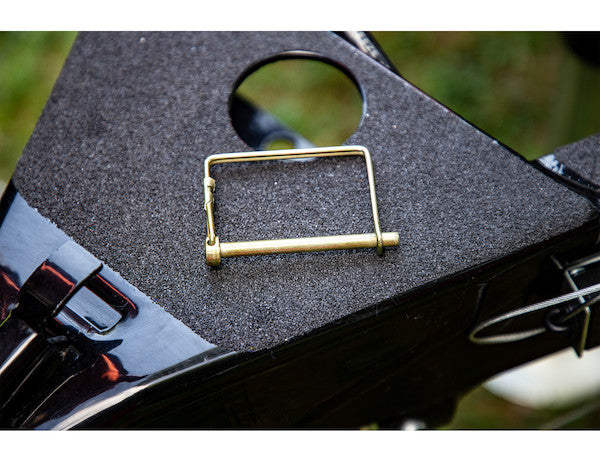
Buyers Products Snapper Pins are used as a convenient way to fasten accessories on truck equipment. Snapper lock pins join the benefits of a pin and cotter combination in a single assembly. Simply pull the wire loop over the pin to lock it in place. It quickly releases for easy removal. Snapper pins are yellow zinc-plated for corrosion resistance.
Specifications
| Clearance (in.) | 1-1/2 |
|---|---|
| Pin Dia (in.) | 1/4 |
| Usable Length (in.) | 1-3/4 |
The Buyers Products Snapper Pin, precisely engineered with a 1/4-inch diameter and a 1-3/4-inch usable length, represents a superior fastening solution designed to meet the rigorous demands of industrial, agricultural, and automotive applications. This particular model, fortified with a high-performance yellow zinc plating, embodies a commitment to both robust mechanical functionality and exceptional corrosion resistance. Far exceeding the capabilities of rudimentary fastening methods, the snapper pin ingeniously integrates the fundamental components of a conventional clevis pin and cotter system into a single, cohesive, and highly efficient assembly. Its primary function is to provide a swift, secure, and easily disengageable connection for a vast array of accessories and implements, extending its utility well beyond truck equipment to encompass diverse operational environments where reliability and operational efficiency are paramount. This detailed technical description aims to elucidate the intricate design, material science, performance characteristics, and broad application spectrum of this essential fastener.
Detailed Specifications and Precision Engineering
The precise dimensional attributes of this snapper pin are foundational to its performance and compatibility. With a nominal pin diameter of 1/4 inch (approximately 6.35 mm), this fastener is meticulously engineered for optimal integration with components featuring correspondingly sized bore holes. This exact fit minimizes clearance and play, which are critical factors in maximizing load transfer efficiency and reducing wear on mating parts. The usable length, measuring 1-3/4 inches (approximately 44.45 mm), defines the effective span over which the pin can engage and securely couple components. This dimension is crucial for accommodating various material thicknesses, ensuring that components up to 1-3/4 inches can be securely fastened without undesirable axial movement. The specified clearance of 1-1/2 inches (approximately 38.1 mm) refers to the optimal space required for the wire loop mechanism to operate freely and engage correctly, indicating the minimum spatial allowance necessary around the pin's head for unimpeded locking and unlocking operations. These exacting specifications are not arbitrary; they underscore the snapper pin's role as a precision-engineered component, specifically designed for mechanical interfaces where dimensional accuracy directly correlates with system reliability, safety, and operational longevity. Engineers and technicians must diligently consider these parameters during fastener selection to ensure optimal performance and structural integrity in their specific applications.
Material Science and Advanced Surface Treatment: Yellow Zinc Plating
The selection of raw materials and subsequent surface treatment for the Snapper Pin are pivotal to its durability and performance under challenging conditions. Typically fabricated from high-grade steel alloys, such as low-carbon or medium-carbon steel, these pins are chosen for their superior balance of tensile strength, shear strength, and inherent ductility. This base material provides the fundamental mechanical properties essential to withstand the significant dynamic and static loads frequently encountered in heavy-duty applications, ensuring the pin resists bending, shearing, or fracturing under stress.
The most distinguishing characteristic of this particular snapper pin is its yellow zinc-plated finish. This surface treatment is far more than a cosmetic enhancement; it is a sophisticated electrochemical process engineered to impart substantial improvements in corrosion resistance and wear characteristics. The yellow hue is indicative of a chromate conversion coating applied over an electrolytic zinc layer. The electroplating process involves immersing the steel pin in an aqueous electrolyte bath containing zinc ions and applying an electric current, which causes a uniform layer of zinc to deposit onto the steel surface. This zinc layer functions as a sacrificial coating, meaning it will corrode preferentially to the underlying steel when exposed to corrosive agents, thereby safeguarding the base metal from rust and degradation, a common failure mode for unprotected steel fasteners.
Following the zinc deposition, a chromate conversion coating is meticulously applied. For yellow zinc, this often involves the use of hexavalent or trivalent chromium compounds to form a passivation layer that profoundly enhances the zinc's inherent corrosion resistance. This chromate layer 'seals' the zinc, establishing an effective barrier against moisture, oxygen, and various chemical agents. This multi-layered protection significantly extends the fastener's service life, particularly in outdoor, humid, or moderately corrosive industrial environments. The characteristic yellow tint is widely recognized within the industry as a visual indicator of this enhanced chromate layer, signifying a robust level of anti-corrosion protection. Beyond its primary role in corrosion mitigation, zinc plating can also contribute to improved lubricity, facilitating smoother insertion and removal, and provides a distinct, easily identifiable finish. The technical rationale behind specifying yellow zinc plating is to guarantee that the snapper pin maintains its structural integrity and operational ease over prolonged periods, even when subjected to arduous environmental conditions, thereby reducing maintenance cycles and extending the overall lifespan of the associated machinery.
Operational Mechanism and Enhanced Security Features
The ingeniously designed locking mechanism of the snapper pin is a cornerstone of its functional superiority and operational efficiency. In stark contrast to traditional clevis pins that mandate a separate cotter pin for securement, the snapper pin features a resilient wire loop, typically forged from high-tensile spring steel, integrated directly onto the pin body. This integrated design is a fundamental innovation, as it consolidates multiple components into a single, self-contained unit, which inherently reduces the risk of lost or misplaced secondary fasteners, a common frustration and potential safety hazard in many applications.
The operational principle is both straightforward and remarkably effective: once the pin is inserted through the aligned bore holes of the components requiring connection, the user simply pulls the spring-loaded wire loop over the exposed end of the pin. The internal geometry of the loop is precisely dimensioned to create a positive locking action against the pin's head or a specially machined groove. The intrinsic spring tension of the wire exerts a constant compressive force, maintaining the loop's position securely over the pin's end. This robust engagement prevents accidental disengagement, even under conditions of high vibration, sudden shock, or dynamic loads, which are prevalent in heavy machinery operations.
To release the pin, the user merely reverses the action, pulling the wire loop back over the pin's tip. This rapid-release mechanism facilitates exceptionally swift assembly and disassembly operations, providing a critical advantage in applications demanding frequent component changes, adjustments, or maintenance. The precision engineering governing the loop's bend radius and wire gauge ensures consistent spring force and an extended cycle life, guaranteeing the mechanism can endure numerous locking and unlocking operations without significant degradation in its performance or security. This sophisticated design elevates the snapper pin from a basic fastener to a vital mechanical element that substantially contributes to the operational efficiency and safety of interconnected systems, actively mitigating the risks associated with loose or improperly secured components. Its ergonomic design also simplifies handling, even when operating with gloves or in challenging environments.
Performance Characteristics: Strength, Durability, and Environmental Resilience
The performance profile of the 1/4-inch diameter, 1-3/4-inch usable length snapper pin is defined by an optimal balance of mechanical strength, operational durability, and enhanced environmental resilience. The choice of high-grade steel for the pin body ensures an impressive shear strength, enabling it to effectively resist forces that attempt to cut across its diameter. This attribute is paramount in load-bearing applications where components are subjected to significant lateral stresses, safeguarding against structural failure. The 1/4-inch diameter is a widely recognized and utilized size, offering a robust load capacity within its class, making it highly suitable for securing medium-duty accessories and components without introducing unnecessary bulk or weight.
Durability extends beyond mere static strength to encompass fatigue resistance. In dynamic applications involving repetitive motion, high-frequency vibration, or cyclical loading, fasteners are particularly susceptible to fatigue failure over time. The inherent design and meticulously selected material properties of the snapper pin, particularly its integral spring mechanism, are optimized to distribute stresses effectively and withstand numerous operational cycles throughout its service life. The spring steel wire loop, specifically engineered for high elasticity and superior fatigue strength, reliably retains its locking efficacy even after extensive repeated engagements and disengagements, ensuring consistent security.
Environmental resilience is a critical feature, significantly enhanced by the multi-layered yellow zinc plating. This protective coating establishes an excellent barrier against atmospheric corrosion, including prolonged exposure to moisture, oxygen, and moderate industrial pollutants. The chromate conversion layer, responsible for the distinctive yellow tint, offers superior salt spray resistance compared to plain zinc or blue-passivated coatings. This makes the pin exceptionally well-suited for outdoor use, agricultural equipment exposed to the elements, and various industrial environments where intermittent moisture or mild chemical exposure is a concern. This layered protection ensures that the pin maintains its structural integrity and ease of operation, effectively preventing seizure due to rust accumulation—a prevalent failure mechanism for unprotected steel fasteners. The synergistic combination of robust mechanical attributes and advanced corrosion protection firmly establishes this snapper pin as a highly reliable and long-lasting fastening solution across an extensive range of demanding operational landscapes.
Expanded Spectrum of Applications
While initially highlighted for its role in fastening accessories on truck equipment, the utility of this 1/4-inch diameter snapper pin traverses an impressively broad spectrum of industries and applications, underscoring its profound versatility as a rapid and dependably secure fastening component.
Within the **Agricultural Sector**, snapper pins are indispensable. They are routinely employed to secure hitch pins on a variety of tractors, attach critical implements such as plows, tillers, planters, and sprayers, and for connecting diverse components of trailers, hay balers, and harvesting machinery. Their pivotal quick-release functionality proves invaluable during intensive field operations, empowering farmers and operators to rapidly switch between implements, fine-tune settings, or efficiently detach equipment for maintenance or transport, thereby significantly enhancing operational efficiency and drastically reducing costly downtime.
In the realm of **Construction and Infrastructure**, these pins find widespread application in securing modular scaffolding components, temporary fence panels, and various attachments on light and medium construction machinery. They are also instrumental in securing safety chains on utility trailers, locking levers on equipment, or holding temporary alignment pins in place during assembly. The inherent ease of installation and removal contributes directly to faster setup and breakdown times for job site equipment, improving overall project timelines.
For the **Marine Industry**, while critical, direct saltwater immersion applications often call for stainless steel due to extreme corrosivity, yellow zinc-plated snapper pins are perfectly suitable and highly effective for non-critical, above-waterline applications on boats, docks, and marine infrastructure. These include securing bimini tops, boat covers, safety equipment, or temporary rigging components where freshwater exposure, spray, or occasional splashes are the primary environmental considerations. Their superior corrosion resistance compared to unplated steel makes them a practical and reliable choice.
The **Automotive and Trailer Applications** domain represents another significant area of deployment. Beyond securing truck equipment accessories, these pins are extensively utilized for securing trailer hitch receivers, coupling mechanisms, tailgate latches, utility trailer ramps, and various tow-behind equipment. Their inherent robustness ensures that valuable equipment and cargo remain securely attached and stable during transit, enhancing road safety.
Within **Industrial and Manufacturing Environments**, snapper pins are leveraged for quick-change tooling setups, securing jigs and fixtures, facilitating temporary assembly configurations, and streamlining maintenance operations where components frequently need to be swapped, adjusted, or inspected without the delay of specialized tools. Their consistent reliability contributes significantly to streamlined production processes and reduced operational bottlenecks.
Even in diverse **Recreational and DIY Applications**, from securing lawnmower attachments and garden equipment to creating rapid-release mechanisms for outdoor gear or custom-built projects, the snapper pin provides an exceptionally convenient, secure, and user-friendly fastening solution.
The unifying characteristic across this diverse array of applications is the persistent demand for a fastener that delivers both unwavering security under varying mechanical loads and environmental conditions, coupled with the profound operational advantage of rapid, tool-free engagement and disengagement. This specific snapper pin, with its precisely defined dimensions and advanced protective finish, consistently meets and exceeds these demanding requirements, making it a truly versatile and invaluable component.
Design Advantages and Innovation Over Traditional Fasteners
The Snapper Pin fundamentally represents a significant and innovative evolutionary step beyond traditional fastening methodologies, particularly in its improvement upon the conventional clevis pin and separate cotter pin combination. The paramount design innovation resides in its singular, integrated construction. In traditional fastening setups, two distinct components—the clevis pin and a separate cotter pin (or an R-clip/hairpin clip)—are mandatorily required to achieve a secure mechanical connection. This multi-component approach inherently introduces potential points of operational inefficiency and failure: the cotter pin can be easily lost, misplaced, or prove difficult and time-consuming to insert and remove, especially when working in confined spaces, low-visibility conditions, or challenging field environments.
The ingeniously integrated wire loop mechanism of the snapper pin directly addresses and effectively eliminates these inefficiencies. By meticulously combining the pin body and its essential locking element into one self-contained unit, the critical risk of losing indispensable components is virtually eliminated. This not only significantly streamlines the entire fastening process but also substantially enhances overall operational safety and reliability. Technicians and operators can achieve secure connections far more rapidly, dramatically reducing the precious time expended on assembly and disassembly tasks. This "tool-free" operation is a profound advantage, as it negates the necessity for pliers or other specialized instruments often required to correctly bend or manipulate cotter pins. This attribute makes the snapper pin an ideal solution for quick field adjustments, emergency repairs, or any scenario where immediate access to a full toolkit might be limited or impractical.
Furthermore, the precise spring-loaded action of the wire loop provides a consistent, predictable, and resilient locking force. Unlike cotter pins, which rely on the often irreversible deformation of metal to maintain their position, the snapper pin's robust spring steel loop is specifically engineered for repeated use without any significant degradation of its critical locking capability. The inherent elasticity and fatigue resistance of the spring steel ensure that the loop maintains a tight and positive grip on the pin, effectively resisting vibration-induced loosening far more reliably than a standard bent cotter pin, which can gradually work itself loose over extended periods if not properly splayed and monitored.
The ergonomic design of the wire loop itself, frequently featuring an intuitive, easy-to-grasp shape, significantly contributes to user comfort and operational efficiency, especially when personnel are working with gloves or in demanding environments where fine motor skills might be compromised. This comprehensive integration of components, coupled with a robust, repeatable, and user-friendly locking mechanism, unequivocally positions the snapper pin as a superior choice for applications that demand both swift functionality and unwavering security. Ultimately, its adoption translates into increased productivity, enhanced safety, and reduced long-term maintenance costs for the equipment it serves.
Installation, Maintenance, and Longevity Considerations
The installation and ongoing maintenance protocols for the 1/4-inch diameter snapper pin are remarkably straightforward, significantly contributing to its widespread appeal as a user-friendly and highly reliable fastening solution across various demanding sectors. This simplicity translates into efficiency and reduced operational overhead.
Installation: The process is inherently intuitive. It involves accurately aligning the bore holes of the components intended for joining, then simply inserting the shaft of the snapper pin through these aligned apertures until its head rests firmly against the surface of one component. Once fully inserted, the spring-loaded wire loop is manually pulled over the exposed end of the pin, securing it firmly in place with a positive lock. Crucially, no specialized tools are required for this entire process, rendering on-the-fly adjustments or field repairs exceptionally efficient and achievable with minimal effort. A critical consideration during installation is to ensure that the usable length of the pin is precisely appropriate for the combined thickness of the components being fastened, allowing ample clearance for the wire loop to fully engage and lock securely past the component's surface. The stated clearance of 1-1/2 inches also explicitly highlights the necessity for adequate surrounding space around the pin's head to ensure the free and unimpeded operation of the wire loop mechanism.
Maintenance: Due to its robust design, high-quality material composition, and the effective protection afforded by its yellow zinc plating, these snapper pins generally necessitate minimal maintenance. A regimen of periodic visual inspection is strongly recommended to diligently check for any discernible signs of wear, deformation, physical damage, or significant localized corrosion. While the yellow zinc plating offers excellent resistance to many corrosive agents, prolonged exposure to exceedingly aggressive corrosive environments or highly abrasive conditions can, over an extended period, eventually degrade the protective coating. If the plating exhibits signs of compromise (e.g., the appearance of red rust on the underlying steel core) or if the integrated wire loop shows indications of stretching, cracking, or a noticeable loss of its critical spring tension, the pin should be promptly considered for replacement to ensure continued safety and functionality. Routine cleaning can typically be accomplished with mild detergents and water to remove any accumulated dirt, debris, or minor contaminants, always followed by thorough drying to prevent moisture retention. Harsh chemical cleaners or abrasive cleaning agents should be strictly avoided as they possess the potential to damage the integrity of the zinc plating.
Longevity: The expected operational lifespan of a snapper pin is significantly influenced by a confluence of factors, including its fundamental material quality, the precision of its manufacturing, the efficacy of its protective surface coating, and the overall severity of its operational environment. Fabricated from high-strength steel and meticulously protected by a multi-layered yellow zinc plating, this particular snapper pin is expertly engineered for an extended service life under challenging conditions. The fatigue resistance of the spring steel loop is especially crucial, as it is designed to endure numerous engagement and disengagement cycles throughout its operational life. With appropriate selection for the specific application's load requirements and environmental exposure, coupled with adherence to basic inspection and maintenance practices, this snapper pin is engineered to provide many years of consistently reliable service, unfailingly delivering its intended function of secure and rapid component fastening. This contributes significantly to minimizing the total cost of ownership over the entire lifetime of the equipment it serves, proving to be a cost-effective and dependable investment.
Quality Assurance and Adherence to Industry Standards
Manufacturing excellence and rigorous adherence to stringent quality assurance protocols are absolutely paramount in the production of high-performance fasteners such as the Buyers Products Snapper Pin. Each pin is subjected to a comprehensive series of multi-stage quality control checks meticulously integrated throughout its entire production lifecycle, commencing from the initial raw material procurement phase right through to the final finishing and packaging stages.
Material Verification: Incoming steel stock undergoes rigorous inspection and testing to unequivocally confirm its chemical composition and mechanical properties. This ensures strict compliance with specified metallurgical standards (e.g., SAE, ASTM), guaranteeing that the base material possesses the prerequisite tensile strength, shear strength, and ductility essential to withstand anticipated operational stresses without exhibiting premature failure or undesirable deformation.
Dimensional Accuracy: Precision machining and forming processes are employed to ensure that all critical dimensions, including the nominal 1/4-inch diameter, the functional 1-3/4-inch usable length, and the precise contours and spring characteristics of the integrated wire loop, conform to extremely tight manufacturing tolerances. Advanced metrology equipment, including precise calipers, micrometers, and optical inspection systems, is utilized to meticulously verify these dimensions, thereby ensuring optimal fitment and flawless function across a wide and diverse range of compatible components and bore hole specifications.
Surface Finish Integrity: The yellow zinc plating process is rigorously controlled and continuously monitored to ensure the application of a uniform thickness and consistently strong adhesion of both the initial electrolytic zinc layer and the subsequent chromate conversion coating. Salt spray testing, frequently performed in strict accordance with industry-recognized standards such as ASTM B117, is a standard and essential method employed to quantitatively assess the corrosion resistance performance of the plated finish. This testing validates the coating's ability to protect the underlying steel from the onset of red rust for specified durations under accelerated corrosive conditions. The visual consistency and specified hue of the yellow chromate layer also serve as an immediate and reliable indicator of proper processing and coating quality.
Functional Testing: The integrated wire loop mechanism undergoes exhaustive functional testing to thoroughly verify its critical spring tension, locking integrity, and cyclic durability. This testing ensures that the pin can be reliably and repeatedly engaged and disengaged throughout its design life without any discernible degradation in its primary securing capability. Additionally, load testing may be systematically performed to ascertain the pin's ultimate shear strength and confirm its capacity to safely and effectively secure components under the full spectrum of anticipated operational loads and stresses. By consistently upholding these rigorous quality assurance measures, Buyers Products ensures that each snapper pin delivered to the market not only meets but frequently exceeds established industry standards for performance, reliability, and extended longevity, thereby instilling profound confidence in its application among engineers, operators, and end-users alike.
Strategic Selection and Concluding Statement
The strategic selection of the appropriate fastener is a pivotal engineering decision that profoundly impacts the safety, reliability, and long-term operational longevity of any mechanical system. For the Buyers Products Snapper Pin with its specific 1/4-inch diameter, 1-3/4-inch usable length, and protective yellow zinc plating, this critical process involves meticulously considering several key factors to optimize its deployment and maximize its inherent benefits. Firstly, the nominal diameter of the pin must precisely match or be infinitesimally less than the bore hole diameter of the components it is intended to join. This ensures an impeccably secure fit that minimizes any undesirable play, which could lead to wear or premature failure. The usable length is equally crucial, as it must adequately accommodate the combined thickness of the components to be fastened while simultaneously allowing sufficient protrusion for the wire loop to fully engage and lock securely. Incorrect sizing in either dimension can lead to loose connections, accelerated wear on mating parts, or, critically, a failure to secure components effectively, potentially compromising safety.
Secondly, the specific environmental conditions inherent to the application critically dictate the necessity and efficacy of the yellow zinc plating. For outdoor use, demanding agricultural settings, or industrial environments characterized by moderate humidity and regular exposure to the elements, the significantly enhanced corrosion resistance provided by this multi-layered finish is invaluable. It dramatically extends the pin's service life when compared to unprotected or minimally coated alternatives. While yellow zinc plating offers robust protection, a comprehensive understanding of its specific limitations—for instance, in highly acidic or alkaline environments, or in prolonged direct saltwater immersion where specialized coatings or marine-grade stainless steel might be unequivocally preferable—is also an essential component of informed fastener selection.
Finally, the specific operational demands, particularly the anticipated frequency of engagement and disengagement, profoundly highlight the unparalleled convenience and operational efficiency offered by the snapper pin’s rapid-release mechanism. Its integrated design and robust spring action render it unequivocally superior to multi-component pin-and-cotter systems, especially in dynamic scenarios that require frequent and swift component changes, adjustments, or maintenance interventions. This inherent advantage minimizes downtime and boosts productivity.
In conclusion, the Snapper Pin – 1/4in Diameter x 1-3/4in Usable Length, Yellow Zinc Plated, stands as a testament to intelligent and meticulously executed fastener design. It masterfully combines exceptional mechanical strength, precision engineering, and advanced surface protection into a single, highly efficient, and remarkably durable unit. Its unparalleled capacity for rapid, tool-free engagement and disengagement, coupled with its superior corrosion resistance, collectively establish it as an indispensable component for an expansive array of demanding applications across truck equipment, agricultural machinery, construction projects, and general industrial use. This advanced fastener offers not merely a connection, but a comprehensively reliable, exceptionally durable, and extraordinarily convenient solution that significantly enhances operational safety, streamlines essential maintenance processes, and contributes substantially to the overall performance, cost-effectiveness, and longevity of any mechanical system it is privileged to serve.